

Car tools are the hand tools and equipment people use to work on vehicles during basic maintenance, checks, and simple repairs. These tools appear in garages, manuals, workshops, and roadside situations when people talk about fixing parts, changing tires, checking engines, or handling small issues. Knowing what these tools are and how they are referred to helps reduce confusion during car related discussions.
In this post, readers learn car tools names with pictures and clear explanations, which supports better understanding and communication in everyday car conversations, workshops, and basic repair settings where these names are used often.
In This Page
Basic Car Tools Names
Basic car tools are used for everyday vehicle tasks such as tightening, loosening, holding, and adjusting parts. These tools are common in garages, home tool kits, and simple repair work, so learning their names helps readers recognize them quickly.
- Wrench: A wrench grips nuts and bolts and turns them to tighten or loosen car parts.
- Spanner: A spanner works like a wrench and usually fits one fixed nut size.
- Adjustable wrench: An adjustable wrench changes jaw width to fit different bolt sizes.
- Screwdriver: A screwdriver turns screws used on panels, lights, and interior parts.
- Flathead screwdriver: A flathead screwdriver fits straight slot screws on older components.
- Phillips screwdriver: A Phillips screwdriver fits cross shaped screws used in many cars.
- Ratchet: A ratchet turns bolts quickly without lifting the tool after each turn.
- Socket wrench: A socket wrench uses removable sockets to turn bolts of many sizes.
- Socket set: A socket set includes multiple sockets for different nuts and bolts.
- Pliers: Pliers grip, twist, or pull metal parts that fingers cannot hold safely.
- Slip joint pliers: Slip joint pliers adjust jaw width for gripping objects of different sizes.
- Needle nose pliers: Needle nose pliers reach narrow spaces and hold small wires or clips.
- Combination wrench: A combination wrench has an open end and a ring end on the same tool.
- Allen key: An Allen key tightens hex shaped screws found in seats and engine covers.
- Hex key set: A hex key set provides several sizes for recessed hex screws.
- Nut driver: A nut driver tightens small hex nuts and looks similar to a screwdriver.
- Breaker bar: A breaker bar provides extra leverage to loosen very tight bolts.
- Torque wrench: A torque wrench tightens bolts to a specific force to avoid damage.
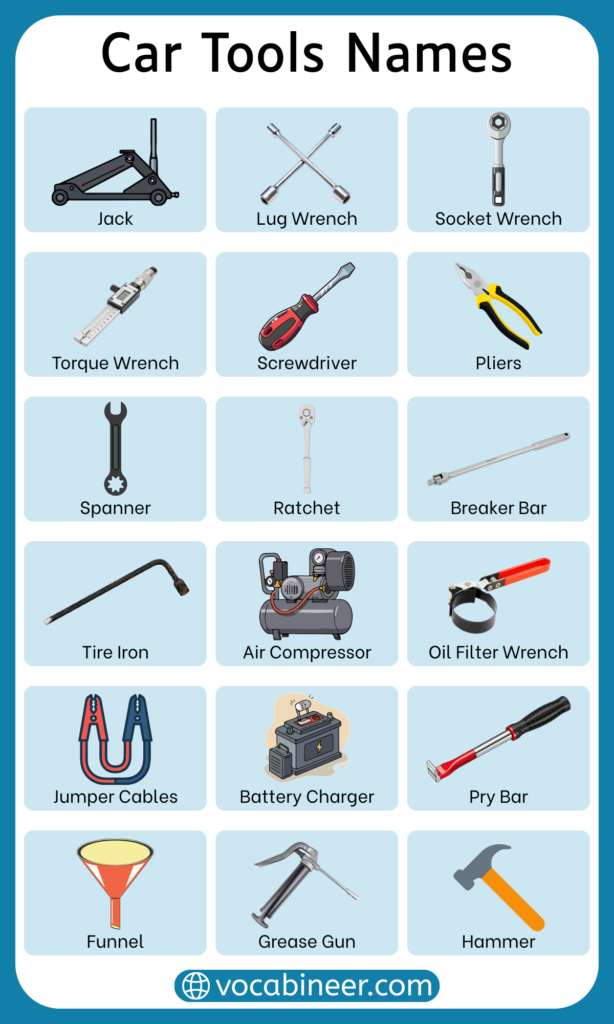
Car Tools Names for Basic Maintenance
Basic maintenance tools are used for everyday car tasks such as tightening, loosening, and adjusting parts. These car tools names appear often in garages and repair instructions, so learning them helps readers understand common vehicle work more clearly.
- Wrench: A wrench grips nuts and bolts and turns them to tighten or loosen car parts.
- Spanner: A spanner works like a wrench and fits fixed size nuts securely.
- Adjustable wrench: An adjustable wrench changes jaw width to fit different bolt sizes.
- Screwdriver: A screwdriver turns screws used on panels, lights, and interior parts.
- Flathead screwdriver: A flathead screwdriver fits straight slot screws on older components.
- Phillips screwdriver: A Phillips screwdriver fits cross shaped screws used in many cars.
- Ratchet: A ratchet turns fasteners quickly without lifting the tool after each turn.
- Nut driver: A nut driver tightens small nuts where a wrench feels too large.
Car Tools Names Found in a Basic Tool Kit
A basic tool kit holds tools needed for routine car handling and small fixes. These automotive tool names are usually packed together and are often the first tools people recognize inside a car tool box.
- Socket wrench: A socket wrench turns bolts using removable sockets of different sizes.
- Socket set: A socket set includes multiple sockets that fit various nuts and bolts.
- Allen key: An Allen key tightens hex shaped screws found in seats and engine covers.
- Hex key set: A hex key set provides different sizes for recessed hex screws.
- Combination wrench: A combination wrench has an open end and a closed ring end.
- Pliers: Pliers grip, twist, or pull metal parts that hands cannot hold safely.
- Slip joint pliers: Slip joint pliers adjust jaw width to grip objects of various sizes.
- Needle nose pliers: Needle nose pliers reach narrow spaces and grip small wires.
Car Tools Names for Lifting and Support
Lifting and support tools raise a vehicle and keep it steady during work. These car tools names are commonly mentioned during tire changes and underside checks.
- Car jack: A car jack lifts the vehicle off the ground for wheel or brake work.
- Scissor jack: A scissor jack lifts the car using a folding metal frame.
- Hydraulic jack: A hydraulic jack lifts heavy vehicles using fluid pressure.
- Floor jack: A floor jack rolls under the car and lifts it with strong leverage.
- Bottle jack: A bottle jack lifts vertically and suits heavier vehicles.
- Jack stand: A jack stand supports the car after lifting to keep it stable.
- Wheel chock: A wheel chock blocks wheels to stop the car from rolling.
Emergency Car Tools Names Every Driver Should Know
Emergency tools are kept in a car for unexpected roadside situations. These car tools names are often mentioned in safety instructions and basic driving discussions, so knowing them helps readers understand what to use during breakdowns or stops.
- Warning triangle: A warning triangle is placed on the road to alert other drivers.
- Reflective safety vest: A reflective safety vest makes the driver visible in low light.
- Jumper cables: Jumper cables connect two batteries to transfer power.
- Portable jump starter: A portable jump starter starts a car without another vehicle.
- Tow hook: A tow hook attaches the car to another vehicle for pulling.
- Tow strap: A tow strap connects vehicles during towing situations.
- Tire inflator: A tire inflator pumps air into a tire during pressure loss.
- Portable air pump: A portable air pump inflates tires using electric power.
Car Tools Names for Tires and Wheels
Tire and wheel tools are used when removing wheels or checking tire condition. These car tools names appear often during tire changes and roadside repairs.
- Lug wrench: A lug wrench loosens and tightens the nuts holding the wheel.
- Tire iron: A tire iron provides leverage to remove tight wheel nuts.
- Wheel brace: A wheel brace has multiple socket ends for different lug sizes.
- Torque wrench: A torque wrench tightens wheel nuts to a specific force.
- Tire pressure gauge: A tire pressure gauge measures air pressure inside tires.
- Valve core tool: A valve core tool removes or tightens the valve core.
- Bead breaker: A bead breaker separates the tire from the wheel rim.
Engine Related Automotive Tools
Engine tools are used under the hood for part removal, checks, and adjustments. These automotive tool names are commonly heard in repair talks and service manuals.
- Spark plug wrench: A spark plug wrench removes and installs spark plugs safely.
- Oil filter wrench: An oil filter wrench grips and removes tight oil filters.
- Timing light: A timing light checks engine ignition timing.
- Feeler gauge: A feeler gauge measures small gaps between engine components.
- Compression tester: A compression tester checks pressure inside engine cylinders.
- Vacuum gauge: A vacuum gauge measures engine vacuum levels.
- Engine hoist: An engine hoist lifts heavy engine parts during major repairs.
Tools for Checking Car Parts
Checking tools help measure, test, and confirm how car parts are working. These car tools names are commonly used during inspections and troubleshooting.
- Multimeter: A multimeter measures voltage, current, and resistance in electrical systems.
- Test light: A test light shows whether electrical power is present in a circuit.
- OBD scanner: An OBD scanner reads fault codes from the car computer.
- Battery tester: A battery tester checks battery strength and charging condition.
- Fuel pressure gauge: A fuel pressure gauge measures fuel system pressure.
- Vacuum gauge: A vacuum gauge checks engine vacuum for leaks or issues.
- Cooling system pressure tester: A cooling system pressure tester finds leaks in the cooling system.
Cutting and Gripping Tools Used on Cars
Cutting and gripping tools handle wires, clamps, and small metal parts. These automotive tool names appear often during wiring and interior work.
- Needle nose pliers: Needle nose pliers reach tight spaces and grip small wires.
- Slip joint pliers: Slip joint pliers adjust jaw width for different object sizes.
- Locking pliers: Locking pliers clamp onto parts and stay locked in place.
- Wire cutter: A wire cutter cuts electrical wires cleanly.
- Diagonal cutter: A diagonal cutter snips wires and small metal pins.
- Hose clamp pliers: Hose clamp pliers remove and install hose clamps.
Tools for Handling Car Fluids
Fluid handling tools manage liquids used in cars during maintenance. These car tools names help control spills and safe transfer.
- Funnel: A funnel guides liquids into narrow openings.
- Oil drain pan: An oil drain pan collects used engine oil.
- Fluid transfer pump: A fluid transfer pump moves liquids between containers.
- Brake bleeder kit: A brake bleeder kit removes air from brake fluid lines.
- Coolant funnel: A coolant funnel fills the cooling system without air pockets.
- Fluid syringe: A fluid syringe extracts or adds small amounts of fluid.
Interior and Small Part Car Tools
Interior and small part tools are used inside the vehicle for panels, clips, and dropped items. These car tools names are common during dashboard and door work.
- Trim removal tool: A trim removal tool removes panels without damage.
- Panel clip tool: A panel clip tool pulls plastic fasteners cleanly.
- Interior pry tool: An interior pry tool lifts panels gently.
- Magnetic pickup tool: A magnetic pickup tool retrieves metal parts from tight spaces.
- Torx screwdriver: A Torx screwdriver fits star shaped screws used inside cars.
- Clip remover pliers: Clip remover pliers remove stubborn interior clips.
Car Tools Names People Often Confuse
Some car tools look similar but are used for different tasks. These car tools names often cause confusion during conversations, manuals, or repair instructions, especially when their shapes or functions seem alike.
- Wrench and spanner: Both grip nuts and bolts, but spanner is more common in British usage.
- Ratchet and breaker bar: A ratchet turns fasteners repeatedly, while a breaker bar loosens very tight bolts with leverage.
- Pliers and wire cutter: Pliers grip and bend parts, while wire cutters are designed only for cutting wires.
- Car jack and jack stand: A car jack lifts the vehicle, but a jack stand holds it safely after lifting.
- Screwdriver and nut driver: A screwdriver turns screws, while a nut driver tightens small hex nuts.
- Torque wrench and regular wrench: A torque wrench applies a measured force, while a regular wrench does not.
| Tool pair | Key difference |
|---|---|
| Car jack vs Jack stand | One lifts the car, the other supports it |
| Ratchet vs Breaker bar | One speeds turning, the other adds leverage |
| Pliers vs Wire cutter | One grips, the other cuts |
| Screwdriver vs Nut driver | One turns screws, the other turns nuts |
FAQs About Car Tools Names
The most common car tools names include wrench, screwdriver, pliers, car jack, lug wrench, socket wrench, and jumper cables. These tools appear often in garages, manuals, and basic repair instructions, so they are usually the first names people learn when dealing with cars.
Basic repairs usually involve tools like wrench, screwdriver, ratchet, socket set, pliers, torque wrench, and tire pressure gauge. These tools handle tasks such as tightening bolts, removing panels, checking tire air, and replacing small parts.
Most car tools names are the same, but a few differ by region. For example, spanner is commonly used in British English, while wrench is more common in American English. Other tools, like screwdriver and pliers, keep the same names in both.
Tools often kept inside a vehicle include car jack, lug wrench, wheel chock, warning triangle, jumper cables, and tire inflator. These tools are meant for roadside situations and basic tire or battery related issues.
Some car tools have similar names because they look alike or perform related tasks. For example, ratchet and breaker bar both turn bolts, but they are used differently. Learning the exact car tools names helps avoid confusion during repairs or instructions.
Conclusion
Understanding car tools names helps people recognize tools used around vehicles and follow basic car discussions. These names appear in garages, manuals, workshops, and roadside situations, so knowing them reduces confusion when tools are mentioned. By learning car tools names with pictures and complete lists, readers can follow simple instructions and take part in everyday car related conversations more comfortably.
Read More