
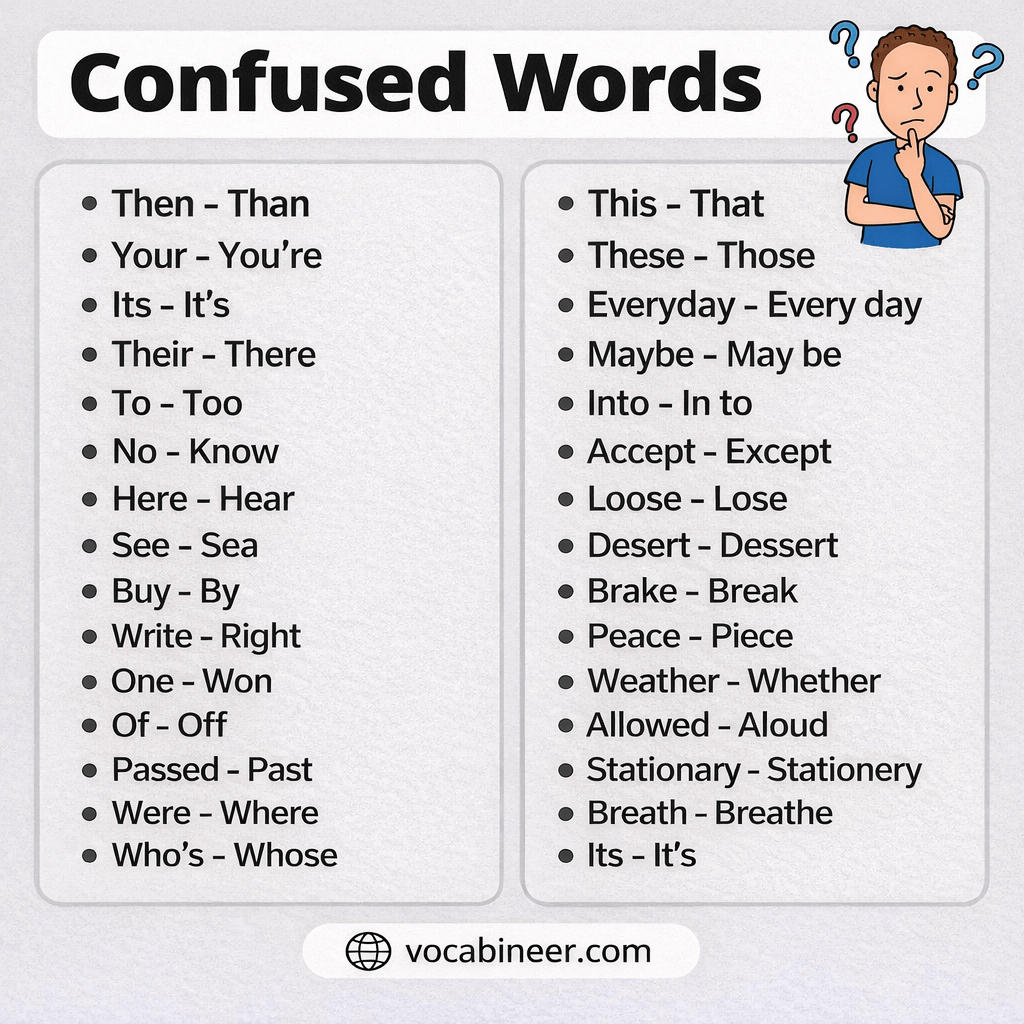
Confused Words are pairs that look or sound similar but behave differently in sentences. Learners often mix them because the difference is small, yet meaning changes quickly. These words appear often in reading, classroom writing, and short daily sentences, where context decides which word fits naturally.
This post helps readers learn Confused Words through examples and pictures, making it easier to choose the correct word while reading everyday passages or writing short sentences.
In This Page
Confusing Words in English With Examples
These confused words appear very early in learning and are used often in short sentences. The words may look or sound familiar, but they serve different purposes in meaning. Paying attention to how each word fits into a sentence helps learners avoid small mistakes that can change meaning.
Below are core confused words with explanations and multiple sentence examples.
- Then / Than: Then talks about time or sequence, while than is used for comparison.
Finish your work, then go outside.
She is taller than me.
We ate first, then left. - Your / You’re: Your shows possession, while you’re means you are.
Is this your bag?
You’re late again.
I like your handwriting. - Its / It’s: Its shows ownership, while it’s means it is or it has.
The dog wagged its tail.
It’s very cold today.
The phone lost its signal. - Their / There: Their shows ownership, while there points to a place.
Their classroom is large.
Put the books over there.
I met their teacher. - To / Too: To shows direction or purpose, while too means also or very.
She went to the market.
I want juice too.
This box is too heavy. - No / Know: No is a refusal, while know means understand.
I know the answer.
No, I cannot come.
Do you know him? - Here / Hear: Here shows place, while hear relates to sound.
Come here please.
I can hear music.
Sit here quietly. - See / Sea: See means notice with eyes, while sea is a large body of water.
I see your point.
The sea looks calm.
Did you see that? - Buy / By: Buy means purchase, while by shows position or method.
I will buy a book.
Sit by the window.
She bought fruit. - Write / Right: Write means put words on paper, while right means correct or direction.
Please write your name.
Turn right at the corner.
Your answer is right. - One / Won: One is a number, while won is past of win.
I have one pen.
She won the race.
Only one prize remained. - Of / Off: Of shows relation, while off shows separation.
A piece of cake.
Take your shoes off.
The cover fell off. - Passed / Past: Passed is a verb, while past relates to time.
He passed the test.
The past feels distant.
She passed me quickly. - Were / Where: Were is a verb form, while where asks about place.
They were happy.
Where are you going?
We were tired. - Who’s / Whose: Who’s means who is, while whose shows ownership.
Who’s at the door?
Whose book is this?
Do you know who’s coming? - This / That: This points to something near, while that points to something farther.
This pencil is mine.
That building is tall.
I like this one. - These / Those: These is plural near, while those is plural far.
These apples are fresh.
Those shoes look old.
I need these notes. - Yes / Yeah: Yes is formal agreement, while yeah is informal.
Yes, I understand.
Yeah, that sounds fine.
She said yes politely. - OK / Okay: Both show agreement, but okay is more formal in writing.
It is OK with me.
Everything is okay now.
Are you OK? - Hello / Hi: Both are greetings, but hello is more formal.
Hello, how are you?
Hi, good to see you.
She said hello first.
Common Confusing Words in Daily English
These confused words appear in everyday conversations and simple writing. Learners often mix them because the meanings feel close, even though their use is different. Paying attention to who is involved, what action happens, and where it happens helps choose the correct word naturally.
Below are common daily English confused words with explanations and multiple sentence examples.
- Say / Tell: Say focuses on words spoken, while tell focuses on the listener.
She said hello politely.
He told me the truth.
Please tell your parents. - Talk / Speak: Talk is informal conversation, while speak is more formal.
They talk after school.
She speaks clearly.
Do not talk during class. - Ask / Request: Ask is general, while request is more formal or polite.
I will ask a question.
He requested help calmly.
She asked for water. - Bring / Take: Bring moves toward you, while take moves away.
Bring your notebook here.
Take this box outside.
Please bring a pen. - Lend / Borrow: Lend gives something, while borrow receives something.
Can you lend me a pencil?
I will borrow your book.
She lent him money. - Come / Go: Come moves toward the speaker, while go moves away.
Come here now.
We will go home soon.
She came early. - Make / Do: Make creates something, while do performs an action.
She made lunch.
Please do your work.
He made a plan. - Look / Watch: Look is quick attention, while watch is careful attention.
Look at the board.
We watched a movie.
Watch the road. - Hear / Listen: Hear happens naturally, while listen needs focus.
I heard a noise.
Please listen carefully.
Did you hear that? - Wear / Carry: Wear is on the body, while carry is holding or moving.
She wears glasses.
He carried a bag.
I wear a jacket. - Find / Discover: Find is general, while discover is new or unexpected.
I found my keys.
Scientists discovered a planet.
She found the answer. - Get / Receive: Get is informal, while receive is more formal.
I got a message.
She received a letter.
Did you get it? - Help / Assist: Help is common, while assist is more formal.
Please help me.
The nurse assisted him.
She helped her friend. - Start / Begin: Both mean the same, but begin sounds more formal.
Let us start now.
The class will begin soon.
She started reading. - End / Finish: End is general, while finish means complete fully.
The show will end soon.
Please finish your work.
He finished early. - Buy / Purchase: Buy is everyday speech, while purchase is formal.
I will buy a notebook.
She purchased a phone.
They bought snacks. - Need / Want: Need is necessary, while want is a wish.
I need water.
I want ice cream.
She needs help. - Try / Attempt: Try is informal, while attempt is formal.
Please try again.
He attempted the task.
She tried hard. - Show / Display: Show is common, while display is formal.
Show me your work.
The shop displays clothes.
She showed kindness. - Job / Work: Job is a position, while work is effort or activity.
He has a new job.
She likes her work.
This job is demanding.
Confusing Words With Similar Spelling
Some confused words look almost the same on the page, so the eyes move past them quickly. A small spelling change can shift meaning, usage, or sentence structure. These pairs often cause mistakes in writing because both words feel familiar and correct at first glance. Slowing down and checking meaning helps choose the right form.
Below are confused words with similar spelling, explained with clear usage and examples.
- Accept / Except: Accept means receive or agree, while except means not including.
She accepted the gift.
Everyone came except Ali.
Please accept my apology. - Affect / Effect: Affect usually shows action, while effect shows result.
Noise can affect focus.
The medicine had an effect.
Stress affects sleep. - Advice / Advise: Advice is a noun, while advise is a verb.
She gave helpful advice.
I advise you to rest.
His advice was useful. - Principal / Principle: Principal means head or main, while principle means rule or belief.
The principal spoke today.
Honesty is a strong principle.
She met the school principal. - Loose / Lose: Loose means not tight, while lose means misplace or fail.
This shirt feels loose.
Do not lose your keys.
He did not want to lose. - Quiet / Quite: Quiet means silent, while quite means very.
Please stay quiet.
The room is quite bright.
She became quiet suddenly. - Desert / Dessert: Desert is dry land, while dessert is sweet food.
Camels live in the desert.
Cake is my favorite dessert.
The desert felt hot. - Stationary / Stationery: Stationary means not moving, while stationery means writing items.
The car stayed stationary.
I bought new stationery.
Keep the bike stationary. - Breath / Breathe: Breath is a noun, while breathe is a verb.
Take a deep breath.
Please breathe slowly.
His breath was fast. - Compliment / Complement: Compliment is praise, while complement completes something.
She gave a kind compliment.
The sauce complements the meal.
His words were a compliment. - Practice / Practise: Practice is a noun in American English, while practise is a verb in British English.
Football practice starts soon.
She will practise daily.
Good practice helps learning. - Moral / Morale: Moral relates to right and wrong, while morale means confidence or spirit.
Honesty is a moral value.
Team morale was high.
The story had a moral. - Capital / Capitol: Capital means city or money, while capitol is a government building.
Paris is the capital of France.
The capitol looks grand.
She invested capital wisely. - Cereal / Serial: Cereal is food, while serial relates to order or series.
I eat cereal daily.
He watched a serial show.
Breakfast cereal is ready. - Weather / Whether: Weather is climate, while whether shows choice or condition.
The weather feels cold.
I wonder whether it will rain.
Bad weather delayed travel. - Historic / Historical: Historic means important, while historical relates to history.
It was a historic moment.
She studies historical events.
The speech felt historic. - Economic / Economical: Economic relates to economy, while economical means cost-saving.
Economic growth slowed.
This car is economical.
They discussed economic plans. - Classic / Classical: Classic means traditional, while classical relates to music or art style.
That is a classic story.
She enjoys classical music.
The movie became a classic. - Childish / Childlike: Childish is negative, while childlike is positive.
His behavior was childish.
She has childlike joy.
That joke felt childish. - Sensible / Sensitive: Sensible means practical, while sensitive means easily affected.
That is a sensible choice.
He is very sensitive.
Be sensible today.
Confused Words With Similar Sound
Some confused words sound the same or almost the same when spoken. Because the ear hears them alike, learners may choose the wrong word while writing. These words depend on meaning and sentence context, not sound, to decide which one fits correctly. Careful reading helps avoid mistakes that sound right but look wrong on the page.
Below are confused words with similar sound, explained with usage and examples.
- Flour / Flower: Flour is used in cooking, while flower is a plant bloom.
She bought flour for baking.
The flower smells sweet.
Use whole wheat flour. - Mail / Male: Mail means letters, while male describes gender.
The mail arrived late.
The male cat slept.
Check your mail today. - Pair / Pear: Pair means two items, while pear is a fruit.
I bought a pair of shoes.
She ate a ripe pear.
This pair is new. - Hour / Our: Hour shows time, while our shows possession.
Wait one hour.
This is our classroom.
An hour passed quickly. - Son / Sun: Son is a child, while sun is the star in the sky.
Her son smiled.
The sun is bright.
His son waved. - Meat / Meet: Meat is food, while meet means come together.
I do not eat meat.
Let us meet tomorrow.
Cook the meat well. - Peace / Piece: Peace means calm, while piece means a part.
We hope for peace.
Take one piece of cake.
The room felt peaceful. - Weak / Week: Weak means not strong, while week is a time period.
He felt weak today.
School starts next week.
The week was busy. - Plain / Plane: Plain means simple, while plane is an aircraft.
She wore a plain dress.
The plane landed safely.
I like plain rice. - Brake / Break: Brake stops movement, while break means damage or rest.
Press the brake slowly.
Do not break the glass.
Take a short break. - Allowed / Aloud: Allowed means permitted, while aloud means spoken loudly.
Talking is allowed here.
Read the line aloud.
Phones are not allowed. - Hole / Whole: Hole is an opening, while whole means complete.
There is a hole in the wall.
Eat the whole apple.
The hole was small. - Heard / Herd: Heard is past of hear, while herd is a group of animals.
I heard a noise.
A herd crossed the road.
She heard the news. - Right / Write: Right means correct or direction, while write means form letters.
Your answer is right.
Please write clearly.
Turn right here. - Buy / Bye: Buy means purchase, while bye is a goodbye.
I will buy milk.
She said bye softly.
They bought bread. - For / Four: For shows purpose, while four is a number.
This gift is for you.
I counted four chairs.
Wait for me. - Know / No: Know means understand, while no shows refusal.
I know the answer.
No, I cannot come.
Do you know her? - One / Won: One is a number, while won is past of win.
I have one pen.
She won the game.
Only one ticket remains. - Here / Hear: Here shows place, while hear relates to sound.
Sit here please.
I can hear music.
Come here now. - There / Their: There points to a place, while their shows possession.
Put it there.
Their house is big.
I stood there quietly.
Confusing Words That Change Meaning by Context
Some confused words change meaning depending on how they are used in a sentence. The same word can describe an action, a quality, or an idea based on context. These shifts often confuse learners because the word looks familiar but behaves differently. Reading the whole sentence carefully helps decide the correct meaning.
Below are confused words that change meaning by context, with explanations and examples.
- Run / Operate: Run can mean move quickly or function, while operate focuses on function.
He runs every morning.
The machine runs smoothly.
The shop operates daily. - Light / Lite: Light relates to weight or brightness, while lite suggests reduced content.
This bag feels light.
The room has light walls.
She prefers lite snacks. - Hard / Difficult: Hard can describe effort or surface, while difficult focuses on challenge.
The test was hard.
This puzzle is difficult.
He worked hard today. - Close / Shut: Close suggests bringing together, while shut feels more final.
Please close the door.
He shut the window firmly.
The shop will close soon. - Open / Free: Open means not closed, while free means available or not restricted.
The door is open.
The seat is free.
Keep your mind open. - Fair / Just: Fair means equal treatment, while just focuses on right action.
The teacher was fair.
The decision felt just.
She wants a fair chance. - Right / Correct: Right can show direction or accuracy, while correct focuses only on accuracy.
Your answer is right.
The spelling is correct.
Turn right here. - Kind / Type: Kind can mean caring or category, while type refers only to category.
She is kind to others.
This kind of fruit is sweet.
What type do you like? - Mean / Average: Mean can show intention or mathematical average, while average is general.
He did not mean harm.
The mean score was high.
The average result improved. - Fast / Quick: Fast often describes speed or firmness, while quick focuses on speed only.
He runs fast.
She gave a quick reply.
Hold fast to the rope. - Old / Former: Old shows age, while former shows past position.
That is an old building.
She is a former captain.
His old bag broke. - Clean / Clear: Clean means not dirty, while clear means easy to understand or see through.
The floor is clean.
The instructions are clear.
Keep your hands clean. - Sharp / Smart: Sharp can mean pointed or intelligent, while smart means intelligent or neat.
The knife is sharp.
She is very smart.
He made a sharp turn. - Cool / Calm: Cool can describe temperature or style, while calm describes emotion.
The water feels cool.
Stay calm during tests.
He looks cool today. - Plain / Simple: Plain means not decorated, while simple means easy.
She wore a plain dress.
The task is simple.
I like plain food. - Strong / Powerful: Strong can describe body or taste, while powerful shows influence or force.
He is strong.
The speech was powerful.
Coffee tastes strong. - Look / Seem: Look relates to appearance, while seem shows impression.
You look tired.
It seems quiet today.
She looks happy. - Hear / Sound: Hear is receiving sound, while sound describes how something seems.
I hear music.
That sounds good.
Did you hear that? - Smell / Scent: Smell is general, while scent refers to a specific smell.
I smell smoke.
The flower has a sweet scent.
This food smells good. - Free / Available: Free can mean no cost or open, while available means ready for use.
Entry is free today.
The seat is available.
I am free now.
Confusing Words Used in Comparisons
Some confused words appear when comparing size, amount, distance, or degree. These words seem interchangeable, but each one fits a specific comparison situation. Choosing the wrong word can make a sentence sound slightly off or change its meaning. Paying attention to what is being compared helps select the correct form.
Below are confused words commonly used in comparisons, with explanations and examples.
- Fewer / Less: Fewer is used with countable items, while less is used with uncountable amounts.
I have fewer books this year.
There is less water left.
She made fewer mistakes. - Older / Elder: Older is general, while elder is often used for people in families.
My brother is older than me.
She is my elder sister.
This building is older. - Further / Farther: Further shows degree or progress, while farther shows physical distance.
We walked farther today.
Let us discuss this further.
The park is farther away. - Better / Best: Better compares two, while best compares more than two.
This option is better.
She chose the best answer.
Today feels better. - Worse / Worst: Worse compares two, while worst compares more than two.
His result is worse.
That was the worst day.
The weather got worse. - More / Most: More compares two, while most refers to the largest amount.
I need more time.
She ate the most fruit.
Give me more space. - Much / Many: Much is used with uncountable nouns, while many is used with countable nouns.
There is not much sugar.
She has many friends.
Too much noise hurts. - Little / Small: Little often shows amount, while small shows size.
There is little hope.
He has a small bag.
Add a little salt. - Same / Similar: Same means exactly alike, while similar means almost alike.
We wear the same uniform.
The bags look similar.
Their answers are same. - Different / Separate: Different means not alike, while separate means kept apart.
We have different ideas.
Keep the files separate.
They chose different paths. - Bigger / Larger: Bigger is informal, while larger is more neutral or formal.
This box is bigger.
They need a larger room.
The dog grew bigger. - Smaller / Lesser: Smaller refers to size, while lesser refers to importance or degree.
I need a smaller cup.
That is the lesser problem.
The bag looks smaller. - Faster / Quicker: Faster often refers to speed, while quicker suggests shorter time.
He runs faster.
This way is quicker.
She learned faster. - Taller / Higher: Taller is used for people or upright objects, while higher is general height or level.
She is taller than me.
The plane flew higher.
That wall is taller. - Longer / Lengthy: Longer compares length or time, while lengthy describes something as long.
The road is longer.
He gave a lengthy speech.
Today feels longer.
Confusing Words Showing Possession
Some confused words are used to show ownership or belonging. These words often look similar or sound alike, which makes them easy to mix up. The key is noticing whether the sentence needs to show who owns something or who is being talked about. Careful use keeps sentences clear and natural.
Below are confused words that show possession, with explanations and examples.
- Their / Theirs: Their comes before a noun, while theirs stands alone.
Their house is new.
This bag is theirs.
I met their teacher. - Your / Yours: Your is used before a noun, while yours replaces the noun.
Is this your pen?
The blue one is yours.
I like your choice. - My / Mine: My comes before a noun, while mine stands alone.
This is my book.
That book is mine.
I lost my keys. - Her / Hers: Her comes before a noun, while hers replaces the noun.
That is her bag.
The red bag is hers.
I spoke to her friend. - Our / Ours: Our is used before a noun, while ours stands alone.
This is our classroom.
The seats are ours.
I like our project. - His / He’s: His shows possession, while he’s means he is or he has.
This is his jacket.
He’s ready to leave.
I borrowed his pen. - Its / His: Its shows ownership for things, while his shows ownership for males.
The dog wagged its tail.
That is his book.
The car lost its mirror. - Whose / Who’s: Whose shows ownership, while who’s means who is or who has.
Whose shoes are these?
Who’s calling you?
I wonder whose bag this is. - Own / Belong: Own shows possession, while belong shows relationship to someone.
I own this house.
This book belongs to her.
They own a shop. - Have / Own: Have shows possession generally, while own shows legal or personal ownership.
I have a bicycle.
She owns a car.
They have time. - Them / Their: Them is an object pronoun, while their shows possession.
I saw them yesterday.
Their dog is friendly.
I helped them move. - It / Its: It is a subject or object, while its shows possession.
It looks broken.
The phone lost its charge.
It fell down. - She / Hers: She is a subject, while hers shows possession.
She is kind.
The prize is hers.
She smiled proudly. - He / His: He is a subject, while his shows possession.
He arrived early.
That is his seat.
He waited quietly. - We / Ours: We is a subject, while ours shows possession.
We are ready.
The victory is ours.
We won the match.
Confusing Words Related to Time
Some confused words describe time, order, or duration. These words feel similar because they all connect to when something happens. The confusion usually comes from choosing between duration, starting point, or sequence. Understanding what kind of time relationship the sentence needs makes the choice easier.
Below are confused words related to time, with explanations and examples.
- Already / All ready: Already means earlier than expected, while all ready means fully prepared.
She has already finished.
We are all ready to leave.
The food is already cold. - Since / For: Since shows a starting point, while for shows duration.
I have lived here since 2020.
She waited for two hours.
He has studied since morning. - During / While: During refers to a period, while while refers to an action happening at the same time.
He slept during the class.
She read while waiting.
Phones rang during the show. - Then / Now: Then refers to past or sequence, while now refers to the present.
He was busy then.
I am free now.
Finish this, then rest. - Early / Soon: Early means before expected time, while soon means after a short time.
She arrived early.
Lunch will start soon.
He woke up early. - Late / Lately: Late shows delay, while lately means recently.
He came late today.
I have been tired lately.
Do not be late. - Always / Usually: Always means every time, while usually means most times.
She always smiles.
He usually walks home.
I always try. - Today / Nowadays: Today refers to the present day, while nowadays refers to recent times in general.
I am busy today.
People travel more nowadays.
It feels warm today. - Before / Ago: Before refers to earlier time, while ago counts back from now.
I met her before lunch.
He left two hours ago.
Finish this before dinner. - Finally / Last: Finally shows the end of a process, while last shows position or time.
She finally arrived.
He was last in line.
The show finally ended. - Soon / Shortly: Soon is general, while shortly means in a brief time.
The bus will arrive soon.
She will call shortly.
We will eat soon. - Recently / Lately: Recently focuses on a specific past time, while lately is more general.
I recently moved here.
He seems busy lately.
She recently called. - Former / Previous: Former refers to an earlier role, while previous refers to earlier order.
He is a former player.
Read the previous chapter.
Her former teacher retired. - Instant / Immediate: Instant suggests no delay, while immediate stresses quick action.
Coffee gives instant energy.
He needs immediate help.
The reply was instant. - Temporary / Permanent: Temporary means for a short time, while permanent means lasting.
This job is temporary.
She found a permanent role.
The sign is temporary.
Confusing Words Showing Cause and Result
Some confused words explain why something happens or what happens because of it. These words are often mixed because they appear in similar sentence positions. The key difference is whether the word points to the reason, the action, or the outcome. Reading the full sentence helps decide which word fits naturally.
Below are confused words showing cause and result, with explanations and examples.
- Because / So: Because gives a reason, while so shows a result.
I stayed home because it rained.
It rained, so we stayed home.
She smiled because she was happy. - Due to / Because of: Both show reason, but due to often follows a form of be.
The delay was due to traffic.
We were late because of rain.
The cancelation was due to weather. - Cause / Reason: Cause is what makes something happen, while reason explains why.
The cause of the fire is unknown.
His reason was honest.
Stress can cause problems. - Result / Effect: Result is the outcome, while effect is the change caused.
The result was surprising.
Noise has a bad effect.
The effect lasted long. - Affect / Impact: Affect is an action, while impact emphasizes strength or importance.
Heat can affect health.
The speech had strong impact.
Stress affects sleep. - Lead / Result: Lead shows direction toward an outcome, while result names the outcome.
Hard work can lead to success.
The result was positive.
Choices lead to change. - Create / Produce: Create focuses on making something new, while produce focuses on output.
Artists create art.
Factories produce goods.
She created a plan. - Make / Cause: Make is general, while cause shows direct responsibility.
He made a mistake.
The storm caused damage.
Stress can cause pain. - Change / Affect: Change means make different, while affect means influence.
Weather can change quickly.
Noise can affect focus.
Plans may change. - Improve / Increase: Improve means make better, while increase means make more.
Practice will improve skills.
Prices increased suddenly.
Sleep helps improve health. - Prevent / Stop: Prevent avoids something before it happens, while stop ends it.
Helmets prevent injury.
Please stop talking.
Rest can prevent illness. - Allow / Permit: Allow is common, while permit is more formal.
Teachers allow discussion.
Smoking is not permitted.
Parents allow outings. - Force / Cause: Force implies pressure, while cause is neutral.
Wind forced the door open.
The error caused delay.
Rules force change. - Fix / Solve: Fix repairs a problem, while solve finds an answer.
He fixed the chair.
She solved the puzzle.
Try to solve it. - Reduce / Decrease: Reduce is general, while decrease is more formal or measured.
We need to reduce waste.
Sales decreased last month.
Exercise can reduce stress.
Confused Words That Look Right but Are Wrong
Some confused words look correct at first glance, but one form is not actually correct English or does not fit the sentence. These mistakes happen because the incorrect form feels familiar or sounds right when spoken. Learning which forms are standard helps avoid errors that stand out in writing.
Below are confused words that look right but are wrong, with explanations and examples.
- Alot / A lot: Alot is incorrect, while a lot means many or much.
I have a lot of homework.
She eats a lot of fruit.
There is a lot to learn. - Into / In to: Into shows movement inside, while in to is used with verbs.
She walked into the room.
Turn your work in to the teacher.
He jumped into the pool. - Apart / A part: Apart means separated, while a part means a piece.
They live apart now.
I want a part of the cake.
The houses are apart. - Everyday / Every day: Everyday is an adjective, while every day shows time.
Wear everyday clothes.
She walks every day.
This is everyday use. - Maybe / May be: Maybe shows possibility, while may be is a verb phrase.
Maybe it will rain.
She may be late.
Maybe tomorrow works. - Anytime / Any time: Anytime is informal, while any time fits specific use.
Call me anytime.
You can leave at any time.
Come anytime you want. - Sometime / Some time: Sometime means at an unknown time, while some time means a period.
Let us meet sometime.
I need some time to think.
She will visit sometime. - Anyway / Any way: Anyway means regardless, while any way refers to method.
I will go anyway.
Is there any way to help?
She smiled anyway. - Already / Allready: Already is correct, while allready is incorrect.
I have already eaten.
She already knows.
They already left. - Until / Untill: Until is correct, while untill is incorrect.
Wait until noon.
Stay until I return.
Sleep until morning. - Definitely / Definately: Definitely is correct, while definately is incorrect.
I will definitely come.
She is definitely ready.
That is definitely true. - Receive / Recieve: Receive is correct, while recieve is incorrect.
Did you receive the email?
She received a gift.
I did not receive it. - Separate / Seperate: Separate is correct, while seperate is incorrect.
Keep the files separate.
The rooms are separate.
Please separate these. - Necessary / Neccessary: Necessary is correct, while neccessary is incorrect.
This step is necessary.
Bring only what is necessary.
Rules are necessary. - Occurred / Occured: Occurred is correct, while occured is incorrect.
The accident occurred suddenly.
It occurred last night.
The problem occurred again.
Confusing Words Commonly Used Incorrectly
Some confused words are used incorrectly because their meanings overlap in casual speech. In writing, however, the difference becomes noticeable. These word pairs require attention to action, position, or intent in a sentence. Understanding how each word functions helps avoid common mistakes that teachers and readers often notice.
Below are confused words commonly used incorrectly, with explanations and multiple examples.
- Lay / Lie: Lay needs an object, while lie does not.
Please lay the book on the table.
I want to lie down.
She laid the bag gently. - Raise / Rise: Raise needs an object, while rise happens on its own.
They raised the flag.
The sun will rise soon.
Prices rose quickly. - Set / Sit: Set places something, while sit means take a seat.
Set the cup here.
Please sit down.
She set the plate carefully. - Teach / Learn: Teach gives knowledge, while learn receives it.
She teaches math.
I want to learn English.
He learned quickly. - Bring / Fetch: Bring moves something toward you, while fetch means go get it.
Bring your notebook here.
Please fetch some water.
She brought snacks. - Assume / Presume: Assume is based on little proof, while presume suggests more confidence.
Do not assume things.
I presume he is ready.
She assumed wrongly. - Refuse / Reject: Refuse declines an offer, while reject pushes something away firmly.
He refused the offer.
The plan was rejected.
She refused politely. - Explain / Describe: Explain gives reasons, while describe gives details.
Please explain the rule.
She described the scene.
He explained clearly. - Rob / Steal: Rob takes from a person or place, while steal focuses on the item.
They robbed the store.
Someone stole my phone.
He was robbed yesterday. - Discover / Invent: Discover finds something existing, while invent creates something new.
Scientists discovered water signs.
He invented a device.
She discovered a fact. - Say / Claim: Say is neutral speech, while claim suggests strong statement.
She said hello.
He claimed innocence.
They said nothing. - House / Home: House is a building, while home has emotional meaning.
The house is large.
I feel safe at home.
They bought a house. - Sick / Ill: Sick is informal, while ill is more formal.
I feel sick today.
He has been ill.
She looks sick. - Big / Large: Big is informal, while large is more neutral.
That is a big bag.
They ordered a large pizza.
The room feels big. - Angry / Mad: Angry is emotional, while mad is more informal.
She felt angry.
He got mad quickly.
Do not stay angry. - Alone / Lonely: Alone means by yourself, while lonely shows feeling.
She stayed alone.
He felt lonely.
Being alone is quiet. - Funny / Fun: Funny causes laughter, while fun describes enjoyment.
That joke was funny.
The trip was fun.
He told a funny story. - Afraid / Scared: Afraid is often formal, while scared is emotional.
She felt afraid.
He was scared of noise.
Do not be afraid. - Busy / Occupied: Busy is informal, while occupied is more formal.
I am busy now.
The seat is occupied.
She stayed busy. - True / Correct: True shows fact, while correct shows accuracy.
That is true.
Your answer is correct.
The story is true.
FAQs
Confused words are common because many look alike or appear in similar sentence positions. The brain often chooses quickly, which leads to using a familiar word even when another fits the meaning better.
No, confused words are not spelling errors. Both words are usually correct English words. The mistake happens when the wrong word is chosen for the sentence meaning.
Yes, using the wrong word can change time, ownership, comparison, or cause. Sometimes the sentence still sounds natural but gives the wrong idea.
Learners avoid confusion by checking what the sentence is showing, such as time, reason, or ownership. Reading and comparing examples helps build correct usage.
Yes, learning confused words in pairs helps the brain notice differences faster than learning them one by one.
Conclusion
Confused Words often look or sound familiar, yet their meanings change how sentences work. Learning these pairs together helps readers notice small differences in time, comparison, possession, and cause. With regular exposure to examples, Confused Words become easier to recognize, making everyday reading and writing more accurate and confident.
Read More