

Desert vs Dessert often creates confusion because the words look similar but have completely different meanings. One usually refers to a dry land area or the act of leaving someone behind, while the other refers to sweet food eaten after a meal. Their spelling difference reflects separate origins and meanings.
Understanding Desert vs Dessert helps you choose the correct word in structured writing, academic contexts, and everyday communication. This article explains their meaning, grammar roles, pronunciation difference, usage patterns, and common mistakes so you can apply them accurately.
In This Page
Desert vs Dessert: Quick Definition
Desert refers to a dry, sandy region or the act of abandoning someone.
Dessert refers to sweet food served after a meal.
The key difference in Desert vs Dessert is dry land or abandon versus sweet course.
Desert vs Dessert Difference in One Sentence
Desert is dry land or to leave someone behind.
Dessert is the sweet dish eaten after a meal.
Why Desert and Dessert Are Often Confused
Desert and Dessert are often confused because they differ by only one letter. In addition, their pronunciation can sound similar in casual speech. Therefore, writers sometimes misspell one for the other.
However, their meanings are completely unrelated. Desert refers to geography or abandonment, while Dessert refers to food. As a result, confusion usually happens due to spelling similarity rather than meaning overlap.
Word Origin and Etymology
The history of Desert vs Dessert shows that both words come from different French roots. Desert comes from the French word desert, meaning abandoned land. It traces back to Latin roots meaning to leave or forsake.
Dessert comes from the French word desservir, meaning to clear the table. Over time, it came to refer to the sweet course served after the main meal.
Although the words look similar, their origins and meanings developed separately.
What Does Desert Mean?
Desert has more than one meaning depending on context. It can refer to a dry region with little rainfall or to the act of abandoning someone.
Definition of Desert
Desert means a dry, sandy region with little rainfall or to abandon someone.
It can function as a noun or a verb.
Desert as a Noun
When used as a noun, Desert refers to a dry, arid land area.
Examples using Desert as dry land:
- The Sahara is a vast desert.
- Camels live in the desert.
- The desert receives little rainfall.
- Many plants survive in the desert.
- The travelers crossed the desert.
- The heat in the desert is intense.
- Sand dunes cover the desert.
- The Atacama is one of the driest deserts.
- Life in the desert requires adaptation.
- The desert landscape stretches for miles.
Desert as a Verb
When used as a verb, Desert means to abandon or leave someone behind.
Examples using Desert as abandon:
- He decided to desert the team.
- She would not desert her family.
- The soldier refused to desert his post.
- They felt he had deserted them.
- He would never desert his friends.
- The workers did not desert the project.
- She was afraid he might desert her.
- He deserted his responsibilities.
- They accused him of deserting the group.
- The captain would not desert the ship.
Common Uses and Collocations of Desert
- Desert climate
- Desert region
- Desert storm
- Desert animal
- Desert plant
- Desert landscape
- Desert heat
- Desert sand
- Desert area
- Desert traveler
- Desert life
- Desert conditions
- Desert survival
- Desert environment
- Desert journey
What Does Dessert Mean?
Dessert refers to the sweet course served at the end of a meal. In the Desert vs Dessert contrast, Dessert always relates to food, especially sweet dishes such as cake, ice cream, or fruit.
Unlike Desert, which can refer to land or abandonment, Dessert has one main meaning connected to meals and dining.
Definition of Dessert
Dessert means a sweet dish eaten after the main course of a meal.
It functions as a noun.
Dessert as a Noun
Because Dessert is a noun, it names the sweet food itself. It does not show action and does not change tense.
Examples using Dessert:
- We had cake for dessert.
- Ice cream is my favorite dessert.
- She ordered chocolate dessert.
- Fruit salad can be a healthy dessert.
- The restaurant served a rich dessert.
- They shared one dessert.
- The chef prepared a special dessert.
- Brownies were served as dessert.
- The menu listed several desserts.
- We skipped dessert tonight.
- The children wanted extra dessert.
- She baked a homemade dessert.
- The sweet dessert tasted delicious.
- They finished dinner with dessert.
- The bakery offers fresh desserts.
- He chose fruit for dessert.
- The party included a variety of desserts.
- Pudding is a classic dessert.
- The guests enjoyed their dessert.
- She served pie for dessert.
Notice something important. Dessert always refers to food eaten after a meal.
Common Uses and Collocations of Dessert
- Chocolate dessert
- Ice cream dessert
- Baked dessert
- Frozen dessert
- Sweet dessert
- Light dessert
- Rich dessert
- Fruit dessert
- Dessert menu
- Dessert plate
- Dessert recipe
- Dessert table
- Dessert course
- Dessert tray
- Homemade dessert
Each phrase relates to sweet food served after a meal.
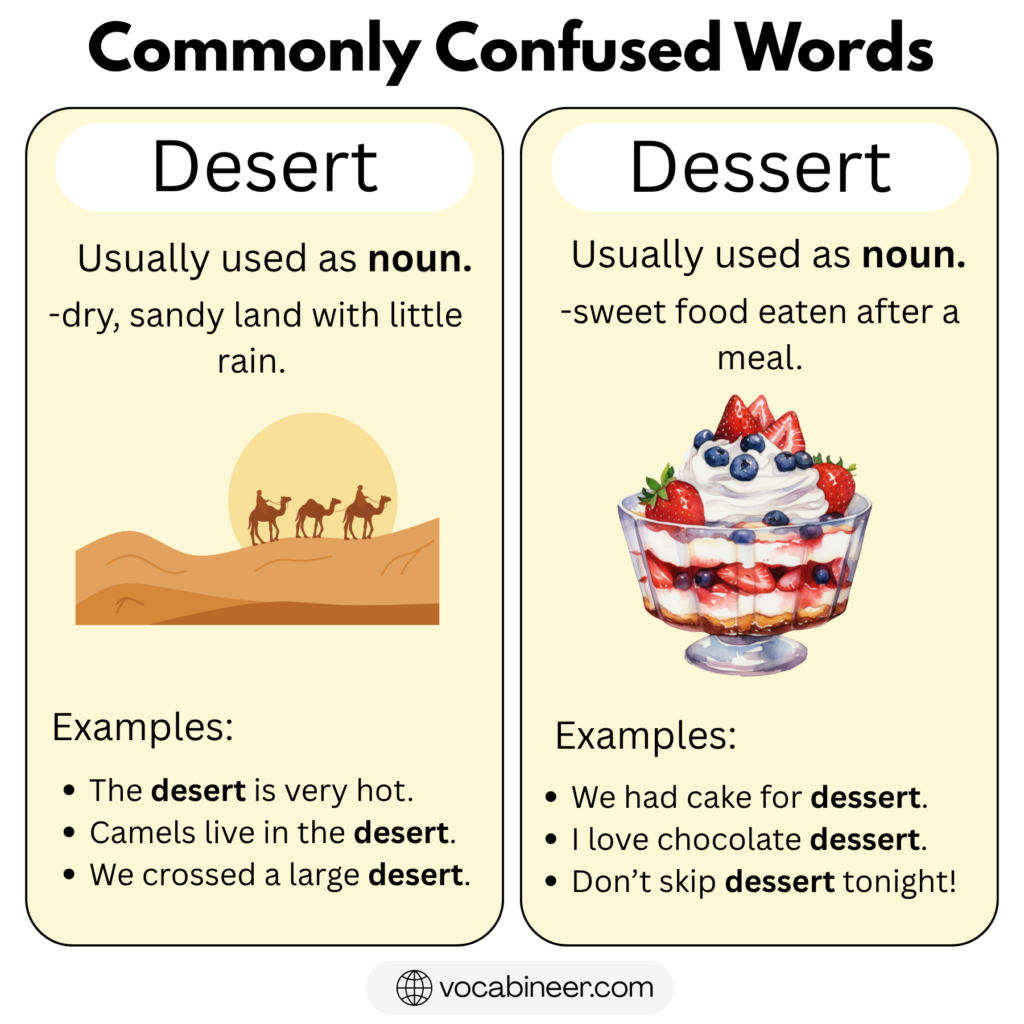
Desert vs Dessert: Key Difference Explained
The main difference in Desert vs Dessert depends on meaning and spelling. Desert refers to dry land or the act of abandoning someone. Dessert refers only to sweet food served after a meal.
If the sentence talks about geography or leaving someone behind, use Desert.
If the sentence talks about sweet food after dinner, use Dessert.
Here is the difference in one sentence:
Desert is dry land or to abandon.
Dessert is the sweet dish eaten after a meal.
Desert vs Dessert: Difference in One Look
| Feature | Desert | Dessert |
|---|---|---|
| Part of Speech | Noun or verb | Noun |
| Meaning | Dry region or abandon | Sweet course after meal |
| Context | Geography or leaving | Food and dining |
| Replace With | Arid land, abandon | Sweet dish |
| Spelling Clue | One “s” in middle | Two “s” in middle |
Notice something helpful. Dessert has two “s” letters, just like you might want two servings of something sweet.
Desert vs Dessert: Side by Side Sentence Contrast
- The Sahara is a vast desert.
- We enjoyed cake for dessert.
- He refused to desert his team.
- She ordered ice cream for dessert.
- The travelers crossed the hot desert.
- The restaurant offered a rich dessert.
In each pair, Desert relates to land or abandonment. Dessert relates to sweet food.
Desert vs Dessert: Sentence Structure Comparison
Understanding structure makes the difference clearer.
| Structure Type | Desert Pattern | Dessert Pattern |
|---|---|---|
| Geography Context | The desert is dry | We ate pie for dessert |
| Verb Context | He did not desert his post | They ordered chocolate dessert |
| Plural Form | The world has many deserts | The bakery sells many desserts |
| With Adjective | Vast desert region | Sweet dessert course |
If the sentence refers to dry land or abandoning someone, use Desert. If it refers to food after a meal, use Dessert.
When to Use Desert and Dessert
Choosing between Desert vs Dessert becomes simple when you focus on meaning. Ask yourself whether the sentence refers to land, abandonment, or sweet food.
Use Desert when the sentence refers to:
- A dry, arid land region
- Sand, heat, or low rainfall
- The act of abandoning someone
- Leaving a responsibility or duty
Examples:
- The Sahara is a vast desert.
- Camels survive in the desert.
- The soldiers refused to desert their post.
- He would not desert his family.
- The travelers crossed the hot desert.
- She feared he might desert the team.
- The desert climate is extreme.
- Many plants grow in the desert.
- He did not desert his responsibilities.
- The hikers were lost in the desert.
Use Dessert when the sentence refers to:
- Sweet food after a meal
- Cakes, ice cream, or pudding
- A final course at dinner
- Bakery or sweet dishes
Examples:
- We had cake for dessert.
- Ice cream is my favorite dessert.
- She ordered fruit for dessert.
- The chef prepared a special dessert.
- They shared one dessert.
- The menu listed several desserts.
- The children asked for extra dessert.
- Brownies were served as dessert.
- The party included many desserts.
- He skipped dessert tonight.
If the word refers to dry land or abandoning someone, choose Desert. If it refers to sweet food after a meal, choose Dessert.
Context Based Usage Guide
Context provides strong clues in Desert vs Dessert decisions.
Desert frequently appears:
- With words like sand, heat, climate, dunes
- In geography discussions
- In action sentences about leaving
Examples:
- The desert heat is intense.
- Sand dunes cover the desert.
- He refused to desert his post.
- The desert region receives little rain.
Dessert frequently appears:
- After dinner references
- With words like cake, pie, ice cream
- In restaurant or food settings
Examples:
- We finished dinner with dessert.
- The bakery sells fresh desserts.
- She chose chocolate dessert.
- They ordered ice cream for dessert.
You may notice a helpful spelling clue. Dessert has two “s” letters, like something sweet you may want twice.
Grammar Difference Between Desert and Dessert
The grammar difference between Desert vs Dessert depends on function.
Desert can function as:
- A noun meaning dry land
- A verb meaning to abandon
Examples:
- The desert stretches for miles.
- He did not desert his duty.
Dessert functions only as:
- A noun meaning sweet food
Examples:
- We enjoyed dessert.
- The dessert was delicious.
If the word shows action of leaving someone, use Desert as a verb. If the word names sweet food, use Dessert.
Pronunciation Difference Between Desert and Dessert
Although Desert vs Dessert look similar, their pronunciation is slightly different. The stress pattern changes depending on the word and meaning.
When Desert refers to dry land, the stress is usually on the first syllable: DEH-zert.
When Desert is used as a verb meaning to abandon, the stress shifts to the second syllable: dih-ZERT.
Dessert always has stress on the second syllable: dih-ZERT.
Below is a quick comparison:
| Feature | Desert (Land) | Desert (Abandon) | Dessert |
|---|---|---|---|
| Part of Speech | Noun | Verb | Noun |
| Stress Pattern | DEH-zert | dih-ZERT | dih-ZERT |
| Meaning | Dry region | To abandon | Sweet dish |
| Changes Form | Yes, deserts | Yes, deserted | Yes, desserts |
Because Dessert and Desert as a verb sound almost the same, spelling becomes the strongest clue in writing.
Common Mistakes With Desert and Dessert
Most mistakes in Desert vs Dessert happen because writers confuse the spelling. Since Dessert has one extra “s,” it is often misspelled.
Below are frequent mistakes with corrections.
- Incorrect: We had cake for desert.
Correct: We had cake for dessert. - Incorrect: The Sahara is a hot dessert.
Correct: The Sahara is a hot desert. - Incorrect: He would never dessert his team.
Correct: He would never desert his team. - Incorrect: She ordered fruit desert.
Correct: She ordered fruit dessert. - Incorrect: Camels live in the dessert.
Correct: Camels live in the desert. - Incorrect: They shared one desert after dinner.
Correct: They shared one dessert after dinner. - Incorrect: The soldier refused to dessert his post.
Correct: The soldier refused to desert his post. - Incorrect: Ice cream is my favorite desert.
Correct: Ice cream is my favorite dessert. - Incorrect: The hikers crossed the dessert.
Correct: The hikers crossed the desert. - Incorrect: She baked a chocolate desert.
Correct: She baked a chocolate dessert.
Notice the consistent pattern. If the sentence talks about food, use Dessert with two “s” letters. If it talks about land or abandoning someone, use Desert.
FAQs
Desert refers to dry land or the act of abandoning someone. Dessert refers to sweet food eaten after a meal.
A common memory trick is that you want two servings of something sweet. Therefore, Dessert has two “s” letters.
Yes. Desert can mean to abandon or leave someone behind. For example, He would not desert his duty.
No. Dessert is only used as a noun referring to sweet food.
Check the meaning. If the sentence refers to land or abandonment, use Desert. If it refers to sweet food after a meal, use Dessert.
Final Summary
Desert vs Dessert may look similar, but their meanings are completely different. Desert refers to dry land or the act of abandoning someone. Dessert refers to sweet food served after a meal. The extra “s” in Dessert helps distinguish it from Desert. If the sentence discusses geography or leaving someone, choose Desert. If it discusses food after dinner, choose Dessert. Understanding this spelling contrast prevents common writing errors and improves sentence accuracy.
Read More
