

Advisor vs Adviser often creates confusion because both spellings are correct and both refer to someone who gives advice. However, their usage may differ depending on region, style preference, or official job titles.
Understanding Advisor vs Adviser helps you write accurately in academic, professional, and formal contexts. Therefore, this guide explains their definitions, usage patterns, grammar roles, and differences so you can choose the correct form confidently.
In This Page
Advisor vs Adviser: Quick Definition
Advisor means a person who gives advice.
Adviser also means a person who gives advice.
In simple terms, both words share the same meaning. The difference lies mainly in spelling preference and usage context.
Advisor vs Adviser Difference in One Sentence
Advisor and Adviser both refer to someone who gives advice.
The difference is mostly in spelling and regional preference.
Why Advisor and Adviser Are Often Confused
Advisor and Adviser are often confused because both spellings are correct and both mean the same thing. In addition, they are pronounced the same in speech. As a result, writers may assume one is incorrect, even though both forms are accepted in standard English.
However, usage preferences differ by region and style guide. For example, British English traditionally prefers Adviser, while American English more commonly uses Advisor, especially in official titles. Therefore, confusion usually arises from regional spelling differences rather than meaning.
Word Origin and Etymology
Advisor and Adviser both come from the verb “advise,” which means to give guidance or recommendations. The suffix “-er” is the traditional English ending for someone who performs an action. Therefore, Adviser follows the standard spelling pattern.
However, Advisor developed as a variant spelling, especially in American English. Over time, it became widely accepted, particularly in official job titles and government roles. Although both words share the same origin and meaning, their spelling evolved differently based on usage trends.
Meaning of Advisor
Advisor refers to a person who gives advice, guidance, or recommendations. It is commonly used in professional, academic, financial, and governmental contexts. Therefore, you often see this spelling in official job titles, especially in American English.
In addition, Advisor functions as a noun. It names a person whose role involves guiding others in decisions or planning.
Definition of Advisor
Advisor means a person who gives professional or formal advice.
In simple terms, it describes someone whose job is to guide or recommend.
Advisor as Part of Speech
Advisor functions as a noun.
Examples:
- She met her academic advisor.
- The president appointed a senior advisor.
- He works as a financial advisor.
- The company hired a legal advisor.
- Students must consult their advisor.
- The board selected a strategic advisor.
- She became a career advisor.
- The government named a policy advisor.
- He trusts his investment advisor.
- The team relies on an expert advisor.
- The university assigned a faculty advisor.
- A tax advisor reviewed the documents.
- The startup hired a business advisor.
- She contacted her academic advisor again.
- The firm appointed a marketing advisor.
- He serves as a technical advisor.
- The minister consulted a security advisor.
- The athlete hired a fitness advisor.
- They selected a senior advisor.
- The project included an external advisor.
Common Uses and Collocations of Advisor
Common patterns include:
- Financial advisor
- Academic advisor
- Legal advisor
- Senior advisor
- Policy advisor
- Career advisor
- Investment advisor
- Technical advisor
These combinations show that Advisor frequently appears in formal titles and professional roles.
Meaning of Adviser
Adviser also refers to a person who gives advice or guidance. Like Advisor, it appears in academic, professional, and formal settings. However, this spelling is traditionally preferred in British English and in many formal writing styles.
In addition, Adviser functions as a noun. It names a person whose role is to provide recommendations or guidance.
Definition of Adviser
Adviser means a person who offers advice, especially in a professional or official role.
In simple terms, it describes someone who guides others in making decisions.
Adviser as Part of Speech
Adviser functions as a noun.
Examples:
- She spoke with her academic adviser.
- The prime minister appointed a special adviser.
- He works as a financial adviser.
- The company consulted a legal adviser.
- Students should meet their course adviser.
- The committee selected an external adviser.
- She became a student adviser.
- The minister hired a policy adviser.
- He trusts his investment adviser.
- The team followed the expert adviser.
- The university assigned a faculty adviser.
- A tax adviser reviewed the report.
- The firm appointed a marketing adviser.
- He serves as a senior adviser.
- The government consulted a security adviser.
- The athlete hired a training adviser.
- They selected a technical adviser.
- The project involved an external adviser.
- She emailed her academic adviser.
- The board relied on a strategic adviser.
Common Uses and Collocations of Adviser
Common patterns include:
- Financial adviser
- Academic adviser
- Legal adviser
- Special adviser
- Policy adviser
- Senior adviser
- Investment adviser
- Student adviser
These patterns show that Adviser carries the same meaning as Advisor but follows a more traditional spelling style.
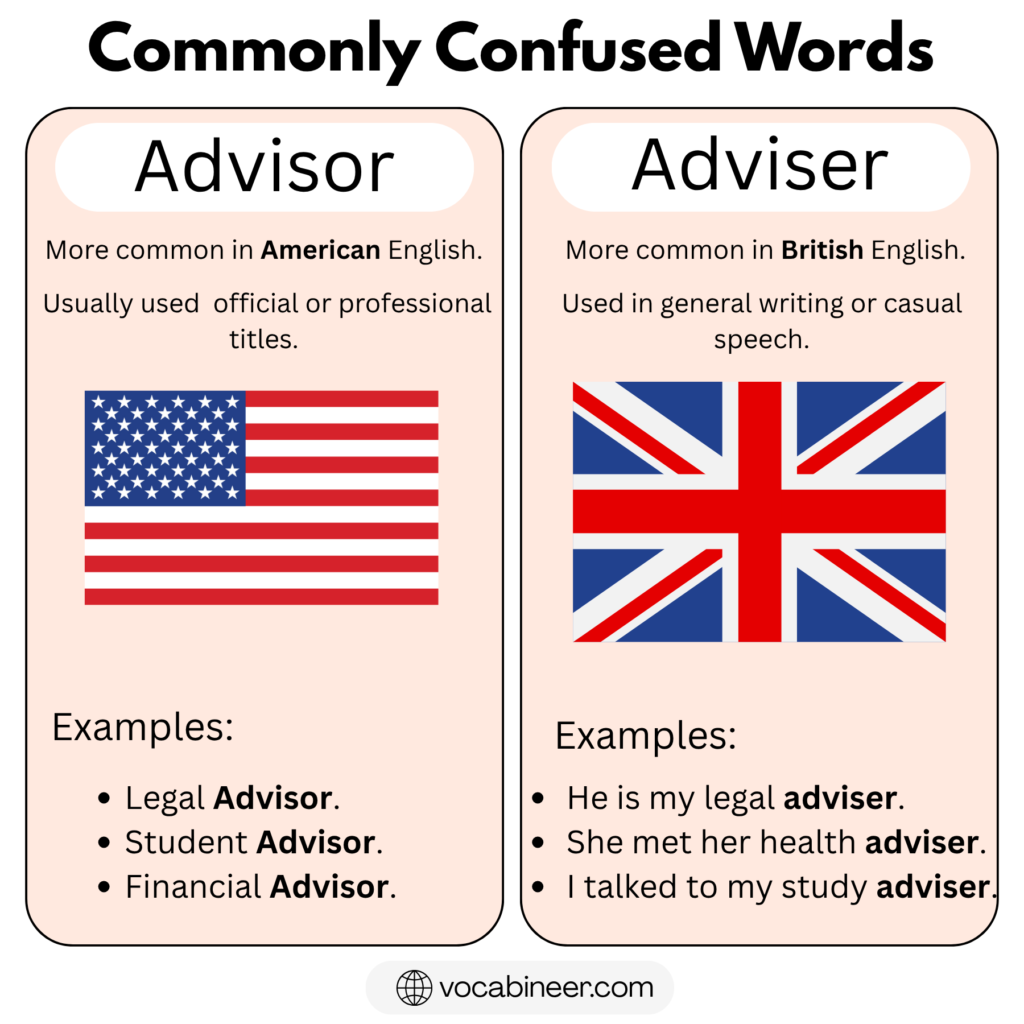
Advisor vs Adviser: Key Difference Explained
Although Advisor and Adviser share the same meaning, their difference lies mainly in spelling preference and regional usage. The term Adviser follows the traditional English spelling pattern using “-er.” In contrast, Advisor developed as a variant spelling and became widely accepted, especially in American English.
Usage patterns clarify the distinction further. In British English, Adviser is generally preferred in formal writing. However, American English commonly uses Advisor, particularly in official titles such as financial advisor or senior advisor. In short, both words mean the same thing, yet regional preference determines the spelling choice.
Advisor vs Adviser: Difference in One Look
| Feature | Advisor | Adviser |
|---|---|---|
| Meaning | Person who gives advice | Person who gives advice |
| Part of Speech | Noun | Noun |
| Spelling Style | Modern / American preference | Traditional / British preference |
| Used In | Official titles (US) | Formal writing (UK) |
| Pronunciation | Same | Same |
| Interchangeable? | Yes (in meaning) | Yes (in meaning) |
This comparison shows that the difference is stylistic rather than semantic. Both words refer to someone who gives advice.
Advisor vs Adviser: Side by Side Sentence Contrast
Since both spellings carry the same meaning, the difference becomes noticeable only in spelling style. Therefore, comparing similar sentences helps you see how usage varies by region.
- She spoke to her academic advisor.
- She spoke to her academic adviser.
- The company hired a financial advisor.
- The company hired a financial adviser.
- The president appointed a senior advisor.
- The prime minister appointed a special adviser.
- He works as an investment advisor.
- He works as an investment adviser.
In each pair, the meaning stays the same. Only the spelling changes based on regional or stylistic preference.
Advisor vs Adviser: Sentence Structure Comparison
Because both words function as nouns, their sentence structure remains identical.
Common patterns:
- Academic advisor/adviser
- Financial advisor/adviser
- Legal advisor/adviser
- Senior advisor/adviser
- Policy advisor/adviser
In addition, both words appear after articles and adjectives in the same grammatical position. Therefore, the structure does not change. The only difference is the spelling choice.
When to Use Advisor and When to Use Adviser
Choosing between Advisor and Adviser depends mainly on regional preference and style guidelines. If you are writing in American English, Advisor is more commonly used, especially in official job titles and government positions. Therefore, many U.S. institutions prefer this spelling.
However, if you are writing in British English or following traditional spelling rules, Adviser is generally preferred. In addition, many academic institutions outside the United States use Adviser in formal documents. Thus, the correct choice often depends on audience and location rather than meaning.
Context Based Usage Guide
If the context is American English or an official U.S. title, choose Advisor. For example:
- She met her academic advisor.
- The company hired a financial advisor.
- He serves as a senior advisor.
- The president appointed a policy advisor.
- The firm selected a legal advisor.
On the other hand, if the context follows British English conventions, choose Adviser. For instance:
- She contacted her course adviser.
- The minister appointed a special adviser.
- He works as a financial adviser.
- The university assigned a faculty adviser.
- The committee relied on an external adviser.
Therefore, always consider your audience and regional spelling standards before making a choice.
Grammar Difference Between Advisor and Adviser
Although Advisor and Adviser look different, their grammatical function is identical. Both words are nouns, and both refer to a person who gives advice. Therefore, the difference is not grammatical but stylistic. The choice depends on regional preference rather than sentence structure.
| Grammar Feature | Advisor | Adviser |
|---|---|---|
| Part of Speech | Noun | Noun |
| Meaning | Person who gives advice | Person who gives advice |
| Sentence Role | Subject or object noun | Subject or object noun |
| Plural Form | Advisors | Advisers |
| Used With Articles | An advisor | An adviser |
| Used With Adjectives | Financial advisor | Financial adviser |
| Regional Preference | More common in American English | More common in British English |
| Interchangeable in Meaning? | Yes | Yes |
This table shows that both words function exactly the same in grammar. The only difference lies in spelling preference.
Pronunciation Difference Between Advisor and Adviser
Advisor and Adviser are pronounced the same in standard English. Therefore, pronunciation does not help distinguish them in speech. Both follow the same stress pattern and sound identical in everyday conversation.
As a result, the difference appears only in writing. Writers must rely on regional spelling preference rather than sound when choosing between the two forms.
Common Mistakes With Advisor and Adviser
Advisor vs Adviser mistakes usually happen because writers think one spelling is incorrect. However, both forms are correct. The real issue is inconsistency within the same document or ignoring regional style.
- Incorrect: She met her academic advisor, and later spoke to another adviser in the same report.
Correct: Use one spelling consistently throughout the document. - Incorrect: Adviser is wrong in American English.
Correct: Adviser is correct, but Advisor is more common in American English. - Incorrect: Advisor is wrong in British English.
Correct: Advisor is accepted, but Adviser is traditionally preferred in British English. - Incorrect: He works as a financial advicer.
Correct: He works as a financial advisor/adviser. - Incorrect: The role changed from advisor to advisar.
Correct: The correct spellings are advisor or adviser only.
Therefore, the main rule is consistency. Choose one spelling based on your regional style and use it throughout the text.
FAQs about Advisor vs Adviser
Both spellings are correct. They have the same meaning and refer to a person who gives advice.
Advisor is more commonly used in American English, especially in official job titles and government roles.
Adviser is traditionally preferred in British English and formal writing styles.
No, they do not. The difference is only in spelling, not meaning.
No. Choose one spelling based on your audience or style guide and use it consistently throughout your writing.
Final Summary
Advisor and Adviser share the same meaning and grammatical function. Both refer to a person who gives advice. The difference lies only in spelling preference. Advisor is more common in American English, while Adviser is traditionally preferred in British English. Therefore, select one spelling based on your audience and remain consistent throughout your writing.
Read More
- Confusing Words in English
- American vs British Words
- Than vs Then in English
- Loose vs Lose in English
