Distributive pronouns are pronouns that refer to members of a group one by one, not as a whole group. They are used when we talk about people or things separately.
This guide explains distributive pronouns in a simple way. You will learn the common distributive pronouns, see clear examples, understand how to use them in sentences, and learn the difference between distributive pronouns and distributive adjectives.
In This Page
What Are Distributive Pronouns?
A distributive pronoun refers to persons or things individually. It does not point to a group as one unit. Instead, it shows that we are thinking about each member separately.
The most common distributive pronouns in English are:
- each
- either
- neither
These pronouns are usually used with singular verbs because they refer to one person or thing at a time.
For example:
- Each was given a certificate.
- Either is a good choice.
- Neither was correct.
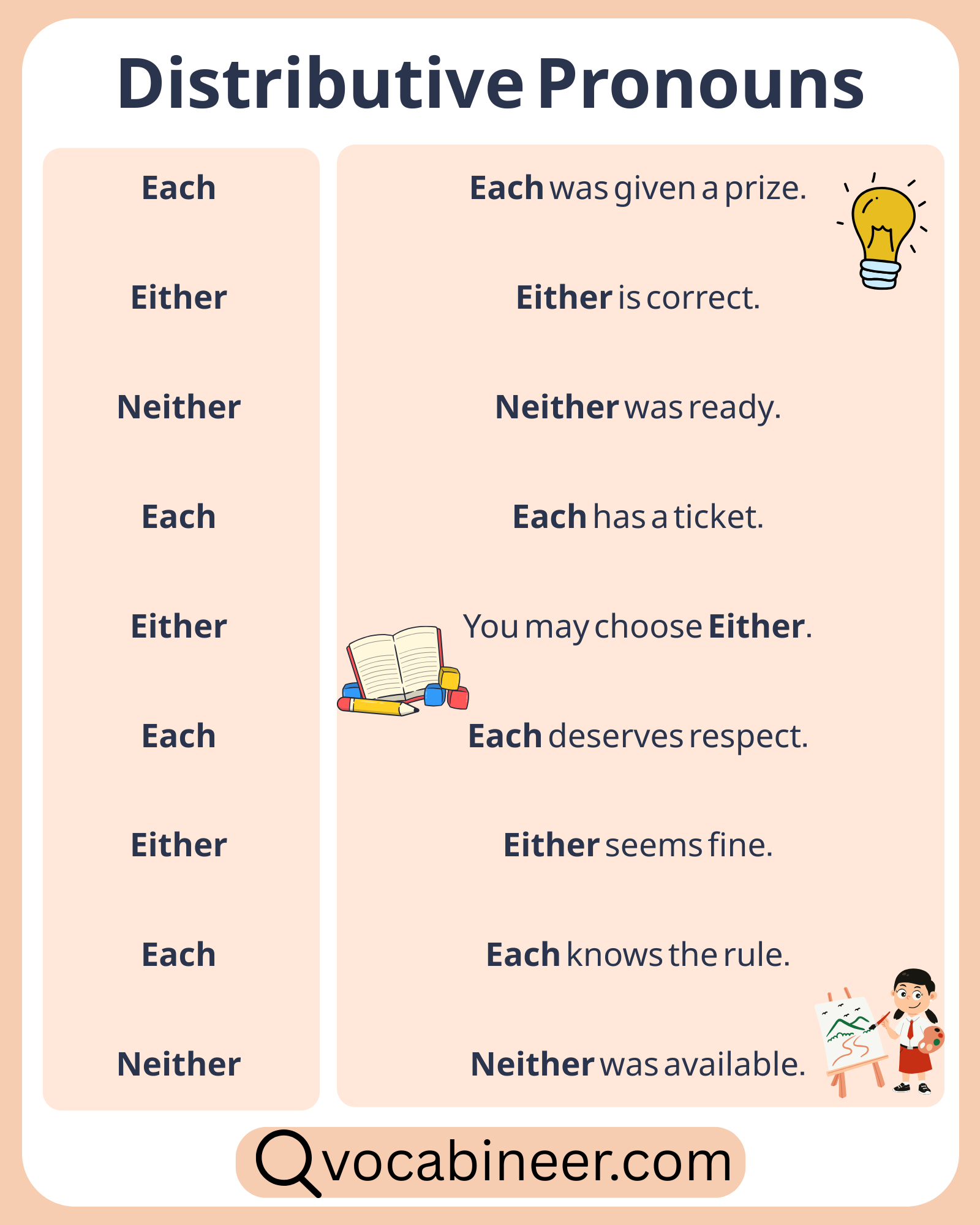
Common Distributive Pronouns in English
Here are the main distributive pronouns and their meanings.
Each
Each refers to every person or thing in a group separately.
Examples:
- Each received a gift.
- The students were ready, and each had a notebook.
- The two answers were simple, but each was different.
Either
Either refers to one of two people or things.
Examples:
- You can take either book. Either is useful.
- There are two roads to the village, and either is safe.
- I like both dresses. Either will look nice.
Neither
Neither means not one and not the other of two people or things.
Examples:
- Neither of the answers was right. In fact, neither made sense.
- There were two keys on the table, but neither opened the door.
- Both players tried hard, but neither won the match.
Distributive Pronouns with Examples
This section will help you understand distributive pronouns more clearly through simple sentences.
- Each of the boys was wearing a cap. Later, each went home happily.
- I offered two pens, and she said either would be fine.
- There were two movies to watch, but neither interested me.
- The teacher gave prizes, and each thanked her politely.
- Two cakes were on the table, and either looked delicious.
- Two plans were suggested, but neither solved the problem.
- The shoes were expensive, but each was well made.
- I checked both boxes, but neither had my book.
- There were two buses available, and either could take us there.
How to Use Distributive Pronouns in Sentences
Distributive pronouns are easy to use when you remember a few simple rules.
1. They refer to people or things one at a time
Distributive pronouns focus on individuals, not the whole group.
Examples:
- Each was invited personally.
- Either can answer the question.
- Neither was ready.
2. They usually take singular verbs
Because distributive pronouns talk about one member at a time, they are normally followed by singular verbs.
Examples:
- Each is important.
- Either seems fine.
- Neither was available.
3. Either and neither are commonly used for two choices
We usually use either and neither when talking about two people or things.
Examples:
- There are two doors, and either leads outside.
- There were two suggestions, but neither was practical.
4. Each can be used for two or more than two
Each can refer to two people or things, but it is also commonly used for larger groups.
Examples:
- The two girls wore blue dresses, and each looked happy.
- The five players entered the room, and each carried a bag.
Distributive Pronouns vs Distributive Adjectives
This is one of the most important parts of the topic.
Words like each, either, and neither can work as pronouns or as adjectives, depending on how they are used.
| Type | Function | Example |
|---|---|---|
| Distributive pronoun | stands alone and replaces a noun | Each was ready. |
| Distributive adjective | comes before a noun and describes it | Each student was ready. |
Here are more examples:
Each
- Pronoun: Each was given a book.
- Adjective: Each student was given a book.
Either
- Pronoun: There are two bags, and either will work.
- Adjective: You may take either bag.
Neither
- Pronoun: The two answers were wrong, and neither was accepted.
- Adjective: Neither answer was accepted.
A simple way to remember this is:
- if the word stands alone, it is a pronoun
- if the word comes before a noun, it is an adjective
FAQs
Distributive pronouns are pronouns that refer to members of a group separately, not together. Common examples are each, either, and neither.
The most common examples are each, either, and neither.
Distributive pronouns usually take singular verbs because they refer to one person or thing at a time.
A distributive pronoun stands alone and replaces a noun, while a distributive adjective comes before a noun and describes it.
Yes, both either and neither can be used as distributive pronouns when they stand alone in a sentence.
Summary
Distributive pronouns refer to people or things one by one. The main distributive pronouns in English are each, either, and neither. These pronouns usually take singular verbs and are used when we want to talk about individuals separately.
In this article, you learned the meaning of distributive pronouns, saw common examples, understood how to use them in sentences, and learned the difference between distributive pronouns and distributive adjectives. This makes the topic easier to understand and use correctly in English.
Read More
- List of Pronouns in English
- Gender Pronouns in English
- Pronouns Chart Table in English
- First Person Pronouns in English