

Demonstrative pronouns are pronouns that point to specific people, things, or ideas in English. They help learners show exactly what they mean in speaking and writing.
This article explains demonstrative pronouns in English with clear sections, simple examples, and easy sentences. It helps learners understand usage better and use these pronouns more naturally every day.
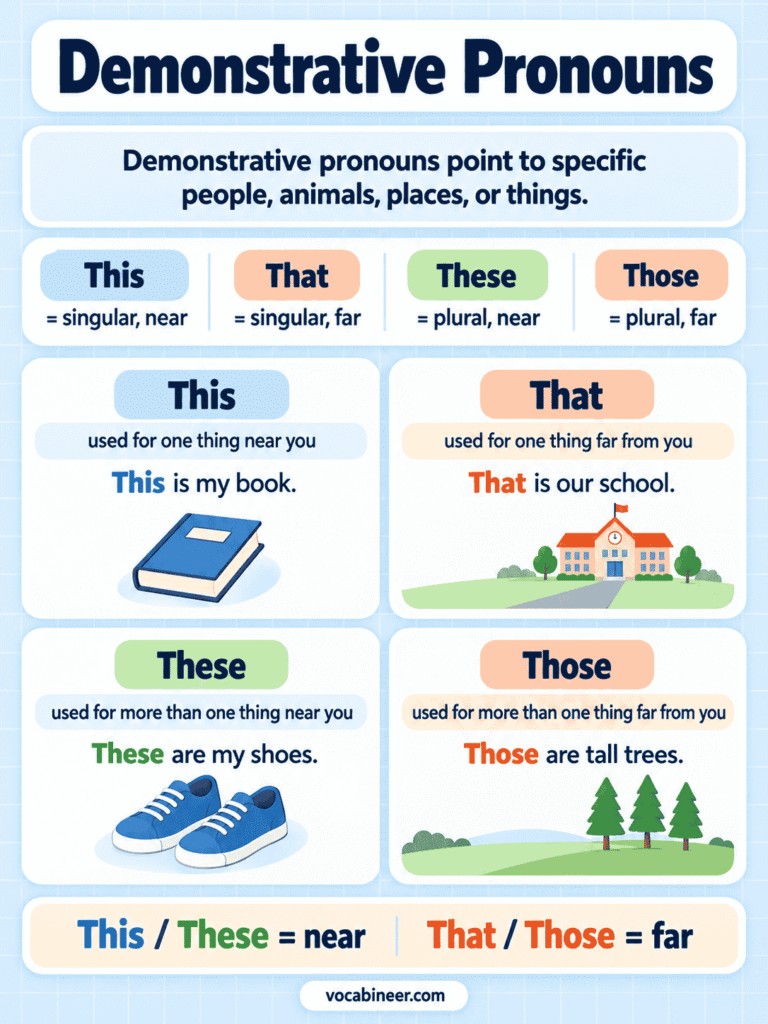
Demonstrative pronouns are words used to point to specific people, things, ideas, or situations without naming them directly. The four main demonstrative pronouns in English are this, that, these, and those.
Learning demonstrative pronouns helps students choose the correct form for singular and plural reference, understand near and far meaning, and distinguish pronouns from demonstrative determiners. These words also help speakers refer naturally to ideas, events, and situations in everyday communication.
In This Page
What Are Demonstrative Pronouns?
A demonstrative pronoun points to a specific person, thing, idea, or situation and stands alone without a noun after it.
Examples:
- This is mine.
- That looks expensive.
- These are fresh.
- Those belong to us.
The key idea is:
A demonstrative pronoun points to something specific without naming it directly.
Demonstrative Pronouns List
The four main demonstrative pronouns are:
- this
- that
- these
- those
Their use depends mainly on:
- number
- distance
- context
Demonstrative Pronouns Chart
| Pronoun | Number | Usual Reference | Example |
|---|---|---|---|
| this | singular | near | This is my bag. |
| that | singular | farther away | That is your car. |
| these | plural | near | These are mine. |
| those | plural | farther away | Those are yours. |
This chart shows the complete basic system.
How We Use This
Use this for one person, thing, idea, or situation that feels close or immediate.
Examples:
- This is my phone.
- This tastes good.
- This is what I mean.
- This is important.
The closeness can be physical or contextual.
How We Use That
Use that for one person, thing, idea, or situation that feels farther away or less immediate.
Examples:
- That is your bag over there.
- That looks expensive.
- That was a good idea.
- That surprised me.
The distance can be physical, conversational, or emotional.
How We Use These
Use these for more than one person or thing that is close.
Examples:
- These are my shoes.
- These look fresh.
- These belong to me.
- These are the ones I want.
The plural relationship is:
this → these
How We Use Those
Use those for more than one person or thing that is farther away.
Examples:
- Those are my books.
- Those look expensive.
- Those belong to Sara.
- Those are the chairs we ordered.
The plural relationship is:
that → those
Singular vs Plural Demonstrative Pronouns
Demonstrative pronouns change according to number.
| Singular | Plural |
|---|---|
| this | these |
| that | those |
Compare:
- This is my book.
- These are my books.
- That is your chair.
- Those are your chairs.
The pronoun and verb should agree in number.
This vs That
Both this and that are singular, but they differ mainly in closeness or perspective.
| This | That |
|---|---|
| singular | singular |
| usually near or immediate | usually farther away |
| This is my pen. | That is your pen. |
Compare:
- This is what we need to discuss now.
- That was a difficult situation last year.
The first feels more immediate, while the second feels more distant in context.
These vs Those
Both these and those are plural.
| These | Those |
|---|---|
| plural | plural |
| usually near | usually farther away |
| These are mine. | Those are yours. |
This is the plural version of this vs that.
Near and Far Reference
A simple rule is:
- this → one thing near
- these → several things near
- that → one thing farther away
- those → several things farther away
Examples:
- This is my cup.
- These are my cups.
- That is your bag.
- Those are your bags.
This is the easiest starting point for understanding demonstrative pronouns.
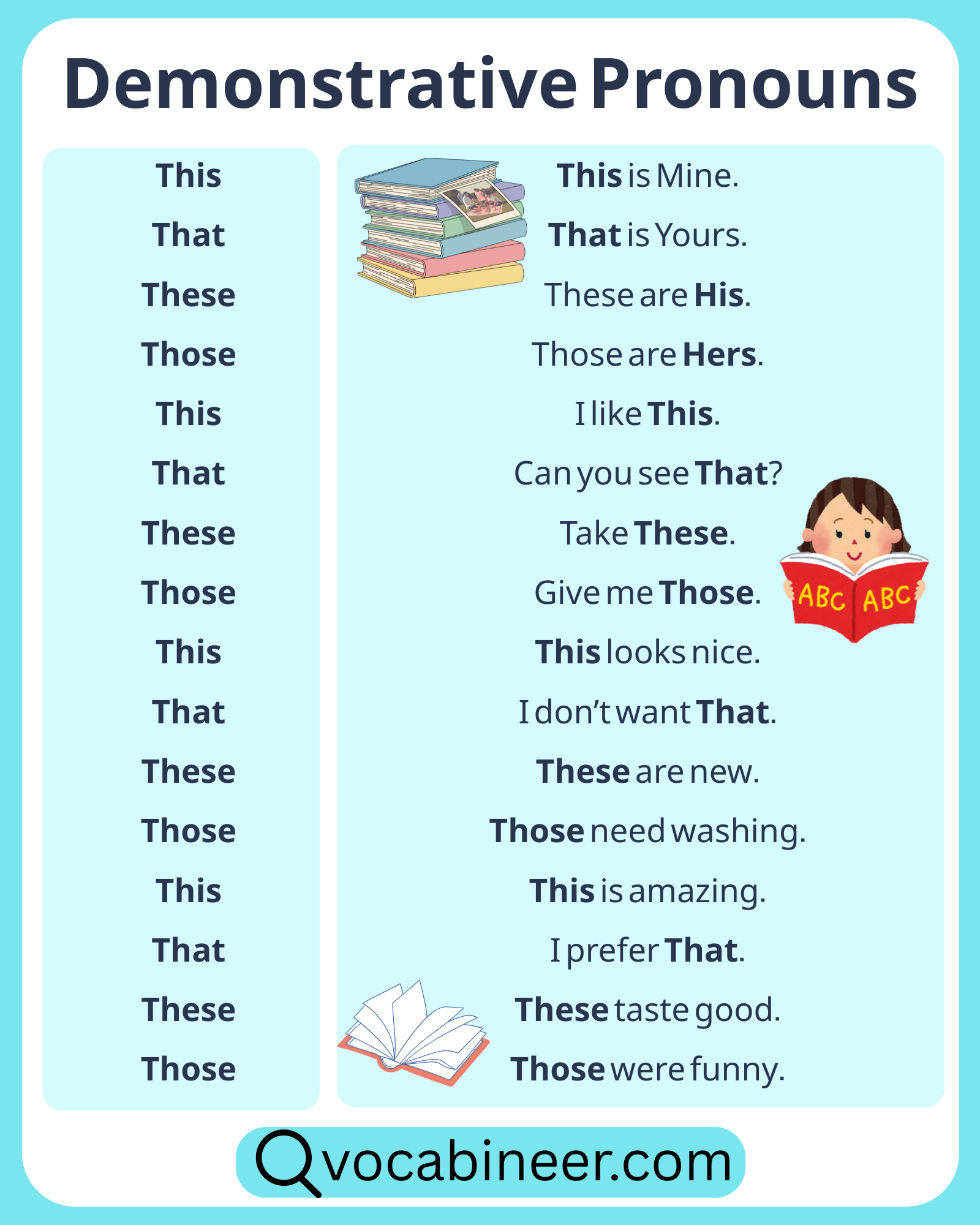
Demonstrative Pronouns for Ideas and Situations
Demonstrative pronouns can refer to ideas, statements, events, and situations as well as physical objects.
Examples:
- We should leave early. That is a good idea.
- He forgot the keys. This caused a delay.
- They changed the plan. Are you happy with that?
- This is what I wanted to explain.
This use is very common in conversation and writing.
That for Previous Statements
That often refers back to something already said.
Example:
“I passed the exam.”
“That’s great.”
Another example:
“Let’s meet tomorrow.”
“That sounds good.”
Here, that refers to the previous statement or idea.
This for Immediate Information
This often introduces or highlights something being discussed now.
Examples:
- Listen to this.
- This is important.
- This is the problem.
- This is what we need to fix.
The word this creates a sense of immediacy.
Demonstrative Pronouns for People
This and that can identify people.
Examples:
- This is my sister.
- That is your teacher over there.
- Who is that?
- This is my friend Sara.
These forms are common in introductions and identification.
This in Introductions
Use this when introducing someone.
Examples:
- This is my brother Ali.
- This is our new teacher.
- This is my friend Sara.
This pattern is natural and common in everyday English.
This and That on the Phone
English commonly uses this and that in telephone conversations.
Examples:
- Hello, this is David.
- Hi, this is Sara speaking.
- Is that Ahmed?
- Is that Maria speaking?
The usual pattern is:
this = the speaker
that = the other person
Demonstrative Pronouns vs Demonstrative Determiners
The same four words can function as pronouns or determiners.
| Demonstrative Pronoun | Demonstrative Determiner |
|---|---|
| This is mine. | This book is mine. |
| That looks good. | That car looks good. |
| These are fresh. | These apples are fresh. |
| Those are expensive. | Those shoes are expensive. |
The key rule is:
A demonstrative pronoun stands alone. A demonstrative determiner comes before a noun.
Demonstrative Pronouns vs Demonstrative Adjectives
Some traditional grammar books use the term demonstrative adjective for forms such as:
- this book
- that car
- these shoes
- those houses
Modern grammar often calls these demonstrative determiners.
So:
- This is mine. → demonstrative pronoun
- This book is mine. → demonstrative determiner
The function depends on whether a noun follows.
Verb Agreement with Demonstrative Pronouns
Singular demonstrative pronouns take singular verbs.
Examples:
- This is mine.
- That looks good.
Plural demonstrative pronouns take plural verbs.
Examples:
- These are mine.
- Those look good.
Incorrect:
- These is mine.
- Those is expensive.
Correct:
- These are mine.
- Those are expensive.
This, These, That, and Those with Number
The number pattern is fixed.
Correct:
- this → singular
- that → singular
- these → plural
- those → plural
Examples:
- This is a chair.
- These are chairs.
- That is a house.
- Those are houses.
This is one of the most important rules for beginners.
Contextual and Emotional Distance
Demonstrative pronouns can express more than physical distance.
This/these may suggest:
- closeness
- immediacy
- involvement
That/those may suggest:
- distance
- separation
- something less immediate
Examples:
- I really like these.
- I don’t want to discuss that again.
This meaning depends on context rather than physical location alone.
That and Those as Substitutes
In more formal English, that and those can replace repeated nouns.
Examples:
- The climate here is warmer than that of the north.
- The results this year are better than those from last year.
- The methods used today differ from those used in the past.
This avoids unnecessary repetition.
Demonstrative Pronouns in Sentences
These examples show the main uses:
- This is mine.
- That is yours.
- These are fresh.
- Those are expensive.
- This is my friend Sara.
- Is that your brother?
- That was a good idea.
- I don’t like those.
- These belong to us.
- Hello, this is David.
- He forgot the tickets. That caused a problem.
- This is exactly what I wanted.
- The results here differ from those reported earlier.
- That sounds interesting.
- These are the books I ordered.
Common Mistakes with Demonstrative Pronouns
Using This with a Plural Reference
Incorrect: This are my books.
Correct: These are my books.
Using These with a Singular Reference
Incorrect: These is my bag.
Correct: This is my bag.
Confusing That and Those
That = singular
Those = plural
Using the Wrong Verb Agreement
Incorrect: Those is expensive.
Correct: Those are expensive.
Calling Every Demonstrative a Pronoun
In this book, this is a determiner, not a pronoun.
Thinking Demonstratives Refer Only to Objects
They can also refer to ideas, statements, events, people, and situations.
Treating Near and Far as Physical Distance Only
Distance can also be contextual or emotional.
Demonstrative Pronouns for Kids
A simple explanation is:
Demonstrative pronouns are words we use to point to specific people or things without naming them.
Examples:
- This is my pencil.
- That is your bag.
- These are my shoes.
- Those are your books.
An easy rule is:
- this → one near
- these → more than one near
- that → one farther away
- those → more than one farther away
Young learners should master this four-word pattern before moving to wider uses with ideas and situations.
FAQs
Demonstrative pronouns are pronouns that point to specific people, things, or ideas and replace nouns in a sentence.
The four demonstrative pronouns in English are this, that, these, and those.
This is singular and refers to something near. These is plural and refers to more than one thing near.
That is singular and refers to something farther away. Those is plural and refers to more than one thing farther away.
Demonstrative pronouns are important because they help learners point to specific things clearly and avoid repeating the same nouns too often.
Summary
Demonstrative pronouns point to specific people, things, or ideas in English. The four main forms are this, that, these, and those. This article explained demonstrative pronouns with simple examples and easy sentences. With regular practice, learners can use them more clearly and more confidently in daily English.
Read More
- List of Nouns in English
- Possessive Nouns in English
- Proper Nouns for People in English
- Singular Collective Nouns in English