

Possessive nouns show ownership, belonging, or a close relationship between one noun and another in English. Words like boy’s, girls’, and children’s are common examples because they clearly show that something belongs to someone, some people, or another noun.
These nouns are useful in everyday English because they help learners show possession clearly in speaking and writing. In this article, you will learn 100 possessive nouns with examples, grouped sections, and simple sentences that make learning easier and more practical.
In This Page
What Are Possessive Nouns?
Possessive nouns are nouns that show ownership, belonging, or connection, so they help learners describe whose thing, place, or idea something is.
For example, the boy’s bag shows that the bag belongs to the boy, while the teacher’s book shows that the book belongs to the teacher. Therefore, possessive nouns are very useful in daily conversation, schoolwork, and writing.
We usually form possessive nouns by adding an apostrophe and sometimes s to a noun. However, the form changes slightly with singular, plural, and irregular plural nouns.
- boy’s
- girl’s
- teacher’s
- girls’
- boys’
- children’s
List of Possessive Nouns in English
Here is a useful list of 100 possessive nouns in English, including singular possessive nouns, plural possessive nouns, and irregular possessive nouns.
- Boy’s
- Girl’s
- Man’s
- Woman’s
- Child’s
- Teacher’s
- Doctor’s
- Student’s
- Friend’s
- Brother’s
- Sister’s
- Mother’s
- Father’s
- Uncle’s
- Aunt’s
- Cousin’s
- Baby’s
- Dog’s
- Cat’s
- Bird’s
- Lion’s
- Horse’s
- Rabbit’s
- Farmer’s
- Driver’s
- Worker’s
- Manager’s
- Chef’s
- Artist’s
- Singer’s
- Writer’s
- Player’s
- Coach’s
- Principal’s
- Librarian’s
- Customer’s
- Passenger’s
- Visitor’s
- Guest’s
- Neighbor’s
- Boys’
- Girls’
- Students’
- Teachers’
- Players’
- Workers’
- Drivers’
- Doctors’
- Nurses’
- Friends’
- Parents’
- Brothers’
- Sisters’
- Cousins’
- Guests’
- Neighbors’
- Customers’
- Passengers’
- Visitors’
- Artists’
- Singers’
- Writers’
- Managers’
- Farmers’
- Librarians’
- Coaches’
- Chefs’
- Players’
- Boys’ School
- Girls’ Team
- Children’s
- Men’s
- Women’s
- People’s
- Mice’s
- Geese’s
- Feet’s
- Teeth’s
- Oxen’s
- Police Officers’
- Firefighters’
- Employees’
- Bosses’
- Teammates’
- Classmates’
- Residents’
- Citizens’
- Shopkeepers’
- Vendors’
- Travelers’
- Hosts’
- Members’
- Leaders’
- Officers’
- Captains’
- Soldiers’
- Actors’
- Actresses’
- Musicians’
- Performers’
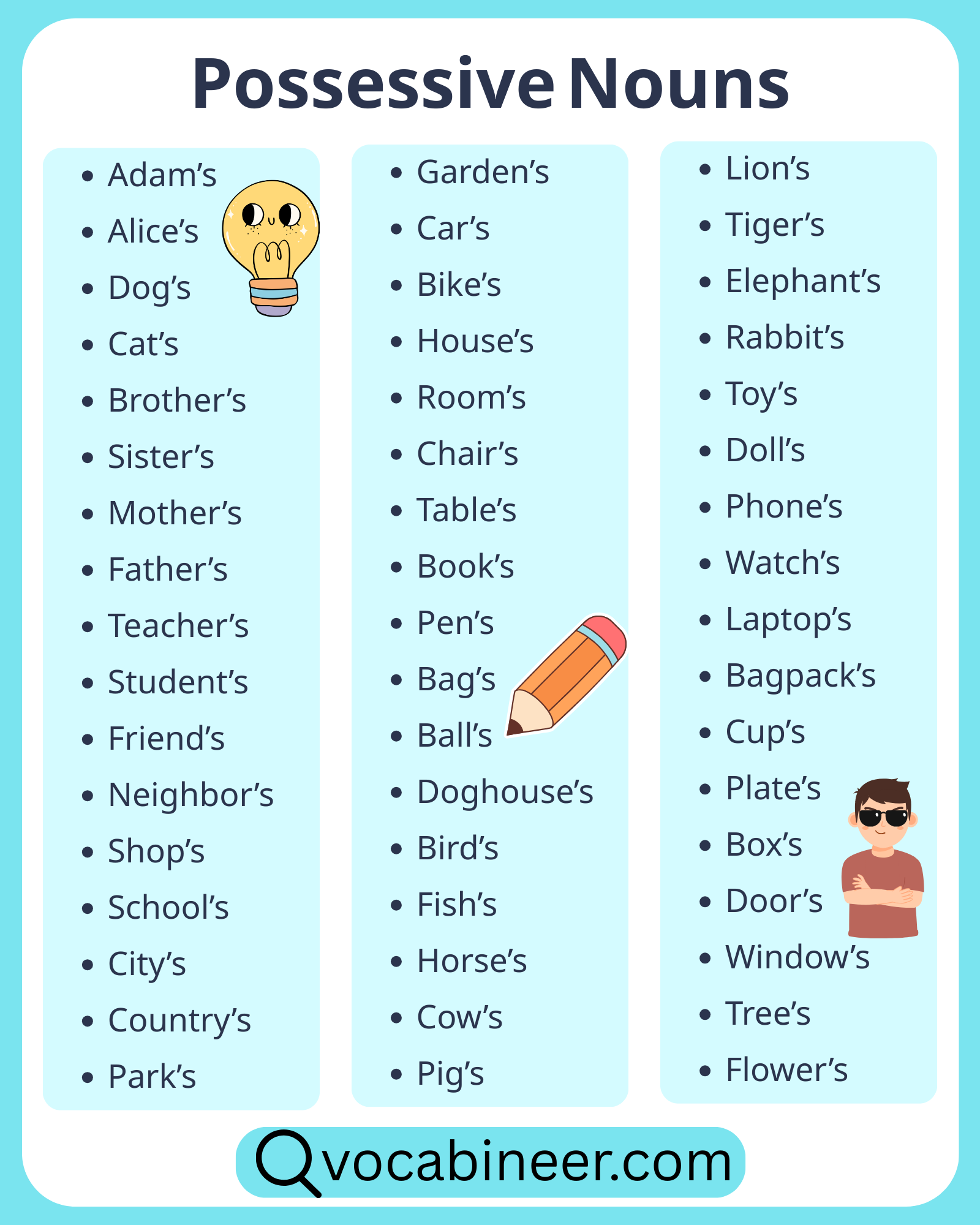
Singular Possessive Nouns Examples
Singular possessive nouns show that one person, animal, or thing owns or is connected to something else in a sentence.
Boy’s
The boy’s bag is on the chair.
Girl’s
The girl’s bicycle is new.
Teacher’s
The teacher’s book is on the desk.
Doctor’s
The doctor’s office is on the second floor.
Student’s
The student’s notebook is full of answers.
Friend’s
My friend’s phone is ringing.
Mother’s
My mother’s dress is blue.
Father’s
My father’s car is parked outside.
Dog’s
The dog’s bowl is empty.
Lion’s
The lion’s mane looked beautiful.
Plural Possessive Nouns Examples
Plural possessive nouns show that more than one person or thing owns or shares something together in a sentence.
Boys’
The boys’ classroom is on the left.
Girls’
The girls’ uniforms are neat.
Students’
The students’ projects were displayed on the wall.
Teachers’
The teachers’ room is near the library.
Players’
The players’ bags are in the locker room.
Workers’
The workers’ tools were kept in a box.
Drivers’
The drivers’ break room is downstairs.
Friends’
My friends’ house is near the market.
Parents’
The parents’ meeting starts at ten o’clock.
Guests’
The guests’ luggage was placed in the hall.
Irregular Possessive Nouns Examples
Irregular possessive nouns come from irregular plural nouns, so they usually take apostrophe plus s instead of only an apostrophe.
Children’s
The children’s toys were on the floor.
Men’s
The men’s jackets were hanging by the door.
Women’s
The women’s team won the match.
People’s
People’s opinions can differ a lot.
Mice’s
The mice’s food was kept in a small box.
Geese’s
The geese’s feathers were white.
Feet’s
The statue showed the feet’s shape clearly.
Teeth’s
The dentist explained the teeth’s condition.
Oxen’s
The oxen’s cart stood near the field.
Children’s books
The children’s books were placed on the shelf.
Possessive Nouns in Sentences
These examples show how possessive nouns work in simple, natural sentences and help learners understand ownership more clearly in English.
- The boy’s shoes are under the bed.
- The girl’s pencil is on the table.
- My teacher’s bag is black.
- The dog’s tail is wagging.
- The doctor’s clinic is near the hospital.
- The boys’ football is in the yard.
- The girls’ books are on the desk.
- The students’ classroom is upstairs.
- The parents’ meeting is tomorrow morning.
- The players’ coach is very strict.
- The children’s clothes were drying outside.
- The women’s team played well today.
- The men’s room is on the right side.
- My friend’s brother is a pilot.
- The visitors’ bus arrived early.
FAQs
Possessive nouns are nouns that show ownership, belonging, or connection, and they help us say clearly who something belongs to.
Some common examples are boy’s, girl’s, teacher’s, students’, children’s, and women’s, because they all show possession clearly.
We usually form a singular possessive noun by adding apostrophe and s to a singular noun, like boy’s or teacher’s.
We usually form a plural possessive noun by adding only an apostrophe after a regular plural noun ending in s.
Possessive nouns are important because they help learners show ownership clearly in speaking, writing, reading, and everyday sentence building.
Summary
Possessive nouns show ownership, belonging, or connection in English. They help learners describe whose object, place, idea, or relationship something is. In this article, you learned 100 possessive nouns, grouped sections, and sentence use.
Read More
- List of Nouns in English
- List of People Nouns in English
- Common Place Nouns in English
- List of 100 Nature Nouns in English