Masculine and feminine gender words are an important part of English vocabulary. They help show whether a noun refers to a male or a female person or animal. Some of these pairs are very common in everyday English, such as Father–Mother, Brother–Sister, and King–Queen. Learning these words can improve vocabulary and make it easier to understand many traditional noun pairs in English.
In this easy-to-follow guide, you will find 100 examples of masculine and feminine gender in English arranged in clear categories. The article includes commonly used word pairs, family relations, royal titles, professions, animals, and birds, along with simple sentence examples. Whether you are a student, teacher, writer, or English learner, this article will help you understand and identify masculine and feminine gender words in a simple and useful way.
In This Page
What Are Masculine and Feminine Gender Nouns?
Masculine and feminine gender nouns are words that show male and female forms.
For example:
- Father is masculine, and Mother is feminine
- King is masculine, and Queen is feminine
- Actor is masculine, and Actress is feminine
- Lion is masculine, and Lioness is feminine
In modern English, many job titles are now often used in a gender-neutral way. Still, traditional masculine and feminine pairs are useful for learning vocabulary and understanding older or formal usage.
List of 100 Masculine and Feminine Words in English
Below is a complete list of 100 examples, shown as 50 masculine–feminine pairs.
- Father — Mother
- Son — Daughter
- Brother — Sister
- Uncle — Aunt
- Husband — Wife
- Nephew — Niece
- Grandfather — Grandmother
- Grandson — Granddaughter
- Boy — Girl
- Man — Woman
- King — Queen
- Prince — Princess
- Emperor — Empress
- Duke — Duchess
- Bridegroom — Bride
- Widower — Widow
- Father-in-law — Mother-in-law
- Brother-in-law — Sister-in-law
- Stepson — Stepdaughter
- Stepfather — Stepmother
- Actor — Actress
- Host — Hostess
- Waiter — Waitress
- Steward — Stewardess
- Landlord — Landlady
- Hero — Heroine
- Policeman — Policewoman
- Salesman — Saleswoman
- Spokesman — Spokeswoman
- Businessman — Businesswoman
- Chairman — Chairwoman
- Postman — Postwoman
- Headmaster — Headmistress
- Schoolmaster — Schoolmistress
- Cameraman — Camerawoman
- Bull — Cow
- Cock — Hen
- Drake — Duck
- Gander — Goose
- Stallion — Mare
- Ram — Ewe
- Buck — Doe
- Boar — Sow
- Lion — Lioness
- Tiger — Tigress
- Peacock — Peahen
- Fox — Vixen
- Colt — Filly
- Billy Goat — Nanny Goat
- Stag — Hind
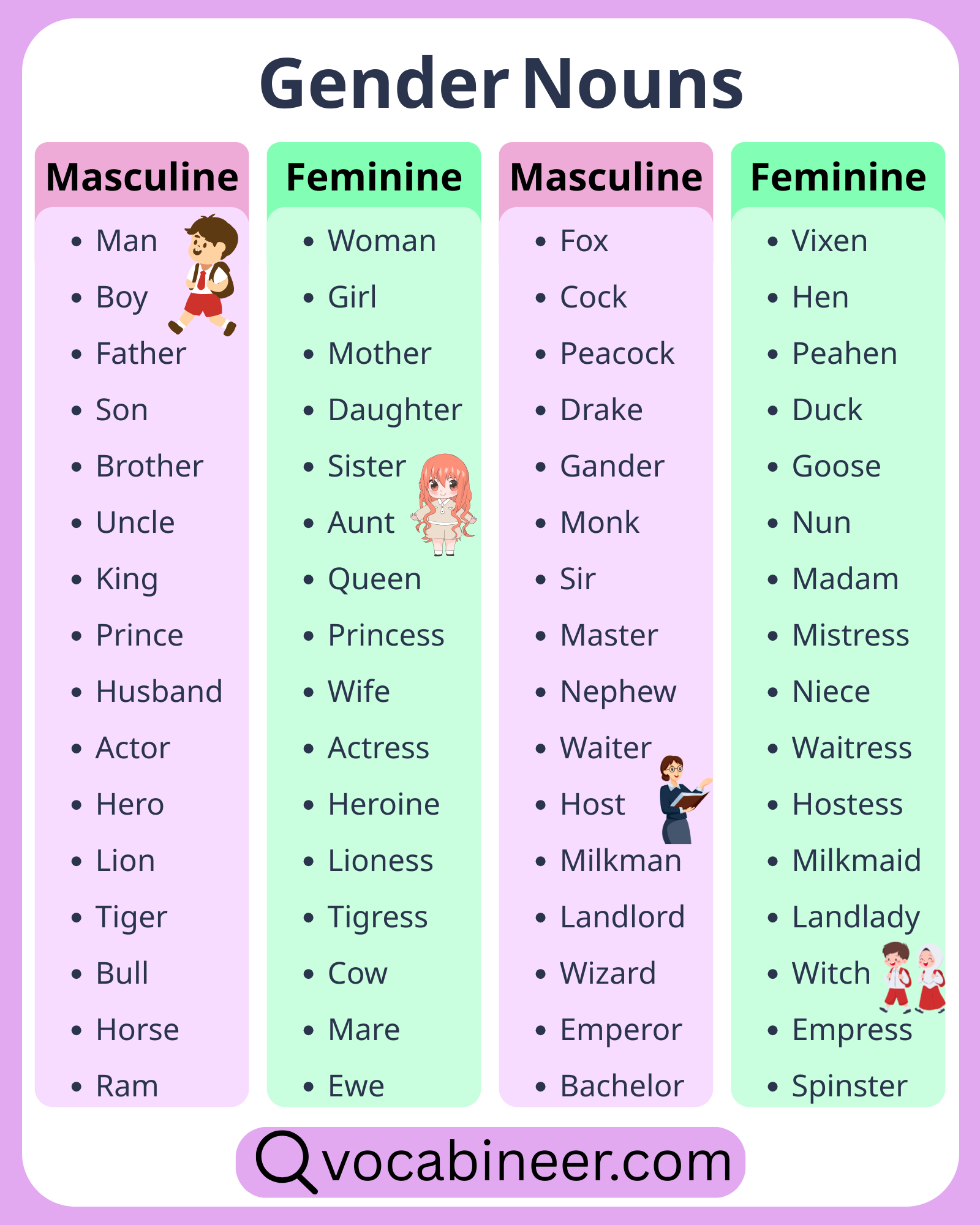
Commonly Used Masculine and Feminine Word Pairs
These are some of the most familiar masculine and feminine pairs in English.
- Father — Mother
- Son — Daughter
- Brother — Sister
- Uncle — Aunt
- Husband — Wife
- Boy — Girl
- Man — Woman
- King — Queen
- Prince — Princess
- Actor — Actress
- Waiter — Waitress
- Hero — Heroine
These pairs are often taught first because they are simple, common, and easy to remember.
Masculine and Feminine Words for Family Relations
These masculine and feminine words are used for family and relationship terms.
- Father — Mother
- Son — Daughter
- Brother — Sister
- Uncle — Aunt
- Husband — Wife
- Nephew — Niece
- Grandfather — Grandmother
- Grandson — Granddaughter
- Father-in-law — Mother-in-law
- Brother-in-law — Sister-in-law
- Stepfather — Stepmother
- Stepson — Stepdaughter
- Bridegroom — Bride
- Widower — Widow
These pairs are useful in daily conversations because they appear often in family vocabulary.
Masculine and Feminine Words for Royal Titles and Traditional Roles
These words are used for royal titles, noble roles, and traditional public titles.
- King — Queen
- Prince — Princess
- Emperor — Empress
- Duke — Duchess
- Chairman — Chairwoman
- Headmaster — Headmistress
- Schoolmaster — Schoolmistress
- Landlord — Landlady
- Host — Hostess
This section adds a more organized and meaningful grouping to the article.
Masculine and Feminine Words for Jobs and Professions
These masculine and feminine pairs are linked with work, public roles, and occupations.
- Actor — Actress
- Waiter — Waitress
- Steward — Stewardess
- Policeman — Policewoman
- Salesman — Saleswoman
- Spokesman — Spokeswoman
- Businessman — Businesswoman
- Postman — Postwoman
- Cameraman — Camerawoman
- Hero — Heroine
These examples are useful in vocabulary learning, even though modern English also often uses neutral job titles in many situations.
Masculine and Feminine Words for Animals and Birds
These masculine and feminine words are used for animals and birds.
- Bull — Cow
- Cock — Hen
- Drake — Duck
- Gander — Goose
- Stallion — Mare
- Ram — Ewe
- Buck — Doe
- Boar — Sow
- Lion — Lioness
- Tiger — Tigress
- Peacock — Peahen
- Fox — Vixen
- Colt — Filly
- Billy Goat — Nanny Goat
- Stag — Hind
These pairs are helpful because many animals have different male and female names.
Most Useful Masculine and Feminine Gender Pairs for Beginners
If you are learning this topic for the first time, these are some of the easiest and most useful pairs to remember:
- Father — Mother
- Brother — Sister
- King — Queen
- Prince — Princess
- Uncle — Aunt
- Husband — Wife
- Actor — Actress
- Lion — Lioness
- Bull — Cow
- Peacock — Peahen
This section makes the article more beginner-friendly and helps readers focus on the most practical examples first.
Examples of Masculine and Feminine Gender in Sentences
Here are some simple sentence examples that show how masculine and feminine gender words are used in real English.
- The King and Queen greeted the people.
- My Brother and Sister study in the same school.
- The Actor thanked the Actress after the show.
- Our Uncle and Aunt visited us on Sunday.
- The Lion and Lioness rested under the tree.
- The Policeman spoke to the Policewoman near the gate.
- A Peacock stood beside a Peahen in the garden.
- The Waiter and Waitress served the guests quickly.
- The Bull and Cow were in the field.
- The Bridegroom and Bride smiled for the photo.
- The Prince and Princess waved to the crowd.
- Her Grandfather and Grandmother live in the village.
FAQs
Masculine and feminine gender nouns are words that show male and female forms. For example, King is masculine and Queen is feminine.
Some common examples are Father — Mother, Brother — Sister, Actor — Actress, Lion — Lioness, and Uncle — Aunt.
Yes, many animals also have masculine and feminine forms. For example, Bull — Cow, Ram — Ewe, and Peacock — Peahen are common examples.
These words are important because they help show the difference between male and female nouns clearly. They also help learners understand traditional noun pairs in English vocabulary.
No, not all English nouns are masculine or feminine. Many nouns are general or gender-neutral. However, some words still have traditional masculine and feminine pairs.
Summary
This article covered 100 examples of masculine and feminine gender in English and included sections for family relations, titles and roles, and animals. It also showed how masculine and feminine gender words are used in simple sentences.
This kind of guide is useful for students, teachers, writers, and English learners because it makes masculine and feminine noun pairs easier to understand and remember. It also helps readers recognize common gender-based vocabulary in everyday English.
Read More
- List of Nouns in English
- Common Singular Nouns List
- Examples of Uncountable Nouns
- Examples of Concrete Nouns in English