Abstract nouns are an important part of English vocabulary. They name things we cannot usually see, touch, hear, smell, or taste in a physical way. Instead, they refer to feelings, qualities, ideas, experiences, and states. Words like Love, Honesty, Freedom, and Hope are abstract nouns because they name things we feel or think about rather than objects we can hold.
In this easy-to-follow guide, you will find 100 abstract nouns in English arranged in clear categories. The list includes abstract nouns for feelings and emotions, qualities and traits, ideas and concepts, and states and conditions. Whether you are a student, teacher, writer, or English learner, this article will help you understand and identify abstract nouns in a simple and useful way.
In This Page
What Are Abstract Nouns?
An abstract noun is a noun that names a feeling, quality, idea, state, or experience. It does not name a physical object.
For example:
- Love is an abstract noun because it names a feeling
- Honesty is an abstract noun because it names a quality
- Freedom is an abstract noun because it names an idea
- Childhood is an abstract noun because it names a period or state of life
Abstract nouns are common in everyday English because people often talk about emotions, behavior, thoughts, and personal experiences.
List of 100 Abstract Nouns in English
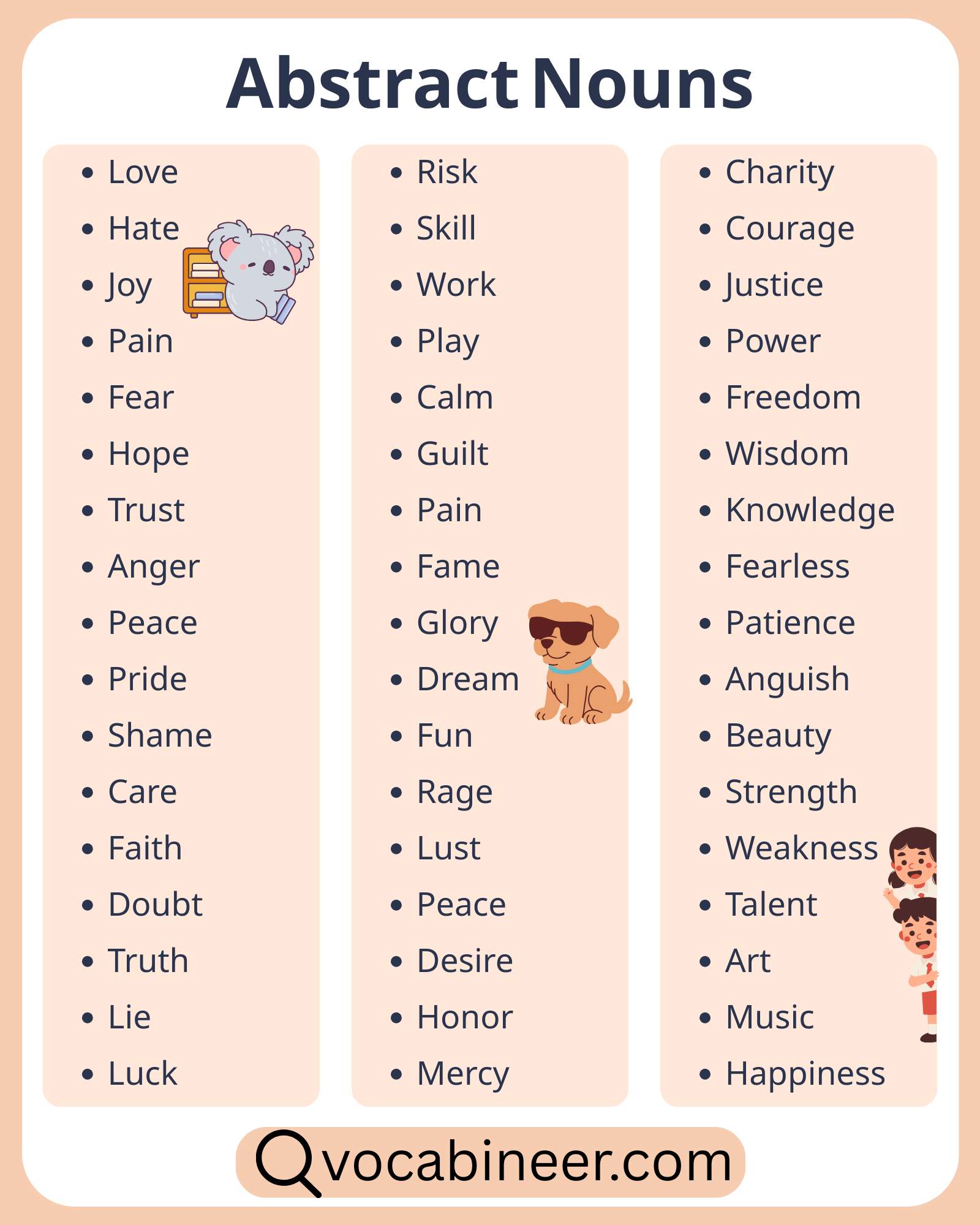
Below is a complete list of 100 abstract nouns in English in a simple and easy-to-scan format.
- Love
- Joy
- Happiness
- Sadness
- Anger
- Fear
- Hope
- Peace
- Excitement
- Pride
- Kindness
- Honesty
- Bravery
- Courage
- Patience
- Loyalty
- Wisdom
- Beauty
- Generosity
- Politeness
- Freedom
- Justice
- Truth
- Knowledge
- Education
- Friendship
- Success
- Failure
- Power
- Equality
- Childhood
- Youth
- Adulthood
- Poverty
- Wealth
- Health
- Illness
- Hunger
- Sleep
- Death
- Idea
- Thought
- Plan
- Dream
- Memory
- Opinion
- Belief
- Imagination
- Advice
- Information
- Trust
- Respect
- Faith
- Envy
- Jealousy
- Grief
- Pleasure
- Pain
- Comfort
- Disappointment
- Responsibility
- Leadership
- Creativity
- Curiosity
- Intelligence
- Confidence
- Weakness
- Strength
- Liberty
- Democracy
- Culture
- Religion
- Progress
- Change
- Development
- Safety
- Danger
- Silence
- Chaos
- Order
- Shame
- Guilt
- Mercy
- Motivation
- Ambition
- Calmness
- Loneliness
- Forgiveness
- Ability
- Awareness
- Care
- Compassion
- Desire
- Discipline
- Energy
- Experience
- Fame
- Humor
- Independence
- Maturity
- Sensitivity
- Sympathy
Abstract Nouns for Feelings and Emotions
These abstract nouns name emotions and inner feelings.
- Love — a strong feeling of care or affection
- Joy — a feeling of great happiness
- Happiness — the state of being happy
- Sadness — the feeling of being sad
- Anger — a strong feeling of being upset
- Fear — the feeling of being afraid
- Hope — a feeling of wanting something good to happen
- Excitement — a feeling of strong enthusiasm
- Pride — a feeling of pleasure in oneself or someone else
- Envy — the feeling of wanting what someone else has
- Jealousy — an unhappy feeling caused by comparison or fear of loss
- Grief — deep sadness, especially after loss
- Pleasure — enjoyment or satisfaction
- Pain — suffering or hurt
- Comfort — a feeling of ease and relief
- Disappointment — sadness because something was not as expected
- Shame — the feeling of embarrassment
- Guilt — the feeling of having done something wrong
- Calmness — a peaceful and quiet feeling
- Loneliness — the feeling of being alone
Abstract Nouns for Qualities and Traits
These abstract nouns name qualities, behavior, and personal traits.
- Kindness — the quality of being kind
- Honesty — the quality of telling the truth
- Bravery — the quality of being brave
- Courage — the ability to face fear
- Patience — the ability to wait calmly
- Loyalty — the quality of being faithful
- Wisdom — the quality of having good judgment
- Beauty — the quality of being beautiful
- Generosity — the quality of being willing to give
- Politeness — the quality of having good manners
- Trust — belief in someone or something
- Respect — admiration and consideration for others
- Faith — strong belief or trust
- Responsibility — the quality of being dependable
- Leadership — the ability to guide others
- Creativity — the ability to make new ideas
- Curiosity — the desire to know more
- Intelligence — the ability to learn and understand
- Confidence — belief in your own ability
- Weakness — a lack of strength or power
- Strength — the quality of being strong
- Mercy — kindness shown toward someone
- Forgiveness — the act of forgiving
- Ability — the power or skill to do something
- Compassion — deep sympathy and care for others
Abstract Nouns for Ideas and Concepts
These abstract nouns name thoughts, beliefs, and general ideas.
- Freedom — the state of being free
- Justice — fairness according to law or morality
- Truth — the quality of being true
- Knowledge — information and understanding gained through learning
- Education — the process of learning
- Friendship — a close relationship between friends
- Success — the achievement of a goal
- Failure — the lack of success
- Power — control or influence
- Equality — the state of being equal
- Idea — a thought or suggestion
- Thought — something in the mind
- Plan — a method or arrangement for action
- Dream — a hope or wish for the future
- Opinion — what someone thinks about something
- Belief — something accepted as true
- Imagination — the ability to form pictures in the mind
- Advice — guidance or suggestions
- Information — facts or details
- Liberty — freedom from control
- Democracy — a system of government by the people
- Culture — shared beliefs, customs, and arts
- Religion — belief in a god or system of worship
- Progress — improvement over time
- Awareness — knowledge or understanding of something
Abstract Nouns for States and Conditions
These abstract nouns name conditions, situations, and life states.
- Childhood — the state of being a child
- Youth — the period of being young
- Adulthood — the state of being an adult
- Poverty — the state of being poor
- Wealth — the state of having riches
- Health — the state of being well
- Illness — the state of being sick
- Hunger — the condition of needing food
- Sleep — the natural state of rest
- Death — the end of life
- Safety — the condition of being protected
- Danger — the possibility of harm
- Silence — the state of being quiet
- Chaos — complete disorder
- Order — a well-arranged state
- Change — the act or result of becoming different
- Development — growth or progress over time
- Care — serious attention or concern
- Discipline — controlled behavior or training
- Energy — strength and power for action
- Experience — knowledge gained through life
- Fame — the state of being widely known
- Independence — the state of being free from control
- Maturity — the state of being fully developed
- Sensitivity — the quality of being easily affected
- Sympathy — feelings of care and sorrow for someone
Examples of Abstract Nouns in Sentences
Here are some simple sentence examples that show how abstract nouns are used in real English.
- Love makes life more beautiful.
- Her Kindness impressed everyone.
- We all want Peace in the world.
- Honesty is an important quality.
- His Fear disappeared after the test.
- Friendship can last for many years.
- The team celebrated its Success.
- She spoke with great Confidence.
- Education helps people grow.
- My grandfather shared his Wisdom with us.
- They admired her Bravery.
- Happiness comes from simple things.
- His Anger faded after a while.
- The child used his Imagination to tell a story.
- We should show Respect to others.
FAQs
Abstract nouns are nouns that name feelings, qualities, ideas, states, or experiences. They refer to things we cannot usually touch or see physically, such as Love, Truth, and Freedom.
Some common examples are Love, Joy, Peace, Honesty, Knowledge, Friendship, Success, and Fear. These words name emotions, ideas, and qualities.
Yes, many emotions are abstract nouns because they name inner feelings. Words like Happiness, Anger, Sadness, Fear, and Joy are abstract nouns.
Yes, qualities are often abstract nouns because they describe traits or characteristics. Examples include Honesty, Kindness, Bravery, Patience, and Wisdom.
Abstract nouns are important because they help us talk about feelings, ideas, qualities, and life experiences. They are very common in speaking, writing, and reading.
Summary
This article covered 100 abstract nouns in English with examples and included sections for feelings and emotions, qualities and traits, ideas and concepts, and states and conditions. It also showed how abstract nouns are used in simple sentences.
This kind of guide is useful for students, teachers, writers, and English learners because it makes abstract nouns easier to understand and remember. It also helps readers use these words more naturally in everyday English.
Read More
- List of Nouns in English
- Common Singular Nouns List
- Examples of Uncountable Nouns
- Examples of Common Nouns in English