

Regular plural nouns follow common spelling rules. Most singular nouns become plural by adding -s or -es. For example, cat becomes cats, box becomes boxes, and baby becomes babies.
In this guide, you will learn 150 regular plural nouns in English with examples and sentences. You will also find simple rules, grouped tables, common mistakes, and easy tips to help you use regular plural nouns correctly.
In This Page
What Are Regular Plural Nouns?
Regular plural nouns are nouns that form the plural by following common spelling rules. Usually, they add -s or -es.
For example:
- Book → books
- Pen → pens
- Bus → buses
- Box → boxes
Therefore, regular plural nouns are easier to learn than irregular plural nouns because they follow clear patterns.
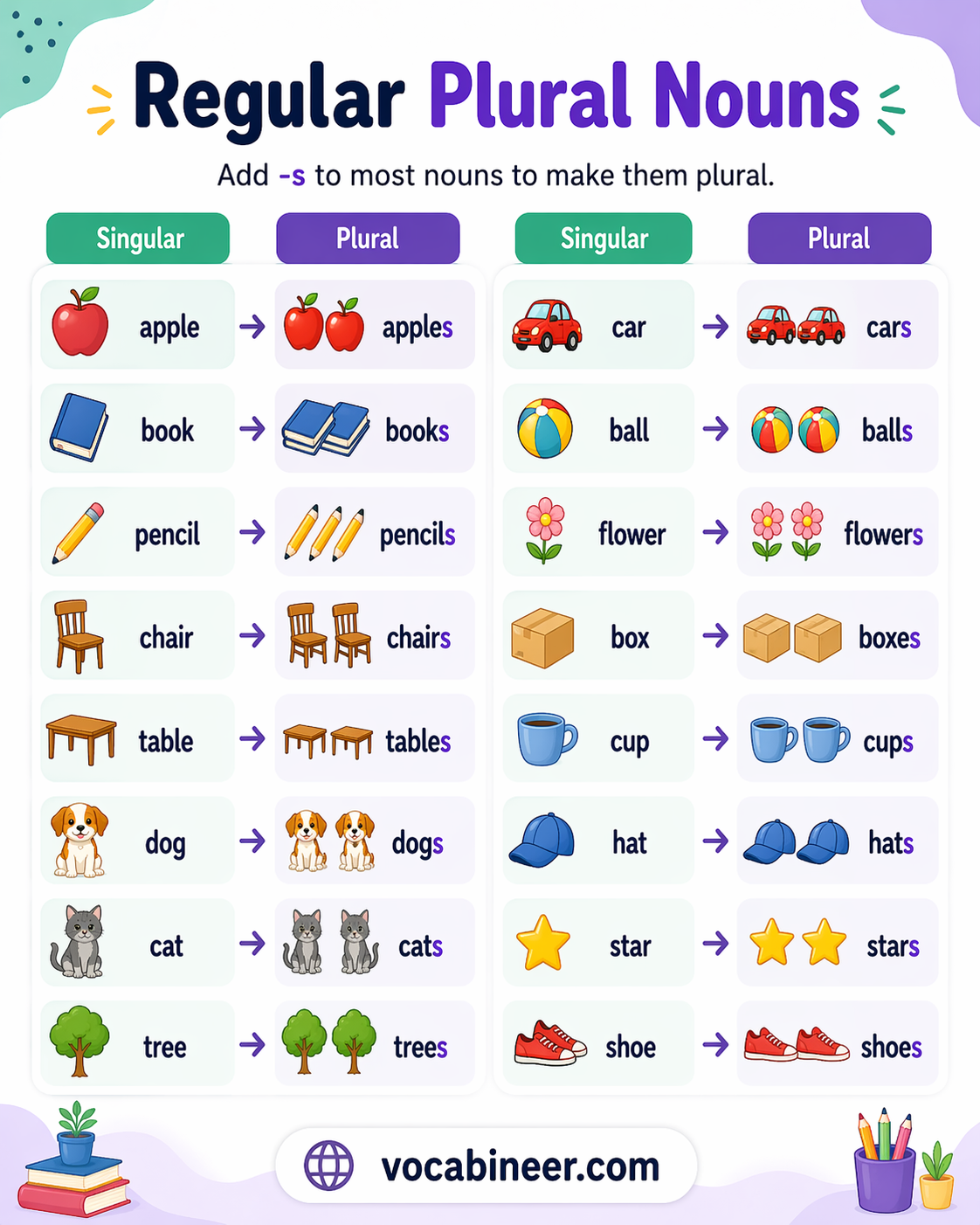
List of 150 Regular Plural Nouns Examples
This table gives a useful list of regular plural nouns in English. As a result, students and English learners can quickly compare singular and plural forms.
| No. | Singular Noun | Regular Plural Noun |
|---|---|---|
| 1 | book | books |
| 2 | pen | pens |
| 3 | pencil | pencils |
| 4 | bag | bags |
| 5 | table | tables |
| 6 | chair | chairs |
| 7 | door | doors |
| 8 | window | windows |
| 9 | car | cars |
| 10 | bike | bikes |
| 11 | tree | trees |
| 12 | flower | flowers |
| 13 | garden | gardens |
| 14 | road | roads |
| 15 | street | streets |
| 16 | river | rivers |
| 17 | mountain | mountains |
| 18 | school | schools |
| 19 | room | rooms |
| 20 | house | houses |
| 21 | cup | cups |
| 22 | plate | plates |
| 23 | spoon | spoons |
| 24 | bottle | bottles |
| 25 | apple | apples |
| 26 | banana | bananas |
| 27 | grape | grapes |
| 28 | cake | cakes |
| 29 | egg | eggs |
| 30 | dog | dogs |
| 31 | cat | cats |
| 32 | bird | birds |
| 33 | cow | cows |
| 34 | goat | goats |
| 35 | lion | lions |
| 36 | tiger | tigers |
| 37 | rabbit | rabbits |
| 38 | teacher | teachers |
| 39 | student | students |
| 40 | doctor | doctors |
| 41 | nurse | nurses |
| 42 | driver | drivers |
| 43 | farmer | farmers |
| 44 | friend | friends |
| 45 | parent | parents |
| 46 | brother | brothers |
| 47 | sister | sisters |
| 48 | worker | workers |
| 49 | player | players |
| 50 | singer | singers |
| 51 | dancer | dancers |
| 52 | actor | actors |
| 53 | artist | artists |
| 54 | idea | ideas |
| 55 | dream | dreams |
| 56 | plan | plans |
| 57 | question | questions |
| 58 | answer | answers |
| 59 | problem | problems |
| 60 | lesson | lessons |
| 61 | word | words |
| 62 | sentence | sentences |
| 63 | letter | letters |
| 64 | page | pages |
| 65 | picture | pictures |
| 66 | photo | photos |
| 67 | phone | phones |
| 68 | computer | computers |
| 69 | laptop | laptops |
| 70 | camera | cameras |
| 71 | radio | radios |
| 72 | video | videos |
| 73 | piano | pianos |
| 74 | zoo | zoos |
| 75 | studio | studios |
| 76 | bus | buses |
| 77 | box | boxes |
| 78 | class | classes |
| 79 | glass | glasses |
| 80 | dish | dishes |
| 81 | brush | brushes |
| 82 | watch | watches |
| 83 | church | churches |
| 84 | bench | benches |
| 85 | fox | foxes |
| 86 | wish | wishes |
| 87 | match | matches |
| 88 | tax | taxes |
| 89 | gas | gases |
| 90 | quiz | quizzes |
| 91 | baby | babies |
| 92 | city | cities |
| 93 | story | stories |
| 94 | country | countries |
| 95 | family | families |
| 96 | lady | ladies |
| 97 | party | parties |
| 98 | puppy | puppies |
| 99 | hobby | hobbies |
| 100 | cherry | cherries |
| 101 | diary | diaries |
| 102 | army | armies |
| 103 | fly | flies |
| 104 | boy | boys |
| 105 | toy | toys |
| 106 | key | keys |
| 107 | day | days |
| 108 | monkey | monkeys |
| 109 | valley | valleys |
| 110 | donkey | donkeys |
| 111 | journey | journeys |
| 112 | turkey | turkeys |
| 113 | tray | trays |
| 114 | chimney | chimneys |
| 115 | lamp | lamps |
| 116 | fan | fans |
| 117 | cupboard | cupboards |
| 118 | notebook | notebooks |
| 119 | kilo | kilos |
| 120 | memo | memos |
| 121 | tomato | tomatoes |
| 122 | potato | potatoes |
| 123 | hero | heroes |
| 124 | echo | echoes |
| 125 | mosquito | mosquitoes |
| 126 | volcano | volcanoes |
| 127 | roof | roofs |
| 128 | chief | chiefs |
| 129 | belief | beliefs |
| 130 | safe | safes |
| 131 | cliff | cliffs |
| 132 | proof | proofs |
| 133 | chef | chefs |
| 134 | handkerchief | handkerchiefs |
| 135 | desk | desks |
| 136 | clock | clocks |
| 137 | shoe | shoes |
| 138 | sock | socks |
| 139 | cloud | clouds |
| 140 | star | stars |
| 141 | ball | balls |
| 142 | game | games |
| 143 | shop | shops |
| 144 | market | markets |
| 145 | bank | banks |
| 146 | hospital | hospitals |
| 147 | bridge | bridges |
| 148 | park | parks |
| 149 | farm | farms |
| 150 | field | fields |
Regular Plural Nouns That Add -s
Most regular plural nouns are made by adding -s. This rule works for many common nouns in everyday English.
| Singular | Plural |
|---|---|
| book | books |
| pen | pens |
| car | cars |
| dog | dogs |
| cat | cats |
| teacher | teachers |
| student | students |
| road | roads |
| river | rivers |
| idea | ideas |
Examples:
- I have one book.
- I have three books.
- The teacher is in class.
- The teachers are in class.
Regular Plural Nouns That Add -es
Some nouns add -es in the plural form. This usually happens when a noun ends in s, x, ch, sh, or z.
| Singular | Plural |
|---|---|
| bus | buses |
| box | boxes |
| class | classes |
| glass | glasses |
| dish | dishes |
| brush | brushes |
| watch | watches |
| church | churches |
| bench | benches |
| quiz | quizzes |
Examples:
- One box is on the floor.
- Two boxes are on the floor.
- The bus is late.
- The buses are late.
Regular Plural Nouns Ending in Y
Nouns ending in y follow two common patterns. If a consonant comes before y, change y to ies. However, if a vowel comes before y, simply add s.
| Rule | Singular | Plural |
|---|---|---|
| consonant + y | baby | babies |
| consonant + y | city | cities |
| consonant + y | story | stories |
| consonant + y | family | families |
| consonant + y | puppy | puppies |
| vowel + y | boy | boys |
| vowel + y | toy | toys |
| vowel + y | key | keys |
| vowel + y | day | days |
| vowel + y | monkey | monkeys |
Examples:
- The baby is sleeping.
- The babies are sleeping.
- One boy is here.
- Three boys are here.
Regular Plural Nouns Ending in O
Nouns ending in o can take -s or -es. Therefore, learners should notice common examples instead of using only one rule.
| Singular | Plural |
|---|---|
| photo | photos |
| radio | radios |
| piano | pianos |
| video | videos |
| zoo | zoos |
| kilo | kilos |
| memo | memos |
| tomato | tomatoes |
| potato | potatoes |
| hero | heroes |
| echo | echoes |
| mosquito | mosquitoes |
| volcano | volcanoes |
Examples:
- I took one photo.
- I took many photos.
- One tomato is red.
- Three tomatoes are red.
Regular Plural Nouns Ending in F or FE
Some nouns ending in f or fe stay regular and add -s. However, other nouns ending in f or fe are irregular and change to ves, so this section focuses only on regular cases.
| Singular | Plural |
|---|---|
| roof | roofs |
| chief | chiefs |
| belief | beliefs |
| safe | safes |
| cliff | cliffs |
| proof | proofs |
| chef | chefs |
| handkerchief | handkerchiefs |
Examples:
- The roof is new.
- The roofs are new.
- The chief gave an order.
- The chiefs gave orders.
When to Use Regular Plurals in English
Regular plural nouns are used in daily conversation, school grammar, reading, writing, and exams. Additionally, they help us talk clearly about more than one person, place, thing, animal, or idea.
You use regular plural nouns when talking about:
- people: teachers, students, doctors
- animals: cats, dogs, rabbits
- things: books, chairs, phones
- places: schools, parks, markets
- ideas: plans, questions, answers
Regular Plural Nouns in Sentences
Sentence pairs help you understand how regular plural nouns work in real English. Moreover, they show how one noun changes when we talk about more than one.
| Singular Sentence | Plural Sentence |
|---|---|
| One cat is here. | Two cats are here. |
| A box is on the table. | Two boxes are on the table. |
| The baby is crying. | The babies are crying. |
| One bus is late. | Three buses are late. |
| A boy is playing. | Many boys are playing. |
| One city is large. | Many cities are large. |
| A photo is on the wall. | Several photos are on the wall. |
| One roof is red. | Two roofs are red. |
| The teacher is speaking. | The teachers are speaking. |
| A dish is clean. | The dishes are clean. |
Common Mistakes with Regular Plural Nouns
Many learners make small spelling mistakes when they form regular plural nouns. However, these mistakes are easy to fix when you know the correct pattern.
| Incorrect | Correct |
|---|---|
| boxs | boxes |
| buss | buses |
| dishs | dishes |
| brushs | brushes |
| watchs | watches |
| churchs | churches |
| quizs | quizzes |
| babys | babies |
| citys | cities |
| ladys | ladies |
| puppys | puppies |
| potatos | potatoes |
| tomatos | tomatoes |
| heros | heroes |
| wolfs | wolves |
Tips:
- Use boxes, not boxs.
- Use dishes, not dishs.
- Use babies, not babys.
- Use tomatoes, not tomatos.
- Use churches, not churchs.
Regular vs Irregular Plural Nouns
Regular plural nouns follow common spelling rules. In contrast, irregular plural nouns change in special ways or stay the same.
| Type | Rule | Example |
|---|---|---|
| Regular plural noun | follows common rules | cat → cats |
| Regular plural noun | adds -es | box → boxes |
| Irregular plural noun | changes spelling | child → children |
| Irregular plural noun | changes vowel | tooth → teeth |
| Irregular plural noun | stays the same | sheep → sheep |
For example, books is a regular plural noun because it adds -s. However, children is an irregular plural noun because it does not follow the regular rule.
FAQs
Regular plural nouns are nouns that follow common rules to become plural. Most regular plural nouns are made by adding -s or -es, such as book/books and box/boxes.
Examples of regular plural nouns include cat/cats, pen/pens, bus/buses, box/boxes, baby/babies, boy/boys, and photo/photos.
You usually form regular plural nouns by adding -s or -es. Some nouns also need small spelling changes, such as baby → babies.
No, not all regular plural nouns add only -s. Some add -es, such as bus/buses, while others change y to ies, such as city/cities.
Regular plural nouns follow common spelling rules, such as cat/cats. Irregular plural nouns do not follow these rules, such as child/children and mouse/mice.
Summary
Regular plural nouns follow common spelling rules. Most add -s, while others add -es or make small spelling changes, such as baby → babies and city → cities.
In this article, you learned 150 regular plural nouns in English with examples and sentences, including nouns that add -s, nouns that add -es, nouns ending in y, o, and f/fe, sentence pairs, common mistakes, and a regular vs irregular comparison. As a result, you can now use regular plural nouns more correctly in writing, speaking, and schoolwork.
Read More
- List of Nouns in English
- Possessive Nouns in English
- Proper Nouns for People in English
- Irregular Plural Nouns in English