

Irregular plural nouns do not follow the normal -s or -es plural rule. For example, child becomes children, man becomes men, and mouse becomes mice. These nouns are common in English, so students and English learners should learn them carefully.
In this guide, you will learn 100 irregular plural nouns in English with examples and sentences. You will also find simple patterns, common mistakes, and easy tips to help you use irregular plurals correctly.
In This Page
What Are Irregular Plural Nouns?
Irregular plural nouns are nouns that do not become plural by simply adding -s or -es. Instead, they may change spelling, change a vowel, take a special ending, or stay the same.
For example:
- Child changes to children.
- Tooth changes to teeth.
- Sheep stays sheep.
- Cactus changes to cacti.
As a result, irregular plural nouns should be learned as special word forms.
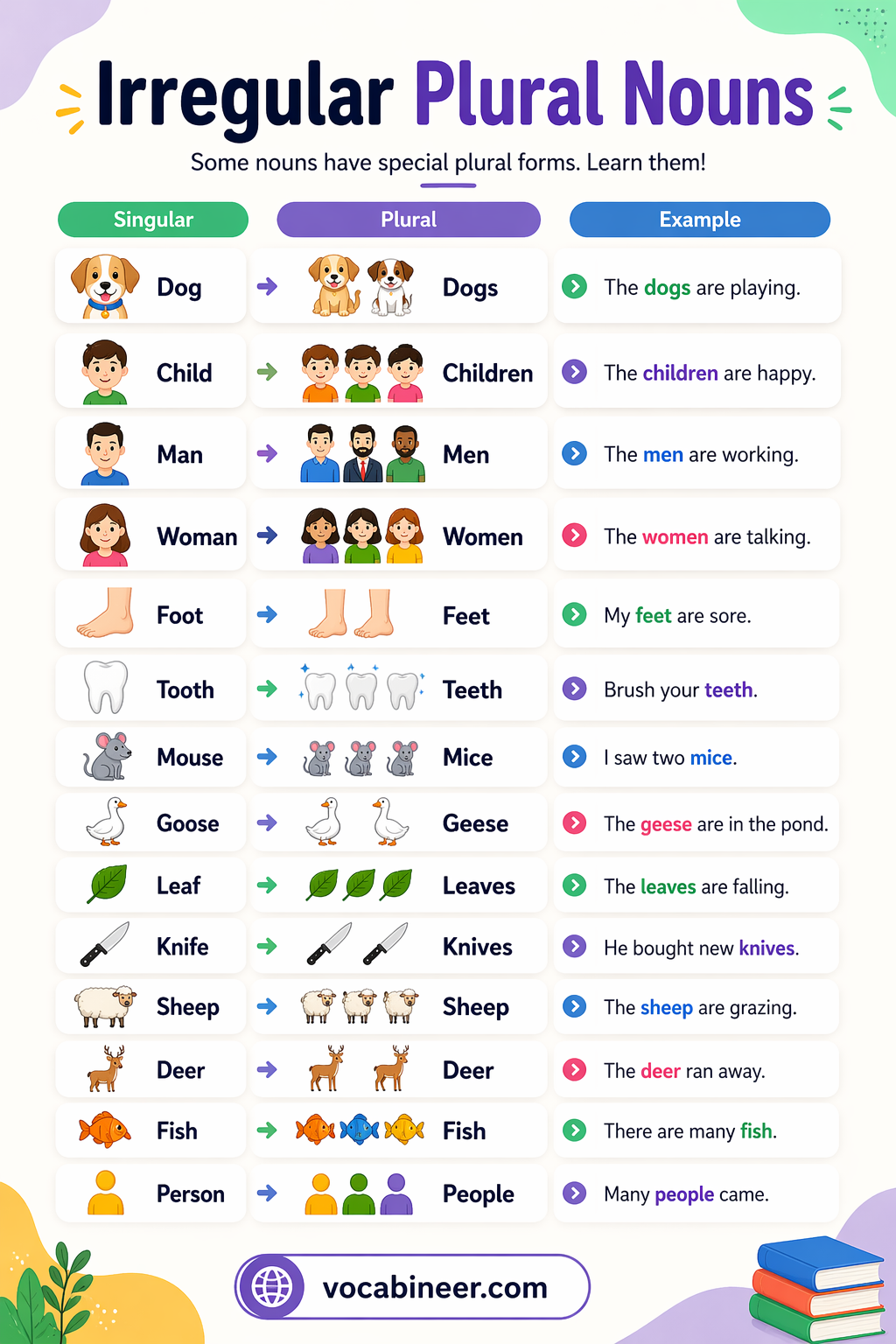
List of 100 Irregular Plural Nouns
This table gives a useful list of irregular plural nouns in English. It includes common daily nouns, same-form plurals, f/fe → ves forms, compound nouns, and a few academic plurals.
| No. | Singular Noun | Irregular Plural Noun |
|---|---|---|
| 1 | man | men |
| 2 | woman | women |
| 3 | child | children |
| 4 | person | people |
| 5 | tooth | teeth |
| 6 | foot | feet |
| 7 | mouse | mice |
| 8 | goose | geese |
| 9 | ox | oxen |
| 10 | louse | lice |
| 11 | sheep | sheep |
| 12 | deer | deer |
| 13 | fish | fish |
| 14 | trout | trout |
| 15 | salmon | salmon |
| 16 | bison | bison |
| 17 | moose | moose |
| 18 | aircraft | aircraft |
| 19 | spacecraft | spacecraft |
| 20 | species | species |
| 21 | series | series |
| 22 | means | means |
| 23 | headquarters | headquarters |
| 24 | leaf | leaves |
| 25 | knife | knives |
| 26 | wife | wives |
| 27 | life | lives |
| 28 | wolf | wolves |
| 29 | shelf | shelves |
| 30 | loaf | loaves |
| 31 | calf | calves |
| 32 | half | halves |
| 33 | thief | thieves |
| 34 | elf | elves |
| 35 | self | selves |
| 36 | scarf | scarves |
| 37 | cactus | cacti |
| 38 | fungus | fungi |
| 39 | nucleus | nuclei |
| 40 | radius | radii |
| 41 | stimulus | stimuli |
| 42 | alumnus | alumni |
| 43 | analysis | analyses |
| 44 | crisis | crises |
| 45 | thesis | theses |
| 46 | diagnosis | diagnoses |
| 47 | oasis | oases |
| 48 | basis | bases |
| 49 | parenthesis | parentheses |
| 50 | phenomenon | phenomena |
| 51 | criterion | criteria |
| 52 | bacterium | bacteria |
| 53 | curriculum | curricula |
| 54 | memorandum | memoranda |
| 55 | appendix | appendices |
| 56 | index | indices |
| 57 | matrix | matrices |
| 58 | vertex | vertices |
| 59 | axis | axes |
| 60 | formula | formulae |
| 61 | vertebra | vertebrae |
| 62 | antenna | antennae |
| 63 | larva | larvae |
| 64 | alga | algae |
| 65 | genus | genera |
| 66 | die | dice |
| 67 | penny | pence |
| 68 | brother | brethren |
| 69 | mother-in-law | mothers-in-law |
| 70 | father-in-law | fathers-in-law |
| 71 | brother-in-law | brothers-in-law |
| 72 | sister-in-law | sisters-in-law |
| 73 | son-in-law | sons-in-law |
| 74 | daughter-in-law | daughters-in-law |
| 75 | passer-by | passers-by |
| 76 | runner-up | runners-up |
| 77 | attorney general | attorneys general |
| 78 | court-martial | courts-martial |
| 79 | notary public | notaries public |
| 80 | chief of staff | chiefs of staff |
| 81 | gentleman | gentlemen |
| 82 | fireman | firemen |
| 83 | policeman | policemen |
| 84 | businesswoman | businesswomen |
| 85 | manservant | menservants |
| 86 | woman doctor | women doctors |
| 87 | man-eater | men-eaters |
| 88 | stepchild | stepchildren |
| 89 | grandchild | grandchildren |
| 90 | schoolchild | schoolchildren |
| 91 | toothpick? | toothpicks |
| 92 | footnote? | footnotes |
| 93 | leafhopper? | leafhoppers |
| 94 | mousepad? | mousepads |
| 95 | gooseberry? | gooseberries |
| 96 | snowman | snowmen |
| 97 | workman | workmen |
| 98 | sportsman | sportsmen |
| 99 | saleswoman | saleswomen |
| 100 | chairwoman | chairwomen |
Common Irregular Plural Nouns
These are the most useful irregular plural nouns for daily English. Therefore, beginners should learn these first.
| Singular | Plural |
|---|---|
| man | men |
| woman | women |
| child | children |
| person | people |
| tooth | teeth |
| foot | feet |
| mouse | mice |
| goose | geese |
| ox | oxen |
| sheep | sheep |
| deer | deer |
| fish | fish |
Examples:
- The child is playing.
- The children are playing.
- One mouse ran across the floor.
- Two mice ran across the floor.
Irregular Plural Nouns with Vowel Changes
Some irregular plural nouns change the vowel inside the word. As a result, the plural looks and sounds different from the singular.
| Singular | Plural |
|---|---|
| man | men |
| woman | women |
| tooth | teeth |
| foot | feet |
| goose | geese |
| mouse | mice |
| louse | lice |
Examples:
- One tooth is loose.
- Two teeth are loose.
- My foot hurts.
- My feet hurt.
Irregular Plural Nouns That Stay the Same
Some nouns have the same form in singular and plural. Therefore, the sentence context tells us whether the noun means one or more than one.
| Singular | Plural |
|---|---|
| sheep | sheep |
| deer | deer |
| fish | fish |
| trout | trout |
| salmon | salmon |
| bison | bison |
| moose | moose |
| aircraft | aircraft |
| spacecraft | spacecraft |
| species | species |
| series | series |
| means | means |
Examples:
- I saw one deer near the road.
- I saw three deer near the road.
- This series is interesting.
- These series are interesting.
Irregular Plural Nouns Ending in F or FE
Some nouns ending in f or fe change to ves in the plural form. However, not every f or fe noun follows this rule.
| Singular | Plural |
|---|---|
| leaf | leaves |
| knife | knives |
| wife | wives |
| life | lives |
| wolf | wolves |
| shelf | shelves |
| loaf | loaves |
| calf | calves |
| half | halves |
| thief | thieves |
| elf | elves |
| self | selves |
| scarf | scarves |
Examples:
- One leaf fell from the tree.
- Many leaves fell from the tree.
- The knife is sharp.
- The knives are sharp.
Common exceptions:
| Singular | Plural |
|---|---|
| chief | chiefs |
| roof | roofs |
| belief | beliefs |
| safe | safes |
| cliff | cliffs |
Latin and Greek Irregular Plural Nouns
Some irregular plurals come from Latin or Greek. These words often appear in science, school, research, and formal English. However, beginners should learn the common irregular nouns first.
| Singular | Plural |
|---|---|
| cactus | cacti |
| fungus | fungi |
| nucleus | nuclei |
| radius | radii |
| stimulus | stimuli |
| analysis | analyses |
| crisis | crises |
| thesis | theses |
| diagnosis | diagnoses |
| phenomenon | phenomena |
| criterion | criteria |
| bacterium | bacteria |
| curriculum | curricula |
| appendix | appendices |
| matrix | matrices |
Examples:
- The analysis is complete.
- The analyses are complete.
- This phenomenon is strange.
- These phenomena are strange.
Compound Irregular Plural Nouns
Some compound nouns become plural by changing the main noun, not always the last word. For example, mother-in-law becomes mothers-in-law.
| Singular | Plural |
|---|---|
| mother-in-law | mothers-in-law |
| father-in-law | fathers-in-law |
| brother-in-law | brothers-in-law |
| sister-in-law | sisters-in-law |
| son-in-law | sons-in-law |
| daughter-in-law | daughters-in-law |
| passer-by | passers-by |
| runner-up | runners-up |
| attorney general | attorneys general |
| court-martial | courts-martial |
Examples:
- My sister-in-law is kind.
- My sisters-in-law are kind.
- A passer-by helped us.
- Two passers-by helped us.
When to Use Irregular Plurals in English
Irregular plurals appear in everyday speech, school grammar, reading, writing, and exams. Therefore, learning them helps you use English more accurately.
You will often use irregular plurals when talking about:
- people: man → men, woman → women, child → children
- body parts: tooth → teeth, foot → feet
- animals: mouse → mice, goose → geese, sheep → sheep
- school subjects: analysis → analyses, criterion → criteria
- family relations: mother-in-law → mothers-in-law
Irregular Plural Nouns in Sentences
Sentence pairs help you understand irregular plurals in real use. Moreover, they show how verbs and pronouns change with singular and plural nouns.
| Singular Sentence | Plural Sentence |
|---|---|
| The child is reading. | The children are reading. |
| One man is waiting. | Two men are waiting. |
| The woman is speaking. | The women are speaking. |
| My tooth hurts. | My teeth hurt. |
| His foot is cold. | His feet are cold. |
| A mouse is in the kitchen. | Two mice are in the kitchen. |
| The goose is near the lake. | The geese are near the lake. |
| One deer crossed the road. | Three deer crossed the road. |
| This knife is sharp. | These knives are sharp. |
| A leaf fell down. | Many leaves fell down. |
| The person is waiting outside. | The people are waiting outside. |
| This series is popular. | These series are popular. |
Common Mistakes with Irregular Plural Nouns
Many learners add -s to irregular nouns, but this often creates incorrect forms. Instead, learn the correct plural form as a full word.
| Incorrect | Correct |
|---|---|
| childs | children |
| mans | men |
| womans | women |
| persons | people |
| tooths | teeth |
| foots | feet |
| mouses | mice |
| gooses | geese |
| oxes | oxen |
| sheeps | sheep |
| deers | deer |
| leafs | leaves |
| knifes | knives |
| wolfs | wolves |
| analysises | analyses |
Tips:
- Use children, not childs.
- Use men, not mans.
- Use mice, not mouses.
- Use sheep, not sheeps.
- Use leaves, not leafs.
FAQs
Irregular plural nouns are nouns that do not form the plural by simply adding -s or -es. Examples include child/children, man/men, and mouse/mice.
Common examples include woman/women, child/children, person/people, tooth/teeth, foot/feet, mouse/mice, and goose/geese.
Some irregular plural nouns stay the same in singular and plural forms. Examples include sheep/sheep, deer/deer, fish/fish, aircraft/aircraft, and species/species.
Child becomes children because it follows an old irregular plural pattern in English. It does not use the regular -s or -es ending.
Learn common irregular plurals first, group them by pattern, and practice them in short sentences. For example, study tooth/teeth, foot/feet, and goose/geese together.
Summary
Irregular plural nouns do not follow the normal plural rules. Instead, they may change spelling, change vowels, take special endings, or stay the same.
In this article, you learned 100 irregular plural nouns in English with examples and sentences, including common irregular nouns, vowel-change nouns, same-form plurals, f/fe → ves plurals, Latin and Greek forms, compound nouns, sentence pairs, and common mistakes. As a result, you can now use irregular plural nouns more confidently in writing, speaking, and schoolwork.
Read More
- List of Nouns in English
- Possessive Nouns in English
- Proper Nouns for People in English
- Singular and Plural Nouns Examples