

Singular nouns name one person, place, thing, animal, or idea. Plural nouns name more than one. For example, book is singular, while books is plural. Similarly, child is singular, while children is plural.
In this guide, you will learn 200 singular and plural nouns examples in clear tables. You will also find simple rules, sentence pairs, common mistakes, and FAQs to help students and English learners use singular and plural nouns correctly.
In This Page
What Are Singular and Plural Nouns?
Singular and plural nouns help us show whether we are talking about one thing or more than one thing.
- Singular noun – names one person, place, animal, thing, or idea.
- Plural noun – names more than one person, place, animal, thing, or idea.
Examples:
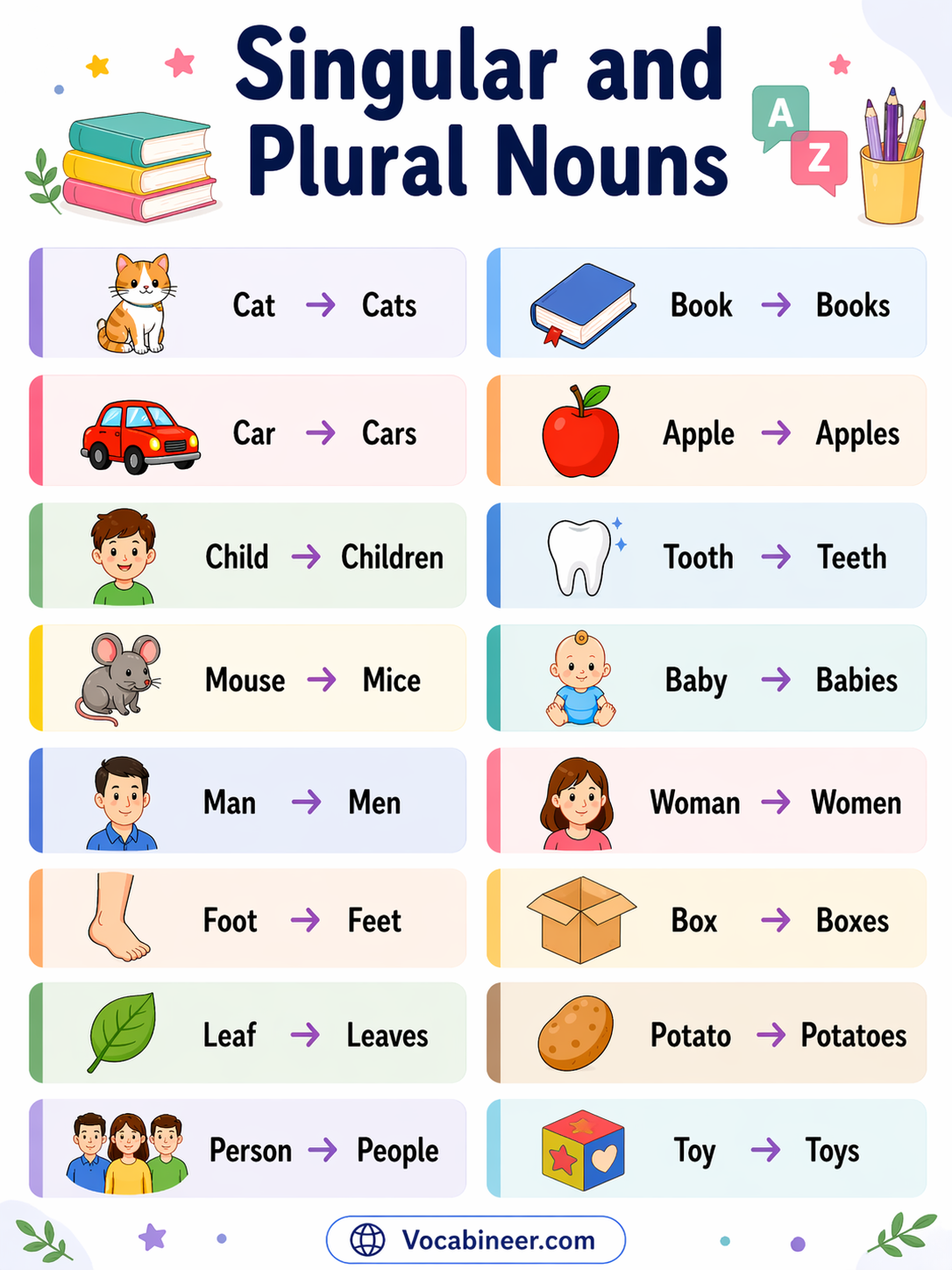
- cat → cats
- box → boxes
- baby → babies
- child → children
Therefore, learning singular and plural nouns helps you write and speak more clearly.
List of 200 Singular and Plural Nouns Examples
This table gives a complete list of 200 common singular and plural nouns in English.
| No. | Singular Noun | Plural Noun |
|---|---|---|
| 1 | book | books |
| 2 | pen | pens |
| 3 | pencil | pencils |
| 4 | bag | bags |
| 5 | table | tables |
| 6 | chair | chairs |
| 7 | door | doors |
| 8 | window | windows |
| 9 | car | cars |
| 10 | bus | buses |
| 11 | box | boxes |
| 12 | class | classes |
| 13 | glass | glasses |
| 14 | dish | dishes |
| 15 | brush | brushes |
| 16 | watch | watches |
| 17 | church | churches |
| 18 | bench | benches |
| 19 | fox | foxes |
| 20 | tomato | tomatoes |
| 21 | potato | potatoes |
| 22 | hero | heroes |
| 23 | baby | babies |
| 24 | city | cities |
| 25 | story | stories |
| 26 | country | countries |
| 27 | family | families |
| 28 | lady | ladies |
| 29 | party | parties |
| 30 | puppy | puppies |
| 31 | boy | boys |
| 32 | toy | toys |
| 33 | key | keys |
| 34 | day | days |
| 35 | monkey | monkeys |
| 36 | leaf | leaves |
| 37 | knife | knives |
| 38 | wife | wives |
| 39 | life | lives |
| 40 | wolf | wolves |
| 41 | shelf | shelves |
| 42 | man | men |
| 43 | woman | women |
| 44 | child | children |
| 45 | tooth | teeth |
| 46 | foot | feet |
| 47 | mouse | mice |
| 48 | goose | geese |
| 49 | person | people |
| 50 | ox | oxen |
| 51 | sheep | sheep |
| 52 | deer | deer |
| 53 | fish | fish |
| 54 | aircraft | aircraft |
| 55 | species | species |
| 56 | dog | dogs |
| 57 | cat | cats |
| 58 | bird | birds |
| 59 | cow | cows |
| 60 | goat | goats |
| 61 | horse | horses |
| 62 | lion | lions |
| 63 | tiger | tigers |
| 64 | elephant | elephants |
| 65 | rabbit | rabbits |
| 66 | apple | apples |
| 67 | banana | bananas |
| 68 | orange | oranges |
| 69 | mango | mangoes |
| 70 | grape | grapes |
| 71 | egg | eggs |
| 72 | cake | cakes |
| 73 | cup | cups |
| 74 | spoon | spoons |
| 75 | plate | plates |
| 76 | bottle | bottles |
| 77 | room | rooms |
| 78 | house | houses |
| 79 | school | schools |
| 80 | garden | gardens |
| 81 | teacher | teachers |
| 82 | student | students |
| 83 | doctor | doctors |
| 84 | nurse | nurses |
| 85 | driver | drivers |
| 86 | farmer | farmers |
| 87 | friend | friends |
| 88 | parent | parents |
| 89 | brother | brothers |
| 90 | sister | sisters |
| 91 | king | kings |
| 92 | queen | queens |
| 93 | worker | workers |
| 94 | player | players |
| 95 | singer | singers |
| 96 | dancer | dancers |
| 97 | actor | actors |
| 98 | artist | artists |
| 99 | river | rivers |
| 100 | mountain | mountains |
| 101 | road | roads |
| 102 | street | streets |
| 103 | bridge | bridges |
| 104 | park | parks |
| 105 | shop | shops |
| 106 | market | markets |
| 107 | bank | banks |
| 108 | hospital | hospitals |
| 109 | idea | ideas |
| 110 | dream | dreams |
| 111 | plan | plans |
| 112 | question | questions |
| 113 | answer | answers |
| 114 | problem | problems |
| 115 | lesson | lessons |
| 116 | word | words |
| 117 | sentence | sentences |
| 118 | letter | letters |
| 119 | page | pages |
| 120 | picture | pictures |
| 121 | photo | photos |
| 122 | phone | phones |
| 123 | computer | computers |
| 124 | laptop | laptops |
| 125 | camera | cameras |
| 126 | radio | radios |
| 127 | video | videos |
| 128 | piano | pianos |
| 129 | zoo | zoos |
| 130 | studio | studios |
| 131 | flower | flowers |
| 132 | tree | trees |
| 133 | clock | clocks |
| 134 | desk | desks |
| 135 | shoe | shoes |
| 136 | sock | socks |
| 137 | cloud | clouds |
| 138 | star | stars |
| 139 | ball | balls |
| 140 | game | games |
| 141 | song | songs |
| 142 | chairperson | chairpersons |
| 143 | cactus | cacti |
| 144 | fungus | fungi |
| 145 | analysis | analyses |
| 146 | crisis | crises |
| 147 | thesis | theses |
| 148 | diagnosis | diagnoses |
| 149 | oasis | oases |
| 150 | phenomenon | phenomena |
| 151 | criterion | criteria |
| 152 | appendix | appendices |
| 153 | index | indexes |
| 154 | loaf | loaves |
| 155 | calf | calves |
| 156 | half | halves |
| 157 | scarf | scarves |
| 158 | thief | thieves |
| 159 | elf | elves |
| 160 | chief | chiefs |
| 161 | roof | roofs |
| 162 | belief | beliefs |
| 163 | safe | safes |
| 164 | cliff | cliffs |
| 165 | halo | halos |
| 166 | kilo | kilos |
| 167 | memo | memos |
| 168 | volcano | volcanoes |
| 169 | echo | echoes |
| 170 | mosquito | mosquitoes |
| 171 | quiz | quizzes |
| 172 | gas | gases |
| 173 | wish | wishes |
| 174 | match | matches |
| 175 | tax | taxes |
| 176 | fly | flies |
| 177 | army | armies |
| 178 | hobby | hobbies |
| 179 | diary | diaries |
| 180 | cherry | cherries |
| 181 | tray | trays |
| 182 | valley | valleys |
| 183 | donkey | donkeys |
| 184 | journey | journeys |
| 185 | turkey | turkeys |
| 186 | chimney | chimneys |
| 187 | trout | trout |
| 188 | salmon | salmon |
| 189 | bison | bison |
| 190 | moose | moose |
| 191 | series | series |
| 192 | means | means |
| 193 | headquarters | headquarters |
| 194 | child | children |
| 195 | woman | women |
| 196 | man | men |
| 197 | tooth | teeth |
| 198 | foot | feet |
| 199 | goose | geese |
| 200 | mouse | mice |
Regular Singular and Plural Nouns
Most nouns become plural by adding -s. This is the easiest and most common plural rule in English.
| Singular | Plural |
|---|---|
| book | books |
| pen | pens |
| car | cars |
| dog | dogs |
| cat | cats |
| teacher | teachers |
| student | students |
| road | roads |
| river | rivers |
| idea | ideas |
Examples:
- I have one book.
- I have three books.
- The teacher is in class.
- The teachers are in class.
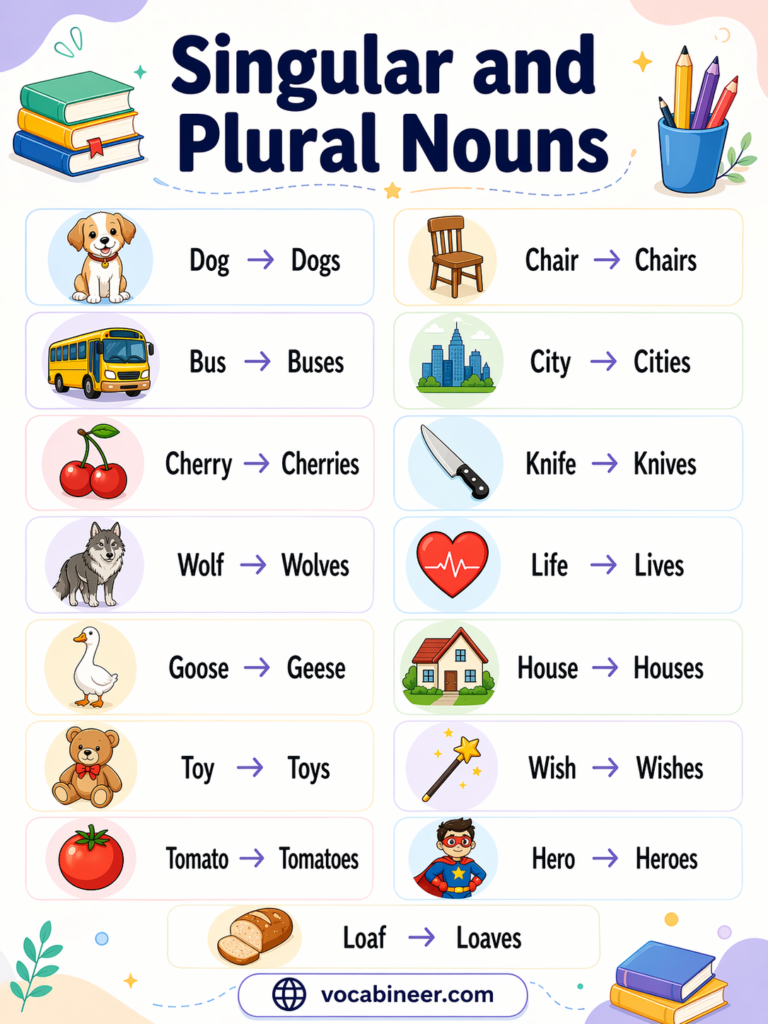
Nouns That Add -es in Plural
Some nouns add -es in the plural form. This usually happens when a noun ends in s, x, ch, sh, or z.
| Singular | Plural |
|---|---|
| bus | buses |
| box | boxes |
| class | classes |
| glass | glasses |
| dish | dishes |
| brush | brushes |
| watch | watches |
| church | churches |
| bench | benches |
| quiz | quizzes |
Examples:
- One box is on the floor.
- Two boxes are on the floor.
- The bus is late.
- The buses are late.
Nouns Ending in Y
Nouns ending in y follow two common patterns. If a consonant comes before y, change y to ies. However, if a vowel comes before y, simply add s.
| Rule | Singular | Plural |
|---|---|---|
| consonant + y | baby | babies |
| consonant + y | city | cities |
| consonant + y | story | stories |
| consonant + y | family | families |
| consonant + y | puppy | puppies |
| vowel + y | boy | boys |
| vowel + y | toy | toys |
| vowel + y | key | keys |
| vowel + y | day | days |
| vowel + y | monkey | monkeys |
Examples:
- The baby is sleeping.
- The babies are sleeping.
- One boy is here.
- Three boys are here.
Nouns Ending in F or FE
Some nouns ending in f or fe change to ves in the plural form. Still, some nouns only add s, so learners should notice the pattern carefully.
| Singular | Plural |
|---|---|
| leaf | leaves |
| knife | knives |
| wife | wives |
| life | lives |
| wolf | wolves |
| shelf | shelves |
| calf | calves |
| half | halves |
| thief | thieves |
| elf | elves |
Common exceptions:
| Singular | Plural |
|---|---|
| chief | chiefs |
| roof | roofs |
| belief | beliefs |
| safe | safes |
| cliff | cliffs |
Examples:
- One leaf fell from the tree.
- Many leaves fell from the tree.
- The chief spoke clearly.
- The chiefs spoke clearly.
Irregular Singular and Plural Nouns
Irregular plural nouns do not follow the normal -s or -es rule. Therefore, you need to learn them as special forms.
| Singular | Plural |
|---|---|
| man | men |
| woman | women |
| child | children |
| tooth | teeth |
| foot | feet |
| mouse | mice |
| goose | geese |
| person | people |
| ox | oxen |
| cactus | cacti |
| fungus | fungi |
| analysis | analyses |
| crisis | crises |
| phenomenon | phenomena |
| criterion | criteria |
Examples:
- The child is playing.
- The children are playing.
- My foot hurts.
- My feet hurt.
Nouns with the Same Singular and Plural Form
Some nouns do not change in the plural form. As a result, the same word can mean one or more than one.
| Singular | Plural |
|---|---|
| sheep | sheep |
| deer | deer |
| fish | fish |
| aircraft | aircraft |
| species | species |
| trout | trout |
| salmon | salmon |
| bison | bison |
| moose | moose |
| series | series |
| means | means |
| headquarters | headquarters |
Examples:
- I saw one deer.
- I saw three deer.
- This series is interesting.
- These series are popular.
Singular and Plural Nouns in Sentences
Sentence pairs help you understand how singular and plural nouns work in real English.
| Singular Sentence | Plural Sentence |
|---|---|
| This is a book. | These are books. |
| I have one pen. | I have two pens. |
| The child is playing. | The children are playing. |
| A box is on the table. | Many boxes are on the table. |
| The baby is crying. | The babies are crying. |
| One leaf is green. | Many leaves are green. |
| The man is tall. | The men are tall. |
| A mouse is in the room. | Two mice are in the room. |
| The sheep is white. | The sheep are white. |
| This fish is small. | These fish are small. |
Common Mistakes with Singular and Plural Nouns
Many learners make mistakes when they use plural nouns. However, these errors are easy to fix when you know the correct forms.
| Incorrect | Correct |
|---|---|
| childs | children |
| mans | men |
| womans | women |
| tooths | teeth |
| foots | feet |
| mouses | mice |
| sheeps | sheep |
| deers | deer |
| boxs | boxes |
| dishies | dishes |
| babys | babies |
| leafs | leaves |
| knifes | knives |
| foxs | foxes |
| quizs | quizzes |
FAQs
A singular noun names one person, place, animal, thing, or idea. For example, book, cat, child, and city are singular nouns.
A plural noun names more than one person, place, animal, thing, or idea. For example, books, cats, children, and cities are plural nouns.
Examples include book/books, box/boxes, baby/babies, leaf/leaves, child/children, and sheep/sheep.
Most nouns become plural by adding -s or -es. However, some nouns change spelling, such as baby/babies, and some are irregular, such as man/men.
Irregular plural nouns do not follow the regular plural rules. Examples include child/children, tooth/teeth, foot/feet, mouse/mice, and goose/geese.
Summary
Singular nouns name one person, place, animal, thing, or idea, while plural nouns name more than one. In this article, you learned 200 singular and plural nouns examples in English, along with regular rules, irregular plurals, same-form nouns, sentence pairs, and common mistakes.
As a result, you can now understand how nouns change from singular to plural and use them more correctly in writing, speaking, and schoolwork.
Read More
- List of Nouns in English
- Possessive Nouns in English
- Proper Nouns for People in English
- Countable Object Nouns in English