

Estimated from sentence length and syllable density.
- Syllables per line
- –
- Total syllables
- 0
- Lines
- 0
- Words
- 0
- Average syllables per line
- 0
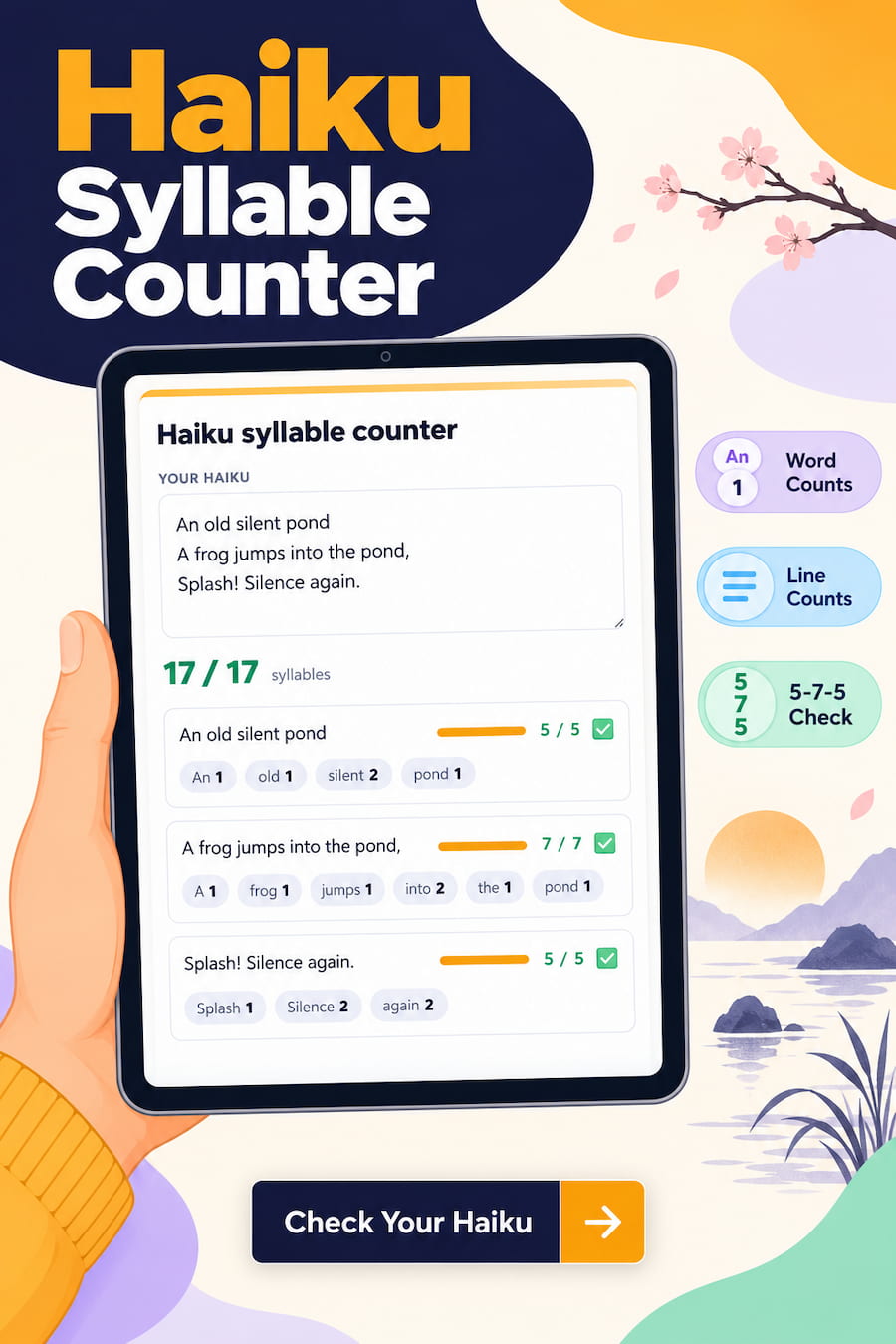
Paste your poem into this haiku syllable counter, and every line and every word shows its syllable count as you type. The same tool works as a haiku checker, testing your three lines against 5-7-5 and telling you whether the poem meets the haiku form.
Poets use it to tighten a draft before submission, and poetry teachers use it as a haiku tester for a class set in minutes. There is no sign-up, and it works in any phone or desktop browser.
How Many Syllables Are in a Haiku?
A haiku has 17 syllables across three lines: 5 in the first line, 7 in the second, and 5 in the third. That count of 5-7-5 syllables is the number of syllables in a haiku as the form is taught in English.
When you check how many syllables in a haiku line, the answer depends on its position: 5 syllables at the start and at the close, with the 7-syllable line between them. Whether a draft meets those targets is the question this tool answers line by line.
How Many Lines Are in a Haiku?
A haiku has three lines. The checker flags a draft with two lines or four, and it names the fix, such as “Add one more line.” Some English poets write one-line haiku, called monoku, but the traditional form keeps three.
A tanka, by comparison, has five lines, and a senryu shares the haiku’s three.
How to Use the Haiku Syllable Counter
- Type or paste your haiku into the box, one line per row.
- Read the count beside each line and under each word as you type.
- Watch each line’s count against its target of five, seven, or five.
- Fix any line the checker names, such as “Line 2 is 1 syllable over.”
- Stop when the total reads 17 / 17 and every item on the checklist is green.
Haiku Checker and Syllable Counter Features
Most haiku tools either count haiku syllables or check the form. This one does both from one box: it counts the syllables in every word and line, then tests the whole poem against the haiku form.
Syllable Count for Every Line and Word
See where each line’s total comes from. Every line shows its count, and a row of word chips beneath it lists each word with its own count, such as morning 2 · frost 1 · retreats 2. When a line is one beat long, the chips show exactly which word to trim.
Haiku Syllable Count Results
Get the haiku syllable count for the whole poem in one panel. The results list syllables per line, total syllables, lines, words, and the average per line. A poem with lines of 6, 1, 7, and 2 syllables reads as 6 · 1 · 7 · 2, with 16 syllables in total.
5-7-5 Check With Named Fixes
Know how close the poem is to its target at a glance. A total at the top reads the syllables written against the 17 a haiku requires, such as 12 / 17 for a draft in progress. When a line misses, the haiku syllable counter names it along with the difference, such as “Line 3 is 1 syllable short.”
Is This a Haiku? The Five-Point Checklist
Get a verdict, not only a count. Beneath the lines, a checklist tests the poem on five points: three lines, the 5-7-5 count, a seasonal word, a cutting pause, and end rhyme. When the first two pass, the verdict reads “Meets the haiku form: three lines in 5-7-5.”
The last three points advise rather than decide. The checklist names any seasonal word it finds, such as frost for winter, and notes a pause marked by a dash or an exclamation. It also warns when two lines rhyme, since a traditional haiku does not.
Free Counting in Any Browser
No account, no install, no limit. This haiku format checker works the same on a phone, a tablet, and a desktop, and your poem is counted in your own browser.
The 5-7-5 Structure of a Haiku
The traditional English haiku format has three lines and seventeen syllables: five, then seven, then five. The short opening line sets a scene, and the longer middle line adds the movement or detail. The closing line turns or settles the image.
morning frost retreats — 5 a sparrow lands on the rail — 7 steam climbs off the fence — 5
Say it aloud, or paste it into the haiku syllable counter, and the beats confirm the count. Mor-ning frost re-treats is five, and a spar-row lands on the rail is seven. The form rewards compression, with one moment described in the fewest words that still name it.
Related:
- Five Syllable Words | Easy Examples & Lists for Students
- Seven Syllable Words with Meanings and Example Sentences
How to Count Syllables in a Haiku
Counting haiku syllables comes down to vowel sounds rather than vowel letters, since the count follows pronunciation rather than spelling. A silent e adds no beat, so cake is one syllable. A final -le keeps its beat, so ta-ble is two. When one word in a line looks wrong, split it in the syllable divider to see each beat.
Numerals count the way they are spoken, so 7 is two syllables and 2024 is five. A handful of words produce most disputes:
| Word | Syllables | Reason |
|---|---|---|
| Fire | 1 or 2 | One beat in clipped speech, two when drawn out as fi-er |
| Hour | 1 | The h is silent, and the word sounds like our |
| Every | 2 | Spoken ev-ry in conversation |
| Poem | 2 | Two beats, po-em, despite its short spelling |
| Flower | 2 | Flow-er, shortened to one beat in fast speech |
| Chocolate | 2 | Choc-late in everyday speech |
| Being | 2 | Be-ing, with two separate vowel sounds |
The haiku syllable counter follows the most common pronunciation for these words. Where your accent gives a different count, adjust the line by ear and read it aloud before you settle on a word.
Related: Word Stress Syllable in English with Rules and Examples
Haiku Examples With Syllable Counts
These three haiku poems meet the 5-7-5 count line for line, and their haiku syllables are marked beside each line. The first two are haiku built on a seasonal image, and the third is a senryu about office life.
the last train pulls out — 5 a paper cup rolls along — 7 the empty platform — 5
cicadas fall still — 5 the heat settles on the porch — 7 one leaf turns yellow — 5
the meeting could have — 5 been an email after all — 7 we nod and take notes — 5
Cicadas and a yellowing leaf mark late summer, the seasonal reference a traditional haiku expects. The senryu keeps the same syllables for haiku but trades nature for human behavior, which is the line between the two forms. Paste any of them into the box for a haiku check against the same count.
Japanese On vs English Syllables
Japanese haiku count on, sound units close to the mora, rather than syllables. Long vowels and doubled consonants each add an on, and so does a syllable-final n. As a result, the Japanese count rises faster than a count of English haiku syllables for the same idea.
The word haiku shows the gap: three on in Japanese, ha-i-ku, and two syllables in English, hai-ku. Across a whole poem, seventeen on correspond to roughly twelve English syllables. For this reason, many editors treat 5-7-5 as a starting frame for English-language haiku rather than a fixed rule. Poems written without a set count are called free-form or organic haiku, and the Haiku Society of America’s definition of haiku sets no syllable count at all. The form reached English poetry through Ezra Pound and the Imagists, and later through Beat writers such as Jack Kerouac.
The 5-7-5 frame is still how the form is taught in schools and judged in most contests, which is why the haiku syllable counter checks it. Learn the count first, and depart from it later by choice.
Kigo and Kireji in Haiku
Seventeen syllables alone produce a measured sentence rather than a poem. A traditional haiku adds two devices that no syllable count measures, and the checklist looks for both.
A kigo is a seasonal word, such as frost, cicada, or first snow, that places the poem at a time of year. Japanese poets draw kigo from a saijiki, a seasonal almanac of accepted words. A kireji, or cutting word, marks a pause between two images. English poets render it with a dash or a line break, which sets up the juxtaposition of two images at the center of the form.
Beyond both devices, a haiku centers on a single moment shown through concrete imagery. It names the frost on the rail rather than stating that the morning felt lonely.
Haiku vs Senryu vs Tanka
Three Japanese forms share syllable counting, and the difference is subject and length.
| Form | Syllable count | Lines | Focus |
|---|---|---|---|
| Haiku | 5-7-5 | 3 | A moment in nature, tied to a season |
| Senryu | 5-7-5 | 3 | Human nature, irony, and wry observation |
| Tanka | 5-7-5-7-7 | 5 | Emotion and reflection, with a turn after line three |
The haiku descends from the hokku, the opening stanza of renga, a form of linked verse. Matsuo Bashō raised the hokku to an independent form in the seventeenth century, during Japan’s Edo period. Yosa Buson and Kobayashi Issa followed him, and Masaoka Shiki gave the form the name haiku in the 1890s. The four are known as the great masters of haiku. Bashō also wrote haibun, travel prose punctuated with haiku, most famously The Narrow Road to the Deep North. The tanka is older still, as the most common form of waka, classical Japanese court poetry. Renga grew out of the tanka.
The senryu takes its name from Karai Senryū, an eighteenth-century judge and compiler of comic verse. Senryu share the 5-7-5 structure, so the haiku syllable counter checks them line for line, and the checklist simply notes that no seasonal word is present.
Common Haiku Mistakes
- ✅ Count vowel sounds, not vowel letters, since cake has two vowel letters and one beat.
- ❌ Never pad a line with filler words to reach five or seven, because a forced syllable shows.
- ❌ Avoid a complete explanatory sentence, since a haiku presents one image rather than a story.
- ✅ Build the poem around a single concrete moment before you adjust the count.
- ✅ Replace a long word with a shorter one from the one syllable words or two syllable words lists when a line goes over.
- ❌ Avoid relying on spelling for words such as fire, hour, and flower, which shift with accent.
When the count and the image conflict, change the wording rather than the form. A tidy 5-7-5 with no image is the most common miss of all.
Haiku Counter vs General Syllable Counter
This syllable counter for haiku counts and checks one form, 5-7-5 across three lines. A general syllable counter for poetry and prose counts any text and adds other forms, pronunciation, and readability scores.
| Tool | What it does | Best for |
|---|---|---|
| Haiku counter | Counts every word and line, then checks the poem against 5-7-5 | Haiku and senryu drafts |
| General syllable counter | Counts any text, with tanka, limerick, and free-verse modes | Longer poems and prose |
Use this page when the poem is a haiku or a senryu. For tanka, limericks, or longer writing, use a general syllable counter.
FAQs
Q1. How do I check if a poem is a haiku?
Paste it into the checker, one line per row. A poem meets the haiku form when it has three lines in a 5-7-5 count, and the checklist adds advice on a seasonal word, a cutting pause, and end rhyme.
Q2. Does a haiku have to be 5-7-5?
No, not in English. The count came from Japanese on, which differ from English syllables, so many poets treat 5-7-5 as a frame rather than a rule. Learn the form first, then depart from it by choice.
Q3. What is the difference between a haiku checker and a haiku syllable counter?
A counter reports numbers: the syllables in each word, each line, and the whole poem. A haiku checker judges the poem against the form and gives a verdict. This tool does both in one box.
Q4. How many syllables does each line of a haiku have?
The first line has 5 syllables, the second has 7, and the third has 5. Together they make the 17 haiku syllables of the traditional form.
Q5. Does the counter work for senryu and tanka?
Yes for senryu, which share the 5-7-5 structure line for line. For tanka, use a general syllable counter with a tanka mode, which checks all five lines.
Q6. Why does my syllable count differ from the counter?
Words such as fire, every, and poem have more than one accepted pronunciation. Accent also shifts words like flower and hour, so read the line aloud and adjust by ear.
Q7. What are kigo and kireji?
A kigo is a seasonal word that places the haiku in a time of year. A kireji is a cutting word that marks the pause between two images, shown in English with a dash or a line break.
Q8. Does a haiku rhyme?
No, a traditional haiku does not rhyme. Its rhythm comes from the 5-7-5 count and the pause between two images, and the checklist warns when two lines rhyme.
Q9. What is the plural of haiku?
The plural of haiku is haiku, the same as the singular. Haikus is common in casual writing, but haiku is the standard form in poetry publishing.