

Estimated from sentence length and syllable density.
- Syllables per line
- –
- Total syllables
- 0
- Lines
- 0
- Words
- 0
- Average syllables per line
- 0
Syllable card maker
Type a word to see it split into syllables.
Estimated from sentence length and syllable density.
- Syllables per line
- –
- Total syllables
- 0
- Lines
- 0
- Words
- 0
- Average syllables per line
- 0
Paste any word, line, or page into this syllable counter, and the exact count is ready before you finish typing. Every word comes back split at its syllable boundaries, pronounced aloud, and one click from a printable card.
Teachers build reading drills with it, poets check a haiku line by line, and editors trim heavy sentences until they read lighter. All three jobs happen in the same box, with no sign-up and nothing to install.
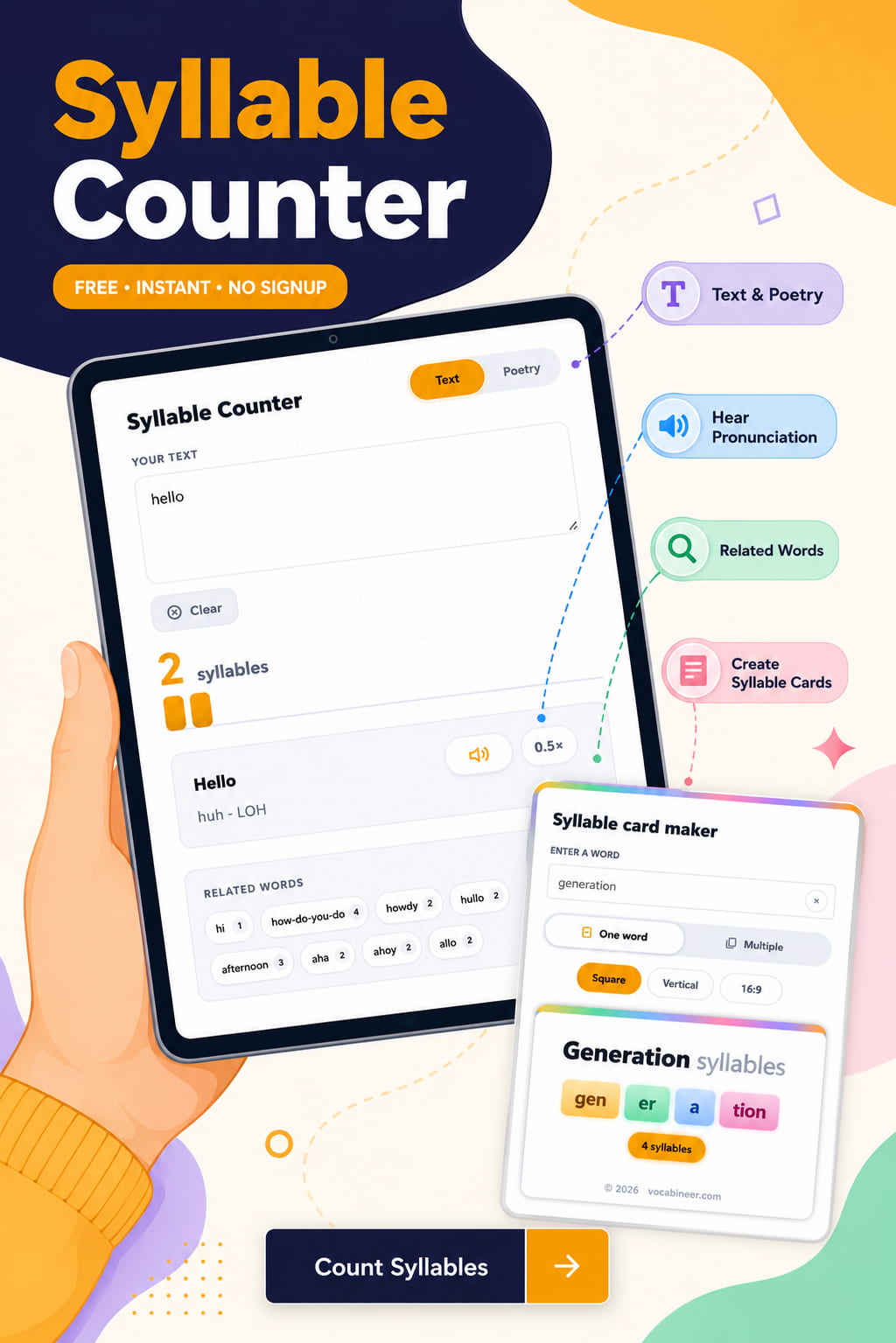
How to Use the Syllable Counter
Start typing, and the count changes with every letter. There is no button to press and no page to reload.
Type one word, and the counter shows its split and its pronunciation beneath the total. A row of related words follows, each ready to count next. Paste a sentence or a longer passage instead, and you get a word-by-word breakdown with counts for words, sentences, and reading time. Switch to the Poetry tab to check a haiku line by line, or open the Card tab to save any word as an image.
Syllable Counter Features
Most syllable counters return a number and stop there. This one also gives you the split, the pronunciation, and synonyms for the same word. A downloadable card is one click away, so there is no second tool to open.
Live Syllable Count for Words and Sentences
See the count before you finish the word. The total updates with every letter, and a row of beats under the number marks each syllable, so the result reads at a glance on a phone. A single word and several thousand characters of prose count the same way, with no submit step. A monosyllabic word shows a single beat, and every added syllable adds one more. At the other end, the count handles the longest words in English, from six-syllable words to ten-syllable words.
Syllable Breakdown for Every Word
Know exactly where each word divides. Every word is split with a middle dot, as in com·pu·ter, won·der·ful, and in·for·ma·tion. The process is called syllabification, and it follows the hyphenation rules of printed dictionaries. For a sentence, the syllable counter lists each word with its own count, so the long words raising the total stand out at once.
Need the division without the numbers? The dedicated syllable divider focuses on the split alone.
Pronunciation With Audio and IPA
Hear any word spoken aloud through your browser’s text-to-speech voice, then slow it to half speed to hear each syllable separately. A plain respelling such as HOW‑dee gives casual readers the sound at a glance. The transcription beside it, /ˈhaʊdi/, uses the International Phonetic Alphabet (IPA). It gives learners and speech-language therapists the exact sounds without a dictionary lookup, including the mark for the stressed beat, whether it falls first or on the last syllable of a word.
Synonyms and Related Words
Shorten a line without leaving the page. Every single word you type shows a row of synonyms and close terms from Datamuse, an open word database. Tap one to count it next, and swap a three-syllable word for a one-syllable word the moment a line needs trimming.
Poetry Mode for Haiku and Verse
Find the line that misses its count before anyone else reads the poem. Poetry mode checks every line against its target and names the fix, such as “Line 2 is 1 syllable over.” A total at the top tracks progress toward the form, like 12 / 17 for a haiku in progress. The whole poem turns green once every line matches. A fourth option, free verse, counts every line with no target, which suits a sonnet’s ten-syllable lines in iambic pentameter.
Check a Haiku for 5-7-5 Syllables
A haiku has three lines of five, seven, and five syllables, seventeen in all. Bashō’s frog poem meets the count line for line:
An old silent pond — 5 A frog jumps into the pond — 7 Splash! Silence again — 5
For a counter locked to this form alone, open the haiku syllable counter.
Check a Tanka for 5-7-5-7-7 Syllables
A tanka extends the haiku shape by two seven-syllable lines, for thirty-one syllables across five lines. The first three lines follow haiku counts, and the closing pair adds a turn in thought or feeling. Poetry mode tracks all five targets at once.
Check a Limerick for 8-8-5-5-8 Syllables
A limerick has five lines in an 8-8-5-5-8 count. Lines one, two, and five rhyme together, while lines three and four form a shorter rhyming pair. A limerick’s meter depends on stress more than exact count, so a nine-syllable line still reads correctly when its stress pattern stays regular.
Readability Scores and Grade Level
Write for the reader you actually have. Readability formulas depend on average syllables per word, so the tool scores readability as you type. You get a Flesch Reading Ease score and a Flesch–Kincaid grade level, with a Gunning Fog index beside them. The Fog index counts polysyllabic words, those of three or more syllables, as a mark of difficult text. Replace a long word with a short one, and the reading-ease score rises in real time.
Word Count and Reading Time
Get every figure a report or a lesson plan asks for in one place. The Counts panel lists words, characters, and sentences, along with average syllables per word and estimated reading time. One copy button places every figure on your clipboard. Writers who need a word counter for an essay or a report get one in the same panel.
Downloadable Syllable Cards in Image and PDF
Turn this week’s spelling list into a printable deck in minutes. Type a word, and the Card tab draws it as a colored card with each syllable on its own tile and the count beneath. Download it as a PNG for slides and social posts, or as a PDF for printing.
Pick a square, vertical, or wide 16:9 shape to fit the slide, the worksheet, or the pin. Batch mode builds up to 24 cards at once. A Copy Text button copies the word, its split, its pronunciation, and its IPA as structured text.
Syllable card maker
Type a word to see it split into syllables.
Syllable Cards for Classroom Reading Practice
Give students a reading drill they hold, clap, and sort. Print a deck, have students clap once per tile, then sort the cards into piles by syllable count. Because every card comes from a word you type, the deck matches this week’s spelling list rather than a fixed pack. Printed cards also fill a word wall sorted by syllable count. Pair the cards with the two-syllable and three-syllable word lists for a small-group rotation.
Free Browser-Based Counting With No Sign-Up
No account, no install, no limit. Open the syllable counter on a phone in the middle of a lesson, and every feature is ready. Longer text is counted on your own device and never leaves the page. Only single words go to the open word database, to fetch their pronunciation and related words.
Syllable Counting for Teachers and Poets
Teachers use the split to build phonological awareness and spelling. Syllable division is a core step in phonics instruction and in Orton-Gillingham programs for readers with dyslexia. A long word broken into beats becomes a sequence a new reader decodes one part at a time. Spelling works in reverse, as students build the word beat by beat instead of memorizing it whole. For how vowel sounds group inside those beats, read open and closed syllable words. Advanced readers move on to multisyllabic words and five-syllable words.
Poets fit every line to a form before a reading, and songwriters fit lyrics to a melody beat by beat. English learners pair the split with the IPA to fix word stress, since pho·tog·ra·phy takes its stress on the second beat rather than the first. Speech-language therapists segment target words for articulation practice. Editors trim long words from heavy sentences until the reading score reaches their target.
Syllable Count Accuracy and Dictionary Differences
The engine combines a list of known counts with an algorithm for silent letters and word endings. The algorithm treats a diphthong, such as the oi in coin, as one vowel sound. It separates silent-e words such as leaves, lovely, and careful from words where the ending keeps its own beat, such as tables and boxes. Common English words return the counts printed in dictionaries.
Proper nouns and rare technical terms account for most miscounts, and the difference is one beat in either direction. Some words have no single correct count at all. Fire is one syllable in clipped speech and two when drawn out as fi-er. Every is two beats in conversation and three when read slowly, and hour and flower shift with accent between American and British speech. For these words the count follows the most common pronunciation, and you adjust the rest by ear.
Dictionaries also disagree on where a word breaks, even when they agree on the count. One prints el·e·phant and another prints e·le·phant. Both give three syllables, and only the boundary moves.
Syllable Counter vs Syllable Divider
A counter gives you the number, and a divider, also called a syllable separator, gives you the word split at every boundary. This tool shows both, and each page puts the emphasis on a different job.
| Tool | What it returns | Best for |
|---|---|---|
| Counter | The total per word, per line, and per text | Poetry, readability, and word counts |
| Divider | The word split at every boundary | Reading lessons, spelling, and pronunciation |
Use the counter when you are checking a poem, a passage, or a readability score. Open the syllable divider when the split itself is the goal, such as teaching a single word or preparing a spelling list.
FAQs
A syllable is a unit of sound built around one vowel sound, with or without consonants on either side. Cat has one syllable, wa·ter has two, and ba·na·na has three. The count follows the vowel sounds you hear rather than the vowel letters you see.
Count the vowel sounds as you say the word slowly. With a hand under your chin, each drop of the jaw marks one syllable. Silent letters add no beat when you count syllables, so cake counts as one and table as two.
Yes, it is free, with no account and no usage limit. It works in the browser on phones, tablets, and desktops.
It returns dictionary counts for common English words. Proper nouns, rare terms, and accent-dependent words such as fire and hour account for most differences, and those differences are a single beat.
A haiku has seventeen syllables across three lines, in a 5-7-5 count. Poetry mode checks each line against its target and names any line that goes over or falls short.
Open the Card tab and type a word to build its syllable card. Each card downloads as a PNG image or a PDF, in square, vertical, or wide format.
Yes, every feature works in a mobile browser, including audio pronunciation and card downloads. Cards save straight to the device.