

Rhymes Finder
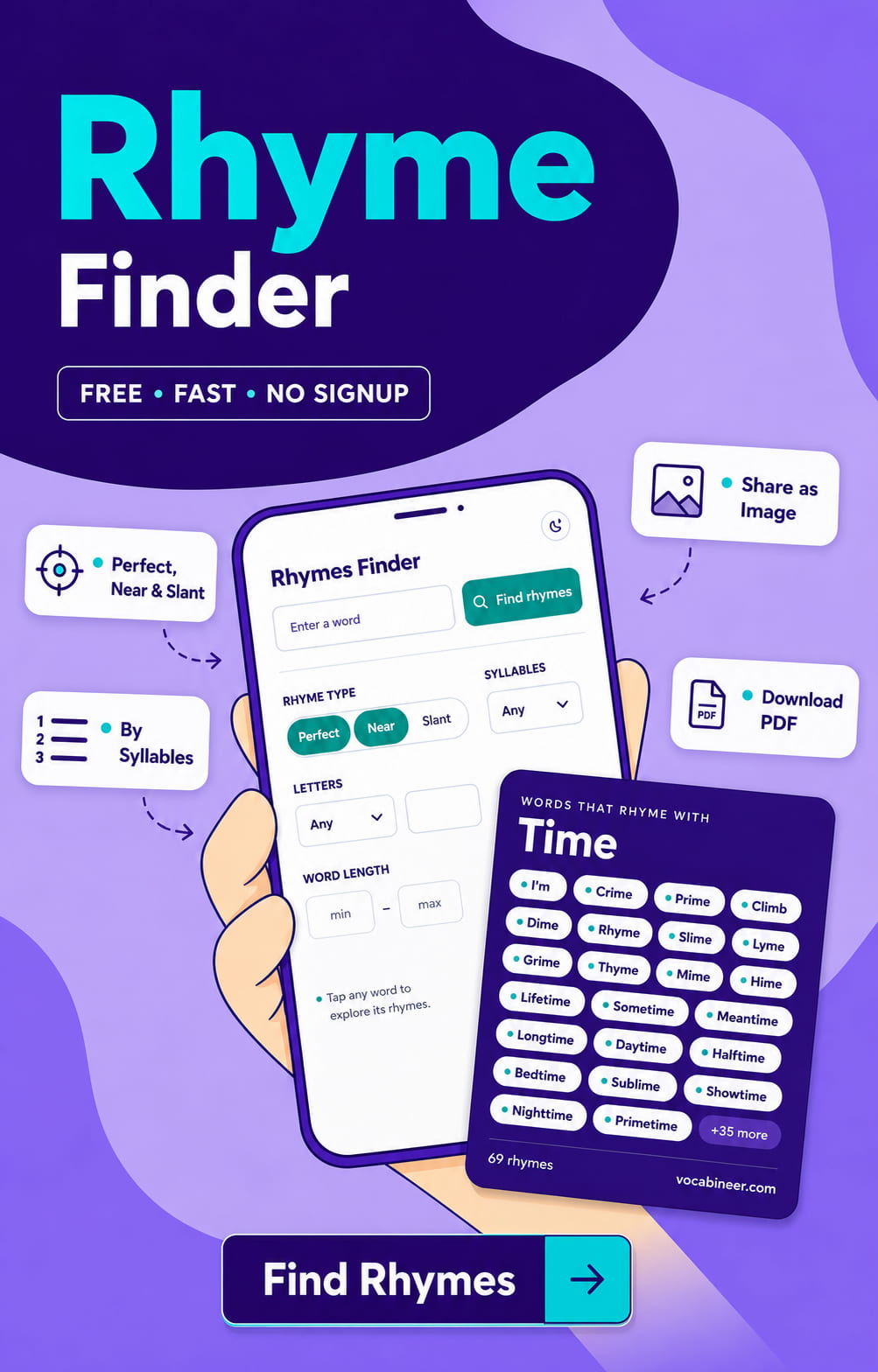
This rhyme finder gives you every word that rhymes with the one you type, ranked from closest match to loosest and grouped by syllable count. Type a word, read the results already sorted best first, and tap any word to explore its own rhymes. Whether you write songs, poems, raps, or you teach English, this free rhymes finder turns a slow search through memory into an instant, organized list of real words you can actually use.
Most rhyming tools hand you one long, flat column of matches mixed with surnames and abbreviations, then leave you to sort the good from the useless. This one ranks rhymes by quality, shows real words first, covers modern slang, and lets you save any search as a shareable image or a printable PDF. The sections below show how to read the results, what each rhyme type does, and why this finder outperforms the older rhyming dictionaries.
What Is a Rhymes Finder
A rhymes finder is a tool that takes a word and returns other words ending in the same sound. It works from the phonetics of a word, not its spelling, so it matches what the ear hears rather than what the letters suggest. A strong rhymes finder does three things at once: it identifies the matching sound, it ranks every result by how closely that sound aligns, and it organizes the list so you can find the right word fast.
This finder reads each word from a phonetic dictionary, locates the final stressed vowel, and matches every word that shares the sound from that point onward. That phonetic core is why it can pair hello with below and no, words that look nothing alike on the page yet rhyme perfectly to the ear.
How the Rhyme Finder Works
The tool takes one word and returns three layers of rhyme. Perfect rhymes come first, near rhymes follow, and slant rhymes appear once you switch them on. That order holds every time, because the closest matches are almost always the ones you want to read first.
Inside each layer, the words sort again by syllable count. One-syllable rhymes group together, then two-syllable rhymes, then longer ones. This second sort matters more than it first appears, because a rhyme only works when it also fits the beat of your line. A songwriter hunting for a single-syllable word to end a chorus finds them gathered in one place, not scattered through longer matches.
You keep control of the order through the sort menu. You can rank words by how common they are, how closely they rhyme, their syllable count, or alphabetically. Whatever you pick, the sort only rearranges words inside their layer. A near rhyme never jumps ahead of a perfect one, so the strongest matches always stay on top. That single rule is where many older rhyming dictionaries fall short, because they pour every match into one flat list and leave you to dig.
Perfect, Near, and Slant Rhymes
Not every rhyme sounds the same, and the difference between the three main types decides how a line lands. Once you can hear them apart, you choose the effect you want instead of taking the first match offered.
Perfect rhymes match every sound from the stressed vowel to the end of the word. Cat and hat are perfect rhymes, and so are night and light. They close a line firmly, which is why hooks, choruses, and punchlines lean on them. A verse built only on perfect rhymes, though, starts to sound like a nursery rhyme.
Near rhymes answer that problem. They share most of the ending sound without matching all of it, as in home and alone, or dream and green. Because they connect the ear without locking it shut, they let you keep the word that carries your exact meaning. Most modern songwriting runs on near rhyme for this reason. Taylor Swift, Bob Dylan, and Kendrick Lamar all use it to keep lines sounding like real speech.
Slant rhymes stretch the link further. The sounds resemble each other without truly matching, as in month and plinth, or worm and storm. The tool keeps them switched off at first, because they open the results so wide. You turn them on when a word has few close matches, or when you want a subtler, less expected sound. For words long thought impossible to rhyme, such as orange and month, slant rhymes are the real answer, and the finder brings them forward the moment nothing closer exists.
Two smaller types are worth knowing. An eye rhyme looks like a rhyme on the page but breaks when you say it aloud, as in love and move. An internal rhyme falls inside a line rather than at the end, the way store and more echo in “I drove to the store to explore some more.” Poets and rappers reach for both when they want a rhyme that hides in plain sight.
The best writing rarely picks one type and stays there. A common approach builds a verse with near and slant rhymes, then lands a perfect rhyme on the line that matters most. That contrast is what keeps a listener leaning in.
Filter by Syllable Count to Match Your Rhythm
A rhyme that fits your meaning but breaks your rhythm still ruins the line. This is where the syllable filter earns its place, because it narrows the results to words of a single length.
Say you need a punchy ending for a hook. You filter the rhymes for fire down to one syllable, and higher, desire, choir appear with no longer words crowding them out. Now say you are writing a denser rap line. You switch the filter to two or three syllables, and the intricate matches rise up, the kind of dedication and celebration pairing that makes a bar land. Short rhymes hit hard and suit choruses, while longer rhymes carry more complexity and suit verses. Matching syllables this way turns a plain word list into a rhythm tool, which is exactly what a working writer reaches for first.
Why Stress Decides What Rhymes
Rhyme follows sound, not spelling, and the sound that matters most is where the stress falls. A rhyme begins at the stressed vowel and runs to the end of the word, which explains a few pairings that catch people off guard.
Take hello. It rhymes perfectly with no, go, and below, because the stress in hello sits on the final syllable, hel-LOH. The same rule explains why yellow and fellow do not rhyme with it, even though they look like a closer fit. Their stress lands on the first syllable, YEL-low, so the matching ends before it begins.
The finder reads this stress from a phonetic dictionary rather than guessing from the letters. That is why it groups words by the sound a speaker actually makes, and why its results hold up where a letter-matching tool falls apart. For English learners, this accuracy carries a second benefit. Searching rhymes trains the ear to hear stress and vowel patterns, the same patterns that decide pronunciation across thousands of other words.
A Dictionary That Shows Real Words
Many rhyming dictionaries pad their results with surnames, abbreviations, and obscure entries almost nobody recognizes. Search a common word on one of them, and you scroll past hundreds of so-called matches that turn out to be place names and dictionary filler. The good rhyme is in there, but you have to find it first.
The Rhyme Finder takes a different approach. Every result is checked against a list of the 120,000 most common English words, so what you see by default are words you would actually write. The rarer matches and proper nouns still exist, tucked behind a single button you open whenever you want a deeper cut. Search butter, for example, and the results lead with utter, cutter, flutter, gutter, not a column of unfamiliar names.
The dictionary also keeps pace with how people write now. Alongside standard vocabulary, it rhymes modern and slang words such as bestie, ghosted, simp, glow-up, and rizz. Writers fill songs and captions with these words every day, so a rhyme tool that ignored them would strand you in a version of English nobody actually speaks.
Why This Rhymes Finder Outperforms the Rest
- Rhymes ranked by closeness. Perfect, then near, then slant, every time, so the best matches stay on top instead of mixing into one flat list.
- Grouped by syllable. Results split by length, with an optional syllable-only view, so the rhythm-matched word is easy to find.
- Real words first. A quality filter hides obscure filler by default and keeps rare and name words one tap away.
- Modern slang included. Today’s words rhyme too, and the dictionary keeps growing.
- Shareable image cards. Wide, square, and pin sizes for social media, which no traditional rhyming dictionary offers.
- Complete PDF export. The full rhyme set for a word, sectioned by type and syllable, ready to print.
- Built for learners. Stress explanations and a clean layout that serve ESL students, not only songwriters.
- Free and fast. No signup, results as you type, the same on phone and desktop.
Turn Any Search Into a Shareable Card
Most rhyme tools end at the list. This one turns any search into a finished image worth sharing. Once you have your results, the share panel builds a clean, styled card that shows your word and its best rhymes, ready to post.
You build that card in three sizes, each matched to where words travel. A wide card at 1200 by 630 suits a blog header or a Facebook post. A square card at 1080 by 1080 fits Instagram. A tall pin at 1000 by 1500 is sized for Pinterest, where word and language content spreads well. You see a live preview as you choose, then download the card or send it straight to an app through your phone. For a teacher, that is an instant classroom visual. For a writer, it is a way to share a clever find in one tap.
Download the Full List as a PDF
A card shows the highlights, but sometimes you want every rhyme in your hands. For that, the finder builds a printable PDF of the complete results. It opens with your word in a clean header, then lays out the perfect, near, and slant rhymes in turn, each split into syllable groups and arranged in tidy columns.
This is the version writers keep beside them. A songwriter prints a rhyme bank for the studio. A teacher hands word lists to a class. A poet marks up the page by hand. Whatever the use, the PDF turns a quick search into something you can print, keep, and return to later.
Built for Learners, Not Only Writers
Most rhyme tools speak only to lyricists. This one serves English learners with equal care. Rhyme is how children, and adult learners, first feel the patterns of a language, the way sounds group together and where stress falls. Searching rhymes trains that ear faster than rote drilling.
The finder leans into that. It explains why words rhyme when the answer surprises, and it flags when a word has no rhymes of a certain type instead of leaving a learner guessing. The plain-language layout, free of clutter and side panels, means a student is reading words rather than fighting an interface. For an ESL classroom, the finder doubles as a pronunciation aid, because every group of rhymes is a group of words that share a sound.
A Tool That Keeps Growing
The Rhyme Finder is not a fixed list shipped once and forgotten. The dictionary expands as language moves, with new slang and modern terms added so your searches reflect how people write today. The matching engine, the filters, and the share and export features are refined on a regular basis. When readers search for a word the tool cannot yet answer well, that gap is logged and filled. The result is a tool that grows sharper over time, rather than one that ages the way the older rhyming sites have.
Explore Our Word-by-Word Rhyme Library
The finder gives you the words. Our rhyme library shows you how to use them, one word at a time, across the kinds of writing rhyme serves best. Each guide pairs a full rhyme list with examples, so you see the words working inside real lines rather than sitting in isolation.
- Words That Rhyme With Love: perfect, near, and slant options for the most-searched rhyme in songwriting.
- Rhyming Words for Kids: short, friendly rhymes built for early readers and classroom poetry.
- Rhymes for Rap and Hip-Hop: multi-syllable and slant rhymes that give your bars more flex.
- Rhyming Words for Songs: matching rhyme to melody, hook, and verse.
- Rhyming Words in Example Sentences: every rhyme shown inside a real line, not just a list.
FAQs
A perfect rhyme matches every sound from the stressed vowel to the end of the word, the way light matches night. A slant rhyme shares only part of that sound, the way light leans toward line without fully matching it. Perfect rhymes sound finished and resolved, while slant rhymes sound open and modern.
Some words genuinely have none, and the count reports the truth instead of padding the list. A word that ends in a single sound, such as yes, either matches that sound exactly, which makes a perfect rhyme, or drifts into slant territory. There is no middle ground for a near rhyme to fill.
Yes, and those are often the most interesting searches. When a word has no perfect or near rhymes, the finder brings forward its slant rhymes automatically. Orange pairs with lozenge, while month opens up to ninth and plinth once you switch slant rhymes on.
Yes. It is completely free, asks for no signup, and runs in any browser on both phone and desktop. The results appear as you type, with nothing to install.
It does. Alongside standard vocabulary, the dictionary rhymes current words like bestie, ghosted, and glow-up, so your results match the way people write today, and the word list keeps growing.
Yes, in two ways. You turn any search into a social-media card in three sizes, or you download the full set of rhymes as a printable PDF, organized by rhyme type and syllable count.
Yes. Because rhymes group words that share a sound, the tool doubles as a pronunciation aid. It also explains why certain words rhyme, which helps learners hear stress and vowel patterns that carry across the wider language.
It ranks rhymes by closeness and groups them by syllable, shows real words by default rather than obscure filler, includes current slang, and lets you share results as images or printable PDFs. It is also built to serve learners, not only songwriters.