

Time nouns are nouns that name points of time, periods of time, and time-related parts of life in English. They help learners talk about when something happens, how long it lasts, and how time is measured.
This article gives a useful list of 80 time nouns in English with grouped sections and simple sentences. It helps learners build vocabulary, improve sentence writing, and use time words more clearly in daily English.
In This Page
What Are Time Nouns?
Time nouns are nouns that name time, time periods, calendar units, and stages connected to life, history, or daily routines.
For example, words like day, month, morning, and century are time nouns because they name specific parts or measures of time. These nouns are useful in speaking, writing, reading, and everyday conversation.
- day
- week
- month
- year
- morning
- century
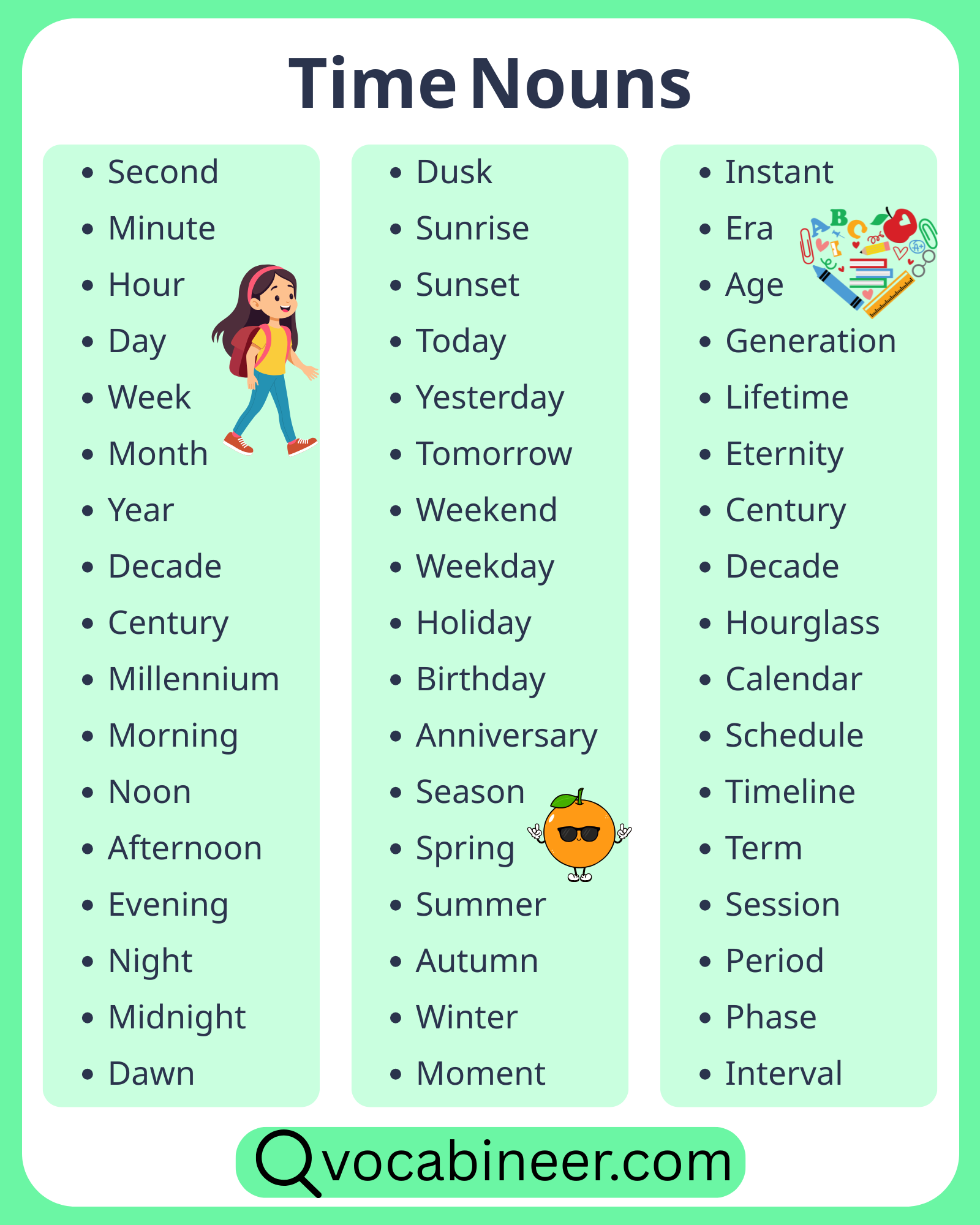
List of Time Nouns in English
Here is a useful list of 80 time nouns in English, including parts of the day, short periods, longer periods, calendar nouns, and history-related time nouns.
- Morning
- Afternoon
- Evening
- Night
- Dawn
- Sunrise
- Sunset
- Midnight
- Noon
- Daybreak
- Second
- Minute
- Hour
- Moment
- Instant
- While
- Break
- Pause
- Delay
- Interval
- Day
- Week
- Fortnight
- Month
- Season
- Year
- Decade
- Century
- Age
- Era
- Monday
- Tuesday
- Wednesday
- Thursday
- Friday
- Saturday
- Sunday
- January
- February
- March
- April
- May
- June
- July
- August
- September
- October
- November
- December
- Weekend
- Weekday
- Holiday
- Birthday
- Anniversary
- Vacation
- Childhood
- Youth
- Adulthood
- Old Age
- Lifetime
- Past
- Present
- Future
- History
- Prehistory
- Yesterday
- Today
- Tomorrow
- Deadline
- Schedule
- Timetable
- Term
- Session
- Shift
- Period
- Spell
- Occasion
- Festival
- Ceremony
- Epoch
Parts of the Day Time Nouns Examples
Parts of the day time nouns name daily time divisions, so they help learners talk clearly about routine actions and everyday events.
Morning
Morning is my favorite time for study.
Afternoon
The meeting starts in the afternoon.
Evening
We usually walk in the evening.
Night
The streets become quiet at night.
Dawn
The birds started singing at dawn.
Sunrise
We watched the sunrise from the hill.
Sunset
The beach looked beautiful at sunset.
Midnight
The train arrived at midnight.
Noon
Lunch is served at noon.
Daybreak
The sky looked pink at daybreak.
Short Periods of Time Nouns Examples
Short periods of time nouns name small units or brief stretches of time, so they are common in daily speech and writing.
Second
Wait a second, please.
Minute
I will be ready in a minute.
Hour
The lesson lasted an hour.
Moment
She stood silent for a moment.
Instant
He answered in an instant.
While
Stay here for a while.
Break
We took a short break after class.
Pause
There was a pause before he spoke.
Delay
The flight faced a delay.
Interval
There was a short interval between the two programs.
Longer Periods of Time Nouns Examples
Longer periods of time nouns name extended spans of time, so they help learners talk about long-term events and measurement.
Day
The whole day felt busy.
Week
We have a test next week.
Fortnight
He stayed there for a fortnight.
Month
This month has gone very quickly.
Season
Spring is my favorite season.
Year
Last year was full of changes.
Decade
A decade is ten years long.
Century
That building is over a century old.
Age
The story comes from another age.
Era
The internet changed the modern era.
Calendar and Date Time Nouns Examples
Calendar and date time nouns name weekdays, months, and special date-related time words used in schedules and daily planning.
Monday
Our classes begin on Monday.
Friday
We finish school early on Friday.
January
January is the first month of the year.
June
My vacation starts in June.
October
The weather becomes cooler in October.
Weekend
We visited our grandparents on the weekend.
Weekday
The roads are busy on weekdays.
Holiday
The children enjoyed the holiday.
Birthday
Her birthday is in March.
Anniversary
They celebrated their anniversary at dinner.
Historical and Lifetime Time Nouns Examples
Historical and lifetime time nouns name stages of life, broad time ideas, and major periods connected to history and human experience.
Childhood
My childhood was full of happy memories.
Youth
He spent his youth in a small town.
Adulthood
Adulthood brings many responsibilities.
Old Age
Good care is important in old age.
Lifetime
She achieved a lot in her lifetime.
Past
We can learn from the past.
Present
The present matters most right now.
Future
Everyone hopes for a better future.
History
History teaches us important lessons.
Epoch
This invention marked a new epoch.
Time Nouns in Sentences
These examples show how time nouns work in simple sentences, so learners can understand meaning and usage more easily.
- Morning is the best time for exercise.
- We met in the afternoon.
- The stars were bright at night.
- Please wait a minute.
- The class lasted an hour.
- I will finish the task this week.
- Summer is a hot season.
- Last year was very busy for us.
- Friday is my favorite weekday.
- Her birthday is in August.
- Childhood is a special part of life.
- We should learn from history.
- The future depends on today’s work.
- There was a delay before the bus arrived.
- The ceremony began at noon.
FAQs
Time nouns are nouns that name time, time periods, calendar units, and stages related to daily life, history, or human experience.
Some common examples are day, week, month, year, morning, night, and century.
Yes, weekdays and months are time nouns because they name specific units of time in the calendar.
Time nouns are important because they help learners talk clearly about schedules, routines, dates, time periods, and life stages.
Yes, time nouns are very common in daily conversation because people often talk about days, months, mornings, evenings, and future plans.
Summary
Time nouns name points of time, periods of time, calendar units, and life stages in English. They help learners talk about routine, duration, history, and future events more clearly. In this article, you learned 80 time nouns in English with grouped examples and easy sentence use.
Read More
- List of Nouns in English
- Possessive Nouns in English
- Proper Nouns for People in English
- Singular Collective Nouns in English