

Collective nouns for people are words that name a group of people as one unit. Instead of naming each person separately, these words give one name to the whole group. Words like team, class, family, and audience are common examples of collective nouns for people.
In this easy-to-follow guide, you will find 100 collective nouns for people in English arranged in clear sections. The article covers common people groups, everyday group names, family and social groups, work and team groups, official and public groups, performer groups, and unusual people group names. Whether you are a student, teacher, writer, or English learner, this article will help you understand and use collective nouns for people in a simple and useful way.
In This Page
What Are Collective Nouns for People?
A collective noun for people is a word that names a group of people as one unit.
For example:
- Team means a group of players
- Class means a group of students
- Family means a group of related people
- Audience means a group of people watching or listening
These nouns are useful because they make speaking and writing shorter, clearer, and more natural.
100 Collective Nouns for People in English
Below is a list of 100 collective nouns for people in English in a simple and easy-to-scan format.
- Team
- Class
- Family
- Staff
- Audience
- Committee
- Crew
- Group
- Crowd
- Band
- Choir
- Panel
- Jury
- Army
- Society
- Company
- Board
- Tribe
- Club
- Delegation
- Faculty
- Patrol
- Cabinet
- Assembly
- Congregation
- Circle
- Party
- Posse
- Regiment
- Squadron
- Troupe
- Bevy
- Host
- Corps
- Council
- Union
- Pair
- Couple
- Crowd
- Gathering
- Mob
- Throng
- Gang
- Brotherhood
- Sisterhood
- Fellowship
- Community
- Neighborhood
- Delegacy
- Teamwork Group
- Orchestra
- Cast
- Crew Team
- Task Force
- Workforce
- Management
- Leadership
- Board of Directors
- Editorial Team
- Search Party
- Rescue Team
- Coaching Staff
- Study Group
- Peer Group
- Support Group
- Wedding Party
- Circle of Friends
- Scout Troop
- Dance Troupe
- Choir Group
- Jury Panel
- Press Corps
- Police Force
- Fire Brigade
- Advisory Board
- Steering Committee
- Governing Body
- Review Panel
- Task Group
- Working Group
- School Board
- City Council
- Senate
- Parliament
- Ministry
- Administration
- Cabinet Team
- Audience Crowd
- Fan Base
- Viewership
- Readership
- Congregation Group
- Production Crew
- Film Cast
- Music Band
- Ensemble
- Fellowship Group
- Rescue Squad
- Flight Crew
- Guard Unit
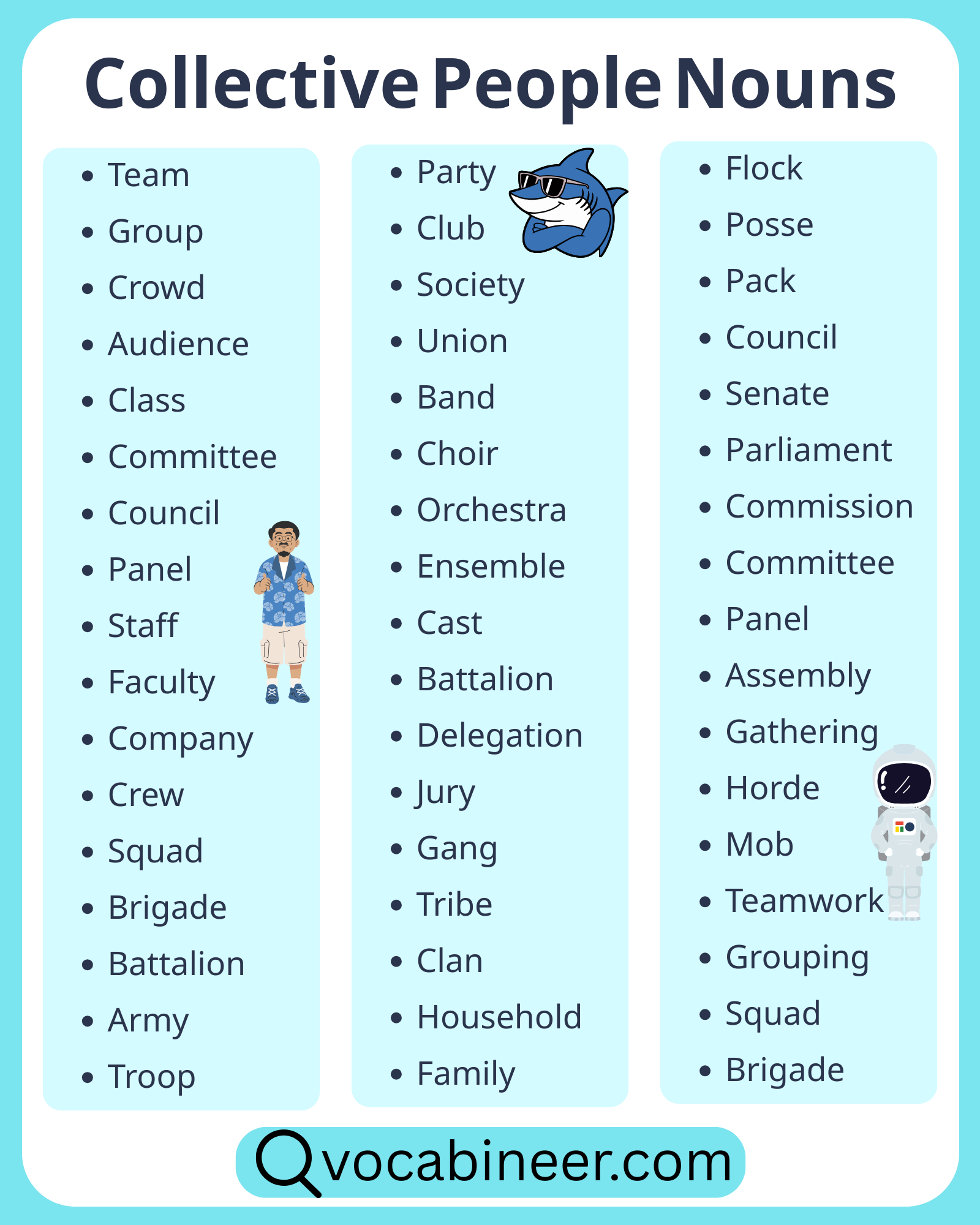
Common Collective Nouns for People
These are some of the most familiar collective nouns for people.
- Team — a group of players or workers
- Class — a group of students
- Family — a group of related people
- Staff — a group of workers in one place
- Audience — a group of people watching or listening
- Committee — a group chosen for a purpose
- Crew — a group working together
- Group — a general word for several people together
- Crowd — a large group of people
- Band — a group of musicians
- Choir — a group of singers
- Panel — a small group of experts or speakers
- Jury — a group of people in a court case
- Board — a group managing an organization
- Club — an organized social or activity group
These are the most useful words to learn first because they are common in everyday English.
Everyday Collective Nouns for People
These group names appear often in daily speaking and writing.
- Family
- Team
- Class
- Staff
- Audience
- Group
- Crowd
- Club
- Choir
- Band
- Couple
- Pair
- Community
- Neighborhood
- Circle
These words are simple, practical, and easy to understand.
Collective Nouns for Family and Social Groups
These collective nouns are used for family, friendship, and social connections.
- Family — a group of related people
- Couple — two people together
- Pair — two people linked together
- Brotherhood — a group joined by shared values or identity
- Sisterhood — a group of women with a shared bond
- Fellowship — a friendly or united group
- Community — people living together or sharing common interests
- Neighborhood — people living in the same area
- Circle of Friends — a close social group
- Wedding Party — the group involved in a wedding
- Support Group — people helping one another
- Peer Group — people of a similar age or status
Collective Nouns for Work and Team Groups
These collective nouns are used for jobs, teamwork, and organized working groups.
- Team — a group working together
- Staff — workers in one place
- Crew — people working together on a task
- Workforce — all the workers in an organization
- Management — the group that manages
- Leadership — the leading group in an organization
- Task Force — a group formed for a special job
- Study Group — learners working together
- Task Group — a small working group
- Working Group — people solving a shared problem
- Coaching Staff — trainers and coaches together
- Flight Crew — workers on an aircraft
- Production Crew — people making a show or film
- Editorial Team — a group of editors
- Search Party — a group looking for someone or something
- Rescue Team — a group helping in danger
- Rescue Squad — an emergency response group
- Guard Unit — a group assigned to protect
Collective Nouns for Official and Public Groups
These collective nouns are used for formal, public, or official bodies.
- Committee — a group chosen for a purpose
- Jury — a legal decision-making group
- Cabinet — a group of top government advisers
- Assembly — a gathering of people
- Congregation — a group in a religious gathering
- Council — a governing or advisory group
- Union — an organized workers’ group
- Delegation — a group sent to represent others
- Board of Directors — the managing group of a company
- Advisory Board — a group giving advice
- Steering Committee — a group guiding a project
- Governing Body — an official controlling group
- Review Panel — a group evaluating something
- School Board — a group managing school matters
- City Council — an elected city group
- Senate — a governing body
- Parliament — a national law-making group
- Ministry — a government department group
- Administration — the group that manages public affairs
- Press Corps — a group of reporters
Collective Nouns for Performers and Entertainers
These collective nouns are linked with music, acting, and performance.
- Band — a group of musicians
- Choir — a group of singers
- Orchestra — a large group of musicians
- Cast — a group of actors
- Troupe — a group of performers
- Dance Troupe — a group of dancers
- Film Cast — actors in a film
- Music Band — musicians playing together
- Ensemble — a coordinated group of performers
- Audience — the people watching a performance
Small and Large Groups of People
Different collective nouns can suggest small or large groups.
Small Groups of People
- Pair
- Couple
- Panel
- Jury
- Crew
- Committee
- Circle
- Study Group
- Task Group
- Support Group
Large Groups of People
- Crowd
- Audience
- Assembly
- Congregation
- Army
- Society
- Community
- Throng
- Mob
- Host
This variation helps learners understand how group size can affect word choice.
Unusual Collective Nouns for People
Some collective nouns for people are less common but still interesting to know.
- Bevy — a group of women or people
- Host — a large number of people
- Posse — a group gathered for a purpose
- Corps — a body of trained people
- Throng — a large tightly packed crowd
- Gang — a group acting together
- Fellowship — a close united group
- Brotherhood — a group linked by a shared idea or identity
- Sisterhood — a united group of women
- Delegacy — a body of delegates
These add variety and make the article more comprehensive.
Collective Nouns for People in Sentences
Here are some simple sentence examples that show how collective nouns for people are used in real English.
- The team won the final match.
- Our class is learning grammar today.
- Her family lives in the same city.
- The staff welcomed the guests warmly.
- A large audience watched the show.
- The committee made a final decision.
- The crew worked all night on the project.
- A big crowd gathered outside the stadium.
- The choir sang beautifully in the hall.
- The board approved the new plan.
FAQs
Collective nouns for people are words that name a group of people as one unit. Examples include team, class, family, and audience.
Some common examples are staff, committee, crew, crowd, choir, and board. These words are often used in everyday English.
They are important because they help us talk about groups of people in a shorter and clearer way. They are useful in both speaking and writing.
Yes, many of them are used in formal English. Words like committee, jury, cabinet, council, and delegation are common in official contexts.
The easiest way is to start with the most common group names, such as team, class, family, staff, and audience, and then learn more specialized ones later.
Summary
This article covered 100 collective nouns for people in English with examples and included sections for common group names, everyday group names, family and social groups, work and team groups, official and public groups, performer groups, small and large groups of people, and unusual people group names. It also showed how these words are used in simple sentences.
This kind of guide is useful for students, teachers, writers, and English learners because it makes collective nouns for people easier to understand and remember. It also helps readers use more natural and accurate English when talking about groups of people.
Read More
- List of Nouns in English
- Common Singular Nouns List
- Examples of Masculine and Feminine
- Collective Nouns for Animals in English