

Estimated from sentence length and syllable density.
- Syllables per line
- –
- Total syllables
- 0
- Lines
- 0
- Words
- 0
- Average syllables per line
- 0
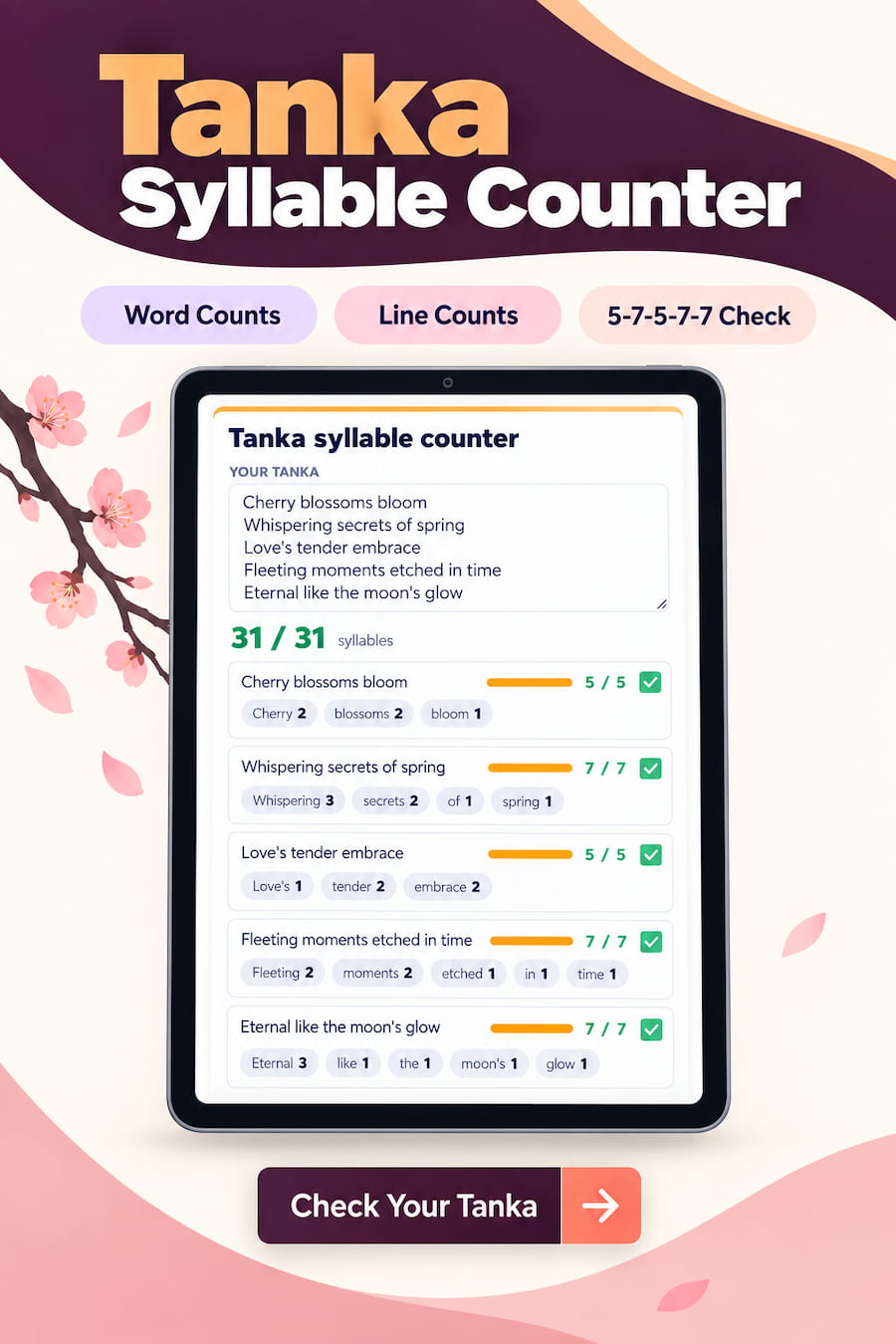
Paste your five lines into this tanka checker, and every line and every word shows its syllable count as you type. The same box works as a tanka syllable counter, testing the poem against 5-7-5-7-7 and telling you whether it meets the form.
Poets use it to settle a line before submitting to a journal, and teachers use it to mark a class set of tanka in minutes. There is no sign-up, and it works in any phone or desktop browser.
How Many Syllables Are in a Tanka?
A tanka has 31 syllables across five lines, counted 5-7-5-7-7. The first and third lines take 5 syllables each, and the second, fourth, and fifth take 7.
Those 31 syllables are why the form is called misohitomoji in Japanese, meaning thirty-one letters. When you check how many syllables in a tanka line, the answer depends on its position, and the tanka checker marks each one against its own target.
How Many Lines Does a Tanka Have?
A tanka has five lines. The checker flags a draft with four lines or six, and it names the fix, such as “Add one more line — a tanka has 5 lines.”
A haiku, by comparison, has three. The tanka’s extra pair of 7-syllable lines is what gives the form room for feeling that a haiku leaves out.
How to Use the Tanka Checker
- Type or paste your tanka into the box, one line per row.
- Read the count beside each line and under each word as you type.
- Watch each line against its target of 5, 7, 5, 7, or 7.
- Fix any line the checker names, such as “Line 4 has 4 syllables — add 3 to reach 7.”
- Stop when the total reads 31 / 31 and every item on the checklist is green.
Tanka Checker Features
Most tanka checkers show five numbers and leave the fixing to you. This one counts the syllables in every word and line, then tests the whole poem against the form and gives a verdict.
Syllable Count for Every Line and Word
See where each line’s total comes from. Every line shows its count, and a row of word chips beneath it lists each word with its own count, such as morning 2 · frost 1 · retreats 2. When a line is one beat long, the chips show exactly which word to trim.
Tanka Syllable Count Results
Get the numbers for the whole poem in one panel. The results list syllables per line, total syllables, lines, words, and the average per line. A finished tanka reads 5 · 7 · 5 · 7 · 7, with 31 syllables in total.
5-7-5-7-7 Check With Named Fixes
Know how close the poem is to its target at a glance. A total at the top reads the syllables written against the 31 a tanka requires, such as 24 / 31 for a draft in progress. When a line misses, the tanka syllable counter names it along with the difference, so you fix the right line without recounting the others.
Is This a Tanka? The Five-Point Checklist
Get a verdict, not only a count. Beneath the lines, the tanka checker a checklist tests the poem on five points: five lines, the 5-7-5-7-7 count, seasonal imagery, a turn after the third line, and end rhyme. When the first two pass, the verdict reads “Meets the tanka form: 5 lines in 5-7-5-7-7.”
The last three points advise rather than decide. The checklist names any seasonal image it finds, without asking for one, since a season word belongs to the haiku rather than the tanka. It marks a turn signalled by a dash or line-end punctuation, and warns when two lines rhyme.
Free Counting in Any Browser
No account, no install, no limit. This tanka format checker works the same on a phone, a tablet, and a desktop, and your poem is counted in your own browser.
The 5-7-5-7-7 Structure of a Tanka
A tanka has five lines counted 5-7-5-7-7, thirty-one syllables in all. Japanese poets treat it as two parts. The first three lines are the kami-no-ku, the upper phrase, and the closing pair of 7-syllable lines is the shimo-no-ku, the lower phrase.
morning frost retreats — 5 a sparrow lands on the rail — 7 steam climbs off the fence — 5 the kettle hums on the stove — 7 we say nothing for a while — 7
The upper phrase sets a scene, exactly as a haiku would. The lower phrase answers it with feeling or reflection, which is the work a haiku has no room to do.
Related:
The Pivot Between the Upper and Lower Phrase
The pivot is the hinge between the two phrases, and the poem turns on it. Line three commonly belongs to both halves at once, closing the image before it and opening the reflection that follows.
English poets mark the pivot with a dash, a line break, or a shift in voice. The tanka checker looks for one and notes its absence, because a tanka whose five lines read as a single sentence loses the two-part shape the form is built on.
How to Count Syllables in a Tanka
Counting tanka syllables comes down to vowel sounds rather than vowel letters, since the count follows pronunciation rather than spelling. A silent e adds no beat, so stove is one syllable. A final -le keeps its beat, so ket-tle is two. When one word looks wrong, split it in the syllable divider to see each beat.
Numerals count the way they are spoken, so 7 is two syllables and 1905 is four. A handful of words produce most disputes:
| Word | Syllables | Reason |
|---|---|---|
| Fire | 1 or 2 | One beat in clipped speech, two when drawn out as fi-er |
| Hour | 1 | The h is silent, and the word sounds like our |
| Every | 2 | Spoken ev-ry in conversation |
| Flower | 2 | Flow-er, shortened to one beat in fast speech |
| Poem | 2 | Two beats, po-em, despite its short spelling |
| Being | 2 | Be-ing, with two separate vowel sounds |
The tanka checker follows the most common pronunciation for these words. Where your accent gives a different count, adjust the line by ear and read it aloud before you settle on a word.
Related: Word Stress Syllable in English with Rules and Examples
Tanka Examples With Syllable Counts
Both poems here meet the 5-7-5-7-7 count line for line. The first turns on a letter, a subject the classical poets returned to; the second stays with an ordinary moment.
your letter arrives — 5 the stamp from a town I left — 7 ten winters have passed — 5 I read it twice by the door — 7 then once more with my coat on — 7
the last train pulls out — 5 a paper cup rolls along — 7 the empty platform — 5 I check the time from habit — 7 there is nowhere left to be — 7
In each, the upper phrase reports what the eye sees, and the lower phrase says what it costs. Paste either into the tanka checker for a check against the same count.
Tanka vs Haiku
The two forms share a counting habit and a heritage, and they differ in length and in what they carry.
| Form | Syllable count | Lines | Focus |
|---|---|---|---|
| Tanka | 5-7-5-7-7 | 5 | Emotion and reflection, with a turn after line three |
| Haiku | 5-7-5 | 3 | A moment in nature, tied to a season |
The tanka is the older form. The haiku grew out of the hokku, the opening stanza of linked verse, which itself follows the tanka’s first three lines. Writing in the shorter form instead? Open the haiku syllable counter, which checks three lines against 5-7-5.
Where the Tanka Came From
The tanka began as waka, the court poetry of classical Japan, and it has an unbroken history of more than a thousand years. Japan’s earliest surviving anthology, the Man’yōshū, was compiled in the eighth century and contains thousands of poems in the form.
During the Heian period, waka became the poetry of the imperial court, and the Kokinshū gathered the work of poets such as Ono no Komachi and Ki no Tsurayuki. Their subjects were love, loss, the seasons, and the passing of time, and courtiers exchanged tanka as letters.
Masaoka Shiki renamed and revived the form in the late nineteenth century, the same reformer who gave the haiku its modern name. Two related forms belong to the same waka family: the chōka, or long poem, and the sedōka, counted 5-7-7-5-7-7. The tanka checker measures the tanka itself, five lines counted 5-7-5-7-7.
Common Tanka Mistakes
- ✅ Count vowel sounds, not vowel letters, since stove has two vowel letters and one beat.
- ❌ Never pad a line with filler words to reach 7, because a forced syllable shows.
- ❌ Avoid writing five lines that read as one flat sentence, since a tanka turns between its upper and lower phrase.
- ✅ Let the lower phrase answer the upper one rather than repeating it.
- ✅ Replace a long word with a shorter one from the one syllable words or two syllable words lists when a line goes over.
- ❌ Avoid relying on spelling for words such as fire, hour, and flower, which shift with accent.
When the count and the feeling conflict, change the wording rather than the form. A tidy 31 syllables with nothing at stake is the most common miss of all.
FAQs
Q1. How do I check if a poem is a tanka?
Paste it into the tanka checker, one line per row. A poem meets the tanka form when it has five lines counted 5-7-5-7-7, and the checklist adds advice on a seasonal word, the turn, and end rhyme.
Q2. How many syllables does each line of a tanka have?
The first line has 5 syllables, the second 7, the third 5, the fourth 7, and the fifth 7. Together they make the 31 syllables of a traditional tanka.
Q3. Does a tanka have to be exactly 31 syllables?
In English, not strictly. Japanese counts on, a sound unit shorter than an English syllable, so many English-language tanka come in under 31. Contests and editors differ, and the Tanka Society of America has awarded poems that exceed it.
Q4. What is the difference between a tanka and a haiku?
A tanka has five lines and 31 syllables; a haiku has three lines and 17. The tanka turns after its third line into reflection, while the haiku keeps to a single image.
Q5. What is the pivot in a tanka?
The pivot is the turn between the upper phrase, the first three lines, and the lower phrase, the closing pair. Line three frequently belongs to both halves at once.
Q6. Why does my syllable count differ from the checker?
Words such as fire, every, and poem have more than one accepted pronunciation. Accent also shifts words like flower and hour, so read the line aloud and adjust by ear.
Q7. Does a tanka rhyme?
No, a traditional tanka does not rhyme. Its music comes from the 5-7-5-7-7 count and the turn between the two phrases, and the checklist warns when two lines rhyme.
Q8. What is the plural of tanka?
The plural of tanka is tanka, the same as the singular. Tankas is common in casual writing, but tanka is the standard form in poetry publishing.