

Syllable divider
Type a word to see it split into syllables.
A syllable divider takes any word you type and breaks it into its exact syllables — determination turns into de·ter·mi·na·tion, four beats you can read, say, and count. Think of it as a syllable separator that marks every break point for you, so you never have to guess where one syllable ends and the next begins.
Type a word into the divider below and the breakdown appears at once: the syllable split, the number of beats, the pronunciation, and the words related to it. Underneath the tool you get the rules behind each split, so you can divide words into syllables on your own — on paper, in a lesson, or while you write a line of poetry.
What Is a Syllable Divider?
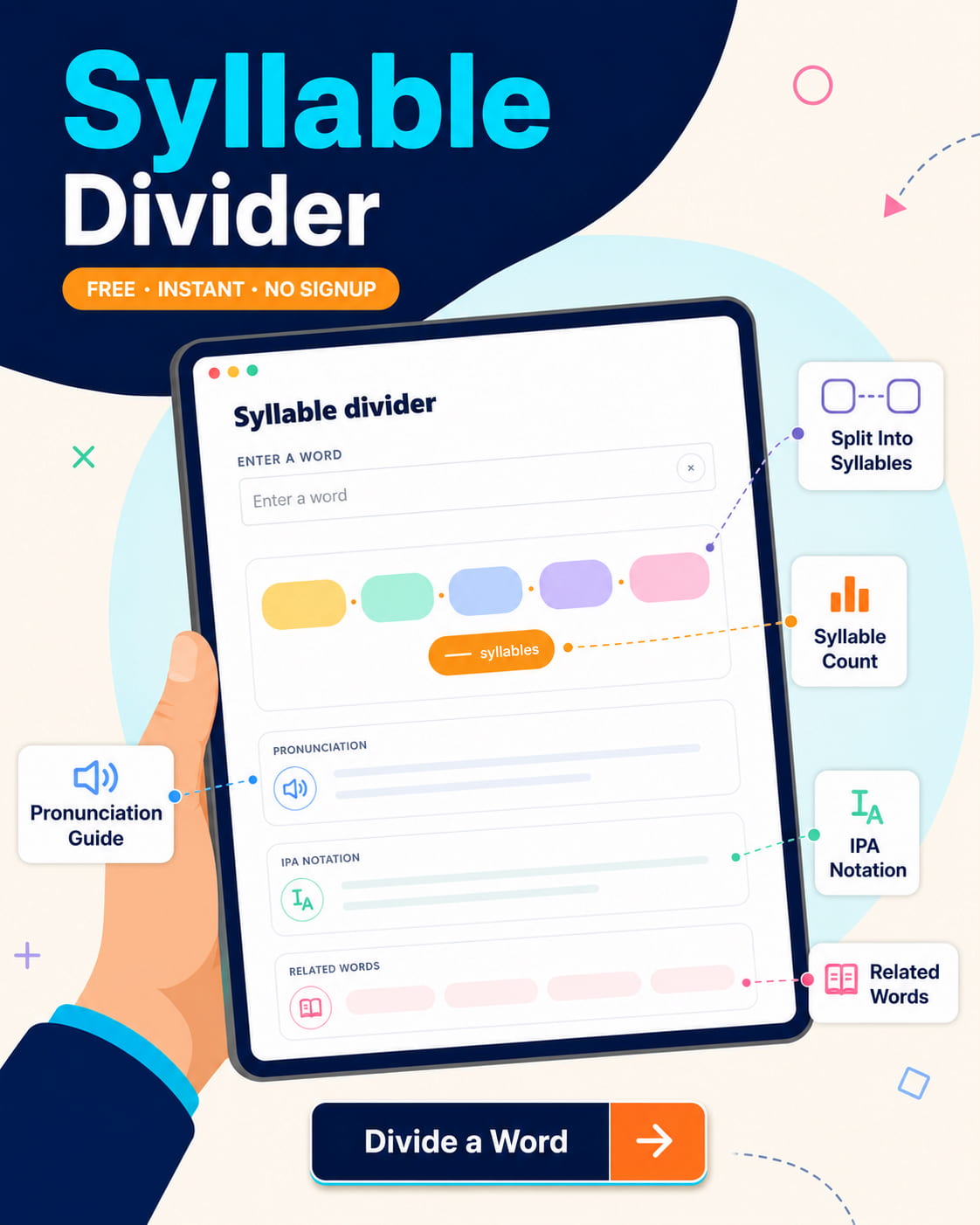
A syllable divider is an online tool that breaks a word into syllables — the single beats of sound that build its pronunciation. The word reading splits into read·ing. The word syllable splits into syl·la·ble. Each beat carries one vowel sound, so the count of syllables matches the count of vowel sounds you hear when you say the word aloud.
Every syllable centres on a vowel sound, with the surrounding consonants attached to it. Linguists call that vowel the nucleus and treat syllables as the building blocks of speech — the units that shape rhythm, stress, and poetic metre. A syllable separator marks the boundary between those units with a dot or a hyphen, which is why you see wa·ter or wa-ter rather than one unbroken string of letters.
How to Use This Syllable Divider
- Type or paste a single word into the input field.
- Watch the split appear as you type, each syllable shown as its own chip — for example, cal·en·dar.
- Read the syllable count beside the word to confirm the number of beats.
- Press the speaker to hear the word spoken, then slow it to half speed to catch each syllable.
- Scan the related words to see the split applied across a whole word family.
The divider runs on the same hyphenation logic dictionaries use, so the break points follow standard written English rather than a rough guess.
Syllable Divider vs. Syllable Separator vs. Syllable Counter
These three terms circle the same word, yet they answer different questions. A divider and a separator both split a word into parts and mark the boundaries. A counter returns a number and stops there. This tool does all three at once: it separates the word, shows each syllable, and reports the total.
| Term | What it produces | Example for water |
|---|---|---|
| Syllable divider | The word split into beats, each break marked | wa·ter |
| Syllable separator | The same split, often shown with hyphens | wa-ter |
| Syllable counter | The number of syllables only | 2 |
Reach for the divider when you need to see the structure of a word. Reach for the counter when a poem or a form asks only for the beat count.
How to Divide Words Into Syllables Yourself
The tool marks the splits instantly, but the reasoning behind them rewards a closer look — especially if you teach reading or study a language. Start the same way every time: underline the vowel sounds, note the consonants sitting between them, then split according to the pattern you see. Six patterns cover the vast majority of English words.
VC/CV — Split Between Two Consonants
When two consonants sit between two vowels, the break falls between them. Basket divides into bas·ket, rabbit into rab·bit, sunset into sun·set. The first syllable closes on a consonant, which keeps its vowel short. Keep digraphs such as sh, ch, and th together, and keep tight blends such as str intact rather than tearing them apart.
V/CV — Split Before One Consonant (Long Vowel)
When a single consonant stands between two vowels, the first split to try lands before that consonant. The opening syllable ends on a vowel and stays open, so its vowel stretches long: tiger becomes ti·ger, paper becomes pa·per, robot becomes ro·bot.
VC/V — Split After One Consonant (Short Vowel)
Some single-consonant words break the other way, after the consonant, which closes the first syllable and shortens its vowel. Lemon divides into lem·on, cabin into cab·in. When the open split produces a word you don’t recognise, slide the consonant back and read it again — secret reads cleanly as se·cret, while seven wants sev·en.
Consonant + le — Count Back Three and Split
Words that end in a consonant followed by le take their own pattern. Count three letters back from the end and place the break there. Table becomes ta·ble, little becomes lit·tle, purple becomes pur·ple. That final chunk holds no spoken vowel, yet it carries its own beat.
V/V — Split Between Two Vowels
When two vowels sit side by side but belong to different sounds rather than a single vowel team, the break falls between them. Diet divides into di·et, create into cre·ate, science into sci·ence. Vowel teams such as ea in team stay whole, since they spell one sound.
Prefixes, Suffixes, and Compound Words
Meaning-based parts break before structure-based rules apply. A prefix or suffix forms its own syllable, and a compound word splits at the seam between its two words. Unhappy divides into un·hap·py, replay into re·play, sunflower into sun·flow·er. Spotting these parts first saves you from forcing a rule where the word already tells you where to cut.
The Six Syllable Types You Create When You Divide
Knowing where to split is half the picture. The other half is recognising what kind of syllable each split produces, because the type dictates the vowel sound. English runs on six of them.
| Syllable type | Pattern | Vowel sound | Example |
|---|---|---|---|
| Closed | Vowel followed by a consonant | Short | cat, nap·kin |
| Open | Ends on a vowel | Long | go, ro·bot |
| Vowel-consonant-e | Vowel, consonant, silent e | Long | cake, com·pete |
| Vowel team | Two letters, one vowel sound | Varies | rain, boat |
| R-controlled | Vowel followed by r | Bent by the r | car, bird |
| Consonant + le | Consonant plus le ending | Schwa beat | ta·ble, can·dle |
Pair the two skills and you have a full decoding system: the division rule tells you where to cut, and the syllable type tells you how to pronounce the piece you cut.
Who Uses a Syllable Divider
Readers reach for it first. Breaking a long word into beats turns an intimidating string of letters into a sequence a child or a new reader decodes one chunk at a time. Spellers use the same split in reverse, building a word beat by beat instead of memorising it whole.
Poets and songwriters lean on a syllable separator for rhythm. A haiku demands a strict five-seven-five pattern, sonnets run on metre, and a lyric has to land its syllables on the beat — all of which start with an accurate count and a clear split. Language learners use the divider to fix pronunciation, since seeing com·for·ta·ble as four beats corrects the instinct to crush it into three. Speech practice and structured literacy programmes built on Orton-Gillingham principles rely on exactly this kind of syllable work to support readers with dyslexia.
Mistakes to Avoid When Separating Syllables
Most errors come from trusting the spelling instead of the sound. A few habits keep your splits accurate:
- ✅ Count vowel sounds, not vowel letters — cake shows two vowels but holds one beat.
- ❌ Never split a digraph such as sh, ch, or th; those two letters spell a single sound and travel together.
- ❌ Avoid breaking a tight blend like str or bl down the middle.
- ✅ Treat a silent e as part of its syllable rather than a beat of its own.
- ❌ Resist forcing a rule onto a name or a borrowed word — proper nouns and loanwords bend the patterns, and even a strong syllable divider flags them as approximate.
When a split produces something you can’t read, try the alternative break before assuming the word is irregular. English rewards flexibility more than rigid rule-following.
Syllable Divider FAQ
How do you divide a word into syllables? Underline the vowel sounds, look at the consonants between them, and split by pattern: between two consonants (bas·ket), before or after one consonant (ti·ger, lem·on), or before a consonant-le ending (ta·ble). The divider above applies these breaks for you the moment you type.
What are the six syllable division rules? The six patterns are VC/CV, V/CV, VC/V, consonant + le, V/V, and division at prefixes, suffixes, and compound seams. Together they cover most English words, with exceptions handled by reading the word aloud and adjusting.
Is a syllable divider the same as a syllable separator? Yes. Both names describe a tool that breaks a word into syllables and marks the boundaries — one with a dot, the other often with a hyphen. The output is the same split either way.
What is the difference between a syllable divider and a syllable counter? A divider shows the word broken into its beats, such as com·pu·ter. A counter returns the number, 3, without showing the split. This tool reports both.
How does the syllable divider know where to split? It applies dictionary-style hyphenation rules to the spelling, the same standard used in printed dictionaries, then marks each boundary. The result matches written English convention rather than a phonetic transcription.
Why divide words into syllables at all? Splitting a word into beats supports reading, spelling, and pronunciation, and it underpins poetry and songwriting, where every line answers to a syllable count.