

Common place nouns are general names for places. They do not tell us the exact name of a place. Instead, they tell us what kind of place something is. Words like school, park, city, and river are common place nouns because they name places in a general way.
These nouns are useful in everyday English because we often talk about places at home, at school, in town, and in nature. In this article, you will learn 100 common place nouns in English with examples, grouped sections, a simple comparison table, and easy sentences.
In This Page
What Are Common Place Nouns?
Common place nouns are general words for places. They name a place by type, not by its exact name.
For example:
- school
- room
- park
- hospital
- beach
- village
All of these are common place nouns because they talk about places in a general way.
We use common place nouns when we speak or write about where people live, study, work, travel, shop, or spend time. They are important for beginners because they appear in daily conversation, reading, and writing.
Common Place Nouns and Proper Nouns
Many learners confuse common place nouns with proper nouns. The difference is simple. A common place noun gives a general name, while a proper noun gives the exact name of a place.
| Common Place Noun | Proper Noun | Difference |
|---|---|---|
| city | Karachi | City is a general place name, while Karachi is one specific city. |
| school | Green Valley School | School is general, while Green Valley School is a specific school name. |
| river | River Nile | River is a general place noun, while River Nile is the name of one river. |
| park | Central Park | Park is a common noun, while Central Park is a proper noun. |
| country | Pakistan | Country is general, while Pakistan is a specific country. |
So, common place nouns are usually not capitalized in the middle of a sentence. Proper nouns are capitalized because they are exact names.
For example:
- The school is near my house.
- Green Valley School is near my house.
In the first sentence, school is a common place noun. In the second sentence, Green Valley School is a proper noun.
List of Common Place Nouns
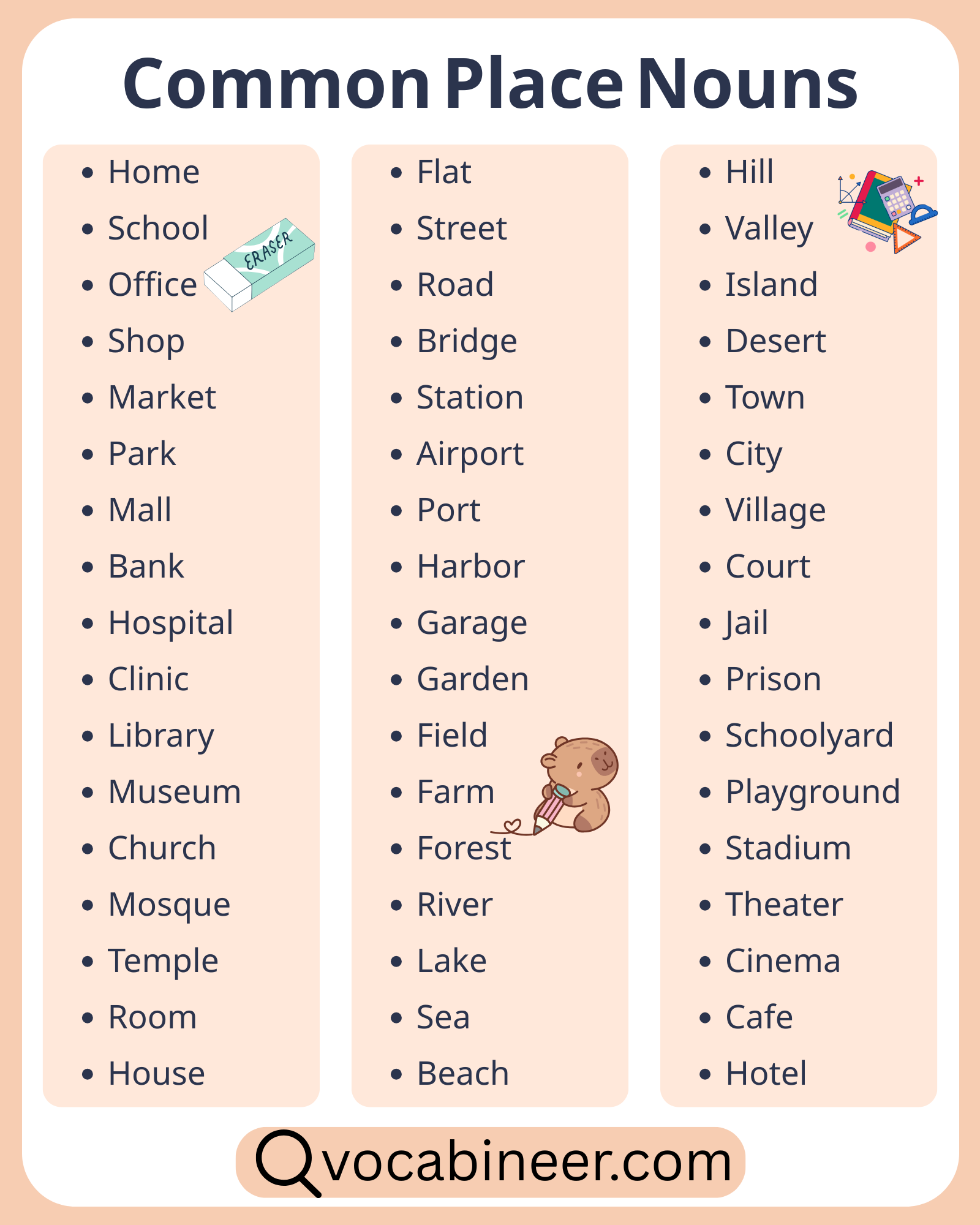
Here is a list of 100 common place nouns in English.
- House
- Home
- Room
- Kitchen
- Bedroom
- Bathroom
- Garden
- Yard
- School
- Classroom
- Library
- Office
- Playground
- Hall
- Lab
- College
- University
- Museum
- Park
- Zoo
- Market
- Store
- Shop
- Mall
- Hospital
- Clinic
- Bank
- Hotel
- Restaurant
- Cafe
- Bakery
- Station
- Airport
- Bus stop
- Road
- Street
- Bridge
- Tunnel
- City
- Town
- Village
- Country
- Capital
- Area
- Neighborhood
- Corner
- Square
- Stadium
- Theater
- Cinema
- Court
- Prison
- Temple
- Mosque
- Church
- Farm
- Field
- Forest
- Jungle
- River
- Lake
- Pond
- Sea
- Ocean
- Beach
- Coast
- Island
- Mountain
- Hill
- Valley
- Desert
- Cave
- Camp
- Campground
- Port
- Harbor
- Dock
- Garage
- Basement
- Attic
- Balcony
- Roof
- Gate
- Entrance
- Exit
- Corridor
- Lane
- Highway
- Path
- Garden center
- Bookstore
- Pharmacy
- Factory
- Workshop
- Tower
- Palace
- Castle
- Apartment
- Flat
- Building
Common Place Nouns at Home
These common place nouns are used for places in and around a home. They are among the first place words many learners study.
House
Their house is painted white.
Home
I feel happy when I come home.
Room
The children are playing in the room.
Kitchen
My mother is cooking in the kitchen.
Bedroom
The bedroom has a large window.
Bathroom
The bathroom is next to the bedroom.
Garden
There are many flowers in the garden.
Yard
The dog is running in the yard.
Garage
My father parked the car in the garage.
Balcony
She stood on the balcony and looked outside.
Basement
We keep old boxes in the basement.
Attic
The attic is full of old books.
Home place nouns are useful because they help us describe daily life clearly. These words often appear in beginner lessons, short stories, and simple conversations.
Common Place Nouns at School
These place nouns are common in schools and learning environments. They help learners talk about study, classes, and school life.
School
The school opens at eight o’clock.
Classroom
The students are sitting in the classroom.
Library
I borrowed a book from the library.
Office
The teacher is in the office.
Playground
The children ran to the playground.
Hall
The meeting was held in the hall.
Lab
The science class went to the lab.
College
Her brother studies at a college.
University
The university is famous for its science program.
Bookstore
We bought notebooks from the bookstore.
School-related place nouns are important for students because they are used in instructions, lessons, school routines, and everyday speaking.
Common Place Nouns in Town and City Life
These common place nouns describe places we see in towns, cities, and neighborhoods. They are very useful in daily English.
Market
My mother bought vegetables at the market.
Store
The store sells clothes and shoes.
Shop
There is a small shop near our house.
Mall
They visited the mall on Sunday.
Hospital
The hospital is across the road.
Clinic
The clinic opens early in the morning.
Bank
He went to the bank after work.
Hotel
We stayed in a hotel during the trip.
Restaurant
The restaurant serves delicious food.
Cafe
They met at a cafe in the evening.
Pharmacy
She bought medicine from the pharmacy.
Building
That building is very tall.
Neighborhood
Our neighborhood is quiet and clean.
Square
The people gathered in the town square.
Station
The train arrived at the station on time.
Town and city place nouns are practical because they help learners talk about shopping, services, travel, public life, and directions.
Common Place Nouns in Nature
These place nouns are used for natural places. They are helpful in reading, travel English, and descriptive writing.
River
The river flows behind the village.
Lake
We sat beside the lake at sunset.
Pond
There are fish in the pond.
Sea
The sea looked calm in the morning.
Ocean
The ship sailed across the ocean.
Beach
The children played on the beach.
Coast
Many people live near the coast.
Island
They visited a small island in summer.
Mountain
Snow covered the mountain peak.
Hill
The house stands on a green hill.
Valley
A river runs through the valley.
Desert
The desert is hot and dry.
Forest
The forest is full of tall trees.
Jungle
Wild animals live in the jungle.
Cave
The explorers entered the cave carefully.
Nature place nouns make the article broader and more useful because place vocabulary is not limited to buildings or cities.
Common Place Nouns for Travel and Public Places
These common place nouns are often used when talking about travel, movement, directions, and public spaces.
Airport
We reached the airport two hours early.
Bus stop
The bus stop is near the market.
Road
The road was busy in the afternoon.
Street
Children were playing in the street.
Bridge
The bridge connects the two towns.
Tunnel
The train passed through a tunnel.
Stadium
The match was played at the stadium.
Museum
The museum displays old paintings.
Zoo
The children saw lions at the zoo.
Theater
We watched a play at the theater.
Cinema
They went to the cinema last night.
Port
Ships arrive at the port every day.
Harbor
The boats were safe in the harbor.
Dock
The workers loaded goods at the dock.
Campground
The family stayed at a campground near the lake.
These place nouns are useful for travel conversations, public directions, and general English vocabulary.
Common Place Nouns in Sentences
Here are some simple sentence examples using common place nouns.
- The school is close to my house.
- We walked through the park in the evening.
- Her father works in a hospital.
- The children are playing in the garden.
- I left my bag in the classroom.
- They stayed in a hotel during the trip.
- The market opens early every morning.
- A bridge crosses the river near our village.
- The family had lunch at a restaurant.
- The bus stopped at the bus stop.
- We read quietly in the library.
- The airplane landed at the airport.
- The road to the town was long and narrow.
- They spent their holiday at the beach.
- The hikers walked through the forest.
FAQs
A common place noun is a general name for a place. Words like school, park, city, and river are common place nouns.
A common place noun names a place generally, while a proper noun gives the exact name of a place. For example, city is a common noun, but Karachi is a proper noun.
Some examples are house, school, market, park, hospital, city, village, river, and beach.
Yes. School is a common noun because it names a place generally, not one specific school.
Common place nouns are important because they help us talk about locations clearly in daily life, travel, reading, writing, and conversation.
Summary
Common place nouns are general names for places, such as school, house, market, park, city, and river. They help us describe locations clearly without using exact names.
In this article, you learned 100 common place nouns in English , grouped sections, a comparison table, and easy sentences. The best way to remember these words is to learn them by category and use them in everyday English.
Read More
- List of Nouns in English
- Common Person Nouns in English
- Collective Nouns for Things in English
- Collective Nouns for People in English