

Common person nouns are general names for people. They do not tell us the exact name of a person. Instead, they tell us what kind of person someone is. Words like teacher, doctor, mother, and friend are common person nouns because they name people in a general way.
These nouns are some of the most useful words in English because we use them every day in school, at home, at work, and in daily conversation. In this article, you will learn 100 common person nouns in English with examples, grouped sections, and simple sentences to make learning easier.
In This Page
What Are Common Person Nouns?
Common person nouns are words we use for people in a general sense. They name a person by role, relationship, job, or type, but not by personal name.
For example, words like boy, girl, farmer, student, and driver are common person nouns. They tell us who the person is in a general way, but they do not identify one specific individual.
Compare these examples:
- teacher
- doctor
- mother
- friend
- neighbor
- student
All of these are common person nouns because they refer to kinds of people, not named individuals.
We often use common person nouns to talk about family members, workers, students, visitors, customers, and many other people around us. They are an important part of everyday English because they help us describe people clearly and naturally.
Common Person Nouns and Proper Nouns
It is easy to confuse common person nouns with proper nouns, especially for beginners. The table below shows the difference clearly.
| Common Person Noun | Proper Noun | Difference |
|---|---|---|
| teacher | Mr. Khan | Teacher is a general name for a person’s role, while Mr. Khan is the name of one specific person. |
| doctor | Dr. Sara Ali | Doctor names a profession in general, but Dr. Sara Ali identifies one person. |
| mother | Amna | Mother is a general relationship noun, while Amna is a personal name. |
| friend | Ahmed | Friend means a person in a relationship, but Ahmed names one exact person. |
| student | Ayesha | Student is a general word for a learner, while Ayesha is a specific individual. |
A common person noun is usually not capitalized in the middle of a sentence. A proper noun is capitalized because it is a name.
For example:
- The teacher helped the class.
- Mr. Khan helped the class.
In the first sentence, teacher is a common noun. In the second sentence, Mr. Khan is a proper noun.
List of Common Person Nouns
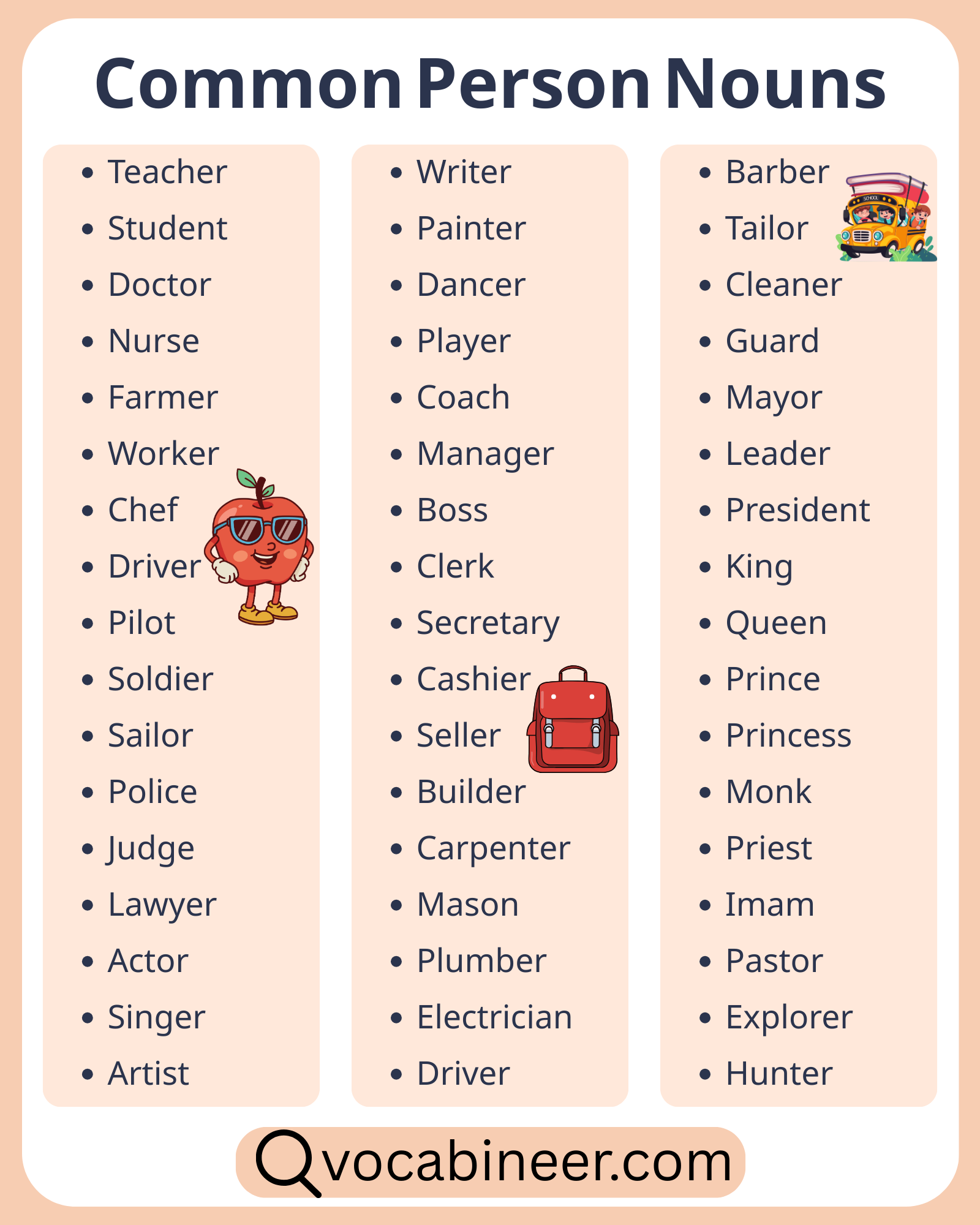
Here is a list of 100 common person nouns in English.
- Teacher
- Student
- Doctor
- Nurse
- Farmer
- Driver
- Worker
- Manager
- Artist
- Singer
- Dancer
- Writer
- Reader
- Player
- Coach
- Principal
- Librarian
- Clerk
- Chef
- Cook
- Baker
- Waiter
- Waitress
- Customer
- Passenger
- Visitor
- Guest
- Neighbor
- Friend
- Brother
- Sister
- Mother
- Father
- Uncle
- Aunt
- Cousin
- Baby
- Child
- Boy
- Girl
- Man
- Woman
- Person
- Parent
- Grandfather
- Grandmother
- Son
- Daughter
- Husband
- Wife
- Bride
- Groom
- King
- Queen
- Prince
- Princess
- Leader
- Member
- Officer
- Police officer
- Soldier
- Judge
- Lawyer
- Guard
- Pilot
- Sailor
- Captain
- Actor
- Actress
- Musician
- Painter
- Poet
- Dentist
- Engineer
- Carpenter
- Electrician
- Plumber
- Mechanic
- Shopkeeper
- Vendor
- Boss
- Employee
- Colleague
- Partner
- Classmate
- Roommate
- Teammate
- Resident
- Citizen
- Stranger
- Traveler
- Guide
- Helper
- Caregiver
- Host
- Speaker
- Learner
- Listener
- Performer
- Guest speaker
Common Person Nouns for Family and Relationships
These common person nouns are used for family members and close personal relationships. They are some of the first person nouns that learners study because they are common in daily life.
Mother
My mother makes breakfast every morning.
Father
Her father works in a bank.
Brother
My brother plays football after school.
Sister
His sister is reading a storybook.
Uncle
Our uncle visited us last weekend.
Aunt
My aunt gave me a birthday gift.
Cousin
My cousin lives in another city.
Parent
Every parent attended the school meeting.
Son
Their son won a prize in the competition.
Daughter
Her daughter likes drawing flowers.
Husband
The husband carried the bags inside.
Wife
His wife teaches at a local college.
Friend
A friend helped me carry my bag.
Neighbor
Our neighbor has a beautiful garden.
Baby
The baby is sleeping in the crib.
Family and relationship nouns are very useful because they help us talk about the people closest to us. These words appear often in conversations, stories, school writing, and personal introductions.
Common Person Nouns for Jobs and Work
These nouns are used for people in jobs, careers, and work settings. Many of them describe professions, while others describe general work roles.
Teacher
The teacher explained the lesson clearly.
Doctor
The doctor checked the patient carefully.
Nurse
A nurse brought the medicine.
Driver
The driver stopped the bus near the school.
Farmer
The farmer works in the fields every day.
Manager
The manager called a meeting in the office.
Chef
The chef prepared a delicious meal.
Engineer
My brother is an engineer.
Lawyer
The lawyer spoke to the client.
Mechanic
The mechanic repaired our car.
Job-related person nouns are especially helpful because they are used in real life, school lessons, occupations, and daily conversation. Learning them in a group makes them easier to remember.
Common Person Nouns for School and Learning
These person nouns are common in schools, colleges, libraries, and learning environments. They are useful for students and teachers because they describe people we often meet in educational settings.
Student
The student finished the homework on time.
Teacher
Our teacher gave us a new assignment.
Principal
The principal spoke at the morning assembly.
Coach
The coach trained the team after class.
Librarian
The librarian helped me find a book.
Classmate
My classmate sits next to me in class.
Learner
A good learner asks questions.
Reader
The reader enjoyed the short story.
Writer
The writer completed the essay quickly.
Speaker
The speaker talked about healthy habits.
These words are useful in classroom English because they help learners talk about lessons, reading, school life, study habits, and people in education.
You can also connect this group with nouns like listener, guide, and roommate depending on the context.
Common Person Nouns for Community and Daily Life
These nouns describe people we meet in public places, neighborhoods, shops, travel settings, and everyday situations.
Customer
The customer bought fresh bread.
Passenger
The passenger waited for the train.
Visitor
A visitor came to our office this morning.
Guest
The guests arrived before dinner.
Resident
Every resident in the building received a notice.
Citizen
A good citizen follows the law.
Shopkeeper
The shopkeeper opened the store early.
Vendor
The vendor sold fruit by the road.
Guard
The guard stood at the gate.
Stranger
The child did not talk to the stranger.
Common Person Nouns in Sentences
Here are some simple sentence examples using common person nouns.
- The teacher wrote the answer on the board.
- My mother cooked rice for dinner.
- A doctor came to the village clinic.
- The driver waited outside the school.
- Her cousin sent a birthday card.
- The customer asked for a glass of water.
- A farmer planted seeds in the field.
- The student opened the notebook.
- The neighbor smiled and waved at us.
- Our coach taught us a new game.
- The mechanic fixed the bike in one hour.
- A visitor asked for directions.
- The librarian showed me the history section.
- My friend called me in the evening.
- The passenger carried a heavy suitcase.
FAQs
A common person noun is a general name for a person. Words like teacher, friend, doctor, and mother are common person nouns because they name a type of person, not a specific individual.
A common person noun names a person generally, while a proper noun gives the exact name of a person. For example, teacher is a common noun, but Mr. Khan is a proper noun.
Some examples are teacher, student, doctor, nurse, mother, father, friend, neighbor, and driver.
Yes. The word teacher is a common noun because it refers to a person generally, not to one specific person by name.
Common person nouns are important because they help us talk about people clearly in daily life, school, work, reading, and writing. They are basic vocabulary words that appear often in English.
Summary
Common person nouns are general names for people, such as teacher, student, mother, friend, doctor, and neighbor. They help us talk about people clearly without using a personal name.
In this article, you learned 100 common person nouns in English, grouped sections, a simple comparison table, and sentence use. The best way to remember these words is to learn them by category and use them in everyday English sentences.
Read More
- List of Nouns in English
- Common Singular Nouns List
- Collective Nouns for Things in English
- Collective Nouns for People in English