Plural nouns are one of the most important parts of English grammar. A plural noun names more than one person, place, animal, thing, or idea. Words like boys, cities, cats, books, and ideas are all plural nouns because each word refers to two or more items.
In this easy-to-follow guide, you will find 300 common plural nouns in English along with clear category sections, simple examples, sentence use, and common mistakes to avoid. Whether you are a student, teacher, writer, or English learner, this article will help you understand plural nouns in a clear and useful way.
In This Page
What Are Plural Nouns?
A plural noun is a noun that refers to more than one person, place, animal, thing, or idea.
For example:
- girls means more than one girl
- cities means more than one city
- dogs means more than one dog
- chairs means more than one chair
- ideas means more than one idea
Plural nouns are often used with words like:
- many
- few
- some
- these
- those
For example:
- many students
- a few apples
- some books
- these flowers
- those houses
Complete List of Plural Nouns in English
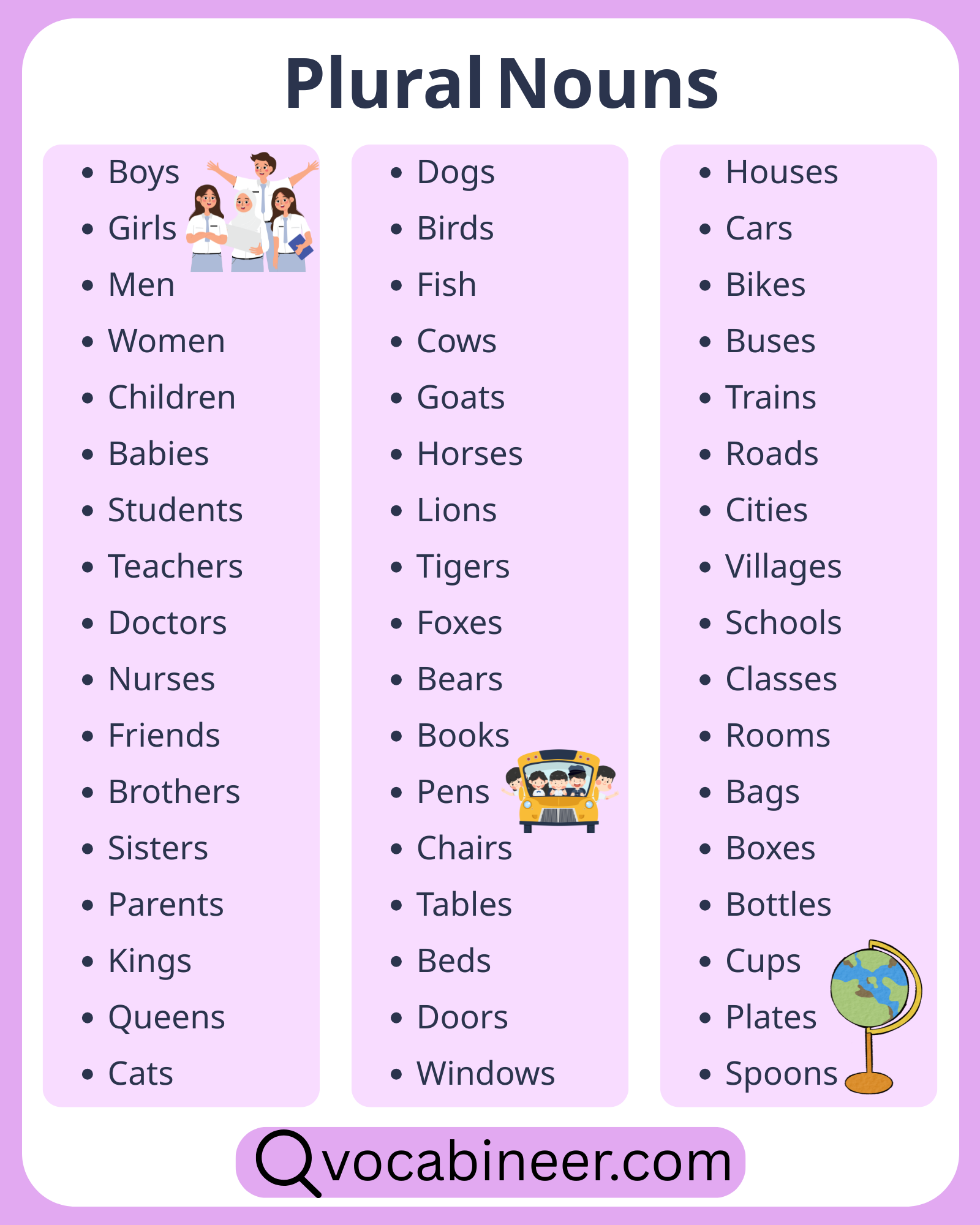
Below is a complete list of 300 common plural nouns in English in a simple and easy-to-scan format.
- Men
- Women
- Boys
- Girls
- Children
- Teachers
- Students
- Doctors
- Nurses
- Farmers
- Drivers
- Artists
- Singers
- Dancers
- Players
- Friends
- Neighbors
- Mothers
- Fathers
- Brothers
- Sisters
- Babies
- Kings
- Queens
- Guests
- Dogs
- Cats
- Horses
- Cows
- Goats
- Sheep
- Lions
- Tigers
- Bears
- Monkeys
- Elephants
- Rabbits
- Birds
- Ducks
- Hens
- Fish
- Dolphins
- Foxes
- Wolves
- Zebras
- Giraffes
- Camels
- Deer
- Frogs
- Turtles
- Cities
- Villages
- Towns
- Countries
- Schools
- Colleges
- Houses
- Homes
- Rooms
- Kitchens
- Gardens
- Parks
- Roads
- Streets
- Bridges
- Rivers
- Lakes
- Mountains
- Beaches
- Forests
- Islands
- Shops
- Markets
- Hospitals
- Libraries
- Offices
- Stations
- Hotels
- Books
- Pens
- Pencils
- Bags
- Chairs
- Tables
- Desks
- Doors
- Windows
- Beds
- Cups
- Plates
- Spoons
- Forks
- Bottles
- Boxes
- Phones
- Clocks
- Watches
- Lamps
- Fans
- Computers
- Laptops
- Screens
- Cameras
- Keys
- Balls
- Toys
- Flowers
- Trees
- Leaves
- Apples
- Bananas
- Mangoes
- Oranges
- Cakes
- Eggs
- Knives
- Vases
- Pillows
- Blankets
- Baskets
- Mirrors
- Brushes
- Combs
- Shirts
- Dresses
- Coats
- Hats
- Rings
- Wallets
- Maps
- Flags
- Candles
- Helmets
- Bicycles
- Cars
- Buses
- Trains
- Airplanes
- Boats
- Ships
- Ideas
- Hopes
- Dreams
- Thoughts
- Plans
- Memories
- Problems
- Answers
- Questions
- Lessons
- Stories
- Poems
- Songs
- Games
- Jobs
- Tasks
- Goals
- Chances
- Events
- Meetings
- Parties
- Journeys
- Trips
- Vacations
- Holidays
- Mornings
- Evenings
- Nights
- Days
- Weeks
- Months
- Years
- Clouds
- Storms
- Stars
- Languages
- Words
- Sentences
- Pictures
- Photos
- Colors
- Shapes
- Sounds
- Voices
- Names
- Numbers
- Rules
- Facts
- Skills
- Habits
- Messages
- Letters
- Emails
- Gifts
- Prizes
- Tickets
- Recipes
- Tools
- Machines
- Pears
- Grapes
- Peaches
- Plums
- Cherries
- Lemons
- Limes
- Tomatoes
- Potatoes
- Carrots
- Onions
- Cabbages
- Peppers
- Beans
- Peas
- Sofas
- Stools
- Shelves
- Buckets
- Ropes
- Chains
- Nails
- Hammers
- Brooms
- Towels
- Glasses
- Napkins
- Curtains
- Carpets
- Shoes
- Socks
- Gloves
- Jackets
- Sweaters
- Scarves
- Belts
- Crowns
- Coins
- Notes
- Cards
- Envelopes
- Notebooks
- Diaries
- Newspapers
- Magazines
- Posters
- Banners
- Paintings
- Statues
- Robots
- Engines
- Motors
- Wheels
- Gates
- Fences
- Fields
- Farms
- Valleys
- Hills
- Caves
- Deserts
- Oceans
- Seas
- Paths
- Lanes
- Temples
- Churches
- Mosques
- Museums
- Theaters
- Airports
- Harbors
- Classrooms
- Playgrounds
- Customers
- Managers
- Leaders
- Officers
- Workers
- Writers
- Readers
- Visitors
- Winners
- Beginners
- Learners
- Speakers
- Viewers
- Builders
- Painters
- Bakers
- Tailors
- Sailors
- Actors
- Daughters
- Sons
- Parents
- Cousins
- Uncles
- Aunts
- Grandparents
- Heroes
- Echoes
- Volcanoes
- Loaves
- Thieves
- Lives
- Wives
- Feet
- Teeth
- Geese
- Mice
Regular Plural Nouns
Regular plural nouns are nouns that usually become plural by adding -s or -es. Here are some common examples:
- Books — the plural of book
- Pens — the plural of pen
- Bags — the plural of bag
- Chairs — the plural of chair
- Tables — the plural of table
- Dogs — the plural of dog
- Cats — the plural of cat
- Teachers — the plural of teacher
- Students — the plural of student
- Flowers — the plural of flower
- Cars — the plural of car
- Apples — the plural of apple
- Games — the plural of game
- Friends — the plural of friend
- Lessons — the plural of lesson
Irregular Plural Nouns
Irregular plural nouns do not follow the normal -s or -es pattern. Their spelling changes in a different way. Here are some common irregular plural nouns:
- Men — the plural of man
- Women — the plural of woman
- Children — the plural of child
- Feet — the plural of foot
- Teeth — the plural of tooth
- Geese — the plural of goose
- Mice — the plural of mouse
- Wolves — the plural of wolf
- Knives — the plural of knife
- Lives — the plural of life
- Wives — the plural of wife
- Leaves — the plural of leaf
- Loaves — the plural of loaf
- Thieves — the plural of thief
- Fish — often the same in singular and plural use
- Deer — the same in singular and plural use
- Sheep — the same in singular and plural use
Common Rules for Forming Plural Nouns
English plural nouns follow several common spelling rules. Learning these patterns makes plural nouns easier to use correctly.
Add -s to most nouns
For many nouns, we simply add -s.
Examples:
- book → books
- chair → chairs
- pencil → pencils
- flower → flowers
- bag → bags
Add -es to nouns ending in -s, -ss, -sh, -ch, -x, or -z
Examples:
- bus → buses
- class → classes
- brush → brushes
- church → churches
- box → boxes
Change -y to -ies if there is a consonant before y
Examples:
- city → cities
- baby → babies
- country → countries
- story → stories
- family → families
Add -s if there is a vowel before y
Examples:
- boy → boys
- toy → toys
- key → keys
- day → days
Change some -f or -fe endings to -ves
Examples:
- leaf → leaves
- wolf → wolves
- knife → knives
- wife → wives
- life → lives
Some nouns ending in -o take -es
Examples:
- tomato → tomatoes
- potato → potatoes
- hero → heroes
- echo → echoes
- volcano → volcanoes
Plural Nouns That Stay the Same
Some nouns have the same form in both singular and plural. These are important because they often confuse learners. Common examples include:
- Sheep — one sheep, two sheep
- Deer — one deer, three deer
- Fish — one fish, many fish
- Aircraft — one aircraft, several aircraft
- Species — one species, many species
- Series — one series, two series
These nouns do not change spelling in the plural form.
Examples of Plural Nouns in Sentences
Here are some simple sentence examples that show how plural nouns are used in real English.
- The boys are playing in the park.
- The teachers are standing near the classroom.
- I saw two dogs near the gate.
- The birds are sitting on the tree.
- They live in different cities.
- My friends are coming today.
- There are many books on the table.
- She bought new shoes yesterday.
- The flowers look beautiful in the garden.
- We ate fresh apples after lunch.
- Their ideas were very helpful.
- The children asked many questions.
- She wrote three short poems.
- Those cars are parked outside.
- The bridges cross the river.
- We visited several villages last summer.
- The women are working in the office.
- The mice ran under the table.
- Those stories are very interesting.
- The leaves are falling from the trees.
Common Mistakes With Plural Nouns
Learners often make mistakes with plural nouns because English has both regular and irregular forms.
- Do not use singular verbs with plural nouns
Incorrect: The boys is happy.
Correct: The boys are happy. - Do not forget to make the noun plural when talking about more than one
Incorrect: I have two book.
Correct: I have two books. - Be careful with irregular plurals
Incorrect: childs, foots, mouses
Correct: children, feet, mice - Do not add s to nouns that stay the same in plural form
Incorrect: sheeps, deers
Correct: sheep, deer - Use these and those with plural nouns
Correct: these chairs, those trees
Not: this chairs, that trees - Watch spelling changes carefully
Incorrect: citys, leafs, knifes
Correct: cities, leaves, knives
FAQs
Plural nouns are nouns that name more than one person, place, animal, thing, or idea. For example, cats, books, and cities are plural nouns.
Some common examples of plural nouns are boys, girls, teachers, dogs, cats, books, chairs, flowers, and ideas.
Plural nouns are often formed by adding -s or -es to a singular noun. Some nouns also change spelling, such as city → cities and knife → knives, while irregular nouns change in a different way, such as child → children.
A singular noun names one person, place, animal, thing, or idea, while a plural noun names more than one. For example, cat is singular and cats is plural.
Plural nouns are important because they help us talk clearly about more than one item. They are also necessary for correct grammar, sentence structure, and subject-verb agreement.
Summary
This article covered 300 common plural nouns in English with examples and included sections on regular plural nouns, irregular plural nouns, common plural rules, same-form plurals, sentence examples, and common mistakes.
This kind of guide is useful for students, teachers, writers, and English learners because it makes plural nouns easier to understand and remember. It also helps readers use plural nouns more naturally in speaking and writing.
Read More