

Compound nouns are nouns made by joining two or more words to create one new meaning. Words like toothbrush, ice cream, and mother-in-law are compound nouns because each one names a person, place, thing, or idea in a combined form.
These nouns are very common in English. We use them in daily conversation, schoolwork, reading, writing, and grammar. Some compound nouns are written as one word, some as two words, and some with hyphens. In this guide, you will find a strong list of 100 compound nouns, grouped examples, simple sentence use, and clear explanations that are easy to follow.
In This Page
What Are Compound Nouns?
Compound nouns are nouns formed from two or more words that work together as one name. The combined words create a meaning that may be easy to guess, like bedroom, or more fixed, like ice cream.
For example, bedroom joins bed and room. Bus stop joins bus and stop. Mother-in-law joins several words to name one relationship. In all these examples, the full expression works as one noun.
Compound nouns are important because English uses them often for everyday objects, places, family relationships, jobs, activities, and ideas. Once learners understand this pattern, vocabulary becomes easier to recognize and remember.
Compound nouns are usually written in three main ways:
- as one word, such as toothbrush
- as two words, such as ice cream
- with hyphens, such as mother-in-law
List of 100 Compound Nouns in English
Here is a useful list of 100 compound nouns in English. It includes closed, open, and hyphenated forms that are common in daily use.
- Toothbrush
- Toothpaste
- Bedroom
- Classroom
- Blackboard
- Notebook
- Football
- Sunlight
- Rainfall
- Haircut
- Handbag
- Backpack
- Cupboard
- Newspaper
- Doorbell
- Moonlight
- Grandmother
- Grandfather
- Airplane
- Airport
- Waterfall
- Bathroom
- Keyboard
- Bookshelf
- Mailbox
- Fireman
- Policeman
- Snowman
- Lighthouse
- Motorcycle
- Headache
- Sunrise
- Sunset
- Earthquake
- Firework
- Ice cream
- Bus stop
- Post office
- Living room
- Dining room
- Coffee shop
- Swimming pool
- High school
- Full moon
- Car park
- Phone number
- Traffic light
- Washing machine
- Dining table
- Coffee cup
- Tea bag
- Police station
- Bank account
- Shop window
- Water bottle
- Bread knife
- School bus
- Bus driver
- Ice cube
- Computer game
- Mother-in-law
- Father-in-law
- Sister-in-law
- Brother-in-law
- Daughter-in-law
- Son-in-law
- Passer-by
- Runner-up
- X-ray
- Merry-go-round
- Dry-cleaning
- Well-being
- Self-control
- Editor-in-chief
- Check-in
- Firefighter
- Shopkeeper
- Lifeguard
- Teapot
- Milkshake
- Cupcake
- Storybook
- Raincoat
- Toothpick
- Wristwatch
- Sunflower
- Sandcastle
- Houseboat
- Highway
- Footpath
- Bookshop
- Schoolbag
- Landlord
- Landlady
- Chairperson
- Fire station
- Train station
- Computer screen
- Tablecloth
- Writing desk
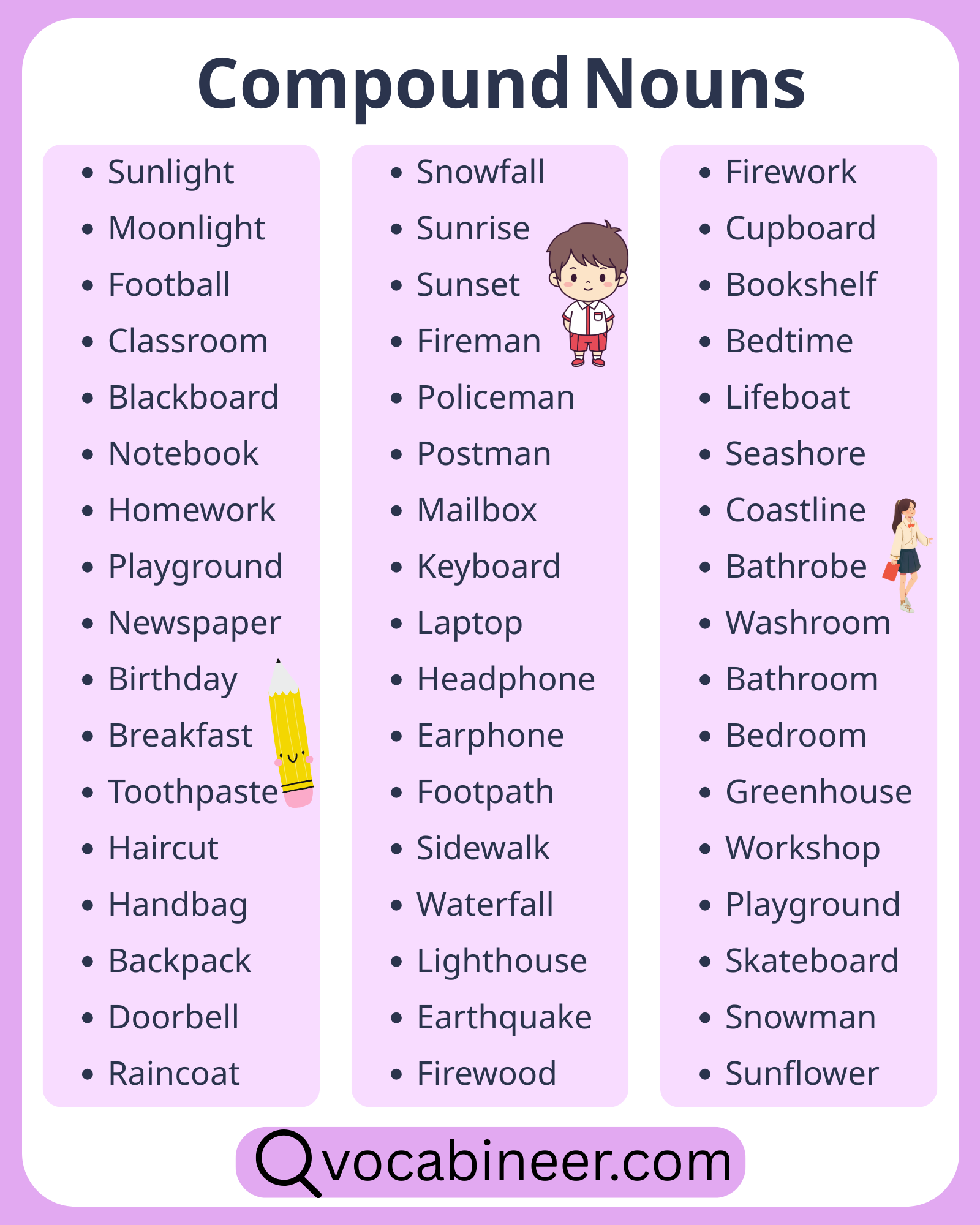
Closed Compound Nouns Examples
Closed compound nouns are written as one word and are very common in everyday English. They often name objects, rooms, people, and natural things.
Toothbrush
I bought a new toothbrush yesterday.
Toothpaste
Please put the toothpaste back in the cupboard.
Bedroom
Her bedroom is very neat.
Classroom
The classroom was full of students.
Notebook
He wrote the answer in his notebook.
Football
They played football after school.
Handbag
She kept her phone in her handbag.
Newspaper
My grandfather reads the newspaper every morning.
Doorbell
The doorbell rang at midnight.
Sunrise
We watched the sunrise from the hill.
Other useful closed compound nouns from the list include backpack, cupboard, moonlight, airplane, airport, waterfall, keyboard, bookshelf, mailbox, motorcycle, headache, sunset, earthquake, raincoat, wristwatch, schoolbag, and tablecloth.
Open Compound Nouns Examples
Open compound nouns are written as two separate words, but they still work together as one noun. This form is common for places, objects, activities, and everyday expressions.
Ice cream
The children wanted ice cream after dinner.
Bus stop
We waited at the bus stop.
Post office
My uncle works at the post office.
Living room
The family sat in the living room.
Dining room
Dinner is ready in the dining room.
Coffee shop
They met at a coffee shop nearby.
Swimming pool
The hotel has a large swimming pool.
High school
She studies at a high school in the city.
Traffic light
The car stopped at the traffic light.
Police station
They went to the police station for help.
Other useful open compound nouns from the list include phone number, washing machine, dining table, coffee cup, tea bag, water bottle, bread knife, school bus, bus driver, computer game, train station, and writing desk.
Hyphenated Compound Nouns Examples
Hyphenated compound nouns are written with hyphens between the words and often appear in relationships, titles, and fixed expressions in English.
Mother-in-law
Her mother-in-law lives nearby.
Father-in-law
My father-in-law visited us last week.
Sister-in-law
His sister-in-law is a doctor.
Brother-in-law
My brother-in-law works in Dubai.
Passer-by
A passer-by helped the lost child.
Runner-up
She was the runner-up in the contest.
X-ray
The doctor looked at the X-ray carefully.
Merry-go-round
The children rode the merry-go-round.
Editor-in-chief
The editor-in-chief approved the article.
Check-in
The check-in was quick and easy.
Other useful hyphenated compound nouns from the list include daughter-in-law, son-in-law, dry-cleaning, well-being, and self-control.
Compound Nouns in Sentences
These examples show how compound nouns are used in everyday English and help learners understand their meaning in clear, natural context.
- My toothbrush is in the bathroom.
- The children are playing in the classroom.
- We bought ice cream after lunch.
- The bus stop is near my house.
- Her mother-in-law is very kind.
- I left my notebook on the table.
- The traffic light turned green.
- They met at the coffee shop in the evening.
- The doorbell rang while we were eating dinner.
- He packed his schoolbag before bed.
- We visited the post office yesterday.
- The football match started at four o’clock.
- A passer-by gave us directions.
- She put the teapot on the shelf.
- The sunrise looked beautiful from the beach.
FAQs
Compound nouns are nouns made from two or more words that join to form one meaning. Examples include toothbrush, bus stop, and mother-in-law.
The three common types are closed compound nouns, open compound nouns, and hyphenated compound nouns.
Closed compound nouns are written as one word, such as bedroom. Open compound nouns are written as two words, such as ice cream.
Some compound nouns take a regular plural, such as toothbrushes. Others follow a different pattern, such as mothers-in-law and passers-by.
Compound nouns are important because they are very common in everyday English. They help us name people, places, objects, relationships, and ideas more clearly.
Summary
Compound nouns are made by joining two or more words to create one noun with one meaning. They can appear as closed, open, or hyphenated forms.
In this article, you learned 100 compound nouns with examples, grouped sections, and sentence use.
Read More
- List of Nouns in English
- List of Food Nouns in English
- Common Place Nouns in English
- Common Person Nouns in English