Collective nouns are useful words in English that name a group of people, animals, or things as one unit. Instead of naming each person or object one by one, a collective noun gives one word for the whole group. Words like Team, Family, Flock, and Bunch are common examples of collective nouns.
In this easy-to-follow guide, you will find 100 collective nouns in English arranged in clear categories. It includes collective nouns for people, animals, and things or objects, along with simple sentence examples. Whether you are a student, teacher, writer, or English learner, this article will help you understand and identify collective nouns in a simple and useful way.
In This Page
What Are Collective Nouns?
A collective noun is a noun that names a group of people, animals, or things as one unit.
For example:
- Team means a group of players
- Family means a group of related people
- Flock means a group of birds
- Bunch means a group of things gathered together
Collective nouns are common in everyday English because they make speaking and writing shorter, easier, and clearer.
Complete List of 100 Collective Nouns in English
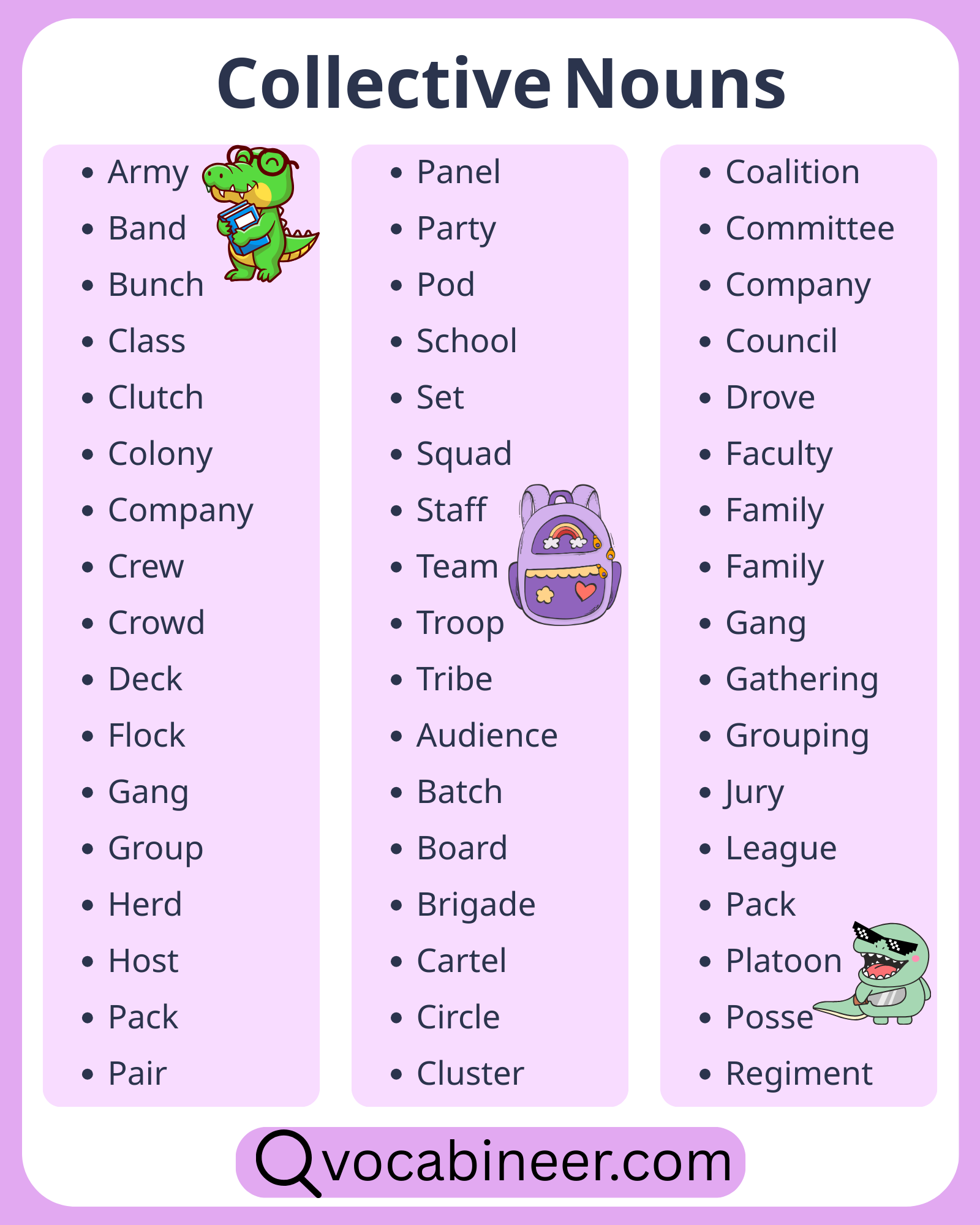
Below is a complete list of 100 collective nouns in English in a simple and easy-to-scan format.
- Team
- Class
- Family
- Staff
- Audience
- Committee
- Crew
- Group
- Crowd
- Band
- Choir
- Panel
- Jury
- Army
- Society
- Company
- Board
- Tribe
- Club
- Delegation
- Flock
- Herd
- Pack
- Swarm
- Colony
- Pride
- Pod
- Shoal
- School
- Nest
- Troop
- Litter
- Hive
- Gaggle
- Brood
- Drove
- Flight
- Leap
- Team
- Caravan
- Bunch
- Set
- Stack
- Pile
- Fleet
- Collection
- Series
- Batch
- Bundle
- Heap
- Bouquet
- Deck
- Cluster
- Range
- Pair
- Row
- Line
- Suite
- String
- Packet
- Cast
- Faculty
- Patrol
- Cabinet
- Assembly
- Congregation
- Circle
- Party
- Posse
- Regiment
- Squadron
- Troupe
- Bevy
- Host
- Orchard
- Grove
- Archipelago
- Constellation
- Galaxy
- Block
- Album
- Library
- Wardrobe
- Gallery
- Forest
- Chain
- Parcel
- Roll
- Pack
- Cache
- Basket
- Bowl
- Tank
- Shelf
- Cupboard
- Cluster
- Packet
- Parade
- Procession
- Queue
- Ring
- Outfit
- Corps
Collective Nouns for People
These collective nouns name groups of people.
- Team — a group of players working together
- Class — a group of students learning together
- Family — a group of related people
- Staff — a group of workers in one place
- Audience — a group of people watching or listening
- Committee — a group chosen for a purpose
- Crew — a group working together on a ship, plane, or task
- Group — a general word for several people together
- Crowd — a large group of people in one place
- Band — a group of musicians
- Choir — a group of singers
- Panel — a small group of experts or speakers
- Jury — a group of people in a court case
- Army — a large group of soldiers
- Society — an organized group of people
- Company — a business group or group of companions
- Board — a group managing an organization
- Tribe — a social group with shared culture
- Gang — a group of people acting together
- Club — an organized social or activity group
- Orchestra — a large group of musicians
- Cast — a group of actors in a play or film
- Faculty — a group of teachers in a school or college
- Patrol — a group assigned to watch or guard
- Delegation — a group sent to represent others
- Cabinet — a group of top government advisers
- Assembly — a gathering of people
- Congregation — a group of people in a religious gathering
- Circle — a group of people with shared interests
- Party — a group traveling or acting together
- Posse — a group gathered for a purpose
- Regiment — a large military group
- Squadron — a military or air force group
- Troupe — a group of performers
- Bevy — a group of people, often ladies
- Host — a large number of people
Collective Nouns for Animals
These collective nouns name groups of animals.
- School — a group of fish
- Herd — a group of cattle, deer, or elephants
- Flock — a group of birds or sheep
- Pack — a group of wolves or dogs
- Swarm — a large group of insects
- Colony — a group of ants, penguins, or similar animals
- Pride — a group of lions
- Pod — a group of dolphins or whales
- Shoal — a group of fish
- Nest — a group of young insects or birds in one place
- Troop — a group of monkeys or scouts
- Litter — a group of baby animals born together
- Hive — a group of bees living together
- Gaggle — a group of geese
- Brood — a group of young birds
- Drove — a group of cattle or sheep moving together
- Leap — a group of frogs
- Flight — a group of birds flying together
- Murmuration — a large group of starlings in flight
Collective Nouns for Things and Objects
These collective nouns name groups of things or objects.
- Bunch — a group of flowers, keys, or bananas
- Set — a group of matching things
- Stack — a pile of things placed one above another
- Pile — a group of things placed together
- Fleet — a group of ships, vehicles, or planes
- Collection — a group of collected items
- Series — a number of things arranged in order
- Batch — a group made or handled at one time
- Bundle — a group of things tied together
- Heap — an untidy pile of things
- Bouquet — a bunch of flowers
- Chain — a connected series of things
- Cluster — a close group of similar things
- Range — a set of different products or items
- Pair — two things used together
- Row — things arranged in a straight line
- Line — a long arrangement of things one after another
- Suite — a set of connected rooms or items
- Deck — a set of cards
- Caravan — a group of vehicles traveling together
- Cache — a hidden group of stored things
- Grove — a small group of trees
- Block — a group of buildings or items together
- Library — a collection of books
- Wardrobe — a collection of clothes
- Album — a collection of songs or photos
- Bowl — a grouped serving of food in a bowl
- Basket — a gathered group of items in one basket
- Tank — a group of stored liquid or fish in one container
- Cupboard — a stored collection of kitchen items
- Gallery — a collection of pictures or works of art
- Shelf — a row of stored books or items
- Archipelago — a group of islands
- Constellation — a group of stars
- Parcel — a wrapped group of items
- Packet — a small packaged group of things
- Roll — a group of papers or cloth wound together
- Suit — a set of matching clothes or cards of one type
Examples of Collective Nouns in Sentences
Here are some simple sentence examples that show how collective nouns are used in real English.
- The team won the match.
- Our family is going on a trip.
- The class is studying grammar today.
- A large crowd gathered outside the stadium.
- The committee made a final decision.
- We saw a flock of birds in the sky.
- A herd of elephants crossed the road.
- The pack of wolves moved quietly through the forest.
- A bunch of bananas was on the table.
- She gave her mother a bouquet of flowers.
- A fleet of buses waited outside the station.
- The collection of books looked impressive.
- They watched a swarm of bees near the tree.
- The choir sang beautifully in the hall.
- A cluster of stars shone brightly at night.
FAQs
Collective nouns are nouns that name a group of people, animals, or things as one unit. Words like team, family, herd, and bunch are common examples.
Some common examples are class, staff, audience, flock, swarm, pack, set, and collection. These words refer to groups as a single unit.
Yes, many collective nouns are used for animals. For example, herd is used for cattle or elephants, flock for birds or sheep, and pack for wolves or dogs.
Yes, collective nouns can also name groups of things. Examples include bunch, stack, pile, set, fleet, and collection.
Collective nouns are important because they help us talk about groups in a shorter and clearer way. They are common in both speaking and writing.
Summary
This article covered 100 collective nouns in English with examples and included sections for people, animals, and things or objects. It also showed how collective nouns are used in simple sentences.
This kind of guide is useful for students, teachers, writers, and English learners because it makes collective nouns easier to understand and remember. It also helps readers use group names more naturally in everyday English.
Read More
- List of Nouns in English
- Common Singular Nouns List
- Examples of Uncountable Nouns
- Abstract Nouns Examples in English
- Examples of Common Nouns in English