

Dreamed vs dreamt is a common spelling variation in English. Both words are past forms of the verb “dream.” However, their usage depends on regional spelling preferences.
Many learners feel confused because they see both forms in books and online content. In reality, both are correct. The difference depends on whether you are using American English spelling or British English spelling.
In this guide, you will learn the meaning, grammar rules, pronunciation, examples, and when to use dreamed or dreamt correctly.
In This Page
Dreamed vs Dreamt: Quick Definition
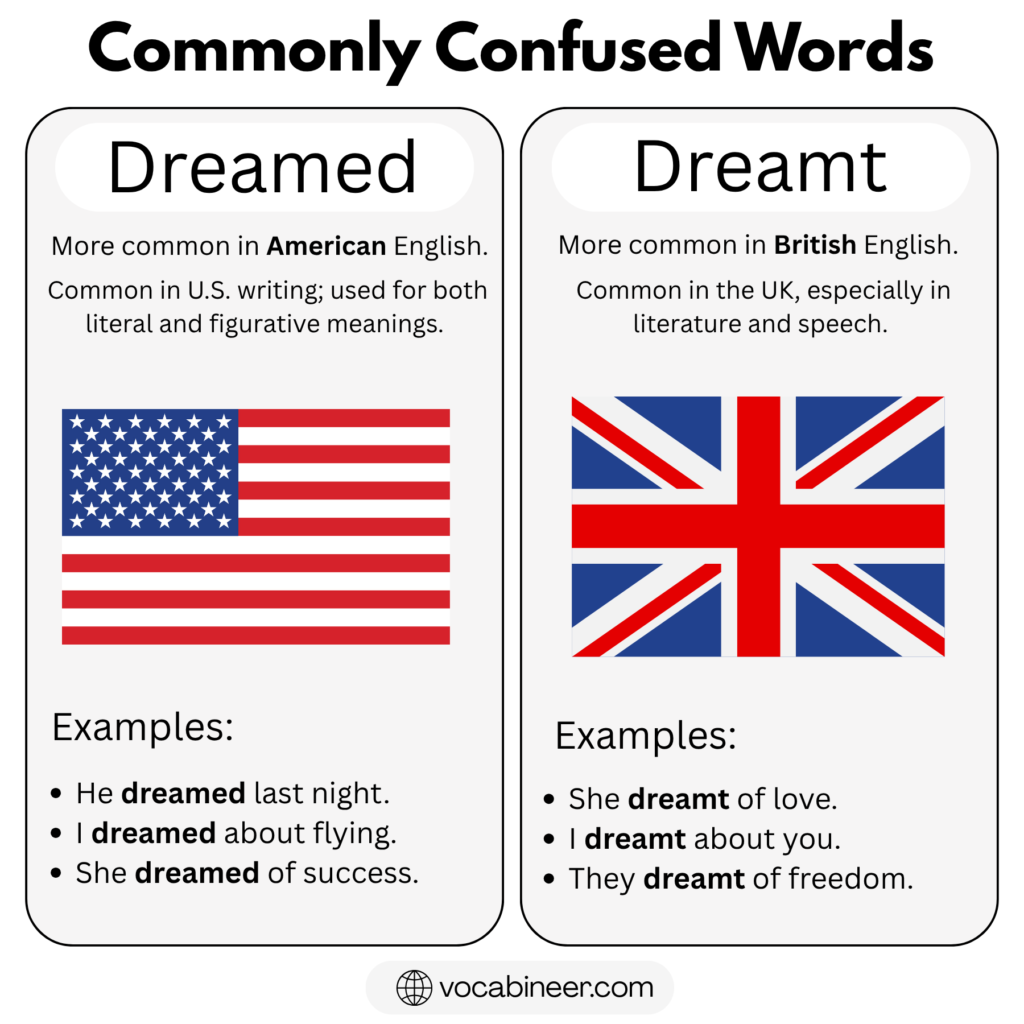
Dreamed is the American English past tense and past participle of “dream.”
Dreamt is the British English past tense and past participle of “dream.”
Dreamed vs Dreamt Difference in One Sentence
Dreamed is mainly used in American English.
Dreamt is mainly used in British English.
Why Dreamed and Dreamt Are Often Confused?
Dreamed and dreamt are often confused because both are correct past forms of the verb “dream.” Therefore, learners do not see a clear difference in meaning.
First, both words mean the same thing. So, context does not help you choose between them. Second, books, movies, and online articles use both spellings. As a result, students naturally mix them.
Moreover, English has many verbs with two past forms. For example:
- learned / learnt
- burned / burnt
- spelled / spelt
- spoiled / spoilt
Because of this pattern, learners assume one form must be wrong. However, the difference is only regional. So, the confusion comes from spelling preference, not grammar or meaning.
Word Origin and Etymology
The verb “dream” comes from Old English drēam, which originally meant joy or music. Over time, its meaning changed to describe thoughts or images during sleep.
Later, English developed two past tense forms: “dreamed” and “dreamt.” The form with “-ed” follows the regular verb pattern. Meanwhile, the “-t” form developed through pronunciation changes in British English.
In the 1800s, American English began favoring regular verb forms. Therefore, “dreamed” became more common in the United States. However, British English continued using “dreamt” more frequently.
Today, both forms are grammatically correct. The difference depends mainly on regional usage.
Meaning of Dreamed
Dreamed is the past tense and past participle of the verb “dream” in American English. It describes thoughts, images, or ideas that someone experienced during sleep or imagined in the past.
For example, “I dreamed about flying” refers to a past sleep experience. It can also describe hopes or goals, as in “She dreamed of becoming a singer.”
Although dreamed follows the regular “-ed” verb pattern, it has the same meaning as “dreamt.” The difference is only regional spelling preference.
Definition of Dreamed
Dreamed is the past tense and past participle of the verb “dream” in American English. It describes thoughts, images, or ideas experienced during sleep or imagined in the past.
Dreamed as Part of Speech
Dreamed functions as a verb. It can be used as:
- Past tense form
- Past participle form
As a past tense verb, dreamed describes something that happened in the past.
- I dreamed about flying last night.
- She dreamed of becoming a doctor.
- He dreamed about his childhood home.
- They dreamed of traveling the world.
- We dreamed of a better future.
- She dreamed about her exam results.
- He dreamed of winning the match.
- I dreamed about my old school.
- She dreamed of success.
- The child dreamed about superheroes.
As a past participle, dreamed is used with helping verbs like “have” or “had.”
- I have dreamed about this day for years.
- She has dreamed of this moment.
- They had dreamed of owning a house.
- We have dreamed about this opportunity.
- He had dreamed of fame.
- She has dreamed of studying abroad.
- I had dreamed about that place before.
- They have dreamed of freedom.
- He has dreamed about success since childhood.
- We had dreamed of starting a business.
Common Uses and Collocations of Dreamed
Dreamed often appears with certain common phrases in American English.
- dreamed about
- dreamed of
- dreamed big
- dreamed that
- dreamed deeply
- dreamed vividly
- dreamed peacefully
- dreamed constantly
- dreamed secretly
- dreamed quietly
These combinations show how dreamed is used in everyday American English writing and speech.
Meaning of Dreamt
Dreamt is the past tense and past participle of the verb “dream” in British English. It describes thoughts, images, or ideas that someone experienced during sleep or imagined in the past.
For example, if someone says, “I dreamt about flying,” they are talking about a past experience during sleep. The word can also describe hopes or wishes, such as “She dreamt of becoming a singer.”
Although dreamt ends in “-t,” it has the same meaning as “dreamed.” The difference is only in regional spelling preference.
Definition of Dreamt
Dreamt is the past tense and past participle of the verb “dream” in British English. It describes thoughts, images, or ideas experienced during sleep or imagined in the past.
Although it ends in “-t,” its meaning is exactly the same as “dreamed.” The difference is regional spelling preference.
Dreamt as Part of Speech
Dreamt functions as a verb. It is used as:
- Past tense form
- Past participle form
As a past tense verb, dreamt describes something that happened in the past.
- I dreamt about flying last night.
- She dreamt of becoming a doctor.
- He dreamt about his childhood home.
- They dreamt of traveling the world.
- We dreamt of a better future.
- She dreamt about her exam results.
- He dreamt of winning the match.
- I dreamt about my old school.
- She dreamt of success.
- The child dreamt about superheroes.
As a past participle, dreamt is used with helping verbs like “have” or “had.”
- I have dreamt about this day for years.
- She has dreamt of this moment.
- They had dreamt of owning a house.
- We have dreamt about this opportunity.
- He had dreamt of fame.
- She has dreamt of studying abroad.
- I had dreamt about that place before.
- They have dreamt of freedom.
- He has dreamt about success since childhood.
- We had dreamt of starting a business.
Common Uses and Collocations of Dreamt
Dreamt appears in many common British English phrases.
- dreamt about
- dreamt of
- dreamt big
- dreamt that
- dreamt deeply
- dreamt vividly
- dreamt peacefully
- dreamt constantly
- dreamt secretly
- dreamt quietly
These combinations show how dreamt is used in British English writing and everyday communication.
Dreamed vs Dreamt: Key Difference Explained
Dreamed and dreamt have the same meaning and grammar function. However, the difference depends on regional usage.
In American English, writers usually prefer dreamed. It follows the regular verb pattern with “-ed.” Therefore, it looks more consistent with other regular past tense verbs.
In contrast, British English often prefers dreamt. This form ends in “-t,” which is common in several British past tense forms like learnt, burnt, and spoilt.
Importantly, both forms are correct in standard English. So, the choice is not about grammar accuracy. Instead, it depends on whether you are using American English spelling or British English spelling.
For professional writing, choose one regional standard and remain consistent throughout your document.
Dreamed vs Dreamt: Difference in One Look
| Feature | Dreamed | Dreamt |
|---|---|---|
| English Variant | American English | British English |
| Verb Type | Regular (-ed form) | Alternative (-t form) |
| Past Tense | I dreamed last night. | I dreamt last night. |
| Past Participle | I have dreamed of this. | I have dreamt of this. |
| Meaning | Same | Same |
| Pronunciation | Same | Same |
This table shows that the only real difference is spelling preference based on regional English.
Dreamed vs Dreamt: Side by Side Sentence Contrast
Both forms fit into the same sentence patterns. However, the spelling changes depending on regional English.
American English:
- I dreamed about you last night.
- She dreamed of becoming famous.
- They dreamed about traveling the world.
- He dreamed of success.
- We have dreamed about this moment.
- She had dreamed of studying abroad.
- I dreamed that I was flying.
- The child dreamed about superheroes.
British English:
- I dreamt about you last night.
- She dreamt of becoming famous.
- They dreamt about traveling the world.
- He dreamt of success.
- We have dreamt about this moment.
- She had dreamt of studying abroad.
- I dreamt that I was flying.
- The child dreamt about superheroes.
As you can see, the meaning and sentence structure remain identical. Only the spelling changes.
Dreamed vs Dreamt: Sentence Structure Comparison
Both words function as past tense and past participle forms of “dream.” Therefore, the grammar structure stays the same.
Past tense structure:
Subject + dreamed/dreamt
- I dreamed last night.
- I dreamt last night.
Present perfect structure:
Subject + have/has + dreamed/dreamt
- She has dreamed of success.
- She has dreamt of success.
Past perfect structure:
Subject + had + dreamed/dreamt
- They had dreamed of freedom.
- They had dreamt of freedom.
So, grammatically, both forms behave the same way. The difference is simply regional spelling preference.
When to Use Dreamed and When to Use Dreamt
Choosing between dreamed and dreamt depends on the type of English you are using.
If you are writing in American English, use dreamed. It is the preferred and more common form in the United States. Moreover, it follows the regular “-ed” verb pattern.
If you are writing in British English, use dreamt. This form is more common in the United Kingdom and other regions that follow British spelling.
Both forms are grammatically correct. However, you should not mix dreamed and dreamt in the same document unless you are explaining the difference.
Therefore, the key rule is consistency. Match the spelling to your regional audience and keep it uniform throughout your writing.
Context Based Usage Guide
Use this simple guide to decide which form fits your context.
For American audiences, choose:
- dreamed
- regular “-ed” past forms
- consistent American spelling
When writing for British audiences, select:
- dreamt
- other “-t” forms like learnt and burnt
- consistent British spelling
In academic writing, check the required style guide first. Then, avoid mixing regional variants within the same paper.
If your content targets global readers, decide on one version at the beginning. After that, keep the same form in headings and examples.
During exams, follow the English variant mentioned in the instructions. Most importantly, avoid switching between American English and British English.
So, the correct choice depends on regional preference, not meaning.
Grammar Difference Between Dreamed and Dreamt
Dreamed and dreamt follow the same grammar rules. The only difference is spelling preference based on regional English.
Both words are past tense and past participle forms of the verb “dream.” They work in the same sentence structures and take the same helping verbs.
Below is a clear comparison table to show the grammar difference.
| Grammar Feature | Dreamed (American English) | Dreamt (British English) |
|---|---|---|
| Past Tense | I dreamed last night. | I dreamt last night. |
| Present Perfect | I have dreamed of success. | I have dreamt of success. |
| Past Perfect | She had dreamed about it. | She had dreamt about it. |
| Verb Pattern | Regular (-ed form) | Alternative (-t form) |
| Meaning | Same | Same |
As shown above, grammar does not change. Only the spelling reflects regional usage.
Pronunciation Difference Between Dreamed and Dreamt
There is no major pronunciation difference between dreamed and dreamt.
Dreamed is pronounced:
/driːmd/
Dreamt is pronounced:
/dremt/ or /driːmt/ depending on accent.
In fast speech, both forms sound very similar. Therefore, the main difference appears in writing rather than in speaking.
Common Mistakes With Dreamed and Dreamt
Many learners make small mistakes when using dreamed and dreamt. However, most errors happen because of regional mixing.
One common mistake is switching between dreamed and dreamt in the same paragraph. This creates inconsistency in writing.
Another mistake is assuming that one form is wrong. In fact, both are correct. The difference is only regional.
Some writers also forget to match related verb forms. For example, using dreamt but then writing other verbs in American English style can look inconsistent.
Additionally, students sometimes use present tense by mistake:
- Incorrect: I dream about it last night.
- Correct: I dreamed about it last night.
- Correct: I dreamt about it last night.
So, always choose one regional style and apply it consistently throughout your document.
FAQs
Both are correct. Dreamed is common in American English, while dreamt is more common in British English.
In American English, dreamed is more common. In British English, dreamt is often preferred.
No, both words have exactly the same meaning. The difference is only in spelling.
Yes, but it is less common. Most American writing prefers dreamed.
Dream is considered a regular verb because it can take the “-ed” form. However, it also has the alternative “-t” form in British English.
Final Summary
Dreamed vs dreamt shows a spelling difference based on regional English usage. Both words are correct past tense and past participle forms of the verb “dream.” However, dreamed is more common in American English, while dreamt is more common in British English.
The meaning, grammar structure, and usage remain the same. Therefore, the only difference is spelling preference. To avoid confusion, choose the version that matches your audience and stay consistent throughout your writing.
Read More
- Confusing Words in English
- American vs British Words
- Canceled or Cancelled in English
- Afterward vs Afterwards in English
