
Emoji meanings in chat depend on more than the symbol itself. In messaging, emojis act as emotional signals that replace tone, facial expression, and body language. The same emoji can feel friendly, sarcastic, supportive, or dismissive based on who is chatting, what was said before, and how the emoji is placed in the message.
In chat conversations, emojis often soften words, shorten responses, or clarify intent. A simple emoji can signal agreement, empathy, humor, or hesitation without adding extra text. Because chats move quickly, readers usually interpret emojis alongside message speed, relationship closeness, and conversation flow rather than as fixed symbols with one meaning.
Small factors matter. An emoji used alone can feel stronger than the same emoji used with words. An emoji placed at the end of a sentence may soften tone, while the same emoji at the start can frame how the message is read. Understanding how emoji meanings work in chat helps avoid misreading tone and makes digital conversations feel more natural.
In This Page
Common Emoji Meanings in Chat Messages
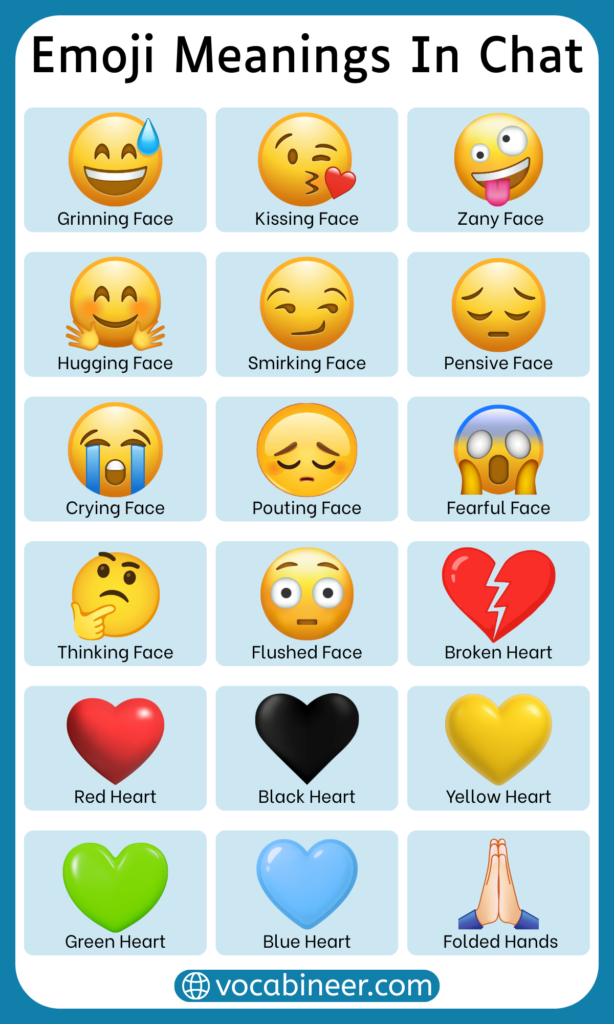
In chat messages, certain emojis appear again and again because their meanings are widely understood. These emojis act as quick emotional cues and help keep conversations smooth without adding extra words. Below is a structured listicle with explanations, followed by a quick-reference table for fast understanding.
Common Positive Emojis in Chat
These emojis usually add warmth, friendliness, or encouragement to a message.
- Smiling face: Shows friendliness, politeness, or a pleasant tone.
- Grinning face: Expresses playful happiness or light humor.
- Laughing face: Reacts to something funny or amusing.
- Face with tears of joy: Shows strong laughter or finding something very funny.
- Red heart: Signals affection, appreciation, or emotional support.
- Thumbs up: Confirms agreement, approval, or acknowledgment.
Common Neutral Emojis in Chat
Neutral emojis help acknowledge messages or keep a conversation going without strong emotion.
- Neutral face: Indicates calm reaction or emotional neutrality.
- Thinking face: Shows consideration, doubt, or reflection.
- Eyes emoji: Signals attention, curiosity, or watching the situation.
- Raised hand: Used to signal participation or pause.
Common Negative or Emotional Emojis in Chat
These emojis express concern, sadness, or emotional awareness.
- Sad face: Shows feeling low or emotionally affected.
- Crying face: Expresses visible sadness or emotional pain.
- Worried face: Signals concern or anxiety about something.
- Weary face: Indicates emotional or mental exhaustion.
Emoji Meanings for Quick Understanding
The table below summarizes common emoji meanings as they are typically understood in chat messages.
| Emoji Type | Emoji Name | Common Meaning in Chat |
|---|---|---|
| Positive | Smiling face | Friendly tone or politeness |
| Positive | Laughing face | Reacting to humor |
| Positive | Face with tears of joy | Strong laughter |
| Neutral | Thinking face | Considering or unsure |
| Neutral | Eyes emoji | Paying attention |
| Emotional | Sad face | Feeling low |
| Emotional | Crying face | Emotional pain |
| Emotional | Worried face | Concern or anxiety |
| Gesture | Thumbs up | Agreement or confirmation |
| Gesture | Raised hand | Pause or participation |
Emoji Meanings Based on Chat Context
Emoji meanings shift with context. The same emoji can feel supportive, playful, or dismissive depending on the situation, relationship, and message flow. In chats, readers interpret emojis alongside timing, topic, and how much text surrounds them.
Emoji Meanings in Friendly Chats
In friendly chats, emojis usually reinforce warmth and shared understanding. They keep messages light and help conversations move smoothly.
- Smiling face: Friendly tone or casual positivity
- Grinning face: Playful agreement or shared joke
- Laughing face: Reacting to humor without overdoing it
- Thumbs up: Easy acknowledgment or approval
- Red heart: Appreciation or friendly affection
Emoji Meanings in Emotional Chats
In emotional chats, emojis carry more weight. They often signal empathy, concern, or emotional honesty.
- Sad face: Feeling low or emotionally affected
- Crying face: Strong emotional response or sadness
- Worried face: Concern about a situation or person
- Weary face: Emotional exhaustion or stress
- Folded hands: Support, hope, or emotional respect
Emoji Meanings in Quick Replies
In quick replies, emojis often replace full sentences. Their meaning depends heavily on speed and placement.
- Smiling face: Polite acknowledgment
- Laughing face: Quick amused reaction
- Eyes emoji: Noticing or following along
- Check mark or thumbs up: Confirmation without continuing the chat
Emoji Meanings by Emotional Tone
Emotional tone shapes how emojis are read in chat. Even familiar symbols can feel encouraging, neutral, or heavy depending on the emotion they carry. Grouping emojis by tone helps readers quickly judge how a message is likely to feel.
Positive Emoji Meanings in Chat
Positive emojis lift the mood and signal friendliness, humor, or support. They often soften messages and keep conversations welcoming.
- Smiling face: Friendly tone or polite warmth
- Grinning face: Playful happiness or shared humor
- Laughing face: Clear amusement or enjoyment
- Face with tears of joy: Strong laughter or finding something very funny
- Red heart: Appreciation, care, or emotional support
- Sparkles: Excitement or positive emphasis
Neutral Emoji Meanings in Chat
Neutral emojis acknowledge messages without adding strong emotion. They help keep conversations moving without changing the tone.
- Neutral face: Calm acknowledgment or emotional balance
- Thinking face: Considering or reflecting
- Eyes emoji: Paying attention or noticing something
- Check mark: Confirmation or completion
- Raised hand: Pause, turn-taking, or signal to speak
Negative Emoji Meanings in Chat
Negative or heavy emojis express concern, sadness, or emotional strain. They are used when conversations turn serious or sensitive.
- Sad face: Feeling low or emotionally affected
- Crying face: Visible sadness or emotional pain
- Worried face: Concern or anxiety
- Weary face: Emotional or mental exhaustion
- Broken heart: Emotional hurt or loss
Quick tone snapshot
| Tone | Typical Emojis | What They Signal |
|---|---|---|
| Positive | Smiling, laughing, hearts | Warmth, humor, encouragement |
| Neutral | Thinking, eyes, check mark | Acknowledgment, reflection |
| Negative | Sad, crying, weary | Concern, sadness, strain |
moji Meaning Changes by Placement in a Message
Where an emoji appears in a chat message often matters as much as which emoji is used. Placement can soften tone, frame intent, or replace words entirely. Readers usually interpret emojis based on whether they come before text, after text, or stand alone.
- Emoji at the end of a sentence: Softens tone and confirms friendly intent. It reassures the reader that the message is not harsh or overly serious.
- Emoji at the beginning of a message: Sets emotional context before the words are read. It prepares the reader for humor, concern, or warmth.
- Emoji in the middle of text: Acts as an emotional pause or emphasis. It highlights a feeling without stopping the message flow.
- Emoji used alone: Replaces a full sentence. Its meaning feels stronger because there are no words to dilute it.
Below is a quick reference showing how placement changes meaning in chat:
| Placement | Common Effect | How It’s Usually Read |
|---|---|---|
| End of sentence | Tone softening | Friendly, polite, or reassuring |
| Start of message | Emotional framing | Sets mood before reading |
| Middle of text | Emotional emphasis | Highlights feeling or reaction |
| Used alone | Strong reaction | Clear emotion without explanation |
Emoji Meaning When Used Alone in Chat
When an emoji is sent by itself, it often carries stronger meaning than when paired with text. Without words to guide interpretation, readers focus entirely on the emoji’s emotional signal. In chat, a single emoji can act as a full response, showing agreement, humor, concern, or hesitation in one symbol.
- Smiling face: Polite acknowledgment or friendly presence
- Thumbs up: Clear agreement or confirmation without continuing the chat
- Laughing face: Amused reaction that replaces a written response
- Face with tears of joy: Strong laughter reacting to something just said
- Sad face: Quiet emotional response or shared understanding
- Eyes emoji: Attention, curiosity, or silently following the conversation
Emoji Meanings That Change Across Devices
Emoji meanings can shift depending on the device or platform used in chat. While the emoji name stays the same, its visual design may look slightly different on phones, tablets, or operating systems. These design changes can affect how the emotion is read, especially in quick conversations.
On some devices, an emoji may appear brighter, softer, or more exaggerated. A smiling or laughing emoji that looks friendly on one phone might seem more intense or sarcastic on another. Subtle differences in eye shape, mouth curve, or added details can change emotional tone without the sender realizing it.
This is why misunderstandings sometimes happen in cross-device chats. The sender reacts based on how the emoji looks on their screen, while the receiver interprets it based on a different version. Being aware that emoji meanings can change across devices helps readers interpret messages more carefully and respond with better emotional judgment.
Emoji Meanings People Often Misunderstand in Chat
Some emojis are misunderstood because their emotional tone depends heavily on context, relationship, or timing. In fast chats, readers may assign meaning based on habit rather than intent, which leads to mixed signals.
- Laughing face: Can feel friendly in casual chats but dismissive during serious topics.
- Face with tears of joy: Often read as support for humor, yet may seem insensitive in emotional moments.
- Thumbs up: Signals agreement for some, but can feel abrupt or final to others.
- Neutral face: Meant as calm acknowledgment, yet sometimes read as indifference.
- Eyes emoji: Shows attention or curiosity, but may be interpreted as pressure or judgment.
Below is a quick view of why confusion happens:
| Emoji | Common Intent | Why It Gets Misread |
|---|---|---|
| Laughing face | Amusement | Tone clash with serious topics |
| Thumbs up | Agreement | Feels abrupt without text |
| Neutral face | Calm response | Lacks emotional warmth |
| Eyes emoji | Attention | Ambiguous focus or intent |
Emoji Meanings That Can Feel Rude in Chat
Some emojis can feel rude or dismissive in chat, even when no offense is intended. This usually happens when the emoji clashes with the topic, timing, or emotional weight of the conversation. In serious or sensitive moments, certain emojis may come across as careless, sarcastic, or overly brief.
- Laughing face: Can feel dismissive if used during emotional or serious discussions.
- Face with tears of joy: May seem insensitive when someone is sharing bad news.
- Thumbs up: Often read as abrupt or final, especially in longer conversations.
- Neutral face: Can appear see unemotional or uninterested when empathy is expected.
- Smirking face: Sometimes feels sarcastic or mocking rather than playful.
Below is a quick reference showing why these emojis can cause friction:
| Emoji | Intended Use | Why It Can Feel Rude |
|---|---|---|
| Laughing face | Humor | Tone mismatch with serious topics |
| Tears of joy | Strong amusement | Appears insensitive in sad moments |
| Thumbs up | Agreement | Feels cold or conversation-ending |
| Neutral face | Calm response | Lacks warmth or empathy |
| Smirking face | Playfulness | Reads as sarcasm or judgment |
Emoji Meanings for Quick Understanding
This quick overview helps readers grasp common emoji meanings in chat at a glance. It focuses on typical intent and how messages are usually read, without overthinking edge cases.
| Emoji Category | Emoji Example | Common Meaning in Chat |
|---|---|---|
| Positive | Smiling face | Friendly tone or polite warmth |
| Positive | Laughing face | Reacting to humor or amusement |
| Positive | Face with tears of joy | Strong laughter or shared joke |
| Neutral | Thinking face | Considering or unsure response |
| Neutral | Eyes emoji | Paying attention or following along |
| Gesture | Thumbs up | Agreement or confirmation |
| Emotional | Sad face | Feeling low or empathetic response |
| Emotional | Crying face | Strong emotion or sadness |
| Emotional | Worried face | Concern or anxiety |
When Emoji Meanings Change by Culture or Setting
Emoji meanings in chat are not always universal. Culture, workplace norms, and social setting can change how an emoji is interpreted, even if the symbol itself stays the same. What feels friendly in one context may feel inappropriate or confusing in another.
In casual personal chats, emojis are often read generously. A smiling or laughing emoji usually signals warmth or humor. In professional or mixed-culture settings, the same emoji may feel too informal or unclear. For example, a thumbs up may be seen as agreement in one culture but as abrupt or dismissive in another. Similarly, heavy use of laughing emojis may feel playful among friends but unprofessional in work-related conversations.
Cultural expectations also shape emotional expression. Some cultures use emojis freely to show feeling, while others prefer limited or restrained use. Being aware of setting and audience helps readers choose emojis that match the situation and avoid unintended tone shifts.
FAQs About Emoji Meanings in Chat
No. Emoji meanings often change based on context, placement, relationship, and the topic being discussed.
Yes. A laughing or smiling emoji can feel friendly in casual chats but dismissive in serious conversations.
Misunderstandings happen because text lacks tone and emojis can look different across devices or cultures.
It depends on the setting. Simple emojis may be acceptable, but excessive or playful ones can feel unprofessional.
Emojis save time and quickly express emotion, reaction, or acknowledgment without typing full sentences.
Conclusion
Emoji meanings in chat depend on emotion, context, placement, and audience rather than fixed definitions. Small differences in how and where an emoji is used can change how a message feels to the reader. Understanding common emoji meanings, potential misunderstandings, and cultural or situational shifts helps readers communicate more clearly and avoid unintended tone. With thoughtful use, emojis can support smoother, more expressive chat conversations.
Read More