

Ensure vs Insure often confuses learners because the words look similar and share related meanings. However, their usage differs depending on context. One focuses on making something certain, while the other relates specifically to financial protection through insurance.
Understanding Ensure vs Insure helps you write accurately in formal, academic, and business communication. Therefore, this guide explains their definitions, grammar roles, usage patterns, sentence structures, and common mistakes so you can apply them correctly.
In This Page
Ensure vs Insure: Quick Definition
Ensure means to make certain or guarantee.
Insure means to provide financial protection through insurance.
In simple words, Ensure guarantees results, whereas Insure protects against financial loss.
Ensure vs Insure Difference in One Sentence
Ensure means to make something certain.
Insure means to protect something financially through an insurance policy.
In other words, Ensure relates to certainty, while Insure relates to insurance coverage.
Why Ensure and Insure Are Often Confused?
Ensure and Insure are often confused because they look almost identical and sound very similar in pronunciation. In addition, both words involve the idea of protection or certainty. As a result, many writers use them interchangeably, especially in formal writing.
However, their meanings are not the same. Ensure focuses on making something certain or guaranteed. In contrast, Insure specifically refers to financial protection through an insurance policy. Therefore, confusion usually happens when writers do not check whether the sentence is about certainty or insurance coverage.
Word Origin and Etymology
Ensure comes from Latin and Old French roots meaning “to make secure.” Over time, it developed the broader meaning of guaranteeing or making something certain. Therefore, its meaning connects to assurance and certainty.
On the other hand, Insure also comes from similar roots but later developed a specialized financial meaning. It became associated specifically with insurance contracts and financial risk protection. Although the words share historical origins, their modern usage clearly differs.
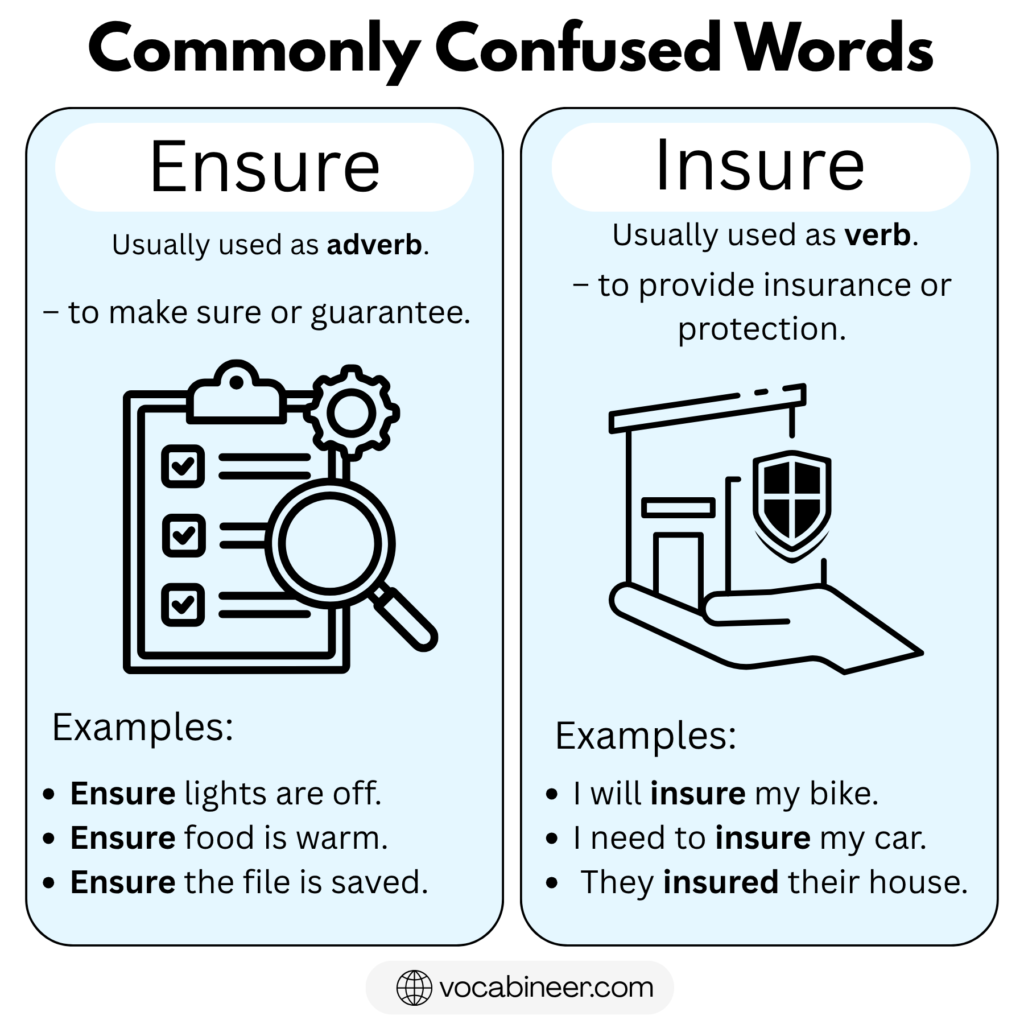
Meaning of Ensure
Ensure means to make something certain, guaranteed, or sure to happen. It focuses on results and outcomes. Therefore, it is commonly used in academic writing, instructions, formal communication, and daily speech.
In addition, Ensure functions as a verb. As a result, it requires an object, usually followed by a clause or noun phrase that explains what is being guaranteed.
Definition of Ensure
Ensure means to make certain that something will happen or be the case.
In simple terms, it guarantees an outcome.
Ensure as Part of Speech
Ensure functions as a verb.
Examples:
- Please ensure the door is locked.
- She worked hard to ensure success.
- The teacher will ensure fairness.
- We must ensure safety at work.
- He checked twice to ensure accuracy.
- They acted quickly to ensure stability.
- Policies help ensure quality service.
- The team trained daily to ensure victory.
- Careful planning can ensure better results.
- The company will ensure customer satisfaction.
- Double-check the data to ensure correctness.
- Steps were taken to ensure compliance.
- The manager will ensure timely delivery.
- Clear rules ensure smooth operations.
- She called ahead to ensure availability.
- Proper maintenance will ensure safety.
- Leaders must ensure transparency.
- Strong systems ensure security.
- We revised the plan to ensure success.
- This update will ensure better performance.
Common Uses and Collocations of Ensure
Common patterns include:
- Ensure safety
- Ensure success
- Ensure accuracy
- Ensure compliance
- Ensure fairness
- Ensure quality
- Ensure security
- Ensure stability
These combinations show that Ensure relates to certainty and guaranteed outcomes.
Meaning of Insure
Insure means to provide financial protection against loss, damage, or risk. It is used mainly in business, legal, and financial contexts. Therefore, it appears most often in discussions about insurance policies, property, health, and vehicles.
Unlike Ensure, which guarantees results, Insure specifically refers to coverage through an insurance agreement. As a result, it is connected to money, risk management, and formal contracts.
Definition of Insure
Insure means to protect something financially by purchasing insurance.
In simple terms, it provides coverage against possible loss.
Insure as Part of Speech
Insure functions as a verb.
Examples:
- They decided to insure the house.
- She plans to insure her car.
- The company will insure the shipment.
- He forgot to insure his property.
- You must insure valuable items.
- The firm agreed to insure the building.
- Travelers should insure their luggage.
- The policy will insure the equipment.
- Farmers insure crops against damage.
- He chose to insure his life.
- The bank required them to insure the property.
- Businesses often insure assets.
- She called to insure her jewelry.
- We need to insure the new vehicle.
- The company agreed to insure the event.
- Many people insure their health.
- They plan to insure the investment.
- Owners must insure rental properties.
- The contract allows you to insure the package.
- He refused to insure the risk.
Common Uses and Collocations of Insure
Common patterns include:
- Insure a car
- Insure a house
- Insure property
- Insure assets
- Insure a shipment
- Insure against loss
- Insure against damage
- Insure against theft
These patterns clearly show that Insure relates specifically to financial protection and insurance coverage.
Ensure vs Insure: Key Difference Explained
Although Ensure and Insure are both verbs, they serve different purposes in English. The verb Ensure means to make something certain or guaranteed. By contrast, Insure refers specifically to protecting something financially through an insurance policy.
The distinction becomes clearer when you focus on intent. If the aim is to guarantee a result or outcome, then Ensure is the correct choice. However, when financial protection against loss or damage is involved, Insure is required. In short, one guarantees certainty, while the other provides insurance coverage.
Ensure vs Insure: Difference in One Look
| Feature | Ensure | Insure |
|---|---|---|
| Part of Speech | Verb | Verb |
| Meaning | Make certain or guarantee | Provide financial protection |
| Focus | Certainty / Outcome | Insurance / Risk coverage |
| Used In | General situations | Financial and legal contexts |
| Replace With | Guarantee / Make sure | Cover / Protect financially |
This comparison clearly shows that Ensure guarantees results, whereas Insure protects against financial risk.
Ensure vs Insure: Side by Side Sentence Contrast
Looking at both words in similar sentence structures makes the difference clearer. Therefore, compare how the meaning changes depending on the context.
- The manager will ensure quality service.
- The company will insure the building.
- We must ensure safety at work.
- They decided to insure the factory.
- Careful planning can ensure success.
- The bank requires you to insure the property.
- She checked again to ensure accuracy.
- He chose to insure his car.
- These steps will ensure compliance.
- Businesses often insure valuable assets.
In each pair, Ensure guarantees a result, whereas Insure protects against financial loss.
Ensure vs Insure: Sentence Structure Comparison
Although both words are verbs, their sentence patterns differ slightly.
Ensure patterns:
- Ensure + noun
- Ensure + that clause
- Ensure success
- Ensure safety
- Ensure that everything is correct
Insure patterns:
- Insure + noun (usually property or asset)
- Insure a car
- Insure a house
- Insure property
- Insure against loss
Therefore, Ensure often appears before abstract nouns or clauses, while Insure usually appears before physical property or financial assets.
When to Use Ensure and Insure
Use Ensure when you want to make something certain or guaranteed. It applies to results, outcomes, safety, fairness, and accuracy. Therefore, if the sentence focuses on achieving a specific result, Ensure is correct.
However, use Insure when you are talking about financial protection through an insurance policy. It applies to cars, houses, property, health, shipments, and assets. Thus, if the sentence involves risk coverage or insurance contracts, Insure is the right choice.
In short, Ensure guarantees results, while Insure protects against financial loss.
Context Based Usage Guide
If the sentence involves certainty, compliance, success, or safety, choose Ensure. For example:
- We must ensure customer satisfaction.
- She worked hard to ensure fairness.
- Double-check to ensure accuracy.
- The plan will ensure stability.
- Clear communication helps ensure success.
On the other hand, if the sentence involves property, vehicles, health, or financial risk, choose Insure. For instance:
- They decided to insure the car.
- The company will insure the shipment.
- You should insure valuable items.
- The bank requires you to insure the house.
- Farmers often insure crops.
Therefore, always check whether the focus is certainty or insurance coverage before choosing the correct verb.
Grammar Difference Between Ensure and Insure
Although Ensure and Insure are both verbs, their grammatical usage differs based on context and object type. Therefore, understanding what follows each verb helps you choose the correct word. In general, Ensure connects with outcomes and abstract nouns, whereas Insure connects with property and financial risk.
| Grammar Feature | Ensure | Insure |
|---|---|---|
| Part of Speech | Verb | Verb |
| Main Function | Make certain or guarantee | Provide financial protection |
| Object Type | Abstract nouns (success, safety, accuracy) | Property, assets, vehicles, goods |
| Common Structure | Ensure + noun / Ensure + that clause | Insure + noun / Insure against + risk |
| Used In | General and formal contexts | Legal and financial contexts |
| Replace With | Guarantee / Make sure | Cover / Protect financially |
| Can Use “That” Clause? | Yes (Ensure that…) | Rare |
| Interchangeable? | No | No |
This table shows that although both words are verbs, Ensure usually works with abstract outcomes, whereas Insure works with tangible property and financial risk.
Pronunciation Difference Between Ensure and Insure
Ensure and Insure are pronounced very similarly in modern English. Therefore, pronunciation alone may not clearly distinguish them in everyday speech. Both words follow a similar stress pattern.
However, careful pronunciation may slightly emphasize the second syllable in each word. Even so, the difference is subtle. As a result, correct usage depends more on meaning and context than on sound.
Common Mistakes With Ensure and Insure
Ensure vs Insure mistakes usually happen because both words suggest protection or security. However, their usage depends on whether the sentence refers to certainty or financial coverage.
- Incorrect: Please insure that the door is locked.
Correct: Please ensure that the door is locked. - Incorrect: The manager will insure quality service.
Correct: The manager will ensure quality service. - Incorrect: We must insure accuracy in the report.
Correct: We must ensure accuracy in the report. - Incorrect: The company will ensure the building against fire.
Correct: The company will insure the building against fire. - Incorrect: She decided to ensure her car.
Correct: She decided to insure her car. - Incorrect: The bank requires you to ensure the property.
Correct: The bank requires you to insure the property. - Incorrect: Careful planning will insure success.
Correct: Careful planning will ensure success. - Incorrect: He forgot to ensure his house.
Correct: He forgot to insure his house.
Therefore, always ask yourself: Is this about making something certain? If yes, use Ensure. If it is about financial protection or insurance coverage, use Insure.
FAQs
Ensure means to make something certain or guaranteed. In contrast, Insure means to provide financial protection through an insurance policy.
No, they cannot. Although they look similar, their meanings are different. Therefore, replacing one with the other changes the sentence meaning.
Use Ensure when you want to guarantee a result, such as safety, accuracy, fairness, or success.
Use Insure when referring to insurance coverage for cars, houses, property, health, or other financial risks.
Think of Insure as connected to “insurance.” If the sentence involves insurance coverage, choose Insure. Otherwise, use Ensure for certainty.
Final Summary
Ensure and Insure are similar in spelling but different in meaning. Ensure guarantees certainty or outcomes, whereas Insure provides financial protection against risk. Although the pronunciation is close, context determines the correct word. Therefore, use Ensure for certainty and Insure for insurance coverage.
Read More
- Confusing Words in English
- American vs British Words
- Than vs Then in English
- Quiet vs Quite in English
