
Farm tools names are used when people talk about preparing land, planting crops, caring for fields, and harvesting produce. These names appear in farming lessons, markets, manuals, and everyday conversations, yet many tools look alike or are known by different names in different places. Knowing the correct farm tools names makes it easier to connect each tool with its shape, purpose, and role in the farming process.
This article explains farm tools names in a clear, organized way so readers can recognize tools, follow farming steps with confidence, and speak more clearly about farming work on small farms, large fields, or during basic farming education.
In This Page
Basic Farm Tools Names to Know
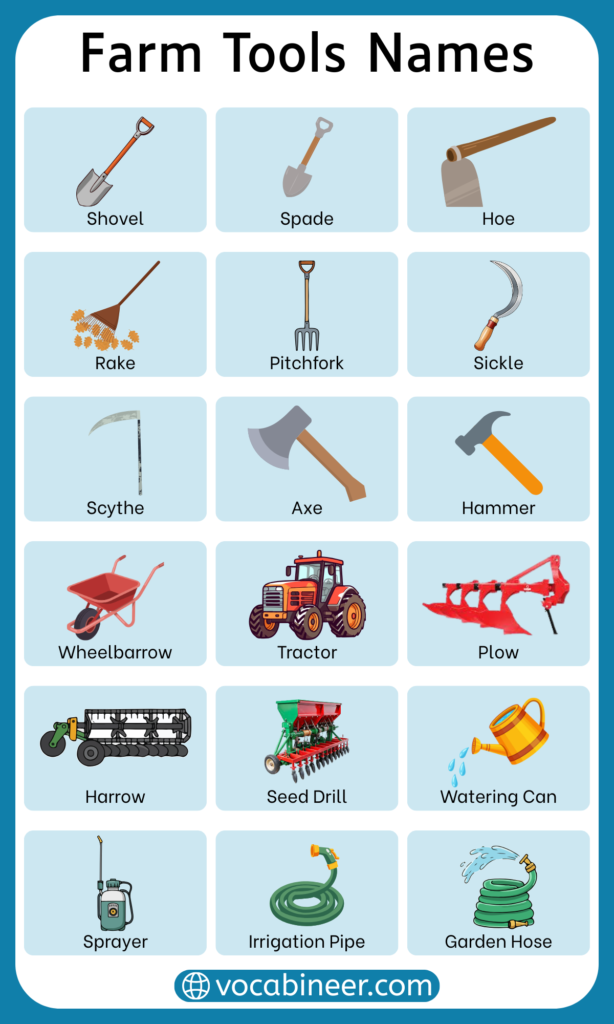
Basic farm tools are the first tools people usually learn when starting farming work. These tools are mostly hand operated and are used for digging, cutting, loosening soil, and moving materials. Knowing these basic farm tools names helps readers recognize tools easily before learning about larger or machine-based equipment.
- Hoe: Used to loosen soil, remove weeds, and, over time, shape planting rows evenly.
- Spade: A flat bladed tool used for digging, cutting, and then turning soil carefully.
- Shovel: Designed for lifting and moving loose materials like soil or manure efficiently.
- Rake: Levels soil and also gathers dry leaves, straw, or crop remains from fields.
- Sickle: A curved blade tool used for cutting grass and, later, harvesting crops.
- Hand Trowel: A small tool used mainly for planting seeds and seedlings in tight spaces.
- Garden Fork: Loosens soil and then lifts root crops without damaging them.
- Pickaxe: Breaks hard ground, stones, or compact soil when digging becomes difficult.
- Wheelbarrow: Carries soil, tools, fertilizer, or harvested crops from one place to another.
- Hand Cultivator: Loosens topsoil and, at the same time, removes weeds around plants.
- Axe: Cuts wood, clears small trees, and prepares wooden posts for farming use.
- Mattock: A digging tool with a flat blade used especially for breaking hard soil and roots.
- Pruning Shears: Cuts small branches, stems, and unwanted plant growth cleanly and quickly.
- Watering Can: Delivers controlled water to plants in gardens and small farm areas as needed.
Common Farm Tools Names Used Daily
Some farm tools are mentioned regularly in everyday talk, even by people who are not full-time farmers. These names are often heard in markets, homes, schools, and local discussions, so knowing them helps connect casual words with the correct tools.
- Plough: A tool used to turn and loosen soil before planting crops.
- Hoe: Commonly mentioned for removing weeds and shaping soil rows.
- Sickle: A familiar name for cutting grass, wheat, or similar crops.
- Shovel: Used daily for lifting and moving soil, manure, or compost.
- Spade: Often confused with a shovel, but mainly used for digging and cutting soil.
- Rake: Used to gather dry leaves, straw, or level loose soil.
- Wheelbarrow: A daily-use tool for carrying tools, soil, or harvested produce.
- Hand Trowel: Commonly named during planting or gardening work.
- Sprayer: Used to apply water, fertilizer, or pest control solutions.
- Watering Can: A simple tool for watering plants in small areas.
- Garden Fork: Often used to loosen soil or lift root crops.
Farm Tools Names with Their Uses
Knowing farm tools names becomes more meaningful when each tool is linked to its actual job on the farm. This section explains how common tools are used during farming work, helping readers connect the name with the task it performs.
- Plough: Turns and loosens soil deeply so the land is ready for planting crops.
- Hoe: Removes weeds and then breaks soil around growing plants.
- Spade: Cuts into soil for digging, edging, and later turning earth.
- Shovel: Lifts and moves loose materials like soil, manure, or compost efficiently.
- Sickle: Cuts crops, grass, and weeds close to the ground during harvesting work.
- Rake: Levels soil and also gathers dry leaves or crop residue.
- Hand Trowel: Plants seedlings and digs small holes where space is limited.
- Garden Fork: Loosens soil and then lifts root vegetables safely.
- Pickaxe: Breaks hard soil, stones, or compact ground when digging becomes difficult.
- Wheelbarrow: Transports tools, soil, and harvested crops from one place to another.
Farm Tools Names for Beginners
Beginners usually start with tools that are easy to handle and used in small farming or gardening tasks. At first, these tools help learners focus on simple work. As a result, they understand basic farming without using complex machinery.
- Hoe: Simple tool for weeding and soil shaping.
- Hand Trowel: Easy to use for planting and digging small areas.
- Watering Can: Helps control water flow while watering plants.
- Rake: Clears debris and smooths soil surfaces.
- Spade: Teaches basic digging and soil turning.
- Sickle: Introduces crop cutting techniques.
- Wheelbarrow: Helps move materials without heavy lifting.
Farm Tools by Farming Stage
Farming work happens in clear stages, from preparing the land to collecting crops. Grouping farm tools by farming stage helps learners understand when and why each tool is used during the farming process.
Tools Used for Soil Preparation
Soil preparation tools are used at the very beginning of farming. These tools help loosen, break, and level the soil so seeds can grow properly.
- Plough: Turns soil deeply and brings fresh soil to the surface.
- Hoe: Breaks soil clumps and removes early weeds.
- Spade: Digs and turns soil in small or medium areas.
- Garden Fork: Loosens soil without cutting plant roots.
- Pickaxe: Breaks hard or rocky ground before planting.
- Rake: Levels soil and removes stones or plant remains.
- Hand Cultivator: Loosens topsoil and prepares seedbeds.
Tools Used for Plowing and Tilling
Plowing and tilling tools prepare larger areas of land by turning and mixing soil more deeply. These tools improve soil structure and help control weeds before planting.
- Plough: Cuts and turns soil to prepare large fields.
- Disc Plough: Uses rotating discs to work heavy or sticky soil.
- Harrow: Breaks soil clods and smooths ploughed land.
- Cultivator: Mixes soil and controls weeds between crop rows.
- Rotary Tiller: Uses rotating blades to finely break soil.
- Animal Drawn Plough: Traditional plough pulled by animals for field preparation.
Tools Used for Sowing and Planting
Sowing and planting tools help place seeds and seedlings into the soil at the correct depth and spacing. As a result, planting becomes faster, more even, and easier to manage on both small and large farms.
- Seed Drill: Places seeds in rows at a uniform depth and spacing.
- Seed Broadcaster: Spreads seeds evenly over the soil surface.
- Hand Seeder: A small tool used to sow seeds in gardens and small plots.
- Dibble: Makes holes in soil for planting seeds or seedlings.
- Hand Trowel: Digs small holes for planting young plants.
- Planter: A machine used to plant seeds in larger fields.
- Transplanter: Moves seedlings from nursery beds into fields.
Tools Used for Weeding and Crop Care
Weeding and crop care tools protect growing plants by removing weeds and maintaining soil health. These tools are used repeatedly during the growing season.
- Hoe: Cuts weeds and loosens soil around crops.
- Hand Weeder: Removes weeds close to plant roots.
- Wheel Hoe: Push tool used for weeding between crop rows.
- Cultivator: Controls weeds and aerates soil between plants.
- Sprayer: Applies water, fertilizer, or pest control solutions.
- Pruning Shears: Cuts unwanted plant parts to support healthy growth.
- Scuffle Hoe: Slides under the soil surface to cut weeds.
Tools Used for Irrigation and Watering
Irrigation and watering tools supply water to crops at different growth stages. As a result, they help control water flow and reduce water waste.
- Watering Can: Delivers water gently to plants in small areas.
- Irrigation Hose: Carries water from the source to crops.
- Sprinkler: Sprays water over crops evenly.
- Drip Irrigation Line: Delivers water directly to plant roots.
- Water Pump: Lifts water from wells, rivers, or tanks.
- Canal Gate: Controls water flow in irrigation channels.
- Spray Nozzle: Adjusts water pressure and spread.
Tools Used for Harvesting Crops
Harvesting tools are used when crops are ready to be collected from the field. These tools help cut, gather, and handle crops efficiently while reducing damage.
- Sickle: Cuts crops like wheat, rice, and grass close to the ground.
- Harvesting Knife: Used for cutting vegetables, fruits, and soft stems.
- Scythe: Long curved blade used for cutting grass and grain over wider areas.
- Reaper: A machine that cuts standing crops quickly in large fields.
- Combine Harvester: Harvests, threshes, and cleans grain crops in one process.
- Fruit Picker: Helps collect fruits from trees without damage.
- Digging Fork: Lifts root crops like potatoes from the soil.
Tools Used After Harvesting
After crops are harvested, several tools are used for cleaning, separating, and storing produce. As a result, crops are prepared properly for transport or storage.
- Threshing Tool: Separates grains from stalks and husks.
- Winnowing Basket: Uses airflow to separate grain from chaff.
- Grain Sieve: Filters and cleans harvested grains.
- Drying Mat: Spreads crops out for sun drying.
- Storage Bin: Holds grains or produce safely after drying.
- Grain Shovel: Moves harvested grain into storage areas.
- Weighing Scale: Measures harvested produce before sale or storage.
Farm Tools by Power Source
Farm tools can also be grouped by the kind of power used to operate them. In some cases, tools depend entirely on human effort, while in others, animal strength is used. Meanwhile, many modern tools run with machines. Because of this, learners can better understand why certain tools suit small farms, traditional methods, or large-scale farming work.
Hand Operated Farm Tools
Hand operated farm tools are powered only by human effort. These tools are common on small farms, home gardens, and in areas where machines are not practical.
- Hoe: Used for loosening soil and removing weeds by hand.
- Spade: Helps dig, cut, and turn soil in small areas.
- Shovel: Lifts and moves soil, compost, or manure.
- Sickle: Cuts crops, grass, and weeds manually.
- Rake: Levels soil and gathers dry leaves or crop remains.
- Hand Trowel: Plants seeds and seedlings in small plots.
- Garden Fork: Loosens soil and lifts root crops.
- Pickaxe: Breaks hard or rocky ground using manual force.
Animal Drawn Farm Tools
Animal drawn farm tools use animals like oxen, buffaloes, or horses for power. These tools are part of traditional farming and are still used where machinery is limited.
- Animal Drawn Plough: Turns soil using animal power.
- Animal Drawn Harrow: Breaks soil clods and smooths fields after ploughing.
- Animal Drawn Cultivator: Loosens soil and controls weeds between crop rows.
- Seed Drill (Animal Drawn): Plants seeds evenly while being pulled by animals.
- Bullock Cart: Transports crops, tools, and materials across the farm.
Machine Based Farm Tools
Machine based farm tools rely on engines and mechanical power. As a result, they cover large areas quickly and are widely used in modern farming.
- Tractor: Provides power to pull or operate many farm tools.
- Rotavator: Uses rotating blades to prepare fine seedbeds.
- Cultivator (Machine): Loosens soil and removes weeds over large areas.
- Seed Drill (Machine): Plants seeds at uniform depth and spacing.
- Combine Harvester: Harvests, threshes, and cleans grain crops in one process.
- Power Sprayer: Applies water, fertilizer, or pest control solutions evenly.
- Trailer: Carries harvested crops or farm materials when attached to tractors.
Farm Tools Names Used in Traditional Farming
Traditional farming relies on tools powered by human or animal effort. These tools have been used for generations and are still common on small farms and in rural areas where simple methods are preferred.
- Wooden Plough: A traditional plough used to turn soil with animal power.
- Iron Plough: Stronger than wooden ploughs, used for deeper soil turning.
- Hoe: Used for weeding, soil loosening, and shaping planting rows.
- Sickle: Cuts crops like wheat, rice, and grass by hand.
- Scythe: Harvests grain and grass over larger areas.
- Hand Cultivator: Loosens soil around plants without machines.
- Winnowing Basket: Separates grain from chaff using wind.
- Bullock Cart: Transports crops, tools, and materials on farms.
Farm Tools Names Used in Modern Farming
Modern farming uses advanced tools and machines to save time and improve efficiency. As a result, these tools are designed for large fields and repeated use.
- Tractor: Provides power to pull or operate other farm tools.
- Rotavator: Uses rotating blades to prepare fine soil beds.
- Seed Drill: Plants seeds at uniform depth and spacing.
- Power Sprayer: Applies water, fertilizer, or pesticides evenly.
- Combine Harvester: Harvests and processes grain crops in one operation.
- Disc Harrow: Breaks soil clods after ploughing.
- Laser Land Leveler: Levels land accurately for better irrigation.
Farm Tools Names Used with Tractors
Some farm tools are designed to be attached to tractors for heavy work. As a result, they increase productivity by covering large areas quickly.
- Plough: Attached to tractors for deep soil turning.
- Harrow: Smooths and breaks soil after ploughing.
- Cultivator: Controls weeds and loosens soil between rows.
- Rotavator: Prepares seedbeds by finely breaking soil.
- Seed Drill: Plants seeds evenly across fields.
- Sprayer: Covers crops with water or treatment solutions.
- Trailer: Carries harvested crops or farm materials.
Farm Tools Names for Home and Small Farms
Home gardens and small farms usually rely on simple, easy-to-handle tools. As a result, these tools support daily tasks like digging, planting, watering, and light harvesting without the need for heavy machinery.
- Hand Trowel: Digs small holes for planting seeds and seedlings.
- Hoe: Controls weeds and loosens soil in small plots.
- Spade: Used for digging, edging, and turning soil.
- Garden Fork: Loosens soil and lifts root crops gently.
- Watering Can: Delivers controlled water to plants.
- Rake: Levels soil and gathers leaves or plant remains.
- Pruning Shears: Trims small branches and plant stems.
- Wheelbarrow: Carries soil, compost, or harvested produce.
Farm Tools That Look Similar but Work Differently
Some farm tools appear similar in shape or size, and as a result, they are often confused. However, small differences in blade design, weight, or use change how each tool works in the field.
| Tool Pair | How They Look Similar | How They Work Differently |
|---|---|---|
| Spade vs Shovel | Both have long handles and metal blades | A spade cuts and digs soil, while a shovel lifts and moves loose material |
| Hoe vs Hand Cultivator | Both loosen soil and remove weeds | A hoe cuts weeds broadly, while a hand cultivator works close to plants |
| Sickle vs Scythe | Both have curved cutting blades | A sickle is hand-held, while a scythe covers wider areas |
| Plough vs Cultivator | Both prepare soil | A plough turns soil deeply, while a cultivator loosens topsoil |
| Harrow vs Rake | Both level soil | A harrow works on fields, while a rake is for smaller areas |
Farm Tool Names People Often Mix Up
Some farm tool names are commonly used incorrectly in daily conversation. Knowing the correct names helps match the tool with its proper job.
- Spade and Shovel: Spades dig and cut soil, while shovels move loose material.
- Hoe and Plough: Hoes manage soil surface, while ploughs turn deep soil.
- Sickle and Scythe: Sickles are hand tools, scythes are longer and cover more ground.
- Cultivator and Harrow: Cultivators loosen soil between crops, harrows smooth fields.
- Seed Drill and Seed Broadcaster: Seed drills place seeds in rows, broadcasters scatter seeds.
FAQs About Farm Tools Names
Common farm tools include hoe, spade, shovel, sickle, plough, rake, seed drill, and sprayer. These tools handle basic tasks like soil preparation, planting, and harvesting.
Tools such as plough, hoe, spade, harrow, cultivator, and rotavator are used to loosen, turn, and level soil before planting.
Traditional farm tools rely on human or animal power, while modern farm tools use machines and tractors to work faster on larger fields.
Hand tools like hand trowel, hoe, spade, watering can, rake, and pruning shears are most suitable for small farms and home gardens.
Many tools look similar or perform related tasks, which causes names like spade and shovel or sickle and scythe to be mixed up.
Conclusion
Farm tools play different roles at every stage of farming, from preparing soil to harvesting and storage. Learning farm tools names and understanding how each tool is used makes farming tasks clearer and more organized. When tools are grouped by function, power source, and farming stage, choosing the right tool becomes easier for beginners and experienced farmers alike.
Read More