

Favorite vs favourite is a common spelling difference in English. Both words have the same meaning. However, the spelling changes depending on regional English usage.
Many learners feel confused because they see both forms online, in books, and in media. In reality, both are correct. The difference depends on whether you are using American English spelling or British English spelling.
In this guide, you will learn the meaning, grammar rules, usage differences, pronunciation, and when to use favorite or favourite correctly.
In This Page
Favorite vs Favourite: Quick Definition
Favorite is the American English spelling.
Favourite is the British English spelling.
Favorite vs Favourite Difference in One Sentence
Favorite is used in American English.
Favourite is used in British English.
Why Favorite and Favourite Are Often Confused?
Favorite and favourite are often confused because both spellings are correct. Therefore, learners do not see a clear difference in meaning.
First, both words mean “most liked” or “preferred.” So, context does not help you choose one. Second, global media mixes American English and British English daily. As a result, students regularly see both forms.
Moreover, spell-check tools can change the spelling automatically. If your device is set to American English, it may underline favourite. However, if it is set to British English, it may flag favorite instead.
In addition, many other words follow the same spelling pattern:
- favorite / favourite
- color / colour
- honor / honour
- labor / labour
Because of this repeated pattern, learners mix the single l rule and the double l rule with the “ou” spelling difference. So, the confusion is about regional spelling, not meaning.
Word Origin and Etymology
The word comes from the Latin word favor, which meant goodwill or approval. Later, it entered Old French as favor and faveur. From there, it became part of Middle English as “favourite.”
Originally, English used the spelling “favourite.” However, in the early 1800s, American English simplified many spellings.
Noah Webster preferred shorter forms without the silent “u.” Therefore, “favourite” became “favorite” in American English.
Meanwhile, British English kept the traditional “ou” spelling.
Today, both forms are historically correct. The spelling difference simply reflects American English spelling and British English spelling preferences.
Meaning of Favorite
Favorite refers to a person or thing that is liked more than others. It describes something preferred above all others.
In American English spelling, favorite does not include the letter “u.” However, it has the same meaning as the British English spelling “favourite.”
Definition of Favorite
Favorite refers to a person or thing that is liked more than others. It describes something preferred above all others.
In American English spelling, favorite follows the simplified form without the letter “u.” However, its meaning is the same as the British spelling “favourite.”
Favorite as Part of Speech
Favorite can function as both a noun and an adjective.
As a noun, favorite refers to the most liked person or thing.
- Pizza is my favorite.
- Blue is her favorite color.
- That movie is a family favorite.
- He became the teacher’s favorite.
- This song is a crowd favorite.
- Chocolate is my favorite dessert.
- That player is the fans’ favorite.
- Summer is her favorite season.
- Reading is his favorite hobby.
- This park is a local favorite.
As an adjective, favorite describes something most liked.
- This is my favorite book.
- She wore her favorite dress.
- He chose his favorite team.
- We visited our favorite restaurant.
- That is her favorite subject.
- He picked his favorite chair.
- This is their favorite game.
- She listened to her favorite song.
- He ordered his favorite meal.
- They watched their favorite show.
Common Uses and Collocations of Favorite
Favorite appears in many common American English combinations.
- favorite color
- favorite food
- favorite movie
- favorite book
- favorite teacher
- favorite place
- favorite sport
- favorite song
- favorite subject
- personal favorite
- all-time favorite
- fan favorite
- childhood favorite
- family favorite
- clear favorite
These collocations show how widely favorite is used in everyday American English writing and speech.
Meaning of Favourite
Favourite refers to a person or thing that is liked more than others. It describes something preferred above all others.
In British English spelling, favourite includes the “ou” pattern. However, it has the same meaning as the American English spelling “favorite.”
Definition of Favourite
Favourite refers to a person or thing that is liked more than others. It describes something preferred above all others.
In British English spelling, favourite includes the “ou” pattern. However, the meaning is exactly the same as the American spelling “favorite.”
Favourite as Part of Speech
Favourite can function as both a noun and an adjective.
As a noun, favourite refers to the most liked person or thing.
- Pizza is my favourite.
- Blue is her favourite colour.
- That film is a family favourite.
- He became the teacher’s favourite.
- This song is a crowd favourite.
- Chocolate is my favourite dessert.
- That player is the fans’ favourite.
- Summer is her favourite season.
- Reading is his favourite hobby.
- This café is a local favourite.
As an adjective, favourite describes something most liked.
- This is my favourite book.
- She wore her favourite dress.
- He chose his favourite team.
- We visited our favourite restaurant.
- That is her favourite subject.
- He picked his favourite chair.
- This is their favourite game.
- She listened to her favourite song.
- He ordered his favourite meal.
- They watched their favourite show.
Common Uses and Collocations of Favourite
Favourite appears in many common British English combinations.
- favourite colour
- favourite food
- favourite film
- favourite book
- favourite teacher
- favourite place
- favourite sport
- favourite song
- favourite subject
- personal favourite
- all-time favourite
- fan favourite
- childhood favourite
- family favourite
- clear favourite
These collocations show how widely favourite is used in British English writing and everyday conversation.
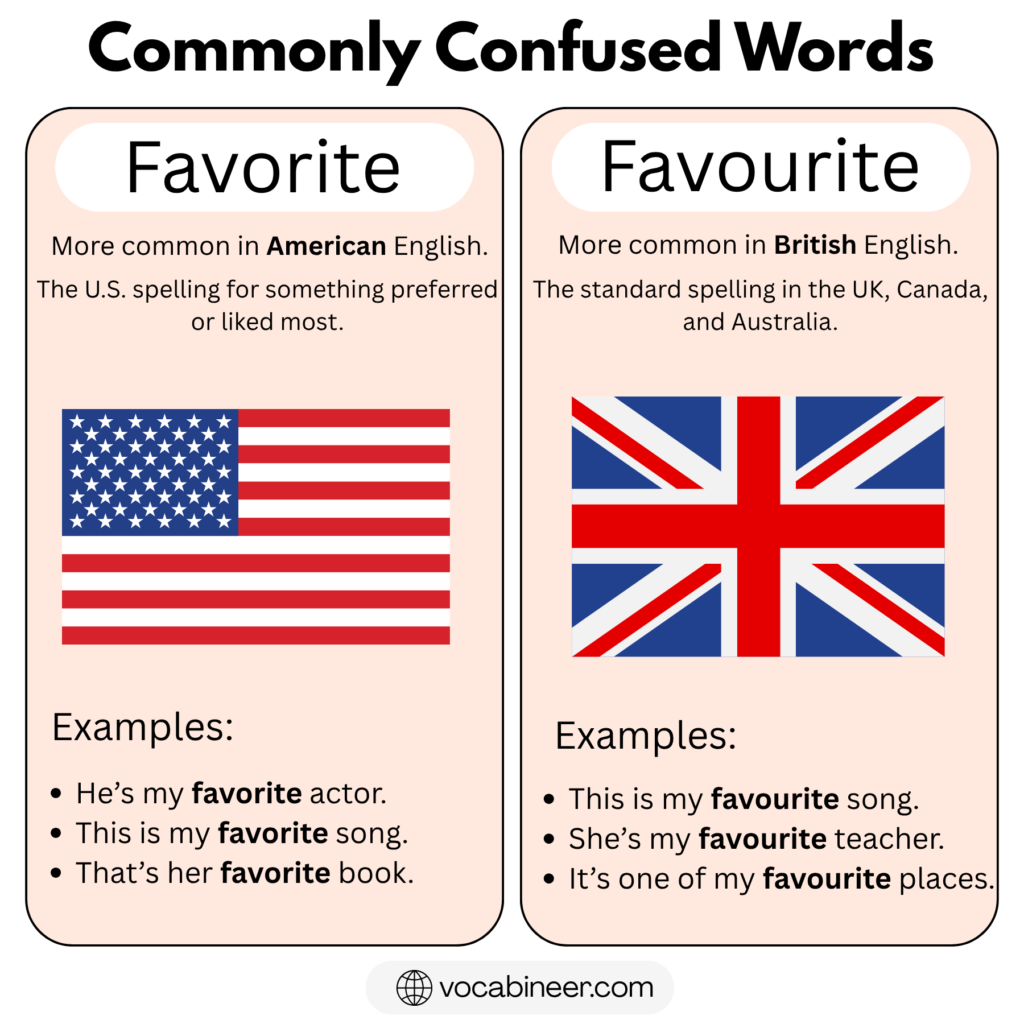
Favorite vs Favourite: Key Difference Explained
Favorite and favourite have the same meaning and pronunciation. However, the spelling difference depends on regional English usage.
In American English, writers use favorite. It follows the simplified spelling system that removes the silent “u” from words like color, honor, and labor.
In contrast, British English uses favourite. This spelling keeps the traditional “ou” pattern found in words like colour, honour, and labour.
Importantly, neither spelling is wrong. The difference is only regional. Therefore, the correct choice depends on your audience.
If you are writing for the United States, use favorite consistently. However, if you are writing for the United Kingdom, Canada, or Australia, use favourite throughout your document.
Mixing both spellings in one article can look unprofessional. So, choose one version and stay consistent.
Favorite vs Favourite: Difference in One Look (Table)
| Feature | Favorite | Favourite |
|---|---|---|
| English Variant | American English | British English |
| Spelling Pattern | No “u” | Includes “ou” |
| Meaning | Most liked or preferred | Most liked or preferred |
| Pronunciation | Same | Same |
| Used In | USA | UK, Canada, Australia |
| Example | My favorite book | My favourite book |
This table shows that the only real difference is spelling preference, not meaning or grammar.
Favorite vs Favourite: Side by Side Sentence Contrast
Both spellings fit into the same sentence structures. However, the spelling changes based on regional English.
American English:
- This is my favorite book.
- Blue is her favorite color.
- That restaurant is our favorite place.
- He chose his favorite team.
- This cake is a family favorite.
- She wore her favorite dress.
- That movie is my all-time favorite.
- He picked his favorite seat.
British English:
- This is my favourite book.
- Blue is her favourite colour.
- That restaurant is our favourite place.
- He chose his favourite team.
- This cake is a family favourite.
- She wore her favourite dress.
- That film is my all-time favourite.
- He picked his favourite seat.
As you can see, the meaning and grammar stay exactly the same. Only the spelling changes.
Favorite vs Favourite: Sentence Structure Comparison
Both words function as nouns and adjectives. Therefore, their sentence structure does not change.
As a noun:
Subject + linking verb + favorite/favourite
- Pizza is my favorite.
- Pizza is my favourite.
As an adjective:
Possessive + favorite/favourite + noun
- She wore her favorite dress.
- She wore her favourite dress.
So grammatically, both forms behave the same way. The only difference is American English spelling versus British English spelling.
When to Use Favorite and When to Use Favourite
Choosing between favorite and favourite depends on the type of English you are using.
If you are writing in American English, use favorite. This spelling is standard in the United States and follows the simplified rule without the letter “u.”
If you are writing in British English, use favourite. This spelling is standard in the United Kingdom and other regions that follow British spelling patterns.
Both forms are correct in standard English. However, you should not mix favorite and favourite in the same document unless you are explaining the difference.
Therefore, the key rule is consistency. Match the spelling to your regional audience and keep it uniform throughout your writing.
Context Based Usage Guide
Use this practical guide to decide which spelling fits your context.
For American audiences:
- Use favorite
- Use related forms like favor and honor
- Keep American spelling consistent
For British audiences:
- Use favourite
- Use related forms like favour and honour
- Stay consistent with British spelling
In academic writing:
- Follow the required style guide
- Avoid mixing regional variants
If targeting global readers:
- Choose one spelling version at the beginning
- Keep the same form in headings and examples
During exams:
- Match the English variant mentioned in instructions
- Do not switch between American English and British English
So, the correct choice depends on regional usage, not meaning.
Grammar Difference Between Favorite and Favourite
Favorite and favourite follow the same grammar rules. The only difference is regional spelling.
Both words can function as nouns and adjectives. Their sentence structure does not change between American English and British English.
Here is a clear comparison table:
| Grammar Feature | Favorite (American English) | Favourite (British English) |
|---|---|---|
| Noun | Pizza is my favorite. | Pizza is my favourite. |
| Adjective | This is my favorite book. | This is my favourite book. |
| Related Noun | favor | favour |
| Related Adjective | favorable | favourable |
| Meaning | Most liked | Most liked |
As shown above, grammar stays the same. Only the spelling reflects regional preference.
Pronunciation Difference Between Favorite and Favourite
There is no pronunciation difference between favorite and favourite.
Both are pronounced:
/ˈfeɪvərɪt/
The stress falls on the first syllable. Therefore, the words sound identical in American English and British English.
The difference appears only in writing, not in speech.
Common Mistakes With Favorite and Favourite
Many learners make small mistakes when using favorite and favourite. However, most errors happen because of regional mixing.
One common mistake is using favorite in one paragraph and favourite in another. This creates inconsistency in writing.
Another mistake is assuming that one spelling is incorrect. In fact, both are correct. The difference depends only on American English spelling and British English spelling.
Some writers also forget related forms. For example:
- favor vs favour
- favorable vs favourable
- favorite vs favourite
Additionally, students sometimes mix spelling styles in exams or academic work. Therefore, always match the required English variant and stay consistent throughout the document.
Final Summary
Favorite vs favourite shows a spelling difference between American English and British English. Both words mean “most liked” or “preferred.” However, favorite is used in American English, while favourite is used in British English.
The grammar, meaning, and pronunciation remain the same. Therefore, the only real difference is spelling preference based on region. To avoid confusion, choose the version that matches your audience and use it consistently throughout your writing.
Read More
- Confusing Words in English
- American vs British Words
- Moral vs Morale in English
- Among vs Amongst in English
