
The human hand is one of the most useful parts of the body. It helps us hold, touch, write, and express ourselves. Each small section has a specific name and purpose. Learning the hand parts name in English allows you to describe movements and gestures clearly.
In this post, you’ll learn every part of the hand from the palm and fingers to the wrist with simple examples. Knowing these names helps you speak naturally in conversations, classes, and everyday situations.
In This Page
Main Parts of the Hand
The hand is divided into four major sections. Each one plays an important role in holding, moving, or feeling things.
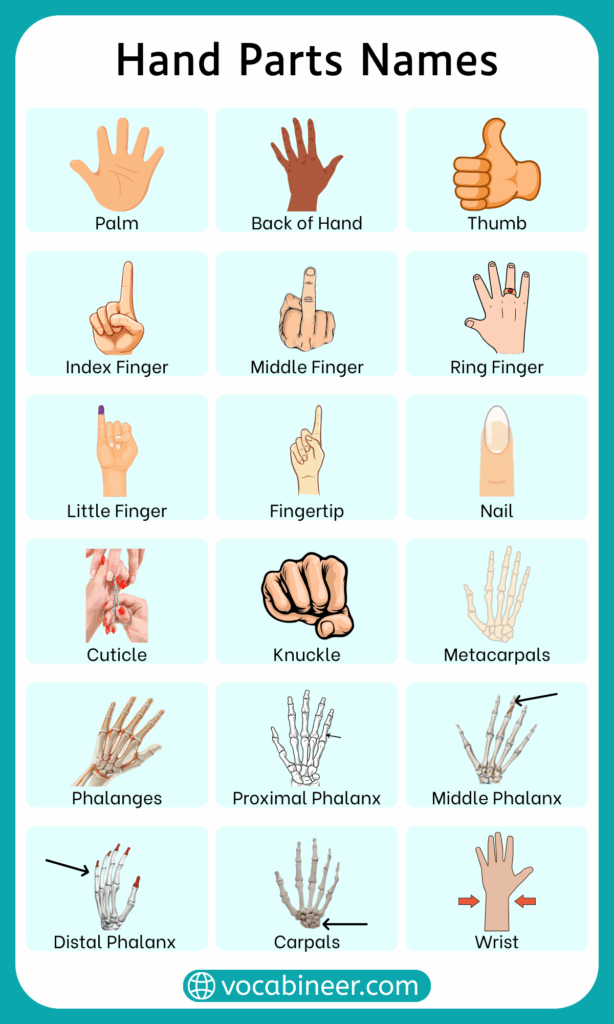
- Palm – the soft inside part of your hand that faces upward.
- Back of the hand – the outer surface that faces outward when your palm is down.
- Fingers – the long, flexible parts used for gripping and touching.
- Thumb – the thick, short finger that moves across the palm to hold objects.
Finger Parts and Their Names
Each finger has smaller parts that help it bend and sense touch. These are the names every learner should know.
- Fingertip – the soft end of the finger used for touching and typing.
- Fingernail – the hard cover at the top of each fingertip that protects it.
- Knuckle – the raised part on the finger that shows when you bend it.
- Finger joint – the flexible connection inside the finger that allows movement.
Names of Fingers in English
Every finger has a unique name in English. These names help describe direction, action, or gesture.
- Thumb – the first and strongest finger.
- Index finger – used to point or press buttons.
- Middle finger – the longest finger located in the center.
- Ring finger – placed next to the little finger, often used to wear rings.
- Little finger (Pinky) – the smallest finger, found at the edge of the hand.
Parts of the Hand Palm
The palm helps hold and press objects. It also has sections that support movement and pressure.
- Lifeline area – the curved line across the middle of the palm.
- Mount of Venus (base of the thumb) – the soft, padded area under the thumb.
- Center of palm – the middle part that presses when you clap.
- Heel of palm – the bottom part near the wrist that supports the hand’s weight.
Parts of the Back of the Hand
The back of the hand protects the bones and muscles. It is also where the veins and skin surface are visible.
- Knuckles – the joints that pop up when the fingers bend.
- Veins – the blue lines that carry blood under the skin.
- Skin surface – the outer covering that protects muscles and veins.
Parts of the Wrist and Its Connection to the Hand
The wrist connects your hand to your arm and lets it rotate and bend freely.
- Wrist bone – the hard structure forming the base of the hand.
- Wrist joint – the hinge that allows the hand to move in different directions.
- Pulse area – the spot where you can feel your heartbeat below the wrist.
Inner Parts of the Hand
These are the inner elements that help the hand move and stay strong.
- Bone – gives shape and support to the hand.
- Muscle – controls the movement of fingers and palm.
- Tendon – attaches muscles to bones to make motion smooth.
Hand Movements and Actions
Knowing these action words helps describe daily hand movements in English.
- Grip – hold something tightly using your fingers and thumb.
- Clench – close your hand firmly, often in anger or strength.
- Point – stretch out your finger to show direction.
- Snap – make a sound by pressing your thumb and finger together quickly.
- Wave – move your hand side to side to greet or say goodbye.
FAQs about Hand Parts Name
The main parts of the hand are the palm, back of the hand, fingers, and thumb. Each part has smaller sections that help with movement and touch.
There are five fingers on one hand — the thumb, index finger, middle finger, ring finger, and little finger (also called pinky).
The soft inner part of the hand is called the palm. It helps in holding, pressing, and gripping objects.
The area just below the thumb is called the Mount of Venus or base of the thumb. It’s the padded section that supports hand pressure.
The wrist connects the hand to the arm. It contains bones and joints that allow the hand to bend and rotate easily.
Conclusion
Each part of the hand from the fingertip to the wrist has a clear name and purpose. Knowing these names helps you describe actions, gestures, and feelings easily in English. The more you use these words, the more confident your speaking and writing become.
Read More