
Homophones for kids are words that sound the same but have different spellings and meanings. Children often come across words like blue and blew, or sun and son, which may confuse them at first. These pairs look different in writing, but when spoken aloud, they sound identical. That’s the core idea behind homophones and why they matter in learning. In this post, you’ll learn a list of homophones for kids with examples, sentences, and activities. Knowing these words helps in conversations at school, in stories, and while writing homework
In This Page
Easy List of Homophones for Kids
Homophones can be easier to understand if you begin with the most common pairs. These examples appear often in stories, lessons, and everyday talk. Children can practice these pairs until they feel comfortable using them.
- Sun / Son
- See / Sea
- Blue / Blew
- Two / Too / To
- One / Won
- Ate / Eight
- Flower / Flour
- Right / Write
- Deer / Dear
- Bare / Bear
- Knight / Night
- Pair / Pear
- Hole / Whole
- Meat / Meet
- Weak / Week
- Break / Brake
- Mail / Male
- Plane / Plain
- Peace / Piece
- Some / Sum
- Stare / Stair
- Allowed / Aloud
- Buy / By / Bye
- Wear / Where
- Tail / Tale
- Read / Red
- Ant / Aunt
- Cell / Sell
- Here / Hear
- Role / Roll
- Nose / Knows
- Steel / Steal
- Hair / Hare
- Way / Weigh
- Weather / Whether
- Board / Bored
- Heard / Herd
- Hour / Our
- Ring / Wring
- Sight / Site
- Soul / Sole
- Toe / Tow
- Knot / Not
- Made / Maid
- Right / Rite
- Sail / Sale
- Weak / Week
- Wood / Would
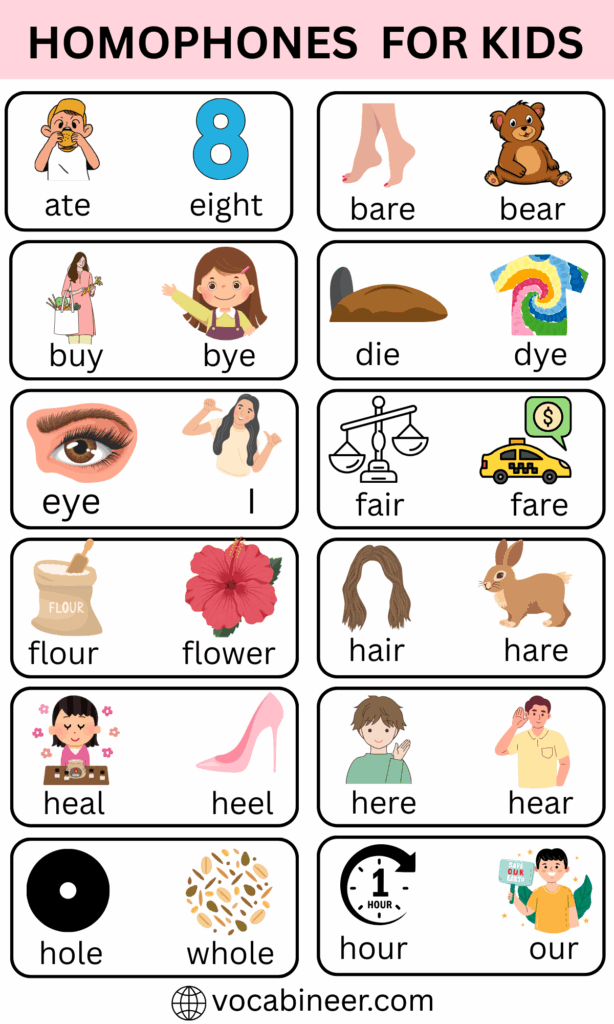
Homophones for Kids with Meanings
Below is a list of common homophones for kids with meanings to make learning these same-sound words easier.
- Sun: the star in the sky
- Son: a boy child
- See: to look
- Sea: a big ocean
- Blue: a color
- Blew: pushed out air
- Two: the number 2
- Too: also
- To: shows direction
- One: the number 1
- Won: achieved victory
- Ate: past of eat
- Eight: the number 8
- Flower: plant bloom
- Flour: powder used in baking
- Right: correct or a side
- Write: put words on paper
- Deer: a forest animal
- Dear: loved or special
Examples of Homophones for Kids
Examples make it clear how words that sound the same can change meaning in writing. Seeing them in sentences helps children connect spelling with meaning.
- Sun / Son: The sun is hot → Her son is happy.
- See / Sea: I can see a kite → We sailed on the sea.
- Blue / Blew: The pen is blue → He blew the horn.
- One / Won: She has one cat → Our team won the game.
- Ate / Eight: He ate pizza → We counted eight stars.
- Flower / Flour: The flower is yellow → Bread is made with flour.
- Right / Write: That is the right key → Please write it down.
- Deer / Dear: A deer ran away → My dear mom smiled.
- Bare / Bear: His hands are bare → A bear lives here.
- Pair / Pear: I bought a pair of shoes → She ate a sweet pear.
- Hole / Whole: The dog dug a hole → He ate the whole cake.
- Meat / Meet: We ate meat for dinner → Let’s meet at the park.
- Weak / Week: He felt weak today → I waited for one week.
- Break / Brake: Do not break the glass → Press the car brake.
- Mail / Male: The mail came today → The male lion is strong.
- Plane / Plain: A plane flew high → She wore a plain dress.
- Peace / Piece: We want peace in class → I ate a piece of cake.
- Wear / Where: I will wear my cap → Do you know where it is?
- Toe / Tow: My toe hurts → They will tow the car.
- Here / Hear: Sit here please → I can hear music.
Sentences Using Homophones for Kids
Sentences provide context and make learning homophones more practical. Children can read these aloud to notice how words sound alike but mean different things.
- The sun is bright, and her son is playing.
- I can see the stars above the sea.
- Her shirt is blue, and he blew the balloon.
- I have two apples, and I want some too to take to school.
- She has one book, and he won the race.
- He ate lunch at eight o’clock.
- A red flower grows, and she adds flour to bake bread.
- That is the right answer, so please write it down.
- A deer ran away, and my dear friend saw it.
- The floor is bare, but a bear walked across it.
- The knight wore armor, and stars shone at night.
- She bought a pair of shoes and ate a sweet pear.
- The dog dug a hole, and I ate the whole cake.
- I like to eat meat, and we will meet tomorrow.
- He is very weak, but he studied all week.
- Be careful not to break the glass when you press the car brake.
- The mail arrived, and the male bird sang.
- A plane flew above the plain fields.
- I want peace in class, and she took a piece of cake.
- She will wear her new dress when she goes where her aunt lives.
Homophones Worksheets for Kids
Worksheets are a great way for children to practice homophones in a structured way. They give kids a chance to match, fill, and write words that sound the same but mean different things. Below is a list of worksheet ideas for kids to try.
- Matching words: Draw lines between pairs like sun/son, flower/flour, and bare/bear.
- Fill in the blank: “The ___ is shining.” (sun/son) or “I want ___ apples.” (two/too).
- Choose the right word: Circle the correct word in a sentence, such as “She will (wear/where) her dress.”
- Sentence practice: Write two short sentences using each pair, for example blue/blew or one/won.
- Sorting activity: Place triples like to/too/two or by/buy/bye in the right group.
- Mini story writing: Write a short story that includes at least five different homophone pairs.
Final Thoughts
Homophones for kids are an essential part of language learning because they show how spelling changes meaning even when words sound the same. With lists, examples, sentences, games, worksheets, and videos, children can practice and enjoy these words in many different ways. Learning them gradually builds confidence in reading, writing, and speaking.
Read More