

Homophones are words that sound the same but have different meanings and often different spellings. For example, hair and hare sound alike, but hair means the strands on your head, while hare means an animal like a rabbit.
In this guide, you will learn common homophone pairs and trios with simple meanings and example sentences. These examples will help students, kids, English learners, and beginner writers choose the correct word in writing, sentences, and everyday English.
In This Page
What Are Homophones?
Homophones are words that have the same pronunciation but different meanings. Many homophones also have different spellings.
For example:
- See means to look with your eyes.
- Sea means a large body of salt water.
They sound the same, but they are used in different ways. Homophones can be confusing because spell-check may not always catch them. Therefore, you need to understand the sentence meaning before choosing the correct word.
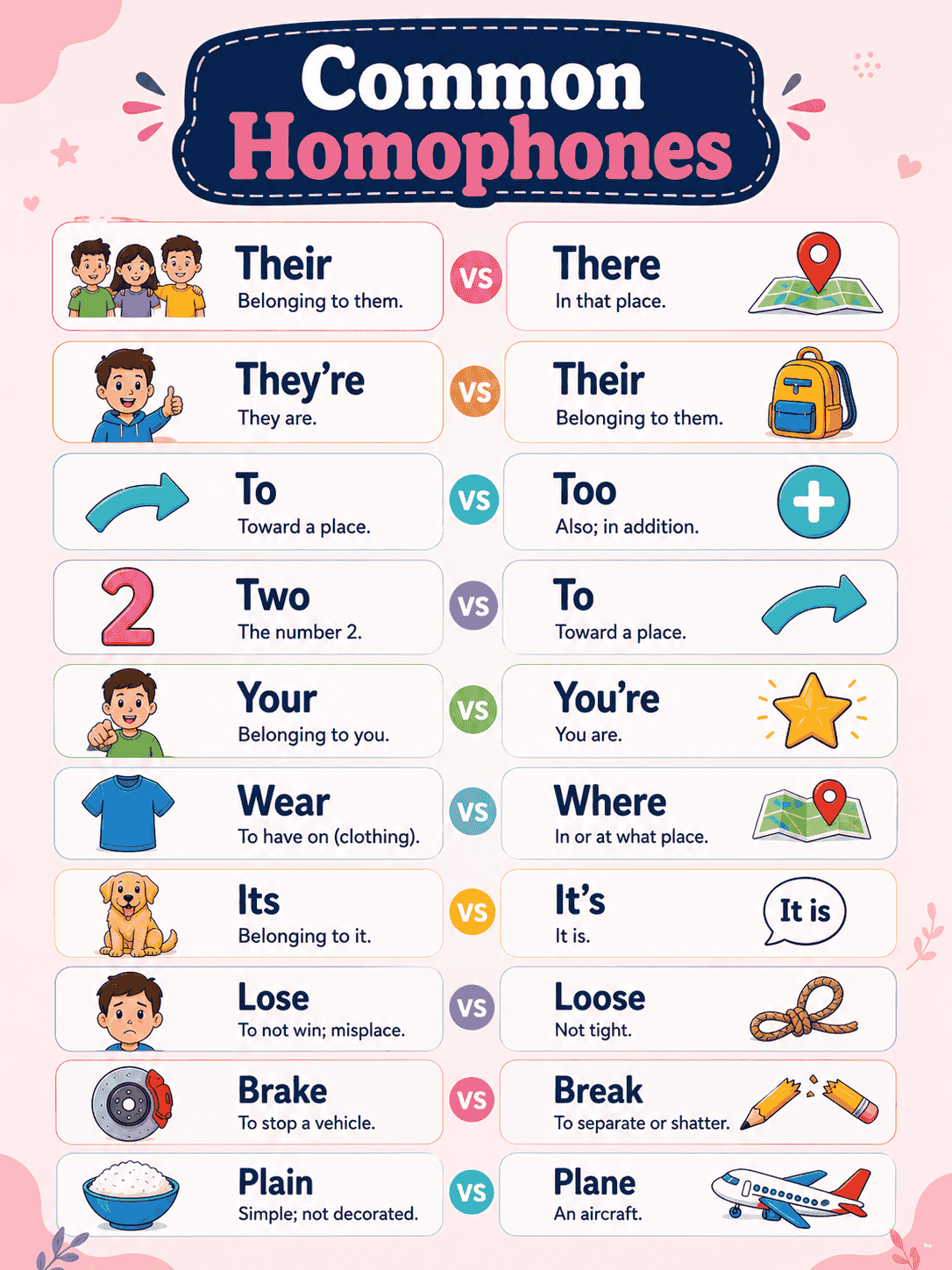
Common homophone examples include:
- To / Too / Two
- Your / You’re
- There / Their / They’re
- Right / Write
- Hear / Here
- Sea / See
- Flower / Flour
How to Use Homophones Correctly
Homophones are easier to use when you look at the full sentence, not only the sound of the word. Since they sound alike, meaning and spelling become very important.
Helpful tips:
- Read the complete sentence.
- Think about the meaning you need.
- Check the spelling carefully.
- Use a dictionary to hear pronunciation.
- Do not depend only on spell-check.
- Practice with short example sentences.
Example:
- I can see the bird.
- The boat is on the sea.
Both see and sea sound the same, but the sentence meaning tells you which word is correct.
100 Homophone Examples with Meanings and Sentences
Note: Some homophones may sound slightly different in different English accents. This list uses common English-learning examples that are widely accepted in pronunciation practice.
- To / Too / Two
To = direction or action. I am going to school.
Too = also or very. I want tea too.
Two = number. I have two books. - There / Their / They’re
There = a place. The bag is over there.
Their = belonging to them. This is their house.
They’re = they are. They’re playing outside. - Your / You’re
Your = belonging to you. Is this your pencil?
You’re = you are. You’re very kind. - Its / It’s
Its = belonging to it. The cat licked its paw.
It’s = it is. It’s raining today. - Than / Then
Than = used for comparison. She is taller than me.
Then = next or after that. We ate lunch, then played. - By / Buy / Bye
By = near or beside. I sat by the window.
Buy = purchase. I will buy a notebook.
Bye = goodbye. Bye, see you soon. - Here / Hear
Here = this place. Come here quickly.
Hear = listen. I can hear music. - Right / Write
Right = correct or direction. Your answer is right.
Write = form words. Please write your name. - No / Know
No = negative answer. No, I do not want it.
Know = understand. I know the answer. - Sea / See
Sea = large salt water area. We swam in the sea.
See = look. I can see the moon. - Flower / Flour
Flower = blooming plant. She picked a red flower.
Flour = powder used for baking. Add flour to the bowl. - Mail / Male
Mail = letters or messages. I got a letter in the mail.
Male = boy or man. The male lion has a mane. - Peace / Piece
Peace = calm or no fighting. We all want peace.
Piece = part of something. I ate a piece of cake. - Plain / Plane
Plain = simple. She wore a plain dress.
Plane = aircraft. The plane landed safely. - Knight / Night
Knight = armored warrior. The knight carried a shield.
Night = dark part of the day. I sleep at night. - Eight / Ate
Eight = number. I have eight crayons.
Ate = past of eat. She ate an apple. - One / Won
One = number. I have one bag.
Won = past of win. He won the race. - Son / Sun
Son = male child. Her son is five years old.
Sun = star that gives light. The sun is bright. - Weak / Week
Weak = not strong. I feel weak today.
Week = seven days. It rained for a week. - Blue / Blew
Blue = color. The sky is blue.
Blew = past of blow. The wind blew hard. - Hair / Hare
Hair = strands on the head. Her hair is long.
Hare = fast animal like a rabbit. A hare runs fast. - Meet / Meat
Meet = come together. Let’s meet after class.
Meat = animal flesh used as food. We had meat for dinner. - Road / Rode
Road = path for vehicles. The road is closed.
Rode = past of ride. She rode her bike. - Heel / Heal
Heel = back part of the foot. My heel hurts.
Heal = become well. Time will heal the wound. - Allowed / Aloud
Allowed = permitted. Pets are not allowed here.
Aloud = out loud. Read the poem aloud. - Pair / Pear
Pair = two matching things. I bought a pair of shoes.
Pear = fruit. She ate a pear. - Hour / Our
Hour = sixty minutes. Wait for an hour.
Our = belonging to us. Our dog is friendly. - Hole / Whole
Hole = empty space or opening. There is a hole in the sock.
Whole = complete. I ate the whole sandwich. - Fair / Fare
Fair = just or equal. That is not fair.
Fare = travel price. The bus fare is low. - Sale / Sail
Sale = selling at a lower price. The shoes are on sale.
Sail = cloth on a boat. The boat raised its sail. - Stare / Stair
Stare = look for a long time. Don’t stare at people.
Stair = step. He stood on the first stair. - Tale / Tail
Tale = story. She told a funny tale.
Tail = back part of an animal. The dog wagged its tail. - Wait / Weight
Wait = stay for some time. Please wait for me.
Weight = how heavy something is. What is your weight? - Die / Dye
Die = stop living. Some plants die in winter.
Dye = color something. She wants to dye her hair. - Cent / Scent / Sent
Cent = small unit of money. A penny is one cent.
Scent = smell. The flower has a sweet scent.
Sent = past of send. I sent you a message. - Scene / Seen
Scene = part of a story or view. It was a sad scene.
Seen = past participle of see. I have seen that movie. - Steel / Steal
Steel = strong metal. The gate is made of steel.
Steal = take without permission. Do not steal things. - Cell / Sell
Cell = small room or phone unit. She called from her cell phone.
Sell = give for money. They sell books here. - So / Sew
So = very or therefore. I am so tired.
Sew = stitch cloth. She can sew well. - Sight / Site
Sight = view or ability to see. The mountains are a beautiful sight.
Site = place or location. This is the site of the event. - Waste / Waist
Waste = use carelessly. Do not waste water.
Waist = middle part of the body. His waist is small. - Bored / Board
Bored = not interested. I feel bored.
Board = flat piece or classroom surface. The teacher wrote on the board. - Brake / Break
Brake = part used to stop. Use the brake carefully.
Break = damage or separate. Do not break the glass. - Close / Clothes
Close = shut. Please close the door.
Clothes = things people wear. Fold your clothes neatly. - Eye / I
Eye = body part used for seeing. I hurt my eye.
I = speaker. I am ready to go. - Air / Heir
Air = gas around us. The air is fresh today.
Heir = person who receives property or title. He is the family heir. - Band / Banned
Band = music group. The band played well.
Banned = not allowed. That song was banned. - Bare / Bear
Bare = uncovered. He walked on bare feet.
Bear = large wild animal. A bear lives in the forest. - Dear / Deer
Dear = loved or used in greetings. Dear friends, welcome.
Deer = wild animal. A deer crossed the road. - Flee / Flea
Flee = run away. The cat tried to flee.
Flea = small jumping insect. The dog had a flea. - Lead / Led
Lead = a heavy metal, pronounced like “led.” The old pipe was made of lead.
Led = guided. She led the group. - Role / Roll
Role = part or duty. He played the main role.
Roll = turn over or small bread. I ate a bread roll. - Pray / Prey
Pray = speak to God. They pray every morning.
Prey = animal hunted for food. The lion chased its prey. - Principal / Principle
Principal = head of a school. The principal gave a speech.
Principle = rule or belief. Honesty is an important principle. - Read / Reed
Read = look at written words. I like to read books.
Reed = tall grass-like plant. A reed grows near the lake. - Sole / Soul
Sole = bottom of the foot or shoe. The sole of my shoe is dirty.
Soul = spirit. Music touched her soul. - Pause / Paws
Pause = stop for a short time. Please pause the video.
Paws = animal feet. The dog’s paws are muddy. - Rain / Reign / Rein
Rain = water from clouds. The rain fell all night.
Reign = rule as king or queen. The king’s reign lasted many years.
Rein = strap used to guide an animal. She held the horse’s rein. - Rays / Raise
Rays = beams of light. The sun’s rays felt warm.
Raise = lift or increase. Please raise your hand. - Ring / Wring
Ring = circular object or sound. She wore a silver ring.
Wring = twist to remove water. Wring the wet cloth. - Threw / Through
Threw = past of throw. He threw the ball.
Through = from one side to another. We walked through the gate. - Wear / Where
Wear = put on clothes. What will you wear today?
Where = asking about place. Where is my book? - Weather / Whether
Weather = condition of the air. The weather is cold.
Whether = if. I don’t know whether he will come. - Which / Witch
Which = asking about choice. Which color do you like?
Witch = magical character. The witch wore a black hat. - Accept / Except
Accept = receive or agree. Please accept my apology.
Except = not including. Everyone came except one student. - Capital / Capitol
Capital = main city or uppercase letter. Paris is the capital of France.
Capitol = government building. The meeting was held at the capitol. - Beat / Beet
Beat = hit or defeat. Our team can beat them.
Beet = vegetable. I added beet to the salad. - Beach / Beech
Beach = sandy shore. We walked along the beach.
Beech = type of tree. The beech tree is tall. - Ball / Bawl
Ball = round object used in games. He threw the ball.
Bawl = cry loudly. The baby began to bawl. - Yolk / Yoke
Yolk = yellow part of an egg. The yolk is yellow.
Yoke = wooden frame for animals. The ox wore a yoke. - Stake / Steak
Stake = pointed stick or share. They put a stake in the ground.
Steak = slice of meat. He ordered a steak. - Stationary / Stationery
Stationary = not moving. The car remained stationary.
Stationery = writing materials. I bought new stationery. - Lesson / Lessen
Lesson = class or teaching unit. Today’s lesson is easy.
Lessen = reduce. Rest can lessen the pain. - Passed / Past
Passed = went by or succeeded. She passed the test.
Past = time before now. That happened in the past. - Guessed / Guest
Guessed = made an answer without being sure. I guessed the answer.
Guest = visitor. The guest arrived early. - Missed / Mist
Missed = failed to catch or attend. I missed the bus.
Mist = light fog. The mist covered the field. - Higher / Hire
Higher = more high. The shelf is higher than the table.
Hire = give a job or rent. They will hire a driver. - New / Knew
New = not old. I bought a new phone.
Knew = past of know. She knew the answer. - Great / Grate
Great = very good. You did a great job.
Grate = shred into small pieces. Please grate the cheese. - Idle / Idol
Idle = not active. The machine stayed idle.
Idol = admired person or object. The singer is his idol. - Peak / Peek / Pique
Peak = highest point. We reached the mountain peak.
Peek = quick look. Don’t peek at the answer.
Pique = excite or annoy. The story can pique your interest. - Medal / Meddle
Medal = award. She won a gold medal.
Meddle = interfere. Do not meddle in their plans. - Morning / Mourning
Morning = early part of the day. I exercise in the morning.
Mourning = sadness after death. The family was in mourning. - None / Nun
None = not any. None of the boxes were empty.
Nun = religious woman. The nun helped at the school. - Pail / Pale
Pail = bucket. She filled the pail with water.
Pale = light in color. His face looked pale. - Poor / Pour / Pore
Poor = having little money. The poor family needed help.
Pour = make liquid flow. Pour water into the glass.
Pore = tiny opening in skin. Sweat comes from a pore. - Real / Reel
Real = true. This is a real story.
Reel = spool or move unsteadily. The fishing reel broke. - Serial / Cereal
Serial = happening in a series. The show has a serial format.
Cereal = breakfast food. I ate cereal with milk. - For / Four / Fore
For = meant for. This gift is for you.
Four = number. I have four pens.
Fore = front area. The golfer shouted fore. - Coarse / Course
Coarse = rough. The cloth felt coarse.
Course = class or path. I joined an English course. - Complement / Compliment
Complement = something that completes. The scarf can complement the dress.
Compliment = praise. She gave me a kind compliment. - Council / Counsel
Council = group that makes decisions. The council met today.
Counsel = advice. He gave wise counsel. - Discreet / Discrete
Discreet = careful and private. Please be discreet.
Discrete = separate. The data has discrete parts. - Guerrilla / Gorilla
Guerrilla = irregular fighter. The story mentioned a guerrilla group.
Gorilla = large ape. The gorilla ate leaves. - Heard / Herd
Heard = past of hear. I heard a loud sound.
Herd = group of animals. A herd of cows crossed the field. - Miner / Minor
Miner = person who works in a mine. The miner found coal.
Minor = small or not major. It was a minor mistake. - Patience / Patients
Patience = ability to wait calmly. Learning needs patience.
Patients = people receiving medical care. The doctor helped the patients. - Profit / Prophet
Profit = money gained. The shop made a profit.
Prophet = religious messenger. The story mentioned a prophet. - Wood / Would
Wood = material from trees. The table is made of wood.
Would = helping verb. I would like some water. - Cite / Site / Sight
Cite = quote or mention as proof. Please cite the source.
Site = place. This is the building site.
Sight = view or ability to see. The view was a beautiful sight.
Most Common Homophones in Daily English
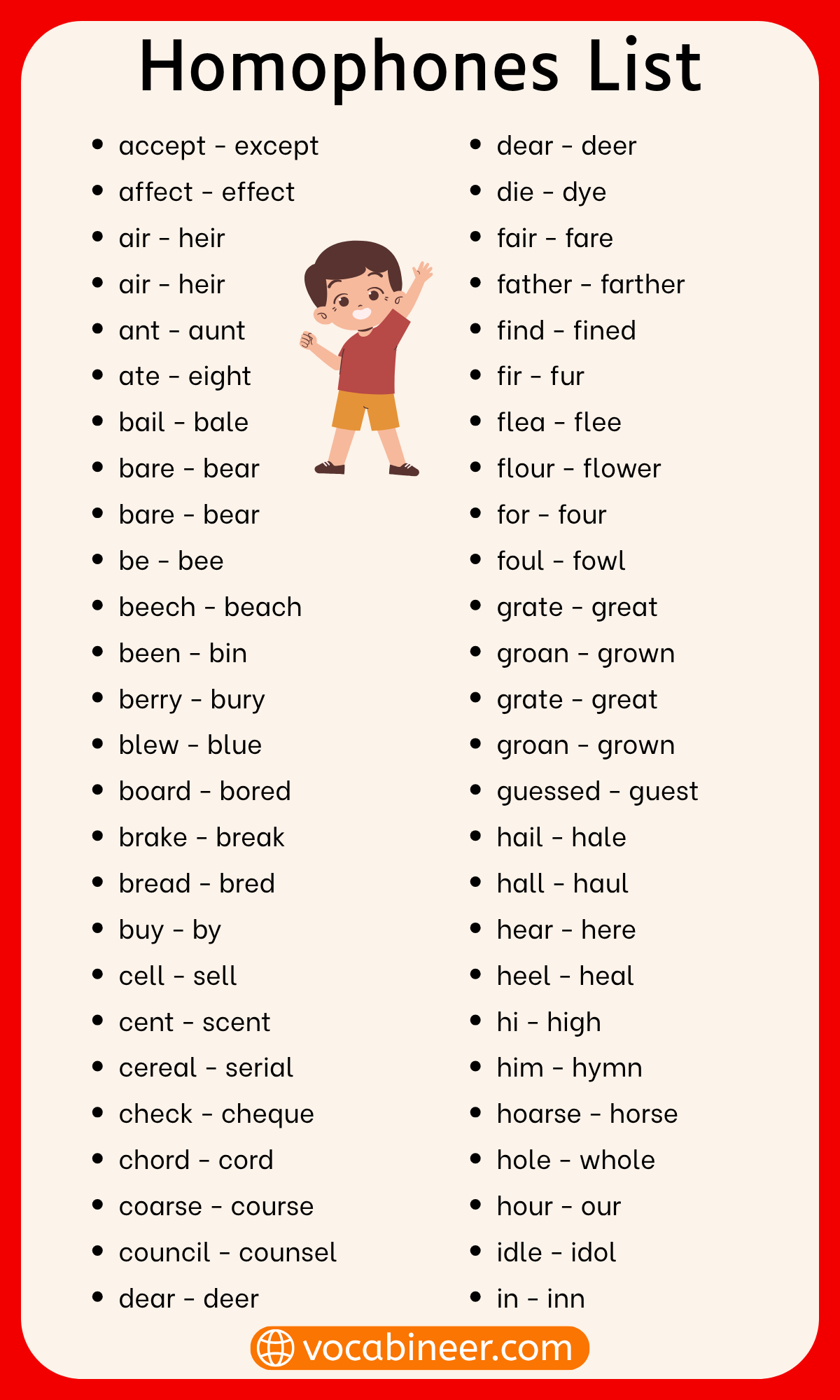
These homophones are used often in everyday English writing and speaking:
- To / Too / Two
- Your / You’re
- There / Their / They’re
- Its / It’s
- Than / Then
- Right / Write
- Hear / Here
- No / Know
- Buy / By / Bye
- See / Sea
- One / Won
- Weather / Whether
- Peace / Piece
- Week / Weak
- Brake / Break
- Flower / Flour
- Hair / Hare
- Pair / Pear
- Son / Sun
- Meet / Meat
Easy Homophones for Kids
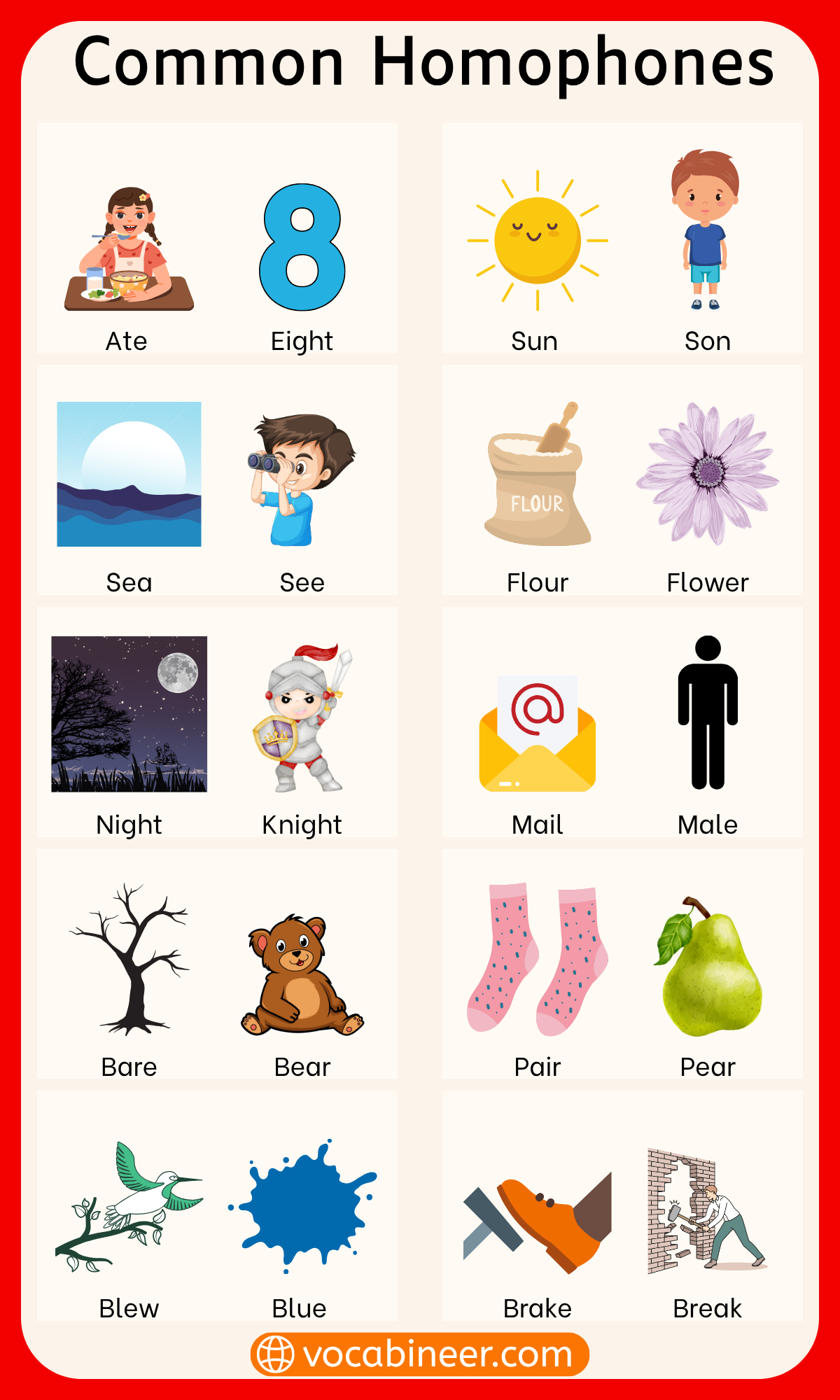
Kids can start with short and simple homophone pairs. These words are easy to understand with pictures and sentences.
- Sun / Son — The sun is bright. Her son is young.
- See / Sea — I can see the bird. The fish swims in the sea.
- Blue / Blew — The sky is blue. The wind blew hard.
- Hair / Hare — Her hair is long. A hare runs fast.
- One / Won — I have one toy. She won the game.
- Eight / Ate — I have eight apples. He ate lunch.
- Flower / Flour — The flower is red. Add flour to the bowl.
- Night / Knight — It is dark at night. The knight wore armor.
- Pair / Pear — I bought a pair of socks. She ate a pear.
- Tail / Tale — The cat has a tail. He told a funny tale.
Homophones by Difficulty Level
Homophones can be easy, medium, or tricky depending on spelling, meaning, and usage.
| Level | Homophone Examples | Why They Fit This Level |
|---|---|---|
| Easy | Sun / Son, See / Sea, Blue / Blew | Short words with simple meanings |
| Medium | To / Too / Two, Their / There / They’re | Common words with different grammar uses |
| Tricky | Principal / Principle, Stationary / Stationery | Longer words with similar spellings |
| Advanced | Complement / Compliment, Discreet / Discrete | More formal and often confused in writing |
Common Phrases with Homophones
Some common English phrases include words that are often confused with homophones.
- Break the ice — Start a conversation. Do not write brake the ice.
- No pain, no gain — Success needs effort. Do not write know pain, know gain.
- A sight for sore eyes — A welcome view. Do not write site for sore eyes.
- Right on time — Exactly at the correct time. Do not write write on time.
- Sow the seeds — Start something that grows later. Do not write sew the seeds.
- Whet your appetite — Increase interest or desire. Do not write wet your appetite.
- Toe the line — Follow rules. Do not write tow the line.
- Peace of mind — Calm feeling. Do not write piece of mind.
Homophones vs Homonyms vs Homographs
These three terms are related, but they are not exactly the same.
| Term | Meaning | Same Sound? | Same Spelling? | Example |
|---|---|---|---|---|
| Homophones | Words that sound the same but have different meanings | Yes | Usually no | Flower / Flour |
| Homonyms | Words with the same sound or spelling but different meanings | Often | Often | Bat / Bat |
| Homographs | Words spelled the same but may sound different | Sometimes | Yes | Lead / Lead |
Homophones focus on sound. Homographs focus on spelling. Homonyms can overlap with both, depending on the words.
Common Homophone Mistakes
Many learners confuse homophones because the words sound the same. Use the sentence meaning to choose the correct spelling.
| Homophones | Difference | Correct Example |
|---|---|---|
| Your / You’re | Your = belonging; you’re = you are | You’re holding your bag. |
| Their / There / They’re | Their = belonging; there = place; they’re = they are | They’re going to their house over there. |
| Its / It’s | Its = belonging; it’s = it is | It’s licking its paw. |
| Than / Then | Than = comparison; then = time/order | She is taller than me, and then we left. |
| To / Too / Two | To = direction; too = also; two = number | I went to buy two apples too. |
| Weather / Whether | Weather = climate; whether = if | I do not know whether the weather will change. |
Homophone Practice Exercises
Use these simple practice ideas to improve your homophone skills:
- Write one sentence for each word in a pair.
- Read your sentence aloud.
- Check the meaning before checking the spelling.
- Circle the homophone in each sentence.
- Use flashcards for tricky pairs.
- Practice daily-use homophones first.
- Review your writing for words like your, you’re, there, their, and they’re.
Practice example:
Choose the correct word:
- I can see / sea the stars.
- She wore a blue / blew dress.
- We went to / too / two the park.
- Their / There / They’re books are on the table.
- He will write / right a letter.
FAQs
Homophones are words that sound the same but have different meanings or spellings. For example, to, too, and two sound alike but are used differently.
Homophones are confusing because they sound the same when spoken. However, their meanings and spellings are different, so learners may choose the wrong word in writing.
Read the full sentence and think about the meaning. Then choose the word that fits the sentence. For example, use sea for water and see for looking.
Your shows ownership, while you’re means you are. Example: You’re holding your pencil.
There means a place, their shows ownership, and they’re means they are. Example: They’re standing near their car over there.
Summary
Homophones are words that sound the same but have different meanings or spellings. Common examples include to / too / two, your / you’re, there / their / they’re, right / write, and sea / see. These words can be tricky because they sound alike, but each one has a different use in writing.
Learning 100 homophone examples in English helps students, kids, and English learners write more clearly. The best way to use homophones correctly is to understand the sentence meaning, check the spelling, and practice with simple examples.
Read More
- Rhyming Words in English
- 3 Letter Words in English
- List of 5 Letter Words in English
- Adjectives That Start with Letter T
