Perfect rhyme is one of the easiest rhyme types to hear because the ending sounds match clearly. Words like cat/hat, light/night, blue/true, and rain/pain are perfect rhymes because their final sounds are the same.
This guide explains perfect rhyme in simple words with easy examples, word pairs, poetry lines, song lines, rap lines, comparison tables, practice activities, and clear tips for writing your own perfect rhymes.
In This Page
Quick Answer: What Is a Perfect Rhyme?
A perfect rhyme happens when two words have the same ending sound from the main stressed vowel to the end.
Examples:
- cat / hat
- dog / log
- light / night
- blue / true
- rain / pain
- day / play
- cake / lake
- bell / shell
- sound / round
- heart / start
Perfect Rhyme Examples
These examples show perfect rhyme pairs inside simple lines.
| Perfect Rhyme Pair | Example Line |
|---|---|
| cat / hat | The cat wore a hat. |
| dog / log | The dog sat on a log. |
| light / night | The light shone through the night. |
| blue / true | The sky was blue, and the story was true. |
| rain / pain | The rain washed away the pain. |
| day / play | We went to play on a sunny day. |
| cake / lake | I ate my cake beside the lake. |
| bell / shell | I found a shell near the ringing bell. |
| sound / round | The sound went round the room. |
| heart / start | A brave heart can make a strong start. |
Easy Perfect Rhyme Examples for Students
These easy perfect rhymes use common words, so students can hear the matching sounds quickly.
- sun / fun
- cat / hat
- dog / log
- red / bed
- bee / tree
- star / far
- moon / tune
- book / hook
- clock / rock
- ball / wall
- fish / dish
- chair / hair
- ring / sing
- snow / glow
- bright / night
- day / play
- cake / lake
- rain / train
- bell / shell
- hand / sand
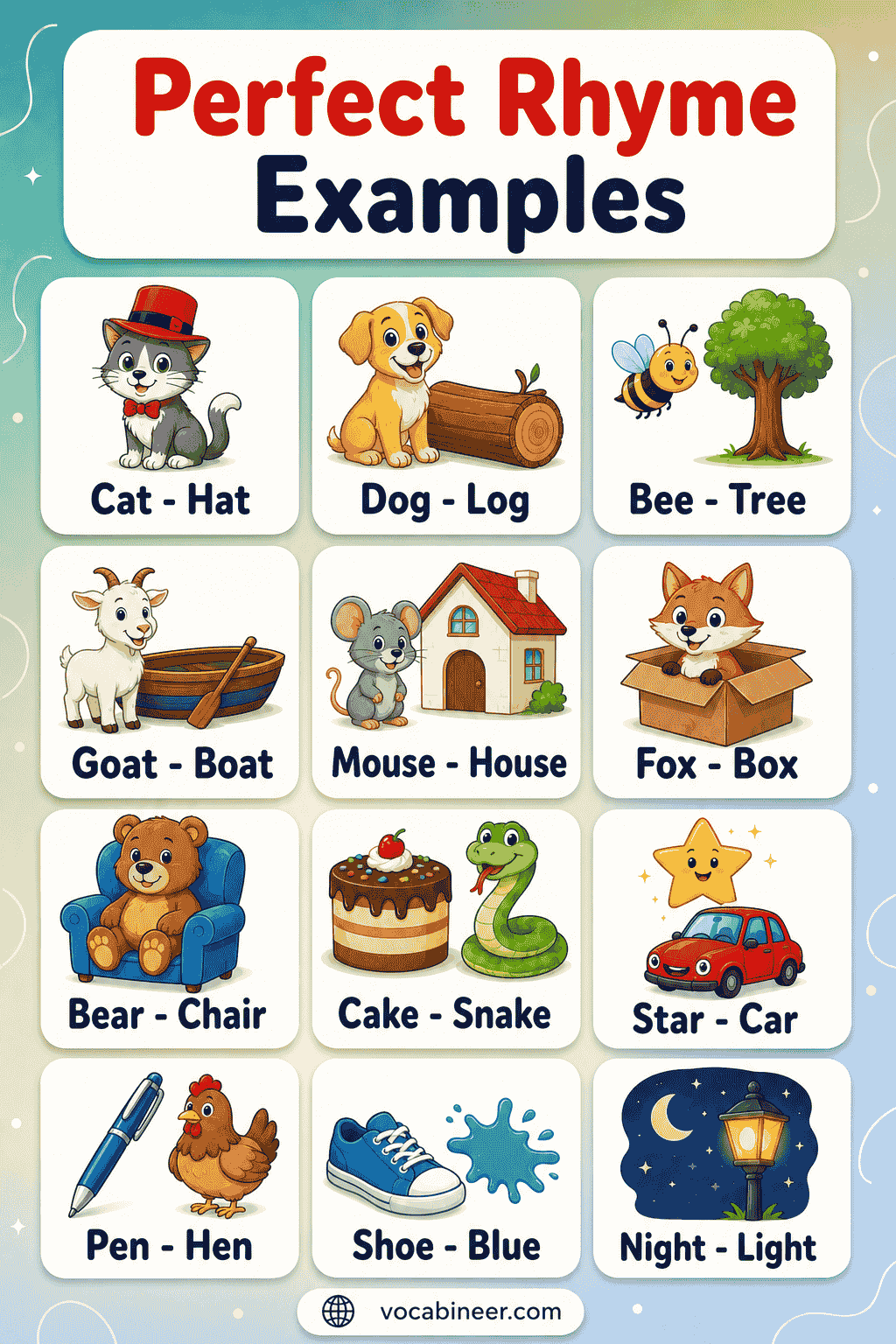
What Is a Perfect Rhyme?
A perfect rhyme is a rhyme where the ending sounds match exactly. The match starts with the main stressed vowel sound and continues to the end of the word.
For example, light and night are perfect rhymes because both words end with the same -ight sound.
| Word | Perfect Rhyme |
|---|---|
| light | night |
| cake | lake |
| blue | true |
| rain | pain |
| heart | start |
| time | rhyme |
| sound | round |
| day | play |
How Perfect Rhyme Works
Perfect rhyme works by matching the sound at the end of two words. The spelling may look different sometimes, but the sound must match.
Examples:
| Word Pair | Ending Sound |
|---|---|
| light / night | -ight |
| blue / true | -oo |
| rain / pain | -ain |
| day / play | -ay |
| sound / round | -ound |
| heart / start | -art |
Perfect Rhyme Word Pairs
These word pairs can help students, poets, lyric writers, and teachers find clear perfect rhymes.
| Word | Perfect Rhymes |
|---|---|
| cat | hat, bat, mat, sat |
| dog | log, fog, hog |
| light | night, bright, sight |
| blue | true, new, grew |
| rain | pain, train, plain |
| day | play, stay, way |
| cake | lake, make, take |
| bell | shell, well, tell |
| sound | round, found, ground |
| heart | start, part, art |
| song | long, strong, wrong |
| sky | fly, try, high |
| road | load, toad, showed |
| face | place, space, grace |
| dream | stream, team, gleam |
One-Syllable Perfect Rhyme Examples
One-syllable perfect rhymes are the easiest to hear and use.
| Word | Perfect Rhyme |
|---|---|
| cat | hat |
| sun | fun |
| dog | log |
| bee | tree |
| light | night |
| moon | tune |
| rain | pain |
| red | bed |
| clock | rock |
| star | far |
| fish | dish |
| ball | wall |
| chair | hair |
| king | ring |
| book | hook |
| hand | sand |
| boat | coat |
| road | load |
| house | mouse |
| face | place |
Two-Syllable Perfect Rhyme Examples
Two-syllable perfect rhymes are useful for poems, songs, and longer lines.
| Word | Perfect Rhyme |
|---|---|
| sharing | caring |
| motion | ocean |
| singing | ringing |
| flower | tower |
| mountain | fountain |
| butter | shutter |
| dancing | glancing |
| sunny | funny |
| better | letter |
| treasure | pleasure |
| morning | warning |
| feather | weather |
| never | clever |
| story | glory |
| happy | snappy |
| lonely | only |
| yellow | mellow |
| crying | flying |
| running | stunning |
| dreaming | streaming |
Longer Perfect Rhyme Examples
Longer perfect rhymes help advanced students, poets, rappers, and songwriters build stronger sound patterns.
| Word | Perfect Rhyme |
|---|---|
| elevation | revelation |
| celebration | delegation |
| dangerous | contagious |
| gratitude | latitude |
| creation | vacation |
| emotion | devotion |
| attention | invention |
| decision | precision |
| relation | vacation |
| forever | whenever |
| confusion | conclusion |
| solution | pollution |
| direction | connection |
| condition | position |
| amazing | blazing |
| attraction | reaction |
| protection | correction |
| illusion | conclusion |
| rotation | location |
| vibration | celebration |
Perfect Rhyme Examples in Poetry
Perfect rhyme appears often in poems because it creates a clear sound pattern.
| Poetry Example | Perfect Rhymes |
|---|---|
| The moon was bright / It filled the sky with light | bright, light |
| I heard the rain / tap softly on the pane | rain, pane |
| The bird began to sing / beside the blooming spring | sing, spring |
| The river moved with grace / beneath the moonlit space | grace, space |
| The child ran out to play / on a warm and sunny day | play, day |
| The little boat would float / beside my yellow coat | float, coat |
| The stars began to glow / above the fields of snow | glow, snow |
| A quiet stream did flow / where silver flowers grow | flow, grow |
Perfect Rhyme Examples in Songs
Songwriters often use perfect rhyme in hooks, choruses, and simple lyric lines.
| Song Example | Perfect Rhymes |
|---|---|
| I’ll stay with you / because my heart is true | you, true |
| We danced through the night / under city light | night, light |
| I hear your name / and feel the same old flame | name, flame |
| We found our way / through another day | way, day |
| Hold me near / and calm my fear | near, fear |
| I’ll never go / where cold winds blow | go, blow |
| Your smile feels bright / like morning light | bright, light |
| We rise and stand / together hand in hand | stand, hand |
Perfect Rhyme Examples in Rap
Rap often mixes perfect rhyme with slant rhyme, but these examples use clear perfect rhyme pairs.
| Rap Example | Perfect Rhymes |
|---|---|
| I bring the flow / everywhere I go | flow, go |
| I write every line / and make it shine | line, shine |
| I stay on the track / and never look back | track, back |
| I move through the street / with rhythm in the beat | street, beat |
| I rise with the flame / and play no weak game | flame, game |
| I build my name / through focus and aim | name, aim |
| I chase the sound / and turn the whole room round | sound, round |
| I keep my pace / and move with steady grace | pace, grace |
Perfect Rhyme vs Slant Rhyme
Perfect rhyme and slant rhyme both use similar sounds. However, perfect rhyme matches more exactly.
| Type | Meaning | Example |
|---|---|---|
| Perfect rhyme | Ending sounds match exactly | light / night |
| Slant rhyme | Sounds are close but not exact | soul / all |
| Perfect rhyme | Clear same ending sound | rain / pain |
| Slant rhyme | Similar sound, softer match | shape / keep |
Perfect Rhyme vs Near Rhyme
Near rhyme sounds close, but it does not match as clearly as perfect rhyme.
| Type | Example | Match |
|---|---|---|
| Perfect rhyme | blue / true | exact ending sound |
| Near rhyme | orange / storage | close sound, not exact |
| Perfect rhyme | rain / pain | exact ending sound |
| Near rhyme | purple / turtle | close sound, not exact |
| Perfect rhyme | day / play | exact ending sound |
| Near rhyme | love / move | close sound, not exact |
Perfect Rhyme vs End Rhyme
Perfect rhyme describes the sound match. End rhyme describes the rhyme position.
| Term | Meaning | Example |
|---|---|---|
| Perfect rhyme | Tells how closely sounds match | light / night |
| End rhyme | Tells where the rhyme appears | The sky was bright / It filled the world with light |
| Perfect rhyme | Can appear anywhere in a line | cat / hat |
| End rhyme | Appears at line endings | I saw a cat / It wore a hat |
Perfect Rhyme vs Internal Rhyme
Perfect rhyme describes sound. Internal rhyme describes placement inside a line.
| Term | Meaning | Example |
|---|---|---|
| Perfect rhyme | Exact sound match | cat / hat |
| Internal rhyme | Rhyme inside a line | The cat wore a hat as it sat on the mat. |
| Perfect rhyme | Focuses on matching sounds | bright / night |
| Internal rhyme | Focuses on where rhymes appear | The bright light filled the night. |
Exact Rhyme, Full Rhyme, and True Rhyme
Perfect rhyme has several related names. These terms often describe the same basic idea.
| Term | Simple Meaning |
|---|---|
| Perfect rhyme | ending sounds match exactly |
| Exact rhyme | another name for perfect rhyme |
| Full rhyme | another name for perfect rhyme |
| True rhyme | another name for perfect rhyme |
Examples:
- light / night
- blue / true
- rain / pain
- day / play
- sound / round
How to Identify Perfect Rhyme
You can identify perfect rhyme by listening carefully to the ending sounds.
Steps:
- Read both words aloud.
- Listen to the stressed vowel sound.
- Check the sounds after the stressed vowel.
- Make sure the ending sounds match clearly.
- Check that the first sounds are different.
- Compare with a slant rhyme if the match sounds close but not exact.
Example:
Light / night
- ending sound: -ight
- exact match: yes
- perfect rhyme: yes
How to Write Perfect Rhymes
You can write perfect rhymes by choosing one word and finding another word with the same ending sound.
Steps:
- Choose a simple word.
- Find words with the same ending sound.
- Check if the ending sound matches exactly.
- Place the rhyme naturally in a line.
- Read the line aloud.
- Avoid forcing meaning just to rhyme.
Example process:
Start with:
day
Perfect rhymes:
- play
- stay
- way
- say
Example line:
We went to play on a sunny day.
Why Writers Use Perfect Rhyme
Writers use perfect rhyme because it creates a clean, memorable sound.
Perfect rhyme can:
- make lines easy to remember
- give poems a musical beat
- make songs catchier
- support rhyme schemes
- help children hear sound patterns
- make simple writing sound complete
- create strong endings
- make chants and poems easier to read aloud
Perfect Rhyme Practice
These quick activities help students recognize and write perfect rhymes.
Find the Perfect Rhyme
Sentence:
The moon was bright in the quiet night.
Answer:
bright / night
Sentence:
The rain fell softly on the pane.
Answer:
rain / pane
Sentence:
The dog sat beside a log.
Answer:
dog / log
Complete the Perfect Rhyme
The cat wore a ____.
Answer:
hat
The moon gave off bright ____.
Answer:
light
We went outside to ____.
Answer:
play
The bee flew near the ____.
Answer:
tree
Choose the Perfect Rhyme
Which word rhymes perfectly with cake?
- lake
- clock
- chair
Answer:
lake
Which word rhymes perfectly with blue?
- true
- ball
- fish
Answer:
true
Which word rhymes perfectly with rain?
- train
- moon
- book
Answer:
train
Write Your Own Perfect Rhyme
Choose one word:
- rain
- blue
- light
- day
- sound
Then write one short line with a perfect rhyme.
Example:
The sound went round the room.
Common Mistakes With Perfect Rhyme
Perfect rhyme depends on sound, not only spelling.
Common mistakes include:
- confusing slant rhyme with perfect rhyme
- using words that look alike but sound different
- forcing awkward rhymes
- repeating the same word as a rhyme
- ignoring pronunciation
- using near rhymes when exact rhyme is needed
- choosing a rhyme that breaks the meaning
- focusing on spelling instead of sound
FAQs
A perfect rhyme happens when two words have the same ending sound from the main stressed vowel to the end. Examples include light/night, blue/true, rain/pain, and cat/hat.
Examples of perfect rhyme include cat/hat, dog/log, light/night, blue/true, rain/pain, day/play, cake/lake, sound/round, and heart/start.
Perfect rhyme has an exact ending sound match, such as light/night. Slant rhyme sounds close but not exact, such as soul/all or orange/storage.
Yes, perfect rhyme is often called exact rhyme, true rhyme, or full rhyme because the ending sounds match clearly.
Choose a word, find another word with the same ending sound, and place both words naturally in a line. For example, choose day, then use play in the line: We went to play on a sunny day.
Summary
Perfect rhyme happens when two words share the same ending sound from the main stressed vowel to the end. Simple examples include cat/hat, light/night, blue/true, rain/pain, and day/play.
Writers use perfect rhyme in poems, songs, rap, chants, and classroom activities because it creates clear rhythm, strong sound patterns, and memorable lines. Perfect rhyme is also called exact rhyme, full rhyme, or true rhyme.
Read More
- Rhyming Words Types and Examples
- Words That Rhyme with Seven
- Words That Rhyme with Four
- Easy Rhymes with Three