Internal rhyme adds rhythm, flow, and musical sound to a line by placing rhyming words inside the line instead of only at the end. Writers often use it in poems, rap bars, songs, chants, and short creative lines to make words sound smoother and easier to remember.
This guide explains internal rhyme in simple words with clear examples, types, poetry lines, rap lines, song-style lines, bold rhyming words, practice activities, and easy tips for writing your own internal rhymes.
In This Page
Quick Answer: What Is Internal Rhyme?
Internal rhyme is a rhyme that happens inside a line, or between words inside nearby lines, instead of only at the end of lines.
Example:
The cat wore a hat as it sat by the mat.
Internal rhyming words:
- cat
- hat
- sat
- mat
Internal Rhyme Examples
Internal rhyme becomes easier to understand when the rhyming words are marked clearly.
| Internal Rhyme Example | Internal Rhyming Words |
|---|---|
| The cat wore a hat as it sat by the mat. | cat, hat, sat, mat |
| The rain tapped the pane while I waited for the train. | rain, pane, train |
| The clock gave a knock as I opened the lock. | clock, knock, lock |
| The bright moonlight filled the night. | bright, night |
| A bee flew free by the tall green tree. | bee, free, tree |
| The slow river below began to glow. | slow, below, glow |
| My mind finds lines when I grind. | mind, finds, lines, grind |
| I make the beat speak as I move through the street. | beat, speak, street |
| The red leaves spread where the quiet path led. | red, spread, led |
| The light looked bright in the silent night. | light, bright, night |
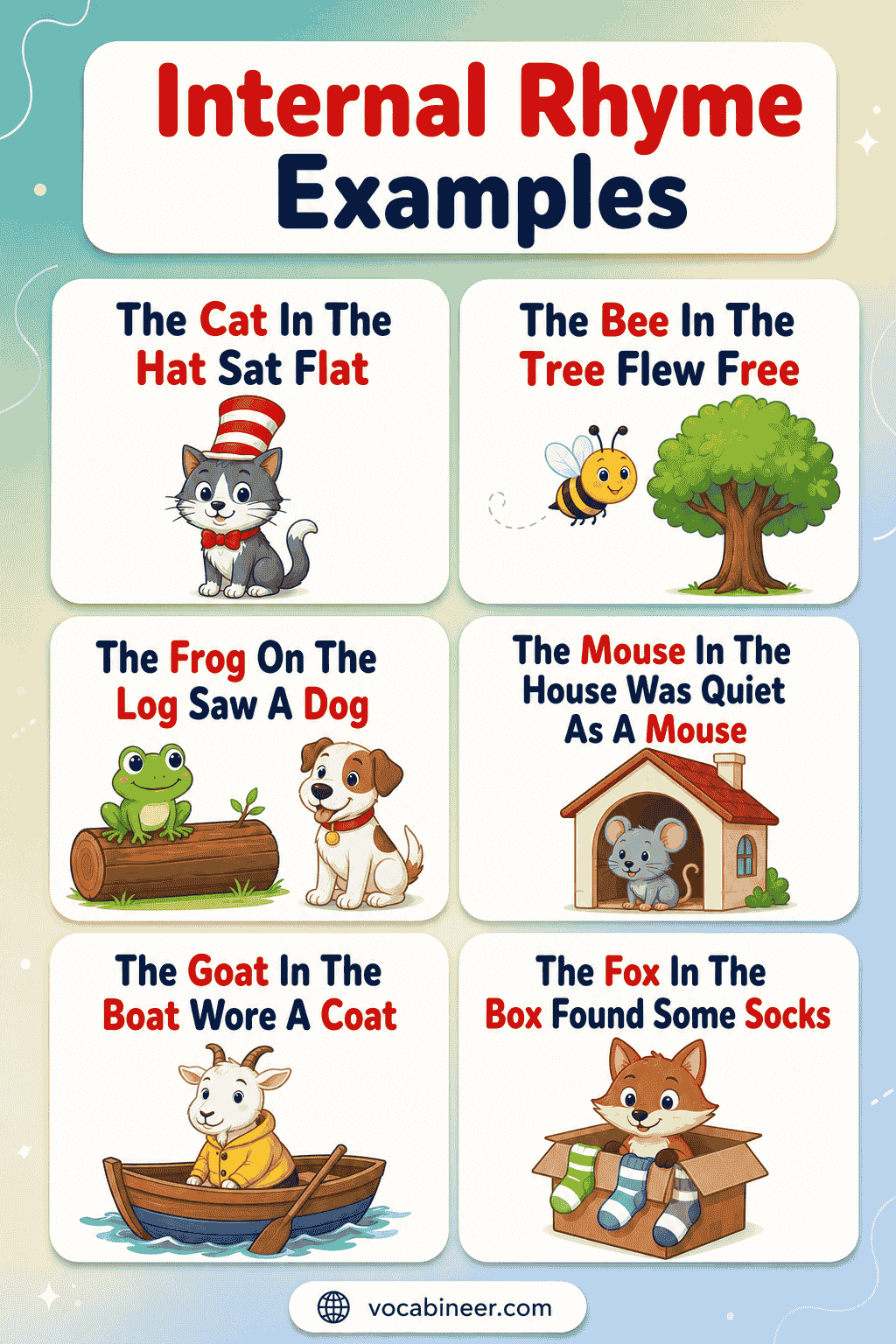
Easy Internal Rhyme Examples for Students
These examples use short words and simple sentences, so students can find the rhyme quickly.
- The sun made it fun to run.
- The dog saw a log in the fog.
- The light was bright at night.
- The bell fell near the well.
- The cake by the lake was mine.
- The train came through the rain.
- The star shone far from the car.
- The mouse ran through the house.
- The goat wore a coat on the boat.
- The frog sat on a log in the fog.
What Is Internal Rhyme?
Internal rhyme is a sound pattern where two or more rhyming words appear inside a line or inside nearby lines. Unlike end rhyme, it does not depend only on the last words of lines.
In simple terms, internal rhyme means rhyming inside the line.
Example:
The bright city light filled the quiet night.
Internal rhyming words:
- bright
- light
- night
How Internal Rhyme Works
Internal rhyme works by repeating similar ending sounds inside a line. Because the rhyme appears before the line ends, it gives the sentence extra beat and movement.
Example:
The rain hit the pane as I walked down the lane.
Internal rhyming words:
- rain
- pane
- lane
Internal Rhyme vs End Rhyme
Internal rhyme and end rhyme both use repeated sounds, but they place those sounds in different spots.
| Rhyme Type | Where the Rhyme Appears | Example |
|---|---|---|
| Internal rhyme | Inside a line or inside nearby lines | The cat wore a hat as it sat on the mat. |
| End rhyme | At the ends of lines | The moon was bright / It filled the sky with light |
Types of Internal Rhyme
Internal rhyme can appear in more than one pattern.
Internal Rhyme Within One Line
This type happens when two or more rhyming words appear inside the same line.
Example:
The cat wore a hat as it sat by the mat.
Internal rhyming words:
- cat
- hat
- sat
- mat
Internal Rhyme Between the Middle and End of One Line
This type happens when a word in the middle of a line rhymes with a word at the end of the same line.
Example:
The light was bright in the quiet night.
Internal rhyming words:
- light
- bright
- night
Internal Rhyme Across Two Lines
This type happens when a word inside one line rhymes with a word inside or near the end of another line.
Example:
The rain fell softly on the lane,
I heard the pain inside her name.
Internal rhyming words:
- rain
- lane
- pain
- name
Internal Rhyme Examples in Poetry
Poets use internal rhyme to add music, mood, and movement to a poem.
| Poetry Example | Internal Rhyming Words |
|---|---|
| The bright moonlight filled the night with silver air. | bright, night |
| The slow river below began to glow. | slow, below, glow |
| The deep waves sleep where the cold stars weep. | deep, sleep, weep |
| The cold wind told stories old. | cold, told, old |
| The red leaves spread where the quiet path led. | red, spread, led |
| The wide tide sighed under the sky. | wide, tide, sighed |
| The stone road alone led back home. | stone, alone, home |
| The light in sight made the dark feel bright. | light, sight, bright |
Internal Rhyme Examples in Rap
Rap often uses internal rhyme to build speed, flow, rhythm, and rhyme density inside each bar.
| Rap Example | Internal Rhyming Words |
|---|---|
| My mind finds lines that shine when I grind. | mind, finds, lines, grind |
| I make the beat speak, then move through the street sleek. | beat, speak, street, sleek |
| The flow stays cold while the whole crowd knows. | flow, cold, whole, knows |
| I write tight lines under city lights. | write, tight, lights |
| I bring fire higher with every desire. | fire, higher, desire |
| My game stays the same while I rise through the flame. | game, same, flame |
| I chase the sound around town till the bass comes down. | sound, around, town, down |
| The track snaps back when I rap on the map. | track, snaps, back, rap, map |
Internal Rhyme Examples in Songs
Songwriters use internal rhyme to make lines smoother, catchier, and easier to sing.
| Song Example | Internal Rhyming Words |
|---|---|
| I feel the rain again calling out your name. | rain, again, name |
| The heart starts beating when the night falls apart. | heart, starts, apart |
| We stay awake and chase the light of day. | stay, awake, day |
| I know we’ll go where the soft winds blow. | know, go, blow |
| The night feels bright when you hold me tight. | night, bright, tight |
| I hear your voice and rejoice in the noise. | voice, rejoice, noise |
| The road feels cold, but I carry the load. | road, cold, load |
| We rise through skies with hope in our eyes. | rise, skies, eyes |
Internal Rhyme Examples with Bold Rhyming Words
Bold words help readers see the internal rhyme pattern quickly.
Example:
The rain tapped the pane while I waited for the train.
Internal rhymes:
rain / pane / train
Example:
The clock gave a knock as I opened the lock.
Internal rhymes:
clock / knock / lock
Example:
The light looked bright in the silent night.
Internal rhymes:
light / bright / night
Example:
My mind finds lines when I grind.
Internal rhymes:
mind / finds / lines / grind
Example:
The slow river below began to glow.
Internal rhymes:
slow / below / glow
Short Internal Rhyme Examples
Short examples are useful for students, worksheets, and quick practice.
- The cat wore a hat.
- The sun made it fun.
- The dog saw a log.
- The bell fell by the well.
- The cake sat by the lake.
- The bee flew free.
- The clock gave a knock.
- The train crossed the rain.
- The star shone far.
- The light looked bright.
Funny Internal Rhyme Examples
Funny lines can make internal rhyme easier to remember.
- The goat wore a coat on a tiny boat.
- The duck had bad luck in a muddy truck.
- The cat in a hat chased a rat on a mat.
- The frog on a log sang to a dog.
- The bee drank tea by a tree.
- The goose got loose with a jar of juice.
- The snail read mail on a windy trail.
- The mouse left the house wearing a blouse.
How to Identify Internal Rhyme
You can find internal rhyme by listening for repeated sounds inside a line.
Steps:
- Read the line aloud.
- Listen for words with matching ending sounds.
- Look for rhyming words before the line ends.
- Check if a middle word rhymes with an end word.
- Compare the pattern with end rhyme.
- Mark the rhyming words in bold or underline them.
Example:
The clock gave a knock as I opened the lock.
Internal rhyming words:
- clock
- knock
- lock
How to Write Internal Rhyme
You can write internal rhyme by choosing a word, finding rhyming words, and placing them naturally inside a line.
Steps:
- Choose a simple word.
- Find one or two rhyming words.
- Place one rhyme inside the line.
- Add another rhyme later in the line.
- Read the line aloud.
- Keep the meaning natural.
- Avoid stuffing too many rhymes into one sentence.
Example process:
Start with:
night
Rhyming words:
- light
- bright
- sight
Internal rhyme line:
The bright city light filled the quiet night.
Why Writers Use Internal Rhyme
Writers use internal rhyme because it adds sound, rhythm, and movement to a line.
Internal rhyme helps writers:
- add rhythm
- improve flow
- create sound patterns
- make lines easier to remember
- strengthen poetry
- make rap bars denser
- make song lyrics catchier
- connect ideas through sound
- create a smoother beat
Internal Rhyme Practice
These practice activities help students understand, find, and write internal rhymes.
Find the Internal Rhyme
Sentence:
The light was bright in the quiet night.
Answer:
light / bright / night
Sentence:
The rain hit the pane near the train.
Answer:
rain / pane / train
Sentence:
The bee flew free by the tree.
Answer:
bee / free / tree
Complete the Internal Rhyme
The cat wore a ____ as it sat on the mat.
Answer:
hat
The bell fell near the ____.
Answer:
well
The dog saw a log in the ____.
Answer:
fog
The cake by the ____ was mine.
Answer:
lake
Write Your Own Internal Rhyme
Choose one word:
- rain
- light
- day
- blue
- sound
Then write one sentence with two or more rhyming words inside it.
Example:
The sound went around the town.
Common Mistakes With Internal Rhyme
Internal rhyme should improve the line, not make it confusing.
Common mistakes include:
- confusing internal rhyme with end rhyme
- adding too many rhymes in one line
- forcing words that do not fit the meaning
- using rhymes that break the rhythm
- forgetting to read the line aloud
- choosing rhymes that sound awkward
- making the sentence hard to understand
FAQs
Internal rhyme is a rhyme that happens inside a line or between words inside nearby lines. For example, The cat wore a hat as it sat by the mat uses internal rhyme because cat, hat, sat, and mat rhyme inside the line.
Examples include The rain tapped the pane while I waited for the train, The clock gave a knock as I opened the lock, and The light looked bright in the silent night. The rhyming words appear inside the line, not only at the end.
Internal rhyme happens inside a line, while end rhyme happens at the ends of lines. For example, The cat wore a hat uses internal rhyme, but The sky was bright / It filled the world with light uses end rhyme.
Writers use internal rhyme to add rhythm, flow, music, and sound patterns. It can make poems, rap lines, songs, and chants smoother and more memorable.
Choose a word, find rhyming words, and place them inside the same line or nearby lines. For example, start with night, then use bright and light to write: The bright city light filled the quiet night.
Summary
Internal rhyme happens when rhyming words appear inside a line or inside nearby lines. It differs from end rhyme because the rhyming words do not appear only at the ends of lines.
Writers use internal rhyme in poems, rap, songs, chants, and creative lines to add rhythm, flow, sound, and musical movement. With simple examples like cat/hat/sat, rain/pane/train, and light/bright/night, internal rhyme becomes easy to spot and fun to write.
Read More
- Rhyming Words Types and Examples
- Words That Rhyme with Seven
- Words That Rhyme with Four
- Easy Rhymes with Three