

Slant rhyme gives writers more freedom when two words sound close but do not rhyme perfectly. Words like love/move, heart/hard, orange/storage, and purple/turtle are slant rhymes because they share a similar sound without making an exact match.
This guide explains slant rhyme in simple words with clear examples, easy word pairs, poetry lines, rap lines, song-style lines, hard-to-rhyme words, comparison tables, practice activities, and writing tips.
In This Page
Quick Answer: What Is Slant Rhyme?
Slant rhyme is a rhyme where two words sound similar but do not match exactly.
Examples:
- love / move
- soul / all
- heart / hard
- orange / storage
- purple / turtle
- silver / sliver
- time / mind
- night / eyes
- month / once
- rhythm / system
These pairs sound close, but they are not exact perfect rhymes.
Slant Rhyme Examples
Slant rhyme becomes easier to understand when you see the close sounds in short lines.
| Slant Rhyme Pair | Example Line |
|---|---|
| love / move | I felt your love every time I move. |
| soul / all | I gave my soul to answer the call. |
| heart / hard | My heart stayed strong when the road grew hard. |
| shape / keep | I changed my shape but tried to keep my name. |
| bridge / grudge | We crossed the bridge and left the grudge behind. |
| moon / run | Under the moon, I learned to run. |
| eyes / light | The light lived softly in her eyes. |
| time / mind | I lost the time inside my mind. |
| orange / storage | The old orange box sat in storage. |
| purple / turtle | A purple shell covered the slow turtle. |
Easy Slant Rhyme Examples for Students
These easy examples use common words and close sounds.
- love / move
- heart / hard
- home / gone
- eyes / light
- moon / run
- shape / keep
- soul / all
- hold / cold
- dream / green
- fire / tired
- orange / storage
- purple / turtle
- silver / sliver
- wolf / full
- month / once
- rhythm / system
- dangerous / famous
- woman / human
- chimney / skinny
- husband / cousin
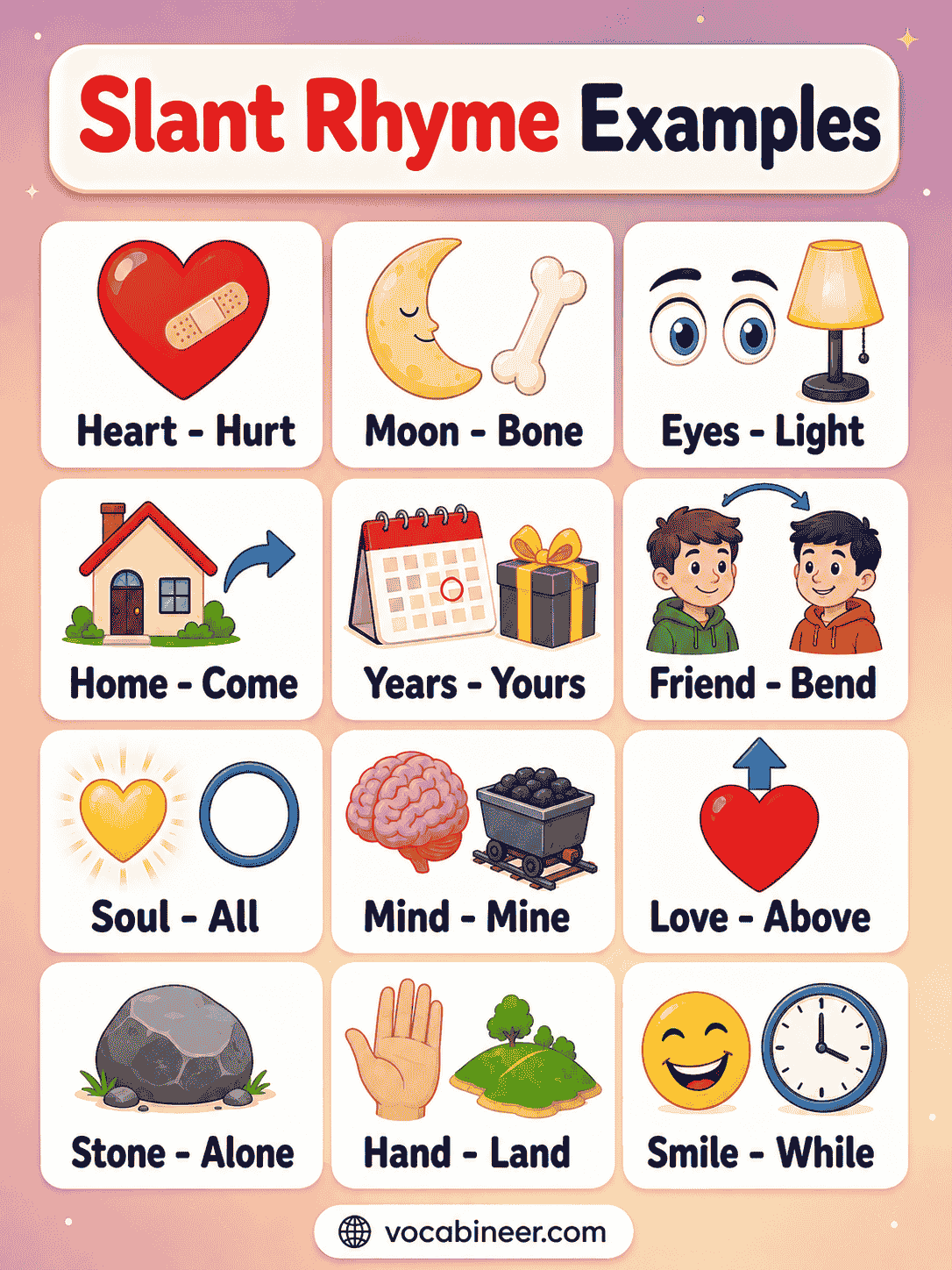
What Is Slant Rhyme?
Slant rhyme is a sound match that feels close but not exact. It often appears in poems, rap lyrics, songs, and creative writing when a perfect rhyme would sound too forced.
Slant rhyme is also called:
| Term | Simple Meaning |
|---|---|
| near rhyme | words that sound close |
| half rhyme | words with a partial sound match |
| off rhyme | an imperfect rhyme |
| partial rhyme | a rhyme that does not fully match |
| imperfect rhyme | a close rhyme, not an exact rhyme |
Examples:
| Word Pair | Why It Is Slant Rhyme |
|---|---|
| love / move | similar sound, not perfect |
| soul / all | close sound, not exact |
| purple / turtle | similar ending feel |
| orange / storage | close sound, not exact |
| heart / hard | similar sound pattern |
How Slant Rhyme Works
Slant rhyme works by using sounds that are similar enough to feel connected. It may repeat a vowel sound, a consonant sound, or a close ending sound.
| Type of Close Match | Example |
|---|---|
| similar vowel sound | eyes / light |
| similar consonant sound | soul / all |
| similar ending feel | purple / turtle |
| close phrase sound | orange / door hinge |
| flexible lyric sound | love / move |
Slant rhyme often depends on how the words sound when you read them aloud.
Slant Rhyme Word Pairs
These word pairs give writers more choices than strict perfect rhymes.
| Word | Slant Rhymes |
|---|---|
| love | move, enough, above |
| soul | all, fall, full |
| night | light, eyes, life |
| heart | hard, hurt, start |
| home | alone, gone, stone |
| time | mine, line, mind |
| dream | green, seen, breathe |
| fire | higher, tired, desire |
| orange | foreign, storage, porridge |
| purple | turtle, circle, hurtful |
| silver | sliver, river, filter |
| month | once, front, crunch |
| rhythm | system, living, given |
| wolf | full, pull, hoof |
| dangerous | famous, anxious |
| woman | human, Roman |
| chimney | skinny, mini |
| husband | cousin, dozen |
| marathon | carry on, Babylon |
| pint | find, kind, night |
Slant Rhyme Examples with Bold Rhyming Words
Bold words make the close sound patterns easier to see.
Example:
I felt your love every time I move.
Slant rhymes:
love / move
Example:
My heart stayed calm when the road grew hard.
Slant rhymes:
heart / hard
Example:
The old orange box sat in storage.
Slant rhymes:
orange / storage
Example:
I chased the time inside my mind.
Slant rhymes:
time / mind
Example:
A purple shell covered the slow turtle.
Slant rhymes:
purple / turtle
Slant Rhyme vs Perfect Rhyme
Perfect rhyme matches exactly. However, slant rhyme sounds close without matching fully.
| Rhyme Type | Meaning | Example |
|---|---|---|
| Perfect rhyme | ending sounds match exactly | light / night |
| Slant rhyme | sounds are close but not exact | soul / all |
| Perfect rhyme | clear same ending sound | rain / pain |
| Slant rhyme | similar sound, softer match | love / move |
| Perfect rhyme | exact sound match | day / play |
| Slant rhyme | close sound match | orange / storage |
Slant Rhyme vs Near Rhyme, Half Rhyme, and End Rhyme
Slant rhyme connects with several rhyme terms, but each term has a slightly different use.
| Term | Meaning | Example |
|---|---|---|
| Slant rhyme | broad term for close but imperfect rhyme | purple / turtle |
| Near rhyme | another common name for close rhyme | orange / storage |
| Half rhyme | often focuses on similar consonant sounds | tell / toll |
| Off rhyme | another name for imperfect rhyme | shape / keep |
| End rhyme | tells where the rhyme appears, not how exact it is | sky / light at line endings |
Types of Slant Rhyme
Slant rhyme can happen through consonant sounds, vowel sounds, or close ending sounds.
Same Consonant Sound Slant Rhymes
These pairs share similar consonant sounds, but the vowel sounds do not match exactly.
Examples:
- soul / all
- tell / toll
- hold / bald
- shape / keep
- bridge / grudge
- heart / hurt
- land / lend
- sound / sand
Same Vowel Sound Slant Rhymes
These pairs share a similar vowel sound, but the full ending does not match exactly.
Examples:
- eyes / light
- time / mind
- home / alone
- fire / tired
- moon / run
- dream / breathe
- stone / road
- name / flame
Close Ending Sound Slant Rhymes
These pairs have endings that feel close, even though they do not match perfectly.
Examples:
- orange / storage
- purple / turtle
- silver / sliver
- month / once
- rhythm / system
- wolf / full
- pint / kind
- dangerous / famous
Slant Rhyme Examples in Poetry
Poets use slant rhyme to create softer sound patterns, natural lines, and emotional movement.
| Poetry Example | Slant Rhymes |
|---|---|
| The soul heard the call beyond it all. | soul, call, all |
| Her heart grew hard beneath the stars. | heart, hard |
| The moon moved slowly as the river ran. | moon, moved, ran |
| The light in her eyes faded into night. | light, eyes, night |
| The wind bent the land with a broken sound. | wind, land, sound |
| The stone road led home through cold rain. | stone, road, home |
| A purple flower leaned near the turtle. | purple, turtle |
| The silver river shimmered like a sliver. | silver, river, sliver |
Slant Rhyme Examples in Rap
Rap often uses slant rhyme because it helps lines move faster and gives writers more word choices.
| Rap Example | Slant Rhymes |
|---|---|
| I chase the time, keep lines inside my mind. | time, lines, mind |
| I bring the fire, rise higher when I’m tired. | fire, higher, tired |
| My flow moves cold through the whole room. | flow, cold, whole |
| I write with heart, even when the road gets hard. | heart, hard |
| I bend the sound until the crowd comes down. | sound, crowd, down |
| I move through the night with light in my eyes. | night, light, eyes |
| My dream stays green while I learn to breathe. | dream, green, breathe |
| I hold my soul through every fall. | soul, hold, fall |
Slant Rhyme Examples in Songs
Songwriters use slant rhyme because it can sound smooth, emotional, and natural in a melody.
| Song Example | Slant Rhymes |
|---|---|
| I feel your love every time I move. | love, move |
| We lost our home, but we’re not alone. | home, alone |
| The light in your eyes keeps me alive. | light, eyes, alive |
| My heart still hurts when the music starts. | heart, hurts, starts |
| I’ll stay through the night till the morning light. | night, light |
| I hear your voice in every choice. | voice, choice |
| The fire burns higher when I’m tired. | fire, higher, tired |
| I follow the sound until hope comes around. | sound, around |
Slant Rhyme Examples for Hard-to-Rhyme Words
Slant rhyme helps writers use words that have no easy perfect rhyme.
| Hard Word | Slant Rhymes |
|---|---|
| orange | foreign, storage, porridge |
| purple | turtle, circle, hurtful |
| silver | sliver, river, filter |
| month | once, front, crunch |
| rhythm | system, living, given |
| wolf | full, pull, hoof |
| pint | find, kind, night |
| dangerous | famous, anxious |
| marathon | carry on, Babylon |
| husband | cousin, dozen |
How to Identify Slant Rhyme
You can identify slant rhyme by listening for close sounds that do not match exactly.
Steps:
- Read both words aloud.
- Listen for similar sounds.
- Check whether the ending sounds are close.
- Ask if the sounds match exactly.
- If they sound close but not exact, it may be slant rhyme.
- Compare the pair with a perfect rhyme.
- Read the whole line aloud to hear the rhythm.
Example:
Love / move
- sounds close: yes
- exact match: no
- slant rhyme: yes
How to Write Slant Rhymes
You can write slant rhymes by choosing words that sound close and still fit the meaning of the line.
Steps:
- Choose a word.
- Find words with similar sounds.
- Do not require an exact match.
- Place the close-sounding word naturally in the line.
- Read the line aloud.
- Keep the meaning stronger than the rhyme.
- Avoid stretching pronunciation too much.
Example process:
Start with:
love
Possible slant rhymes:
- move
- enough
- above
Example line:
I felt your love every time I move.
Why Writers Use Slant Rhyme
Writers use slant rhyme when perfect rhyme feels too strict or unnatural.
Slant rhyme helps writers:
- get more word choices
- avoid forced perfect rhymes
- make poems sound more natural
- add flexibility to rap flow
- make songs feel smoother
- rhyme difficult words
- create a softer sound
- shape emotional lines
- support internal rhyme
- keep meaning stronger than rhyme
Slant Rhyme Practice
These practice activities help students recognize and write close sound matches.
Find the Slant Rhyme
Sentence:
I felt your love every time I move.
Answer:
love / move
Sentence:
My heart grew hard beneath the stars.
Answer:
heart / hard
Sentence:
The old orange box sat in storage.
Answer:
orange / storage
Choose the Slant Rhyme
Which word is a slant rhyme for orange?
- storage
- cat
- blue
Answer:
storage
Which word is a slant rhyme for purple?
- turtle
- day
- book
Answer:
turtle
Which word is a slant rhyme for month?
- once
- tree
- hat
Answer:
once
Complete the Slant Rhyme
My heart grew ____ beneath the stars.
Answer:
hard
The silver river shimmered like a ____.
Answer:
sliver
I chased the time inside my ____.
Answer:
mind
Write Your Own Slant Rhyme
Choose one word:
- love
- orange
- heart
- night
- dream
Then write one line with a close-sounding word.
Example:
My heart stayed calm when the road grew hard.
Common Mistakes With Slant Rhyme
Slant rhyme should sound close enough to feel connected.
Common mistakes include:
- confusing slant rhyme with perfect rhyme
- forcing words that sound too different
- using slant rhymes that break meaning
- stretching pronunciation too much
- using too many weak rhymes in one line
- ignoring rhythm and flow
- thinking slant rhyme is wrong
- choosing words only because they look similar
FAQs
Slant rhyme is a rhyme where two words sound similar but do not match exactly. Examples include love/move, soul/all, heart/hard, orange/storage, and purple/turtle.
Examples of slant rhyme include love/move, time/mind, heart/hard, night/eyes, orange/storage, purple/turtle, silver/sliver, and month/once.
Perfect rhyme has an exact sound match, such as light/night or rain/pain. Slant rhyme sounds close but not exact, such as love/move or orange/storage.
Slant rhyme and near rhyme often mean almost the same thing in everyday writing guides. Both describe words that sound close but do not rhyme perfectly.
Choose a word, find another word with a similar sound, and place both words naturally in a line. For example, choose love, then use move in the line: I felt your love every time I move.
Summary
Slant rhyme happens when two words sound close but do not match exactly. It is also called near rhyme, half rhyme, off rhyme, partial rhyme, or imperfect rhyme in many writing guides.
Writers use slant rhyme in poetry, rap, songs, and creative writing because it gives more word choices and helps avoid forced perfect rhymes. Common examples include love/move, soul/all, heart/hard, orange/storage, purple/turtle, and silver/sliver.
Read More
- Rhyming Words Types and Examples
- Words That Rhyme with Seven
- Words That Rhyme with Four
- Easy Rhymes with Three