Homophones appear often in English sentences, and they confuse beginners because one sound links to more than one meaning. Words like pair and pear or sea and see show this clearly. The following is a list of homophones with meanings A to Z. Each section explains pairs you will meet in school, reading, and daily conversations.
In This Page
Common Homophones with Meanings
These are some of the most widely used homophones in English. Knowing their meanings helps avoid mistakes in writing and speaking.
- Sun: the star that gives light
- Son: a male child
- See: to look at something
- Sea: a large body of salt water
- Blue: a color
- Blew: past tense of blow
- One: the number 1
- Won: past tense of win
- Ate: past tense of eat
- Eight: the number 8
- Flower: a plant bloom
- Flour: powder for baking
- Right: correct or direction opposite left
- Write: to put words on paper
- Deer: a wild animal with antlers
- Dear: loved or valued person
- Pair: two of something
- Pear: a fruit
- Bare: uncovered or without clothing
- Bear: a large animal
Easy Homophones with Meanings
These homophones are short and simple, making them easier to remember for learners.
- Toe: part of the foot
- Tow: to pull something behind
- Here: in this place
- Hear: to notice sound
- Weak: not strong
- Week: seven days
- Mail: letters or packages delivered
- Male: the opposite of female
- Plain: simple or without design
- Plane: an aircraft
- Hole: an empty space
- Whole: complete or full
- Knight: soldier from the past
- Night: time after sunset
- Made: created or built
- Maid: house helper
- Wood: material from trees
- Would: a word showing intention
- Nose: part of the face for smelling
- Knows: understands or has knowledge
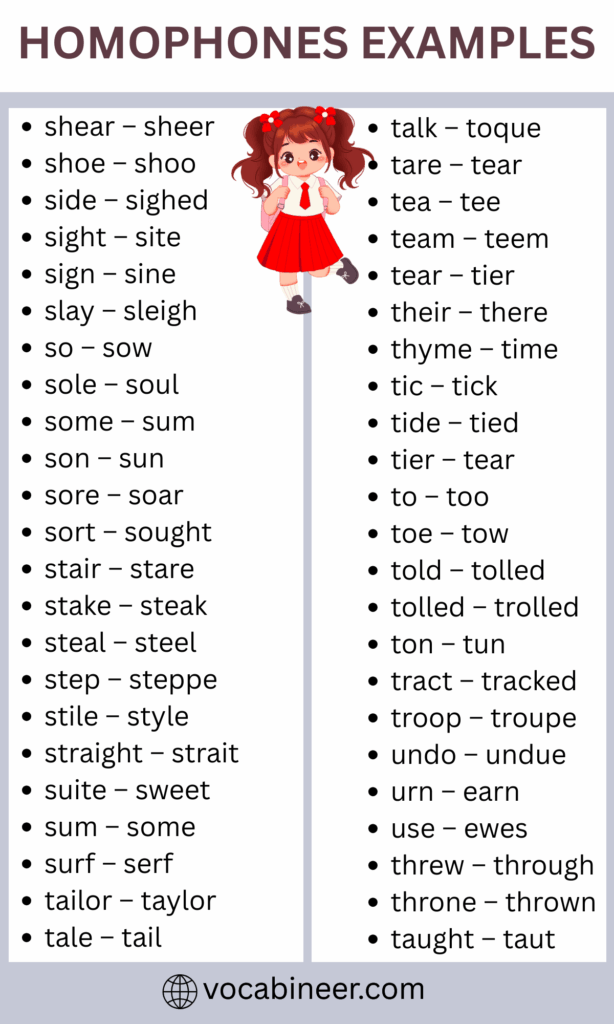
List of Homophones with Meanings A to Z
A
- Ate: past tense of eat
- Eight: the number 8
- Affect: to influence something
- Effect: the result of an action
- Allowed: given permission
- Aloud: spoken so people can hear
B
- Bare: uncovered, without clothing
- Bear: a large animal, or to carry
- Break: to damage or stop
- Brake: device to stop a vehicle
- Board: flat wooden surface
- Bored: feeling uninterested
C
- Cell: small unit in biology or prison
- Sell: to trade for money
- Cite: to quote as evidence
- Sight: ability to see
- Site: place or location
D
- Deer: wild animal with antlers
- Dear: loved or valued
- Die: to stop living
- Dye: to color something
E
- Eye: part of the body used to see
- I: personal pronoun
- Ewe: a female sheep
- You: the person being spoken to
F
- Fair: just or light in color
- Fare: cost of travel
- Flour: powder for baking
- Flower: plant bloom
G
- Grate: to shred or rough surface
- Great: very good or large
- Groan: sound of pain
- Grown: fully developed
H
- Hair: strands on the head or body
- Hare: fast-running animal
- Hole: an empty space
- Whole: complete, entire
- Hour: 60 minutes
- Our: belonging to us
I
- Idle: inactive or lazy
- Idol: admired person or figure
K
- Knight: soldier from the past
- Night: time after sunset
- Know: to understand or be aware
- No: opposite of yes
L
- Loan: borrowed money
- Lone: single, alone
- Lead: a metal, or to guide
- Led: past tense of lead
M
- Made: created something
- Maid: house helper
- Mail: letters or parcels delivered
- Male: opposite of female
- Meat: food from animals
- Meet: to come together
N
- None: not any
- Nun: religious woman in convent
- Navel: belly button
- Naval: related to ships
O
- One: the number 1
- Won: past tense of win
P
- Peace: calm, no war
- Piece: part of something
- Pair: two of something
- Pear: a fruit
- Plain: simple or flat land
- Plane: aircraft
R
- Right: correct or opposite of left
- Write: to put words down
- Read: interpret written words
- Red: a color
S
- Sun: the star that gives light
- Son: male child
- Sole: bottom of foot or shoe
- Soul: spiritual essence
- Some: a part or quantity
- Sum: total amount
T
- Tail: part of an animal’s body
- Tale: a story
- Toe: part of the foot
- Tow: pull along behind
- Two: number 2
- Too: also, or very
- To: preposition showing direction
V
- Vain: full of pride
- Vein: blood vessel
- Vane: flat object moved by wind
W
- Wear: to put on clothes
- Where: location or place
- Weak: not strong
- Week: seven days
- Wood: material from trees
- Would: expresses intention
X
- X: No strong standard homophones in English; very rare. Some sources stretch with names like “Xerox / 0” but these are not genuine.
Y
- Yoke: wooden frame for animals
- Yolk: yellow part of an egg
Z
- Zee: American name for the letter Z
- Zed: British name for the letter Z
Homophones with Meanings in Sentences
Seeing homophones used in sentences makes it easier to understand their roles.
- The sun is bright → Her son is tall.
- I can see the stars → The sea is calm.
- He ate lunch → There are eight books.
- She picked a flower → The bread needs more flour.
- That answer is right → Please write neatly.
- A deer ran away → My dear friend smiled.
- I bought a pair of shoes → He ate a pear.
- His feet were bare → A bear climbed the tree.
- The mail arrived late → A male bird sang.
- She wore a plain dress → A plane flew overhead.
Conclusion
Homophones add variety to English but also cause confusion because of their identical sounds. Learning them with meanings side by side makes it easier to choose the right word while reading and writing. Keep practicing with these examples to build confidence in everyday English.
Read More