Household tools are items people use for small tasks and basic fixes inside the home. Many tools look alike, however their names differ, and because of this, confusion is common. Learning these names helps readers recognize, understand, and use correct terms when tools are mentioned. With pictures included, name recognition becomes faster and more accurate.
This post helps readers learn Household tools names with pictures, so they can use these words correctly in daily talk, repair discussions, shopping situations, and basic learning settings.
In This Page
Household Tools Names Used at Home
Household tools names appear in everyday talk, shopping lists, and short repair notes. However, many tools are recognized by shape rather than by name, and because of this, people often use general or incorrect words. At the same time, these tools are used across rooms and tasks, which makes their names feel interchangeable. For this reason, listing them clearly helps readers connect each name with the correct object in daily settings.
- Toolbox:
A portable container used to store household tools together, often carried from room to room. - Tool kit:
A packaged set of basic tools kept for common household tasks, usually stored in one place. - Hammer:
A hand tool with a weighted head, often used to drive nails into walls or wood. - Screwdriver:
A tool with a shaped tip, usually used to turn screws found in furniture and fixtures. - Pliers:
A gripping tool used to hold, bend, or pull small objects, especially in tight spaces. - Wrench:
A metal tool designed to tighten or loosen nuts and bolts of different sizes. - Allen key:
A small L-shaped tool used for hexagonal screws, commonly seen in furniture fittings. - Measuring tape:
A flexible measuring tool marked with units, often used for furniture or room measurements. - Scissors:
A two-bladed cutting tool used for paper, fabric, or light household materials. - Utility knife:
A small knife with a replaceable blade, usually used for cutting packaging or plastic. - Step ladder:
A short folding ladder used indoors to reach shelves, lights, or wall fixtures. - Flashlight:
A handheld light tool used during power cuts or in dark household areas. - Extension cord:
A flexible cable used to extend the reach of electrical devices when outlets are far. - Work gloves:
Protective gloves worn when handling tools or rough objects, rather than bare hands.
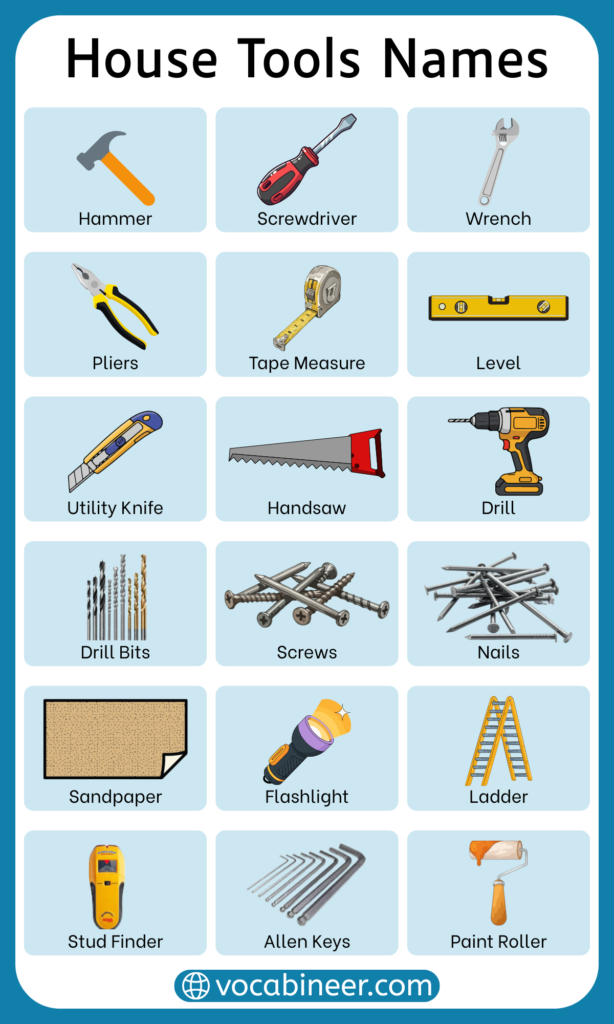
Common Hand Tools for Household Tasks
Common hand tools are used for simple household work and do not require electricity. However, their names are often mixed up because many look similar. At the same time, these tools are stored and used close together. For this reason, grouping them by function helps with clear name recognition.
Tools Used for Tightening Fasteners
These tools are used to tighten or loosen screws, bolts, and nuts. However, different fasteners require different tool shapes, which often causes name confusion.
- Flathead screwdriver:
A screwdriver with a straight tip, usually used for screws with a single slot. - Phillips screwdriver:
A screwdriver with a cross-shaped tip, commonly used for plus-shaped screws. - Allen key:
An L-shaped metal tool used for hexagonal screws, often found in furniture. - Adjustable wrench:
A wrench with a movable jaw that fits nuts and bolts of various sizes. - Socket wrench:
A hand tool that uses detachable sockets to turn bolts more easily. - Nut driver:
A screwdriver-style tool designed specifically for tightening hex nuts.
Tools Used for Holding Objects
These tools are used to grip, bend, or keep objects steady. However, they are often mistaken for fastening tools because both are used during repairs.
- Pliers:
A hand tool used to grip, twist, or pull small objects. - Needle-nose pliers:
A narrow-tipped plier used for reaching into tight or narrow spaces. - Clamp:
A tool used to hold objects firmly in place without being held by hand. - Vice grip:
A locking plier that stays clamped once adjusted. - Tweezers:
A small gripping tool used for holding very fine or delicate items.
Tools Used for Striking Surfaces
Striking tools apply force by hitting an object. However, their names depend on head shape and material.
- Hammer:
A tool with a hard metal head, commonly used to drive nails. - Claw hammer:
A hammer with a curved claw used for pulling out nails. - Mallet:
A striking tool with a softer head, often used on delicate surfaces. - Rubber mallet:
A mallet with a rubber head used to avoid surface damage.
Tools Used for Basic Home Repairs
Tools used for basic home repairs are usually mentioned when small problems come up around the house. However, many of these items are called by general names, and because of this, their exact terms are often missed.
At the same time, these tools are used only occasionally, which makes recognition harder. For this reason, grouping them by repair role helps connect each name with the correct item.
Tools Used for Minor Fixes
These tools and items are used to attach, support, or replace small parts. However, many of them look similar, so their names are often confused.
- Nail:
A thin metal pin driven into wood or soft surfaces to hold objects in place. - Screw:
A threaded fastener turned into material, usually removable without damage. - Wall plug:
A plastic insert placed in walls to help screws hold securely. - Anchor bolt:
A strong fastener used to secure heavy objects to walls or floors. - Toggle bolt:
A fastener with folding wings, often used in hollow walls. - Hook screw:
A curved screw used for hanging light household items. - Bracket:
A support piece used to hold shelves or mounted objects.
Tools Used for Measuring Length
Measuring tools help identify size or distance during repairs. However, their names are often replaced with vague words like “measure.”
- Measuring tape:
A flexible strip marked with units, commonly used for furniture or room sizes. - Ruler:
A straight measuring tool used for short and precise measurements. - Foldable ruler:
A segmented ruler that folds, often used for compact storage. - Tape rule:
A retractable metal measuring tool used for quick length checks. - Yardstick:
A long, flat measuring stick used for longer straight measurements.
Household Measuring Tools
Household measuring tools are used to check size, distance, or alignment. However, their names are often replaced with general words. At the same time, these tools differ by shape and purpose. For this reason, clear naming helps with correct recognition.
- Measuring tape:
A flexible strip marked with units, often used for furniture or room measurements. - Ruler:
A straight, flat tool used for short and precise measurements. - Spirit level:
A tool with liquid-filled tubes used to check straightness or balance. - Foldable ruler:
A segmented measuring tool that folds for easy storage. - Measuring square:
A right-angle tool used to check corner alignment. - Caliper:
A tool used to measure small distances or thickness accurately. - Angle finder:
A tool used to measure angles between surfaces.
Household Cutting Tools
Cutting tools are identified by blade shape and material strength. However, many people use one name for different tools because they all cut. Grouping them properly helps with correct recognition.
Tools Used for Light Materials
These tools are used for paper, fabric, plastic, or thin household materials.
- Scissors:
A two-bladed cutting tool used for paper, fabric, and light materials. - Household shears:
Stronger scissors used for thicker fabric or packaging. - Utility knife:
A small knife with a replaceable blade, often used for boxes. - Box cutter:
A compact cutting tool designed mainly for cartons and packaging. - Craft knife:
A fine-tip knife used for detailed cutting on light materials.
Tools Used for Hard Materials
These tools are used for wood, metal, or hard plastic. Because of this, their blades are thicker or toothed.
- Handsaw:
A hand-operated saw with a long blade used to cut wood. - Hacksaw:
A fine-toothed saw used for cutting metal or hard plastic. - Coping saw:
A thin-bladed saw used for curved cuts in wood. - Pruning saw:
A small saw used for cutting thicker branches or wooden pieces.
Tools Used for Opening and Removing
These tools are recognized by their ability to open, pry, or remove objects. However, they are often confused with cutting or holding tools.
- Bottle opener:
A tool used to remove metal caps from bottles. - Can opener:
A tool designed to cut and remove lids from food cans. - Crowbar:
A curved metal tool used to pry open objects or remove nails. - Pry bar:
A flat metal tool used for lifting or separating materials. - Nail puller:
A tool specifically shaped to remove nails from surfaces.
Cleaning Tools Used in Homes
Cleaning tools are often recognized by movement rather than by name. However, many different tools are casually called the same thing. Because of this, grouping them by purpose helps with clear identification.
Tools Used for Dusting
These tools are used to remove dry dust from surfaces. In many cases, they are confused with wiping or washing tools.
- Duster:
A soft tool used to remove dust from furniture and shelves. - Feather duster:
A lightweight duster made with feathers for delicate surfaces. - Microfiber cloth:
A fine fabric cloth used to trap dust rather than spread it. - Dusting brush:
A small brush used to clean corners, vents, or narrow spaces. - Electrostatic duster:
A disposable duster that attracts dust through static charge.
Tools Used for Floor Cleaning
These tools are used on hard floors or carpets. However, their names are often used interchangeably.
- Broom:
A long-handled tool with bristles used for sweeping dry floors. - Dustpan:
A flat container used with a broom to collect swept debris. - Mop:
A floor-cleaning tool used with water to remove dirt. - Spin mop:
A mop with a wringing mechanism for excess water removal. - Floor brush:
A stiff-bristled brush used for scrubbing hard floors.
Fastening Tools Used in Households
Fastening tools are named based on how firmly they hold objects together. However, many people use one general word for all fasteners. Clear naming helps separate temporary holds from permanent ones.
Tools Used for Temporary Fastening
These fasteners are meant to hold items lightly or for a short time. Because of this, they are easy to remove without tools.
- Thumbtack:
A short pin with a flat head, used to attach paper to soft surfaces. - Push pin:
A small pin with a plastic head, commonly used on boards or walls. - Adhesive hook:
A removable hook that sticks to surfaces without drilling. - Velcro strip:
A hook-and-loop fastener used for temporary attachment. - Paper clip:
A bent metal clip used to hold sheets of paper together.
Tools Used for Permanent Fastening
These fasteners are used when items need to stay fixed in place. In many cases, removal requires tools.
- Screw:
A threaded fastener used to secure objects firmly into surfaces. - Bolt:
A thick fastener used with a nut for strong holding. - Nail:
A smooth metal fastener driven into material by striking. - Anchor bolt:
A heavy-duty fastener used for strong wall or floor attachment. - Wall plug:
A plastic insert that allows screws to grip securely in walls.
Tools Used for Hanging and Mounting at Home
Some household tools are named mainly by how they support hanging items. However, they are often confused with general fasteners.
- Picture hook:
A small hook designed specifically for hanging frames. - Wall hook:
A fixed hook used to hang bags, keys, or clothing. - Shelf bracket:
A supporting piece used to hold shelves against walls. - Curtain rod bracket:
A mount used to support curtain rods. - Mounting plate:
A flat piece used to attach fixtures securely to walls.
Tools Commonly Found in Home Tool Kits
Home tool kits usually contain a small group of frequently used tools. However, many of these items are recognized by sight rather than by name.
At the same time, tool kits mix different tool types together. For this reason, listing their names clearly helps with quick identification.
- Toolbox:
A portable container used to store and organize household tools. - Tape measure:
A compact measuring tool with a retractable strip marked with units. - Screwdriver set:
A group of screwdrivers with different tip shapes and sizes. - Flathead screwdriver:
A screwdriver with a straight tip used for single-slot screws. - Phillips screwdriver:
A cross-tip screwdriver used for plus-shaped screws. - Combination wrench:
A wrench with one open end and one closed ring end. - Adjustable wrench:
A wrench with a movable jaw for different bolt sizes. - Allen key set:
A set of L-shaped tools used for hexagonal screws. - Pliers:
A gripping tool used to hold, bend, or pull small objects. - Utility knife:
A small cutting tool included for light cutting tasks. - Spirit level:
A leveling tool used to check straight or even surfaces. - Hammer:
A striking tool commonly included for nails and light fixes. - Work gloves:
Protective gloves used when handling tools or rough materials.
Household Tools Names Used by Room
Some household tools are easier to recognize when grouped by where they are commonly used. Because of this, room-based grouping reduces name confusion in everyday situations.
Tools Commonly Used in Kitchens
Kitchen tools are often mixed with utensils, although many are clearly tools by function.
- Can opener:
A tool used to cut and remove lids from food cans. - Bottle opener:
A tool designed to remove caps from bottles. - Grater:
A metal tool used to shred food items into small pieces. - Peeler:
A handheld tool used to remove thin outer layers from vegetables. - Measuring cup:
A container marked with volume units for measuring ingredients.
Tools Commonly Used in Bathrooms
Bathroom tools are often named by function rather than category. However, their names appear frequently in household conversations.
- Plunger:
A suction tool used to clear blockages in sinks or toilets. - Drain snake:
A flexible tool used to remove clogs from pipes. - Grout scraper:
A narrow tool used to remove material between tiles. - Squeegee:
A flat rubber tool used to remove water from smooth surfaces. - Toilet brush:
A brush designed for cleaning toilet bowls.
Tools Commonly Used in Bedrooms
Bedroom tools are usually connected to furniture, storage, or light adjustments. However, their names are often overlooked because they blend into everyday items. Grouping them here helps with clearer recognition.
- Allen key:
A small L-shaped tool used for tightening furniture screws in beds or wardrobes. - Screwdriver:
A hand tool used for assembling, adjusting, or tightening bedroom fixtures. - Hammer:
A striking tool sometimes used for light furniture fixes or wall hooks. - Picture hook:
A small hook used to hang frames or wall décor. - Curtain rod bracket:
A mounted support used to hold curtain rods above windows.
Household Tools Names People Often Confuse
Some household tools are confused because they look similar or appear in the same situations. As a result, people often use the wrong name in conversation or lists. The table below separates these names clearly for quick recognition.
| Tool Name A | Tool Name B | Key Difference | How They Are Recognized |
|---|---|---|---|
| Screw | Nail | A screw is turned into place, while a nail is driven in by striking. | Screws have threads; nails have smooth shafts. |
| Hammer | Mallet | A hammer has a hard metal head, however a mallet has a softer head. | Mallets are often rubber or wood; hammers are metal. |
| Pliers | Clamp | Pliers are held by hand, while clamps hold objects on their own. | Clamps stay fixed; pliers must be squeezed. |
| Wrench | Socket wrench | A wrench grips directly, but a socket wrench uses removable sockets. | Socket wrenches have round socket heads. |
| Utility knife | Box cutter | A utility knife is multipurpose, whereas a box cutter is more compact. | Box cutters are smaller with shorter blades. |
| Broom | Mop | A broom is used dry, however a mop is used with water. | Mops have absorbent heads; brooms have bristles. |
| Screwdriver | Nut driver | A screwdriver turns screws, while a nut driver turns hex nuts. | Nut drivers have hollow, socket-like tips. |
FAQs About Household Tool Names
In many cases, yes. “Wrench” is commonly used in American English, while “spanner” is more common in British English.
A screw is turned into place using a tool, however a nail is driven in by striking.
No. Pliers must be held and squeezed by hand, while clamps stay fixed once tightened.
They are similar, but a box cutter is usually smaller and mainly used for opening cartons.
In many cases, this happens because of regional English, slight shape differences, or specific naming habits.
Conclusion
This article covered household tools names by grouping them according to function, shape, and everyday location. In this way, similar-looking tools were separated so their names are easier to recognize and remember. Because of this clear grouping, readers can better understand tool names when they appear in lists, conversations, or instructions. Overall, organizing names by purpose helps reduce confusion and improves everyday recognition.
Read More