

Loose vs Lose often creates confusion because the words look and sound similar but carry completely different meanings. One describes something that is not tight, while the other refers to failing to win or no longer having something. Their spelling difference reflects adjective versus verb contrast.
Understanding Loose vs Lose helps you choose the correct word in structured writing, academic contexts, and daily communication. This article explains their meaning, grammar roles, pronunciation difference, usage patterns, and common mistakes so you can apply them accurately.
In This Page
Loose vs Lose: Quick Definition
Loose means not tight or not firmly fixed.
Lose means to fail to win or to no longer have something.
The key difference in Loose vs Lose is not tight versus fail to keep.
Loose vs Lose Difference in One Sentence
Loose describes something not tight.
Lose describes failing to keep or win something.
Why Loose and Lose Are Often Confused
Loose and Lose are often confused because they share similar spelling and pronunciation. In addition, both appear frequently in everyday sentences. Therefore, small spelling differences can easily be overlooked.
However, their grammar roles differ clearly. Loose is usually an adjective, while Lose is a verb. As a result, confusion usually happens when writers ignore whether the sentence needs a describing word or an action word.
Word Origin and Etymology
The history of Loose vs Lose shows that both words come from Old English roots connected to separation or freedom. Loose developed to describe something free or not tight. Lose developed as a verb meaning to fail to keep or to be deprived of something.
Over time, English separated the adjective form Loose from the verb form Lose. Therefore, the extra “o” in Loose marks the descriptive form, while Lose remains the action form.
What Does Loose Mean?
Loose describes something that is not tight, not firmly attached, or not secure.
Definition of Loose
Loose means not tight, not firmly fixed, or free from constraint.
It usually functions as an adjective.
Loose as an Adjective
Because Loose is an adjective, it describes nouns rather than showing action.
Examples using Loose:
- The screw is loose.
- His shirt feels loose.
- The door handle is loose.
- She wore loose clothing.
- The rope became loose.
- My tooth feels loose.
- The lid is loose.
- He prefers loose shoes.
- The cable came loose.
- The knot was loose.
- The dog ran free with a loose leash.
- The handle feels loose.
- Her hair fell in loose waves.
- The bolt is still loose.
- The thread came loose.
- The pants are too loose.
- The strap is loose.
- The pages are loose.
- The wire is loose.
- The bracelet feels loose.
Notice that Loose describes the condition of something rather than showing action.
Common Uses and Collocations of Loose
- Loose clothing
- Loose screw
- Loose knot
- Loose thread
- Loose wire
- Loose connection
- Loose strap
- Loose pages
- Loose handle
- Loose bolt
- Loose fit
- Loose hair
- Loose soil
- Loose sand
- Loose leash
What Does Lose Mean?
Lose describes the action of no longer having something or failing to win. In the Loose vs Lose contrast, Lose always shows action. It refers to misplacing something, being defeated, or missing an opportunity.
Unlike Loose, which describes condition, Lose expresses a result caused by action or circumstance.
Definition of Lose
Lose means to no longer have something, to fail to win, or to misplace something.
It functions as a verb.
Lose as a Verb
Because Lose is a verb, it connects to a subject that performs the action. It changes form depending on tense.
Examples using Lose:
- I do not want to lose my keys.
- She may lose the game.
- They lost the match yesterday.
- We cannot afford to lose time.
- He loses focus easily.
- She lost her phone.
- Try not to lose patience.
- The team might lose again.
- He does not want to lose money.
- She lost her balance.
- We could lose the opportunity.
- He loses interest quickly.
- They have lost hope.
- Do not lose your temper.
- She lost her way.
- I might lose my job.
- He loses confidence under pressure.
- We nearly lost the contract.
- She lost her glasses.
- The company may lose customers.
Notice something important. Lose changes tense to loses, lost, and losing because it is a verb.
Common Uses and Collocations of Lose
- Lose weight
- Lose money
- Lose focus
- Lose balance
- Lose time
- Lose interest
- Lose patience
- Lose control
- Lose opportunity
- Lose confidence
- Lose hope
- Lose power
- Lose direction
- Lose track
- Lose your way
Each phrase shows action of failing to keep or retain something.
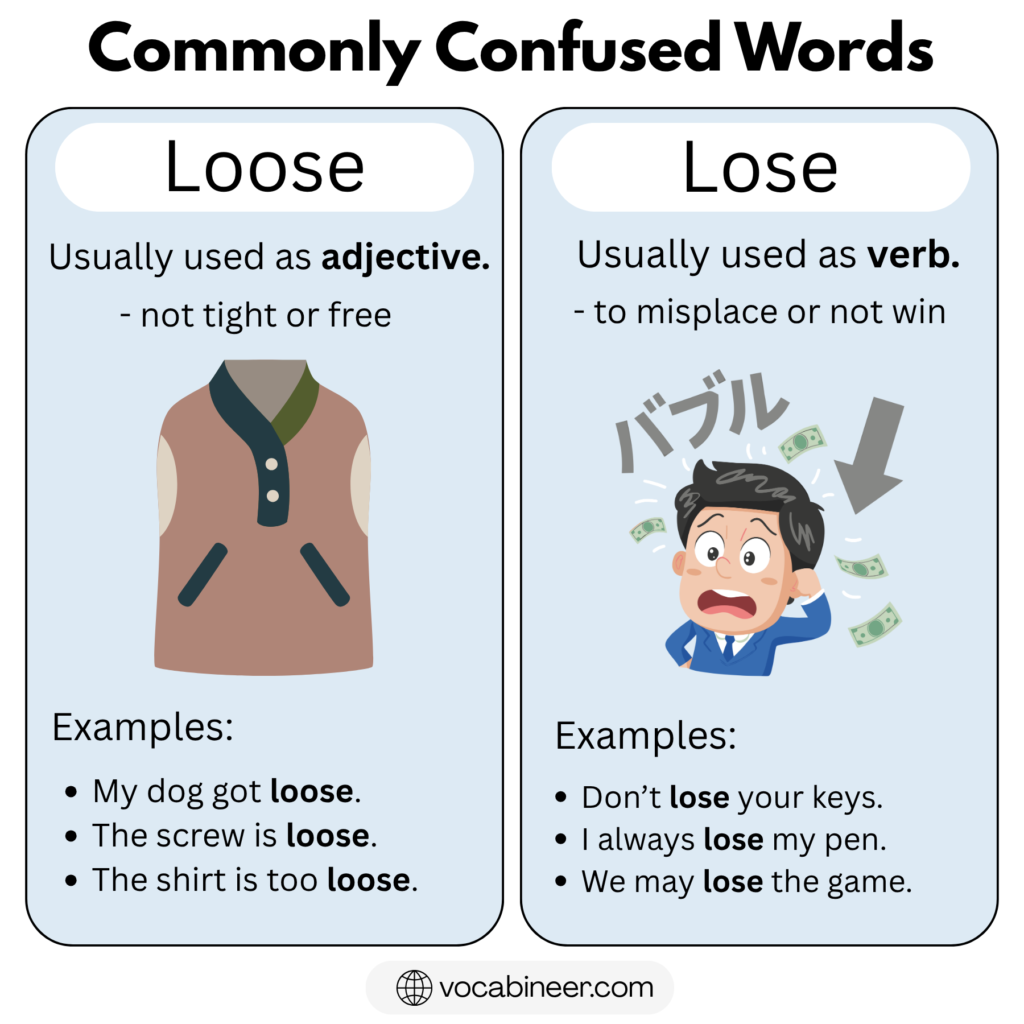
Loose vs Lose: Key Difference Explained
The main difference in Loose vs Lose depends on grammar role and meaning. Loose describes something that is not tight or not secure. Lose describes the action of failing to keep something or failing to win.
If the sentence needs a describing word, use Loose.
If the sentence needs an action word, use Lose.
Here is the difference in one sentence:
Loose means not tight.
Lose means to fail to keep or win something.
Loose vs Lose: Difference in One Look
| Feature | Loose | Lose |
|---|---|---|
| Part of Speech | Adjective | Verb |
| Meaning | Not tight or free | Fail to keep or win |
| Shows Action | No | Yes |
| Changes Form | No tense change | Loses, lost, losing |
| Replace With | Not tight | Fail |
Notice something important. Because Lose is a verb, it changes tense. Loose does not change form.
Loose vs Lose: Side by Side Sentence Contrast
- The screw is loose.
- I do not want to lose the screw.
- Her shoes feel loose.
- She may lose her shoes.
- The knot became loose.
- He does not want to lose the rope.
In each pair, Loose describes condition. Lose shows action of failing to keep something.
Loose vs Lose: Sentence Structure Comparison
Understanding structure makes the choice easier.
| Structure Type | Loose Pattern | Lose Pattern |
|---|---|---|
| Basic Pattern | The strap is loose | Do not lose the strap |
| With Modal | The wire seems loose | You might lose the wire |
| Past Form | The bolt was loose | He lost the bolt |
| Continuous | Not used as verb | She is losing time |
| Plural Subject | The pages are loose | They may lose the pages |
If the word follows a linking verb like is or seems, it is usually Loose. If the word changes tense or follows a subject performing action, it is usually Lose.
When to Use Loose and When to Use Lose
Choosing between Loose vs Lose becomes simple when you check whether the sentence needs a description or an action. Ask yourself whether the word describes something or shows someone doing something.
Use Loose when the sentence refers to:
- Something not tight
- Something not firmly attached
- Something free or relaxed
- A condition of looseness
Examples:
- The bolt is loose.
- Her shoes feel loose.
- The rope became loose.
- The lid seems loose.
- His shirt is too loose.
- The handle feels loose.
- The pages are loose.
- The knot is still loose.
- The strap looks loose.
- The cable is slightly loose.
Use Lose when the sentence refers to:
- Failing to win
- Misplacing something
- No longer having something
- Missing an opportunity
Examples:
- I do not want to lose my keys.
- She might lose the game.
- He lost his wallet.
- Do not lose focus.
- They may lose time.
- She lost her balance.
- We could lose the chance.
- He loses patience easily.
- They have lost hope.
- Do not lose your temper.
If the sentence shows condition or description, choose Loose. If it shows action of failing to keep something, choose Lose.
Context Based Usage Guide
Context gives strong clues in Loose vs Lose decisions.
Loose frequently appears:
- After linking verbs like is, are, seems
- With physical objects like screw, wire, knot
- In descriptive sentences
Examples:
- The screw is loose.
- The door handle seems loose.
- The cable came loose.
- The soil feels loose.
Lose frequently appears:
- With direct objects
- In action based sentences
- With words like game, money, focus, job
Examples:
- Do not lose your phone.
- She might lose the match.
- He does not want to lose money.
- They nearly lost control.
You may notice a helpful clue. If the word changes form to lost or losing, it must be Lose, not Loose.
Grammar Difference Between Loose and Lose
The grammar difference between Loose vs Lose is clear.
Loose is usually an adjective.
Lose is a verb.
Loose does not change tense:
- The knot is loose.
- The straps were loose.
Lose changes tense:
- He loses focus.
- He lost the match.
- He is losing time.
If the sentence needs a verb that shows action, use Lose. If it needs a describing word, use Loose.
Pronunciation Difference Between Loose and Lose
Although Loose vs Lose look similar, their pronunciation clearly separates them. The difference appears in the vowel sound.
Loose has a long “oo” sound, like in the word moon.
Lose has a long “oo” sound as well, but the final “s” sounds like a “z.”
Below is a quick comparison:
| Feature | Loose | Lose |
|---|---|---|
| Part of Speech | Adjective | Verb |
| Vowel Sound | Long “oo” | Long “oo” |
| Final Sound | Soft “s” | “z” sound |
| Changes Form | No | Yes, loses, lost |
Say them slowly:
Loose
Lose
You may notice that Loose ends with a soft “s,” while Lose ends with a “z” sound. This sound difference helps distinguish the two in speech.
Common Mistakes With Loose and Lose
Most mistakes in Loose vs Lose happen when writers add an extra “o” or remove one incorrectly. Because both words contain “oo,” spelling errors are common.
Below are frequent mistakes with corrections.
- Incorrect: I do not want to loose my keys.
Correct: I do not want to lose my keys. - Incorrect: She might loose the game.
Correct: She might lose the game. - Incorrect: The screw is lose.
Correct: The screw is loose. - Incorrect: He could loose control.
Correct: He could lose control. - Incorrect: My shoes are lose.
Correct: My shoes are loose. - Incorrect: They will loose money.
Correct: They will lose money. - Incorrect: The wire is lose.
Correct: The wire is loose. - Incorrect: Try not to loose focus.
Correct: Try not to lose focus. - Incorrect: The knot became lose.
Correct: The knot became loose. - Incorrect: She does not want to loose her job.
Correct: She does not want to lose her job.
Notice the consistent pattern. If the sentence needs an action verb, use Lose with one “o” before the final “se.” If it describes something not tight, use Loose with two “o” letters.
FAQs
Loose describes something not tight. Lose means to fail to keep or win something.
Loose is usually an adjective. It describes condition, such as a loose screw or loose clothing.
No. Lose is a verb. It shows action, such as losing a game or losing money.
Loose has two “o” letters, which can remind you of something wide or open. Lose has one “o” before “se” and shows action.
Both words contain similar spelling and sound. Therefore, writers often add or remove an extra “o” by mistake.
Final Summary
Loose vs Lose may look almost identical, but their grammar roles are different. Loose is an adjective that describes something not tight. Lose is a verb that means to fail to keep or win something. If the sentence describes condition, choose Loose. If it shows action, choose Lose. Understanding this adjective versus verb contrast prevents common spelling errors and improves sentence accuracy.
Read More
- Confusing Words in English
- American vs British Words
- Breath vs Breathe in English
- Your vs You’re in English
