

Is it ma’am or mam? Although they sound the same when spoken, their spelling and usage are not identical. In standard English, ma’am is the correct contraction of “madam” and is used as a polite, formal way to address a woman. In contrast, mam appears mainly in informal or regional speech, especially in parts of the United Kingdom. So, the difference is not about pronunciation. Instead, it comes down to spelling, formality, and context. Therefore, choosing the correct form depends on where and how you are writing.
In This Page
Ma’am vs Mam: Quick Definition
Ma’am is a polite and formal way to address a woman.
Mam is an informal or regional spelling used in casual speech.
Ma’am vs Mam Difference in One Sentence
Ma’am is the standard and grammatically correct form in formal English.
Mam is mainly used in regional or informal contexts.
Why Ma’am and Mam Are Often Confused?
Both words sound exactly the same in everyday speech. Because of that, many people assume the spelling does not matter. However, spelling becomes important in formal writing.
Another reason for confusion is texting and casual messaging. In informal chats, people often write mam because it is shorter and quicker to type. Over time, this informal spelling starts to look normal.
Regional accents also play a role. In some parts of the UK, especially in northern England and Wales, mam is commonly used to mean “mother.” As a result, learners may think both spellings are equally standard.
So, the confusion happens mainly because the pronunciation is identical, but the writing rules are not.
Word Origin and Etymology
The word ma’am comes from “madam,” which was originally a respectful French term meaning “my lady.” Over time, English speakers shortened “madam” to ma’am in polite speech.
The spelling mam, however, developed as a regional variation. In British dialects, especially in northern areas, mam became a common informal word for “mother.” Unlike ma’am, it is not a contraction of “madam.”
Therefore, while the words sound alike, their origins and standard usage are different.
Meaning of Ma’am
In standard English, ma’am is a polite form of address used when speaking to or about a woman. It shows respect and is commonly used in formal or professional settings.
Definition of Ma’am
Ma’am is a contraction of the word “madam.” It is used as a respectful title when addressing a woman.
Ma’am as Part of Speech
Ma’am functions as:
- A noun used in direct address
- A respectful title in conversation
- A formal response in service or military contexts
Common Uses and Collocations of Ma’am
Common combinations include:
- Yes, ma’am
- No, ma’am
- Excuse me, ma’am
- Thank you, ma’am
- Police officer to civilian: ma’am
Example Sentences With Ma’am
- Yes, ma’am, I will help you.
- Excuse me, ma’am, you dropped your wallet.
- Thank you, ma’am, for your patience.
- No, ma’am, that is not correct.
- How can I assist you, ma’am?
- Please wait here, ma’am.
- The officer said, “Step aside, ma’am.”
- I appreciate your time, ma’am.
- Would you like a receipt, ma’am?
- Good afternoon, ma’am.
- “Yes, ma’am,” the student replied.
- The clerk greeted her with, “Hello, ma’am.”
Meaning of Mam
In informal or regional English, mam is used mainly to mean “mother.” It is common in parts of northern England, Wales, and Ireland.
Definition of Mam
In certain British dialects, mam is an informal noun used to refer to one’s mother.
Mam as Part of Speech
Grammatically, this word functions as a common noun. It behaves like other family terms such as “mom” or “dad.”
Common Uses and Collocations of Mam
You will often see it used in phrases like:
- my mam
- his mam
- tell mam
- mam said
- mam and dad
Example Sentences With Mam
- My mam is cooking dinner tonight.
- I asked my mam for advice.
- His mam works at the hospital.
- Tell your mam I called.
- My mam always wakes up early.
- She said her mam lives nearby.
- We visited my mam last weekend.
- Their mam helped them study.
- My mam makes the best soup.
- I spoke to my mam yesterday.
- Her mam picked her up from school.
- My mam told me to be careful.
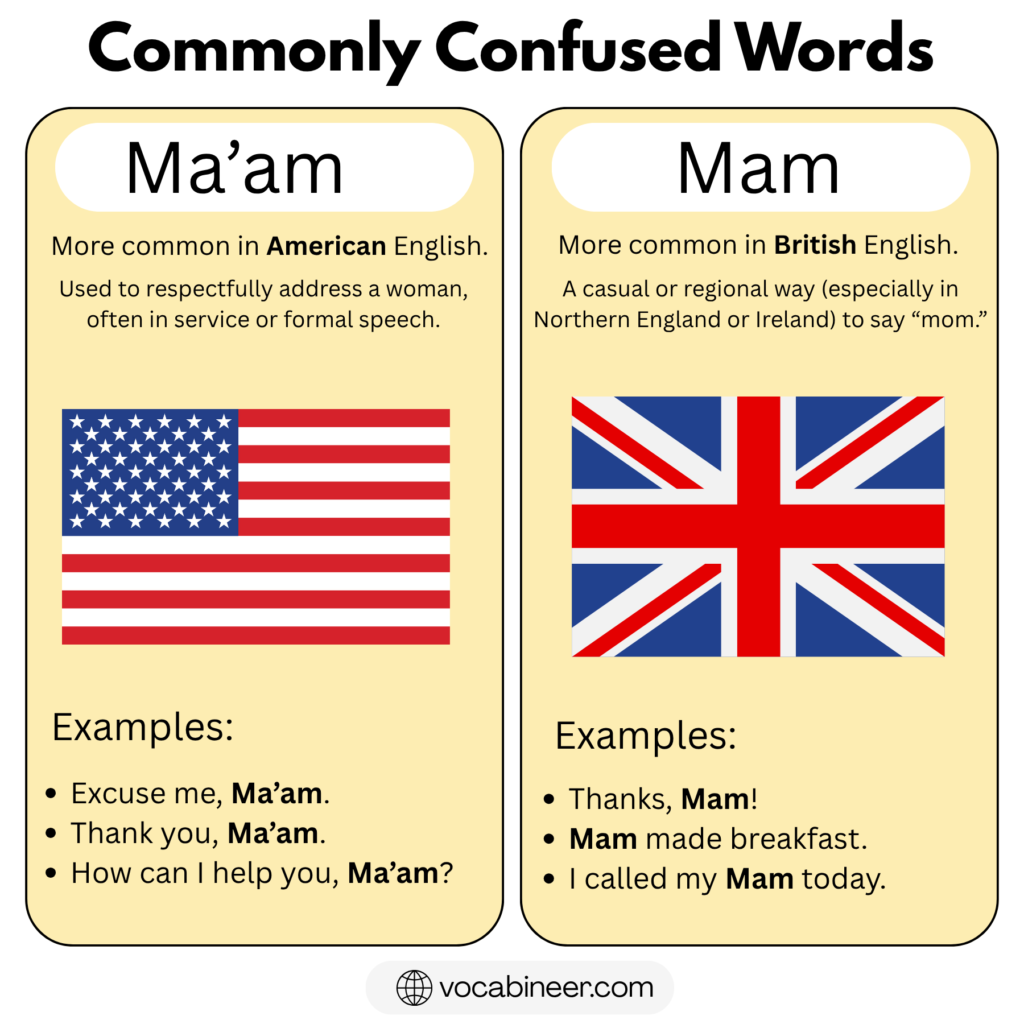
Ma’am vs Mam: Key Difference Explained
At its core, the difference between ma’am and mam is about formality and standard spelling. Although they sound the same in speech, their usage is not interchangeable in writing.
Ma’am is the correct and standard contraction of “madam.” It is used to address a woman politely in formal, professional, or respectful situations. For example, it is common in customer service, schools, and official conversations.
In contrast, mam is mainly a regional word. It is widely used in parts of northern England, Wales, and Ireland to mean “mother.” However, it is not considered the standard spelling for polite address in formal English.
So, the key difference is simple:
- Ma’am → formal, respectful address
- Mam → informal, regional term for mother
Therefore, context determines the correct choice.
Ma’am vs Mam: Difference in One Look
| Feature | Ma’am | Mam |
|---|---|---|
| Origin | Contraction of “madam” | Regional dialect form |
| Meaning | Polite address for a woman | Informal word for mother |
| Formality Level | Formal / Respectful | Informal / Regional |
| Standard English | Yes | No (in formal writing) |
| Common Regions | US, general English | Northern UK, Wales, Ireland |
Ma’am vs Mam: Side by Side Sentence Contrast
Although ma’am and mam may sound the same, their meanings change depending on context. The contrast becomes clear when you see them in sentences.
- Yes, ma’am, I will handle it right away.
- My mam will pick me up after school.
- Excuse me, ma’am, you left your bag.
- I told my mam about the meeting.
- Thank you, ma’am, for your help.
- His mam makes great tea.
- No, ma’am, that is not my seat.
- Her mam works at the hospital.
- Good afternoon, ma’am.
- I called my mam yesterday.
As shown above, ma’am is used when addressing someone respectfully. In contrast, mam refers to one’s mother in informal or regional speech.
Ma’am vs Mam: Sentence Structure Comparison
Both words function as nouns. However, their placement in a sentence differs slightly because of their meaning.
Direct address structure:
- Yes, ma’am.
- Thank you, ma’am.
Possessive or subject structure:
- My mam is at home.
- His mam called earlier.
Dialogue structure:
- “Please wait here, ma’am,” the officer said.
- “My mam told me to study,” he explained.
So, while the grammar category is the same, the usage depends entirely on meaning and situation.
When to Use Ma’am and When to Use Mam
Choose ma’am when you are speaking or writing in a formal or respectful situation. It is appropriate in professional settings, customer service, schools, and official communication.
Use mam only in informal or regional contexts. It is commonly used in parts of northern England, Wales, and Ireland to mean “mother.” However, it is not suitable for formal writing or polite address.
Here is the simple rule:
- Formal, respectful address → ma’am
- Informal, regional word for mother → mam
Always consider your audience. In academic, professional, or international writing, ma’am is the correct choice.
Context Based Usage Guide
If you are addressing a woman politely:
- Yes, ma’am, I understand.
- Excuse me, ma’am, may I ask a question?
- Thank you, ma’am, for your support.
If you are referring to your mother in a regional dialect:
- My mam is waiting outside.
- I spoke to my mam last night.
- His mam called earlier.
So, the choice depends on meaning and setting. In formal English, always use ma’am for respectful address. Use mam only when referring to “mother” in regional speech.
Grammar Difference Between Ma’am and Mam
From a grammar standpoint, ma’am and mam both function as nouns. However, their grammatical role depends on meaning and usage.
Ma’am is used mainly in direct address. It appears at the beginning or end of a sentence when speaking to someone respectfully.
Mam, on the other hand, is used as a common noun meaning “mother” in certain dialects. It behaves like other family nouns such as “mom” or “dad.”
So, while both are nouns, their usage context differs.
| Grammar Feature | Ma’am | Mam |
|---|---|---|
| Part of Speech | Noun (form of address) | Noun (family term) |
| Used in Direct Address | Yes | No |
| Used as Subject/Object | Rare | Yes |
| Formal Writing | Yes | No |
| Regional Usage | No | Yes |
As shown above, the grammar category is the same, but the function in a sentence is different.
Pronunciation Difference Between Ma’am and Mam
In most accents, there is no clear pronunciation difference between ma’am and mam. They are usually pronounced the same way.
Common pronunciation:
/mæm/
Because they sound identical, confusion happens mainly in writing, not in speech.
Common Mistakes With Ma’am and Mam
Many people mix up ma’am and mam because they sound the same. However, the mistakes usually happen in writing, not in speech.
Here are the most common errors:
- Writing mam when addressing someone politely
- Using ma’am when referring to one’s mother in regional speech
- Forgetting the apostrophe in ma’am
- Assuming both spellings are equally formal
One frequent mistake is dropping the apostrophe and writing “mam” instead of ma’am in formal emails or professional communication. That changes the meaning and can look incorrect.
So, always remember:
Formal respect → ma’am
Regional word for mother → mam
FAQs
No. Ma’am is a formal contraction of “madam.” Mam is a regional word for mother in parts of the UK and Ireland.
In formal English, ma’am is correct. Mam is not considered standard for polite address.
The apostrophe shows that ma’am is a contraction of “madam,” with letters removed.
Not commonly. American English uses mom for mother and ma’am for polite address.
In most accents, they sound the same. The difference appears mainly in spelling and usage.
Final Summary
Although ma’am and mam sound the same, their usage is different. Ma’am is the standard and formal contraction of “madam,” used to address a woman respectfully. In contrast, mam is an informal or regional word meaning “mother,” mainly used in parts of the United Kingdom and Ireland. Therefore, the choice depends on context. In professional or formal writing, always use ma’am. Use mam only when referring to “mother” in regional speech.
Read More
- American vs British Words
- Confusing Words in English
- Traveled vs Travelled in English
- Altogether vs All Together in English
