

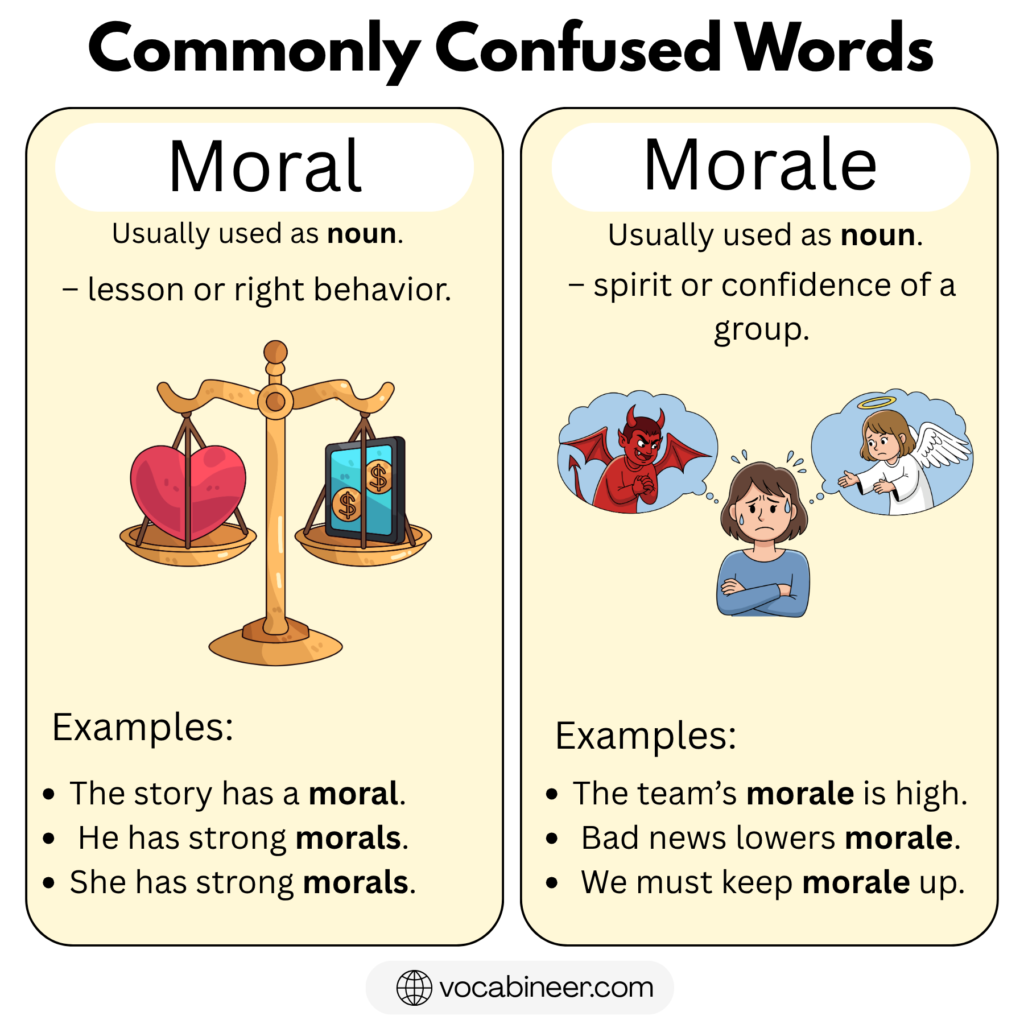
Moral vs Morale often creates confusion because the words look similar and sound close in pronunciation. However, their meanings are completely different. Moral relates to right and wrong behavior, while Morale refers to confidence or team spirit. Although the spelling difference is small, the meaning difference is large.
Understanding Moral vs Morale helps you write clearly in essays, workplace communication, and daily conversations. Therefore, this guide explains their definitions, grammar roles, usage patterns, and common mistakes so you can apply both words correctly and confidently.
In This Page
Moral vs Morale: Quick Definition
Moral relates to principles of right and wrong.
Morale refers to confidence, enthusiasm, or emotional strength.
In simple words, Moral connects to ethics, whereas Morale connects to motivation and spirit.
Moral vs Morale Difference in One Sentence
Moral is about what is right or wrong.
Morale is about how confident or motivated someone feels.
In other words, Moral guides behavior, while Morale influences attitude and energy.
Why Moral and Morale Are Often Confused?
Moral and Morale are often confused because their spelling differs by only one letter. In addition, their pronunciation sounds very similar in fast speech. As a result, many writers accidentally choose the wrong word, especially in exams or formal writing.
However, their meanings belong to different categories. Moral connects to ethics and behavior, whereas Morale relates to feelings and confidence. Therefore, confusion usually happens in written form rather than in spoken context where meaning becomes clearer through the sentence.
Word Origin and Etymology
Moral comes from the Latin word moralis, which relates to manners, character, and proper behavior. Over time, it developed into a word connected to right and wrong actions. Therefore, its history clearly links to ethics and conduct.
On the other hand, Morale comes from French roots connected to spirit and emotional condition. It later entered English to describe confidence, especially in groups like soldiers or teams. Although the two words share a similar root, their meanings developed differently. Thus, understanding their origin helps reduce confusion.
Meaning of Moral
Moral relates to principles of right and wrong behavior. It describes ideas, lessons, or standards that guide how people should act. Therefore, the word often appears in discussions about ethics, character, and responsibility.
In addition, Moral can function as both a noun and an adjective. As a result, its usage changes slightly depending on sentence structure and context.
Definition of Moral
Moral means a principle about what is right or wrong. It can also describe something connected to ethical behavior.
In simple terms, a Moral guides decisions and actions based on values.
Moral as Part of Speech
Moral functions mainly as a noun and an adjective.
As a noun, it refers to a lesson or ethical message:
- The moral of the story is honesty.
- Every fable teaches a moral.
- The story has a strong moral.
- Children understood the moral clearly.
- The teacher explained the moral.
- The book ends with a clear moral.
- The film carries a powerful moral.
- The tale shares a simple moral.
- Students discussed the moral.
- The writer emphasized the moral lesson.
As an adjective, it describes ethical standards:
- She has strong moral values.
- He faced a moral decision.
- They showed moral courage.
- The issue raised moral questions.
- It was a moral responsibility.
- The leader made a moral choice.
- Society sets moral rules.
- He followed his moral beliefs.
- The debate involved moral principles.
- It was a serious moral conflict.
Common Uses and Collocations of Moral
Common patterns include:
- Moral values
- Moral lesson
- Moral responsibility
- Moral duty
- Moral courage
- Moral standards
- Moral belief
- Moral support
- Moral conflict
- Moral obligation
These combinations show that Moral connects strongly to ethics, character, and principles.
Meaning of Morale
Morale refers to confidence, enthusiasm, or emotional strength, especially within a group. Unlike Moral, which connects to right and wrong behavior, Morale focuses on feelings and motivation. Therefore, it often appears in discussions about teamwork, leadership, school environments, and workplaces.
In addition, Morale functions only as a noun. It does not work as an adjective. As a result, its grammatical role remains consistent in sentences.
Definition of Morale
Morale means the level of confidence, spirit, or optimism felt by a person or group.
In simple terms, Morale shows how positive and motivated people feel in a situation.
Morale as Part of Speech
Morale functions as a noun.
Examples:
- Team morale improved after the win.
- The manager boosted staff morale.
- Low morale affected productivity.
- The speech raised public morale.
- Soldier morale remained strong.
- School morale increased this year.
- Poor morale slowed progress.
- High morale encouraged teamwork.
- Leadership strengthened company morale.
- The event lifted community morale.
- Employee morale declined recently.
- The coach focused on team morale.
- Crisis reduced national morale.
- Support improved worker morale.
- Group morale stayed positive.
- New policies affected staff morale.
- Strong leadership builds morale.
- Rewards increased employee morale.
- Negative feedback lowered class morale.
- Unity strengthened overall morale.
Common Uses and Collocations of Morale
Common combinations include:
- Team morale
- Staff morale
- Employee morale
- High morale
- Low morale
- Boost morale
- Improve morale
- Raise morale
- Damage morale
- Group morale
These patterns clearly show that Morale connects to emotional strength and collective confidence.
Moral vs Morale: Key Difference Explained
Moral and Morale belong to completely different meaning categories. The word Moral relates to ethics, principles, and standards of right and wrong behavior. In contrast, Morale refers to confidence, motivation, and emotional strength, especially within a group.
While one term focuses on values and character, the other centers on attitude and spirit. Therefore, Moral guides decisions about what is right, whereas Morale influences how positive or discouraged people feel. In short, Moral shapes conduct, but Morale affects energy and performance.
Moral vs Morale: Difference in One Look
| Feature | Moral | Morale |
|---|---|---|
| Meaning | Right and wrong principles | Confidence or team spirit |
| Word Type | Noun / Adjective | Noun only |
| Focus | Ethics and values | Emotional strength |
| Used In | Decisions, lessons, beliefs | Teams, workplaces, groups |
| Replace With | Ethical principle | Confidence / Spirit |
This table clearly shows that Moral connects to behavior standards, whereas Morale connects to emotional condition.
Moral vs Morale: Side by Side Sentence Contrast
The difference becomes clearer when both words appear in similar sentence structures. Therefore, comparing them directly helps reduce confusion.
- The story teaches an important moral.
- The coach improved team morale.
- She faced a difficult moral decision.
- The manager focused on employee morale.
- He showed great moral courage.
- The victory raised school morale.
- The debate raised serious moral questions.
- Support from leaders strengthened national morale.
- Parents teach strong moral values.
- Positive feedback boosts class morale.
In each pair, Moral connects to ethics, while Morale connects to confidence or spirit.
Moral vs Morale: Sentence Structure Comparison
Although both words are nouns in many cases, their sentence patterns differ slightly.
Moral patterns:
- A strong moral
- A clear moral lesson
- A moral responsibility
- Show moral courage
- Face a moral dilemma
Morale patterns:
- High morale
- Low morale
- Boost morale
- Improve staff morale
- Damage team morale
Therefore, Moral often appears before abstract nouns like values or courage, while Morale usually follows group-related words like team, staff, or employee.
When to Use Moral and Morale
Use Moral when the sentence talks about right and wrong, values, character, or ethical choices. For example, discussions about honesty, responsibility, or principles require Moral. Therefore, if the focus is behavior or judgment, Moral is correct.
However, use Morale when the sentence refers to confidence, enthusiasm, or emotional strength. This word often appears in school, workplace, sports, or military contexts. So, if the focus is group spirit or motivation, choose Morale.
In short, Moral guides actions, while Morale affects feelings.
Context Based Usage Guide
If the sentence includes ideas like values, ethics, duty, or courage, use Moral. For instance:
- She made a difficult moral choice.
- The story carries a clear moral message.
- Leaders must show moral responsibility.
- It became a serious moral issue.
- He followed his moral beliefs.
On the other hand, if the sentence involves teams, employees, students, or soldiers, use Morale. For example:
- The coach raised team morale.
- Low morale slowed the project.
- The speech improved public morale.
- Rewards increased staff morale.
- Crisis reduced national morale.
Thus, checking the context carefully helps you choose the correct word.
Grammar Difference Between Moral and Morale
Although Moral and Morale look similar, their grammar roles are different. Moral can function as both a noun and an adjective. In contrast, Morale functions only as a noun. Therefore, sentence structure often helps you choose the correct word.
Moral as a noun:
- The moral is simple.
- Every story has a moral.
- Children understood the moral.
- The film shared a clear moral.
- The teacher explained the moral.
- The book ends with a strong moral.
- Students discussed the moral.
- The writer highlighted the moral.
- The lesson carried a deep moral.
- The tale includes a helpful moral.
Moral as an adjective:
- She showed moral strength.
- He faced a moral problem.
- They accepted moral responsibility.
- It was a moral decision.
- Leaders need moral courage.
- Society sets moral standards.
- The issue raised moral concerns.
- He defended his moral position.
- It became a moral debate.
- Parents teach moral values.
Morale as a noun:
- High morale improves teamwork.
- Low morale affects performance.
- The speech boosted morale.
- Team morale increased quickly.
- Staff morale declined recently.
- Strong leadership builds morale.
- Rewards improve employee morale.
- The victory raised school morale.
- Crisis lowered national morale.
- Support strengthened group morale.
Thus, Moral changes form depending on function, whereas Morale remains only a noun.
Pronunciation Difference Between Moral and Morale
Moral and Morale are pronounced almost the same in everyday speech. Therefore, sound alone does not help much in distinguishing them. Both words follow a similar rhythm and stress pattern.
However, Morale may have slightly more emphasis on the second syllable in careful pronunciation. Even so, the difference is small. As a result, writers must rely on meaning and context rather than pronunciation.
Common Mistakes With Moral and Morale
Many learners mix these words because of their similar spelling. However, the mistake usually becomes clear when you check the meaning.
- Incorrect: The speech improved team moral.
Correct: The speech improved team morale. - Incorrect: She showed strong morale values.
Correct: She showed strong moral values. - Incorrect: The story teaches an important morale.
Correct: The story teaches an important moral. - Incorrect: Low moral reduced productivity.
Correct: Low morale reduced productivity. - Incorrect: Leaders must build employee moral.
Correct: Leaders must build employee morale. - Incorrect: It became a serious morale issue.
Correct: It became a serious moral issue. - Incorrect: The coach focused on player moral.
Correct: The coach focused on player morale. - Incorrect: Parents teach children good morale lessons.
Correct: Parents teach children good moral lessons. - Incorrect: The manager praised the team’s moral.
Correct: The manager praised the team’s morale. - Incorrect: The debate raised morale questions.
Correct: The debate raised moral questions.
FAQs
Moral relates to right and wrong behavior. In contrast, Morale refers to confidence, enthusiasm, or team spirit.
No, they cannot. Although they look similar and sound close, their meanings are completely different. Therefore, using one in place of the other changes the meaning of the sentence.
Moral can function as both a noun and an adjective. For example, it can mean a lesson, or it can describe ethical values.
No, Morale functions only as a noun. It describes emotional strength or group confidence.
Remember that Moral ends in “-al,” like ethical principle. Meanwhile, Morale ends in “-ale,” which relates to feelings and spirit. So, think values for Moral and motivation for Morale.
Final Summary
Moral relates to ethics, principles, and right or wrong behavior. In contrast, Morale refers to confidence, enthusiasm, and emotional strength, especially in groups. Although the spelling difference is small, the meaning difference is large. Therefore, always check the context. If the focus is values, use Moral. If the focus is motivation or team spirit, use Morale.
Read More
- Confusing Words in English
- American vs British Words
- Right vs Write in English
- Peace vs Piece in English
