Learning normal vs advanced English words with meaning shows how everyday language shifts from simple to more precise forms. Many common words have clearer alternatives that express ideas more directly and with better tone. As learners notice these differences, they begin to move beyond basic expression while still keeping language natural and easy to follow. This balance supports understanding across schoolwork, conversation, and reading.
In this post, readers will see how normal and advanced English words relate in meaning and how they fit naturally into sentences. By learning normal vs advanced English words with meaning, learners can choose words more confidently for daily communication, classroom tasks, and written responses.
In This Page
What Are Normal and Advanced English Words?
Normal words are commonly used in everyday conversation, while advanced words express similar ideas with greater precision or tone. Both types describe the same actions, emotions, and thoughts, but advanced forms often sound more formal, specific, or expressive. Below is a comparison table showing how basic words change into more developed expressions.
Below is a comparison table of common examples:
| Normal Word | Advanced Word |
|---|---|
| Big | Enormous |
| Small | Tiny |
| Happy | Delighted |
| Sad | Miserable |
| Fast | Rapid |
| Slow | Sluggish |
| Easy | Effortless |
| Hard | Difficult |
| Start | Begin |
| End | Conclude |
Difference Between Normal and Advanced English Vocabulary
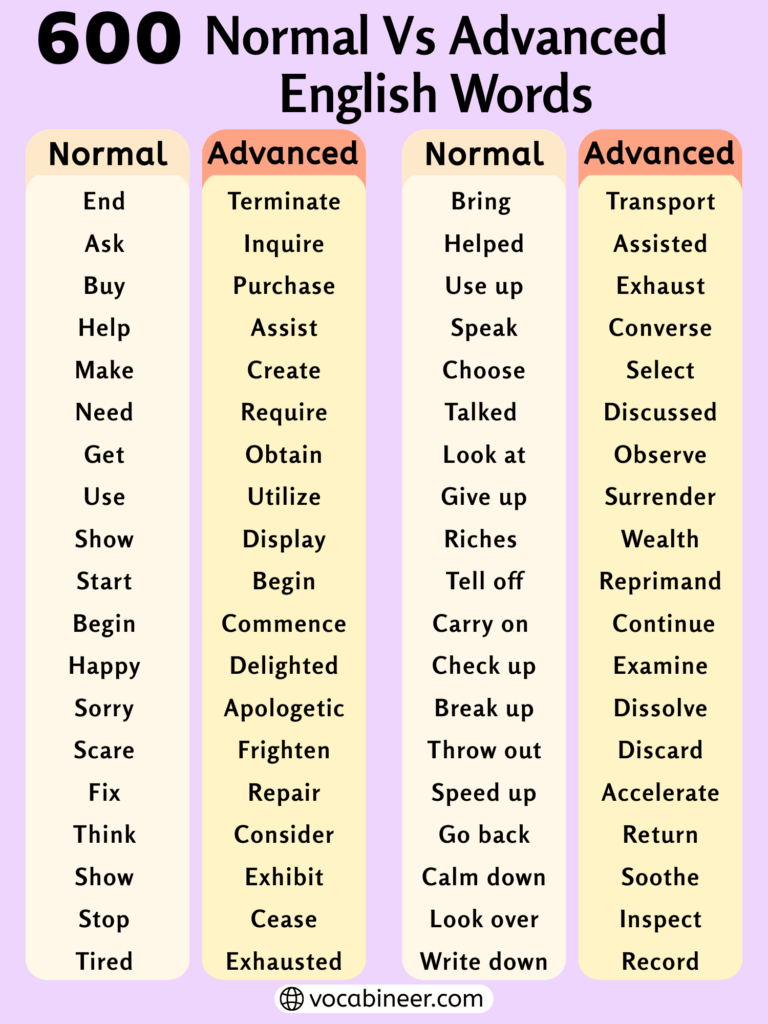
The main difference between normal and advanced English vocabulary lies in clarity, strength, precision, and tone. Normal words are simple, common, and widely used in daily conversation. They help express basic ideas clearly and naturally. Advanced words, however, express the same ideas with greater detail, accuracy, or formality, making language richer and more precise.
Normal vocabulary is best for casual speaking, friendly conversation, and simple writing. Words like big, happy, sad, fast, and help are easy to understand and suitable for everyday communication. Advanced vocabulary is often used in academic writing, formal speech, professional settings, and descriptive language. Words such as enormous, delighted, miserable, rapid, and assist help convey deeper meaning and stronger emotion.
Another key difference is tone. Normal words usually sound neutral and relaxed, while advanced words can sound more formal, emotional, or serious. For example, angry shows basic emotion, but furious shows extreme anger. Tired expresses mild fatigue, while exhausted expresses complete tiredness. Choosing the right word depends on how strong the feeling or action is.
Common Normal vs Advanced English Word Pairs with Meaning
Common normal vs advanced English word pairs with meaning helps learners understand how simple words shift into clearer and more precise forms. These pairs support better sentence clarity and improve word choice in everyday communication and learning.
Everyday Actions and Activities
These words describe common actions people perform throughout the day. Their advanced forms help express routine activities with greater precision and clarity.
| No | Normal | Advanced |
|---|---|---|
| 1 | Help | Assist |
| 2 | Buy | Purchase |
| 3 | Ask | Inquire |
| 4 | Show | Demonstrate |
| 5 | Walk | Stroll |
| 6 | Run | Sprint |
| 7 | Jump | Leap |
| 8 | Look | Observe |
| 9 | See | Notice |
| 10 | Hear | Perceive |
| 11 | Eat | Consume |
| 12 | Drink | Sip |
| 13 | Sleep | Slumber |
| 14 | Wake | Awaken |
| 15 | Find | Discover |
| 16 | Lose | Misplace |
| 17 | Meet | Encounter |
| 18 | Join | Participate |
| 19 | Leave | Depart |
| 20 | Come | Arrive |
| 21 | Give | Donate |
| 22 | Take | Seize |
| 23 | Get | Obtain |
| 24 | Bring | Deliver |
| 25 | Send | Dispatch |
| 26 | Open | Access |
| 27 | Close | Shut |
| 28 | Hold | Grasp |
| 29 | Drop | Release |
| 30 | Try | Attempt |
| 31 | Fix | Repair |
| 32 | Break | Shatter |
| 33 | Build | Construct |
| 34 | Make | Create |
| 35 | Clean | Sanitize |
| 36 | Wash | Rinse |
| 37 | Cut | Slice |
| 38 | Mix | Blend |
| 39 | Cook | Prepare |
| 40 | Bake | Roast |
| 41 | Catch | Grasp |
| 42 | Throw | Hurl |
| 43 | Carry | Transport |
| 44 | Push | Thrust |
| 45 | Pull | Tug |
| 46 | Wait | Linger |
| 47 | Start | Begin |
| 48 | End | Conclude |
| 49 | Sit | Settle |
| 50 | Stand | Remain upright |
| 51 | Move | Shift |
| 52 | Stay | Remain |
| 53 | Travel | Journey |
| 54 | Visit | Tour |
| 55 | Return | Revisit |
| 56 | Stop | Cease |
| 57 | Use | Utilize |
| 58 | Watch | Observe |
| 59 | Listen | Attend |
| 60 | Pay | Compensate |
| 61 | Save | Preserve |
| 62 | Spend | Expend |
| 63 | Work | Labor |
| 64 | Play | Engage |
| 65 | Learn | Acquire |
| 66 | Teach | Instruct |
| 67 | Read | Examine |
| 68 | Write | Compose |
| 69 | Plan | Arrange |
| 70 | Decide | Determine |
| 71 | Choose | Select |
| 72 | Pick | Opt |
| 73 | Answer | Respond |
| 74 | Explain | Clarify |
| 75 | Warn | Alert |
| 76 | Order | Command |
| 77 | Request | Appeal |
| 78 | Thank | Appreciate |
| 79 | Apologize | Regret |
| 80 | Forgive | Pardon |
| 81 | Share | Distribute |
| 82 | Follow | Pursue |
| 83 | Lead | Guide |
| 84 | Protect | Defend |
| 85 | Attack | Assault |
| 86 | Fight | Struggle |
| 87 | Win | Triumph |
| 88 | Lose | Forfeit |
| 89 | Improve | Enhance |
| 90 | Change | Modify |
| 91 | Grow | Develop |
| 92 | Reduce | Minimize |
| 93 | Increase | Expand |
| 94 | Fill | Occupy |
| 95 | Empty | Vacate |
| 96 | Hide | Conceal |
| 97 | Seek | Search |
| 98 | Keep | Retain |
| 99 | Remove | Eliminate |
| 100 | Add | Insert |
Emotions, Feelings, and Reactions
These words describe emotional states and natural human reactions. Their advanced forms help express feelings more accurately, deeply, and clearly across different situations.
| No | Normal | Advanced |
|---|---|---|
| 101 | Happy | Delighted |
| 102 | Sad | Miserable |
| 103 | Angry | Furious |
| 104 | Afraid | Terrified |
| 105 | Tired | Exhausted |
| 106 | Calm | Serene |
| 107 | Nervous | Anxious |
| 108 | Glad | Pleased |
| 109 | Scared | Frightened |
| 110 | Lonely | Isolated |
| 111 | Excited | Thrilled |
| 112 | Bored | Dull |
| 113 | Proud | Confident |
| 114 | Ashamed | Embarrassed |
| 115 | Worried | Concerned |
| 116 | Shocked | Astonished |
| 117 | Relaxed | Peaceful |
| 118 | Upset | Distressed |
| 119 | Content | Satisfied |
| 120 | Fear | Dread |
| 121 | Love | Adore |
| 122 | Hate | Detest |
| 123 | Like | Admire |
| 124 | Hope | Anticipate |
| 125 | Jealous | Envious |
| 126 | Kind | Compassionate |
| 127 | Mean | Cruel |
| 128 | Brave | Courageous |
| 129 | Shy | Bashful |
| 130 | Lazy | Indolent |
| 131 | Friendly | Amiable |
| 132 | Rude | Impolite |
| 133 | Honest | Truthful |
| 134 | Liar | Deceptive |
| 135 | Fair | Just |
| 136 | Unfair | Biased |
| 137 | Gentle | Tender |
| 138 | Rough | Harsh |
| 139 | Nervous | Tense |
| 140 | Relaxed | Tranquil |
| 141 | Confused | Perplexed |
| 142 | Curious | Inquisitive |
| 143 | Shocked | Stunned |
| 144 | Surprised | Amazed |
| 145 | Proud | Arrogant |
| 146 | Modest | Humble |
| 147 | Hopeful | Optimistic |
| 148 | Hopeless | Despairing |
| 149 | Sensitive | Delicate |
| 150 | Angry | Irritated |
| 151 | Calm | Composed |
| 152 | Nervous | Jittery |
| 153 | Sad | Downcast |
| 154 | Happy | Cheerful |
| 155 | Afraid | Apprehensive |
| 156 | Serious | Grave |
| 157 | Funny | Hilarious |
| 158 | Quiet | Reserved |
| 159 | Loud | Boisterous |
| 160 | Brave | Daring |
| 161 | Careful | Cautious |
| 162 | Careless | Reckless |
| 163 | Proud | Vain |
| 164 | Angry | Hostile |
| 165 | Happy | Joyful |
| 166 | Sad | Gloomy |
| 167 | Tired | Fatigued |
| 168 | Scared | Panicked |
| 169 | Calm | Relaxed |
| 170 | Excited | Enthusiastic |
| 171 | Friendly | Cordial |
| 172 | Rude | Abrupt |
| 173 | Gentle | Mild |
| 174 | Harsh | Severe |
| 175 | Loving | Affectionate |
| 176 | Hateful | Malicious |
| 177 | Nervous | Uneasy |
| 178 | Confident | Assured |
| 179 | Proud | Self-satisfied |
| 180 | Fearful | Timid |
| 181 | Kind | Benevolent |
| 182 | Mean | Heartless |
| 183 | Calm | Untroubled |
| 184 | Angry | Resentful |
| 185 | Sad | Sorrowful |
| 186 | Happy | Ecstatic |
| 187 | Afraid | Startled |
| 188 | Lazy | Idle |
| 189 | Busy | Preoccupied |
| 190 | Relaxed | At ease |
| 191 | Serious | Solemn |
| 192 | Funny | Amusing |
| 193 | Nervous | Restless |
| 194 | Calm | Placid |
| 195 | Angry | Livid |
| 196 | Sad | Heartbroken |
| 197 | Happy | Overjoyed |
| 198 | Afraid | Horrified |
| 199 | Tired | Drained |
| 200 | Calm | Tranquil |
Thinking, Learning, and Communication
These words describe mental processes, learning actions, and ways of sharing ideas. Advanced forms help express thoughts and communication with more accuracy, clarity, and purpose.
| No | Normal | Advanced |
|---|---|---|
| 201 | Think | Consider |
| 202 | Know | Recognize |
| 203 | Learn | Acquire |
| 204 | Guess | Estimate |
| 205 | Decide | Determine |
| 206 | Plan | Arrange |
| 207 | Remember | Recall |
| 208 | Forget | Omit |
| 209 | Understand | Comprehend |
| 210 | Believe | Trust |
| 211 | Doubt | Question |
| 212 | Choose | Select |
| 213 | Pick | Opt |
| 214 | Say | State |
| 215 | Talk | Discuss |
| 216 | Tell | Inform |
| 217 | Ask | Request |
| 218 | Answer | Respond |
| 219 | Explain | Clarify |
| 220 | Warn | Alert |
| 221 | Speak | Address |
| 222 | Shout | Yell |
| 223 | Whisper | Murmur |
| 224 | Write | Compose |
| 225 | Read | Examine |
| 226 | Teach | Instruct |
| 227 | Study | Review |
| 228 | Show | Reveal |
| 229 | Guide | Direct |
| 230 | Advise | Counsel |
| 231 | Think deeply | Reflect |
| 232 | Think carefully | Evaluate |
| 233 | Guess roughly | Predict |
| 234 | Learn fully | Absorb |
| 235 | Know well | Master |
| 236 | Explain clearly | Elaborate |
| 237 | Speak clearly | Articulate |
| 238 | Discuss deeply | Deliberate |
| 239 | Ask formally | Inquire |
| 240 | Answer briefly | Reply |
| 241 | Teach formally | Educate |
| 242 | Learn slowly | Develop |
| 243 | Understand clearly | Grasp |
| 244 | Think again | Reconsider |
| 245 | Plan carefully | Strategize |
| 246 | Choose wisely | Discriminate |
| 247 | Judge | Assess |
| 248 | Check | Verify |
| 249 | Record | Document |
| 250 | Explain simply | Simplify |
| 251 | Think ahead | Anticipate |
| 252 | Believe strongly | Convict |
| 253 | Tell officially | Announce |
| 254 | Ask politely | Entreat |
| 255 | Order firmly | Command |
| 256 | Suggest | Propose |
| 257 | Warn early | Forewarn |
| 258 | Ask again | Reiterate |
| 259 | Tell secretly | Confide |
| 260 | Speak loudly | Proclaim |
| 261 | Speak softly | Murmur |
| 262 | Write carefully | Draft |
| 263 | Read carefully | Scrutinize |
| 264 | Learn deeply | Internalize |
| 265 | Think calmly | Contemplate |
| 266 | Decide quickly | Resolve |
| 267 | Plan ahead | Forecast |
| 268 | Ask for help | Appeal |
| 269 | Explain clearly | Illuminate |
| 270 | Think quietly | Meditate |
| 271 | Share ideas | Exchange |
| 272 | Speak formally | Address |
| 273 | Answer fully | Elaborate |
| 274 | Explain fully | Expound |
| 275 | Teach clearly | Clarify |
| 276 | Learn properly | Comprehend |
| 277 | Think slowly | Ponder |
| 278 | Know surely | Ascertain |
| 279 | Speak openly | Declare |
| 280 | Think carefully | Deliberate |
| 281 | Explain again | Restate |
| 282 | Ask strongly | Insist |
| 283 | Answer softly | Murmur |
| 284 | Write fully | Elaborate |
| 285 | Read aloud | Recite |
| 286 | Speak strongly | Assert |
| 287 | Ask formally | Petition |
| 288 | Answer formally | Respond |
| 289 | Learn quickly | Assimilate |
| 290 | Think clearly | Reason |
| 291 | Decide firmly | Conclude |
| 292 | Teach patiently | Mentor |
| 293 | Learn actively | Engage |
| 294 | Ask quietly | Whisper |
| 295 | Speak calmly | Converse |
| 296 | Explain simply | Clarify |
| 297 | Think freely | Imagine |
| 298 | Learn easily | Grasp |
| 299 | Understand deeply | Internalize |
| 300 | Think thoroughly | Analyze |
Movement, Work, and Daily Tasks
These words describe physical movement, job-related actions, and common daily tasks. Advanced forms help express actions more precisely and professionally.
| No | Normal | Advanced |
|---|---|---|
| 301 | Move | Relocate |
| 302 | Walk | Roam |
| 303 | Run | Dash |
| 304 | Jump | Vault |
| 305 | Sit | Recline |
| 306 | Stand | Remain upright |
| 307 | Lift | Hoist |
| 308 | Carry | Transport |
| 309 | Push | Propel |
| 310 | Pull | Tug |
| 311 | Throw | Hurl |
| 312 | Catch | Grasp |
| 313 | Drop | Release |
| 314 | Hold | Clutch |
| 315 | Work | Labor |
| 316 | Build | Construct |
| 317 | Make | Create |
| 318 | Fix | Repair |
| 319 | Break | Fracture |
| 320 | Clean | Sanitize |
| 321 | Wash | Rinse |
| 322 | Cut | Slice |
| 323 | Mix | Blend |
| 324 | Cook | Prepare |
| 325 | Bake | Roast |
| 326 | Fry | Sauté |
| 327 | Drive | Operate |
| 328 | Ride | Mount |
| 329 | Travel | Journey |
| 330 | Visit | Tour |
| 331 | Stay | Remain |
| 332 | Leave | Depart |
| 333 | Enter | Access |
| 334 | Exit | Withdraw |
| 335 | Stop | Halt |
| 336 | Start | Initiate |
| 337 | Finish | Complete |
| 338 | Try | Endeavor |
| 339 | Help | Support |
| 340 | Guide | Direct |
| 341 | Lead | Conduct |
| 342 | Follow | Pursue |
| 343 | Wait | Linger |
| 344 | Hurry | Rush |
| 345 | Slow | Decelerate |
| 346 | Speed | Accelerate |
| 347 | Fall | Collapse |
| 348 | Rise | Ascend |
| 349 | Rest | Pause |
| 350 | Act | Perform |
| 351 | Plan | Organize |
| 352 | Arrange | Coordinate |
| 353 | Manage | Administer |
| 354 | Control | Regulate |
| 355 | Check | Inspect |
| 356 | Test | Evaluate |
| 357 | Measure | Gauge |
| 358 | Compare | Contrast |
| 359 | Join | Unite |
| 360 | Separate | Divide |
| 361 | Send | Dispatch |
| 362 | Receive | Obtain |
| 363 | Buy | Acquire |
| 364 | Sell | Trade |
| 365 | Pay | Compensate |
| 366 | Save | Preserve |
| 367 | Spend | Expend |
| 368 | Earn | Generate |
| 369 | Win | Triumph |
| 370 | Lose | Forfeit |
| 371 | Improve | Enhance |
| 372 | Change | Modify |
| 373 | Grow | Develop |
| 374 | Reduce | Minimize |
| 375 | Increase | Expand |
| 376 | Fill | Occupy |
| 377 | Empty | Vacate |
| 378 | Hide | Conceal |
| 379 | Find | Locate |
| 380 | Keep | Retain |
| 381 | Remove | Eliminate |
| 382 | Add | Insert |
| 383 | Build again | Reconstruct |
| 384 | Break down | Dismantle |
| 385 | Set up | Establish |
| 386 | Shut down | Terminate |
| 387 | Pack | Compress |
| 388 | Unpack | Unload |
| 389 | Store | Preserve |
| 390 | Move away | Relinquish |
| 391 | Clean up | Tidy |
| 392 | Throw away | Discard |
| 393 | Fix again | Restore |
| 394 | Work hard | Toil |
| 395 | Relax | Unwind |
| 396 | Focus | Concentrate |
| 397 | Try again | Retry |
| 398 | Carry out | Execute |
| 399 | Settle | Resolve |
| 400 | Handle | Manage |
Size, Quality, Time, and Speed
These words describe how big or small something is, how good or bad it seems, and how fast or slow actions happen. Advanced forms help express size, condition, timing, and pace with greater accuracy.
| No | Normal | Advanced |
|---|---|---|
| 401 | Big | Enormous |
| 402 | Small | Tiny |
| 403 | Large | Massive |
| 404 | Little | Minute |
| 405 | Long | Lengthy |
| 406 | Short | Brief |
| 407 | High | Elevated |
| 408 | Low | Shallow |
| 409 | Wide | Broad |
| 410 | Narrow | Slim |
| 411 | Heavy | Weighty |
| 412 | Light | Featherlight |
| 413 | Thick | Dense |
| 414 | Thin | Slim |
| 415 | Deep | Profound |
| 416 | Full | Packed |
| 417 | Empty | Vacant |
| 418 | Good | Excellent |
| 419 | Bad | Awful |
| 420 | Clean | Spotless |
| 421 | Dirty | Filthy |
| 422 | Easy | Effortless |
| 423 | Hard | Difficult |
| 424 | Strong | Powerful |
| 425 | Weak | Frail |
| 426 | Safe | Secure |
| 427 | Dangerous | Risky |
| 428 | Bright | Radiant |
| 429 | Dark | Gloomy |
| 430 | Warm | Cozy |
| 431 | Cold | Freezing |
| 432 | Fresh | Crisp |
| 433 | Old | Ancient |
| 434 | New | Novel |
| 435 | Smooth | Sleek |
| 436 | Rough | Coarse |
| 437 | Sharp | Keen |
| 438 | Soft | Gentle |
| 439 | Fast | Rapid |
| 440 | Slow | Sluggish |
| 441 | Quick | Swift |
| 442 | Hurry | Rush |
| 443 | Early | Prompt |
| 444 | Late | Delayed |
| 445 | Soon | Shortly |
| 446 | Now | Currently |
| 447 | Then | Previously |
| 448 | Always | Constantly |
| 449 | Often | Frequently |
| 450 | Sometimes | Occasionally |
| 451 | Never | Rarely |
| 452 | Quickly | Briskly |
| 453 | Slowly | Gradually |
| 454 | Suddenly | Abruptly |
| 455 | Immediately | Instantly |
| 456 | Finally | Eventually |
| 457 | Huge | Colossal |
| 458 | Tiny | Miniature |
| 459 | Tall | Lofty |
| 460 | Short | Petite |
| 461 | Rich | Wealthy |
| 462 | Poor | Needy |
| 463 | Clear | Obvious |
| 464 | Hidden | Concealed |
| 465 | Calm | Serene |
| 466 | Noisy | Boisterous |
| 467 | Quiet | Silent |
| 468 | Busy | Occupied |
| 469 | Free | Available |
| 470 | Strong | Robust |
| 471 | Weak | Feeble |
| 472 | Bright | Brilliant |
| 473 | Dark | Dim |
| 474 | Smooth | Polished |
| 475 | Rough | Uneven |
| 476 | Clean | Pristine |
| 477 | Dirty | Grimy |
| 478 | Hot | Scorching |
| 479 | Cold | Icy |
| 480 | Fresh | New |
Social Interaction and Behavior
These words describe how people behave, interact, and respond in social situations. Advanced forms help express personality traits, manners, attitudes, and relationships more clearly and politely.
| No | Normal | Advanced |
|---|---|---|
| 481 | Friend | Companion |
| 482 | Enemy | Opponent |
| 483 | Kind | Benevolent |
| 484 | Mean | Cruel |
| 485 | Brave | Courageous |
| 486 | Coward | Timid |
| 487 | Honest | Truthful |
| 488 | Liar | Deceptive |
| 489 | Friendly | Amiable |
| 490 | Rude | Impolite |
| 491 | Polite | Courteous |
| 492 | Proud | Arrogant |
| 493 | Humble | Modest |
| 494 | Calm | Composed |
| 495 | Angry | Hostile |
| 496 | Gentle | Tender |
| 497 | Harsh | Severe |
| 498 | Lazy | Indolent |
| 499 | Busy | Preoccupied |
| 500 | Smart | Intelligent |
| 501 | Silly | Foolish |
| 502 | Serious | Grave |
| 503 | Funny | Amusing |
| 504 | Quiet | Reserved |
| 505 | Loud | Boisterous |
| 506 | Careful | Cautious |
| 507 | Careless | Reckless |
| 508 | Fair | Just |
| 509 | Unfair | Biased |
| 510 | Helpful | Supportive |
| 511 | Talkative | Chatty |
| 512 | Silent | Mute |
| 513 | Shy | Bashful |
| 514 | Confident | Assured |
| 515 | Nervous | Tense |
| 516 | Calm | Placid |
| 517 | Jealous | Envious |
| 518 | Loving | Affectionate |
| 519 | Hateful | Malicious |
| 520 | Respect | Honor |
| 521 | Trust | Rely |
| 522 | Doubt | Question |
| 523 | Agree | Consent |
| 524 | Disagree | Oppose |
| 525 | Accept | Approve |
| 526 | Refuse | Decline |
| 527 | Welcome | Greet |
| 528 | Thank | Appreciate |
| 529 | Apologize | Regret |
| 530 | Forgive | Pardon |
| 531 | Invite | Request |
| 532 | Help | Assist |
| 533 | Support | Endorse |
| 534 | Blame | Accuse |
| 535 | Praise | Commend |
| 536 | Criticize | Condemn |
| 537 | Encourage | Motivate |
| 538 | Discourage | Deter |
| 539 | Suggest | Propose |
| 540 | Advise | Counsel |
| 541 | Order | Command |
| 542 | Beg | Plead |
| 543 | Promise | Pledge |
| 544 | Cancel | Withdraw |
| 545 | Join | Unite |
| 546 | Leave | Depart |
| 547 | Meet | Encounter |
| 548 | Visit | Tour |
| 549 | Share | Distribute |
| 550 | Argue | Dispute |
| 551 | Fight | Clash |
| 552 | Peace | Harmony |
| 553 | Trouble | Conflict |
| 554 | Noise | Disturbance |
| 555 | Crowd | Gathering |
| 556 | Group | Assembly |
| 557 | Team | Squad |
| 558 | Leader | Commander |
| 559 | Follower | Supporter |
| 560 | Neighbor | Resident |
| 561 | Guest | Visitor |
| 562 | Stranger | Foreigner |
| 563 | Partner | Associate |
| 564 | Owner | Proprietor |
| 565 | Worker | Employee |
| 566 | Boss | Supervisor |
| 567 | Helper | Assistant |
| 568 | Guard | Protector |
| 569 | Judge | Arbiter |
| 570 | Winner | Victor |
| 571 | Loser | Defeated |
| 572 | Brave | Heroic |
| 573 | Weak | Timorous |
| 574 | Calm | Untroubled |
| 575 | Angry | Resentful |
| 576 | Happy | Cheerful |
| 577 | Sad | Gloomy |
| 578 | Afraid | Apprehensive |
| 579 | Excited | Enthusiastic |
| 580 | Tired | Fatigued |
| 581 | Lazy | Idle |
| 582 | Busy | Engaged |
| 583 | Helpful | Cooperative |
| 584 | Honest | Upright |
| 585 | Mean | Nasty |
| 586 | Friendly | Cordial |
| 587 | Rude | Abrupt |
| 588 | Proud | Self-satisfied |
| 589 | Humble | Meek |
| 590 | Calm | Collected |
| 591 | Angry | Livid |
| 592 | Kind | Generous |
| 593 | Fair | Impartial |
| 594 | Unfair | Prejudiced |
| 595 | Loyal | Faithful |
| 596 | Disloyal | Treacherous |
| 597 | Brave | Valiant |
| 598 | Coward | Craven |
| 599 | Gentle | Mild |
| 600 | Respectful | Reverent |
Most Confusing Normal and Advanced Word Pairs
Some normal and advanced word pairs seem very close in meaning, which often confuses learners. A small change in word choice can affect strength, emotion, formality, and clarity. Understanding these confusing pairs helps students avoid incorrect usage and express ideas more accurately in daily conversation, schoolwork, and writing.
Below is a table of the most commonly confused word pairs with brief meaning differences.
| Normal | Advanced | Difference in Meaning |
|---|---|---|
| Big | Enormous | Big means large, enormous means extremely large |
| Happy | Delighted | Happy shows general joy, delighted shows strong joy |
| Sad | Miserable | Sad means unhappy, miserable means deeply unhappy |
| Fast | Rapid | Fast is common, rapid sounds more formal |
| Angry | Furious | Angry is mild, furious shows extreme anger |
| Tired | Exhausted | Tired means needing rest, exhausted means very tired |
| Clean | Spotless | Clean means not dirty, spotless means perfectly clean |
| Good | Excellent | Good is general, excellent is much stronger |
| Hard | Difficult | Hard is simple, difficult sounds more formal |
| Small | Tiny | Small means little, tiny means extremely small |
| Cold | Freezing | Cold is mild, freezing is very cold |
| Hot | Scorching | Hot is general, scorching is extreme |
| Calm | Serene | Calm means relaxed, serene means deeply peaceful |
| Afraid | Terrified | Afraid is mild fear, terrified is extreme fear |
| Nice | Pleasant | Nice is casual, pleasant sounds more formal |
Example Sentences Using Normal and Advanced Words
These examples show how normal and advanced words fit naturally into everyday sentences. Compare how advanced words add depth, strength, and clarity to meaning while keeping the sentence structure simple and easy to understand.
- She felt happy, and later she became delighted after hearing the good news.
- The house was big, but the stadium was enormous.
- He was tired, but after running, he felt completely exhausted.
- The problem was hard, yet the final step was difficult.
- The classroom looked clean, but the laboratory was spotless.
- The weather felt cold, but the wind was freezing.
- She looked sad, and later she became miserable after the result.
- His performance was good, but her work was excellent.
- The runner moved fast, but the cheetah moved rapidly.
- The fire felt hot, but the metal surface was scorching.
Normal and Advanced Vocabulary in Spoken English
In spoken English, people usually prefer normal words because they sound natural, simple, and friendly. However, advanced words can be used to express stronger emotions, polite requests, or formal situations. Knowing when to switch between simple and advanced words helps learners speak more confidently and naturally.
Normal words are common in daily talk:
- “Can you help me?”
- “I am happy today.”
- “That exam was hard.”
Advanced words add clarity and expression:
- “Can you assist me?”
- “I feel delighted today.”
- “That exam was challenging.”
Normal and Advanced Vocabulary in Formal Writing
In formal writing, such as school assignments, exams, reports, and letters, advanced vocabulary is often preferred because it sounds clearer, more precise, and more professional. Normal words are simple and common, but advanced words help avoid repetition and express ideas with greater accuracy. Learning how to replace simple words with suitable advanced alternatives improves writing quality and clarity.
Below are examples of how normal words change into advanced forms in formal writing:
- Buy → Purchase
The company decided to purchase new equipment for the office. - Help → Assist
The teacher agreed to assist the students during the project. - Ask → Inquire
She wrote an email to inquire about the admission process. - Show → Demonstrate
The experiment will demonstrate the results clearly. - End → Conclude
The meeting will conclude at noon.
Common Mistakes When Using Advanced English Words
Many learners make mistakes when using advanced vocabulary because they choose words that do not match the situation or emotion. One common error is using very strong words for small problems, which can make sentences sound unnatural. Another mistake is replacing every normal word with an advanced one, which can make writing or speech sound forced.
Common mistakes include:
- Using furious instead of angry for minor issues
- Using enormous when something is only slightly big
- Using exhausted when only a little tired
- Using purchase in casual conversation instead of buy
How to Choose the Right Advanced Word
Choosing the right advanced word depends on meaning strength, situation, and tone. Some advanced words express stronger emotions or actions, while others sound more formal. Before using an advanced word, learners should think about how serious, intense, or polite the situation is. This helps avoid unnatural or incorrect usage.
For example, angry fits daily situations, while furious suits extreme anger. Big works for common objects, while enormous fits very large sizes. In casual speech, simple words often sound better, while in writing or formal speech, advanced words improve clarity. Practicing with example sentences helps learners understand when and how to choose the correct word naturally.
Practice Exercises to Improve Vocabulary
Practice is the best way to master normal and advanced word pairs. Learners can start by rewriting simple sentences using advanced words and comparing the tone and meaning. Another useful exercise is matching normal words with their advanced forms from memory. Creating short dialogues using both forms also helps build confidence.
Try replacing these words:
- Big → __________
- Happy → __________
- Tired → __________
- Fast → __________
- Help → __________
FAQs About Normal vs Advanced English Words
Normal words are simple and common, while advanced words express the same ideas with more precision, strength, or formality. For example, big → enormous and happy → delighted.
Advanced words improve clarity, sentence quality, and understanding. They help learners read better, write more clearly, and express ideas accurately in school tasks and formal writing.
Normal words fit everyday conversation and casual writing. They sound natural and friendly, while advanced words suit formal situations and stronger expression.
Practice with sentences, reading, writing, and picture-based learning helps build memory and improves correct word usage.
No. Advanced words are also used in speaking when clarity, emotion, or respect is needed. The situation decides which word fits best.
Conclusion
Learning normal vs advanced English words with meaning helps learners express ideas more clearly and accurately. Regular practice with word pairs, examples, and usage builds stronger understanding, improves reading and writing, and supports confident communication in everyday situations.
Read More
- Basic vs Advanced English Words
- 1000 Daily Use English Words
- Rhyming Words in English
- 100+ Examples of Homophones