Ocean animals names include the names of animals that live in the ocean and are strongly linked with saltwater habitats. These animals may swim in shallow water, live near coral reefs, move through open ocean areas, or survive in very deep parts of the sea.
In this article, you will learn ocean animals names in English with grouped lists and simple explanations. You will also see ocean mammals, fish, invertebrates, birds, and other useful sections that make this vocabulary easier to understand and remember.
In This Page
What Are Ocean Animals?
Ocean animals are animals that live in saltwater environments such as seas, oceans, coral reefs, and deep marine waters. Some stay near the coast, while others live far from land or in very deep areas where sunlight is low. Because of that, ocean animals include many different kinds of creatures.
Some ocean animals are mammals, some are fish, some are birds, and many are invertebrates such as jellyfish, octopuses, and starfish. In this topic, the focus stays on animals commonly linked with the ocean, so readers can learn the names in a clear and organized way.
Common Ocean Animals Names List
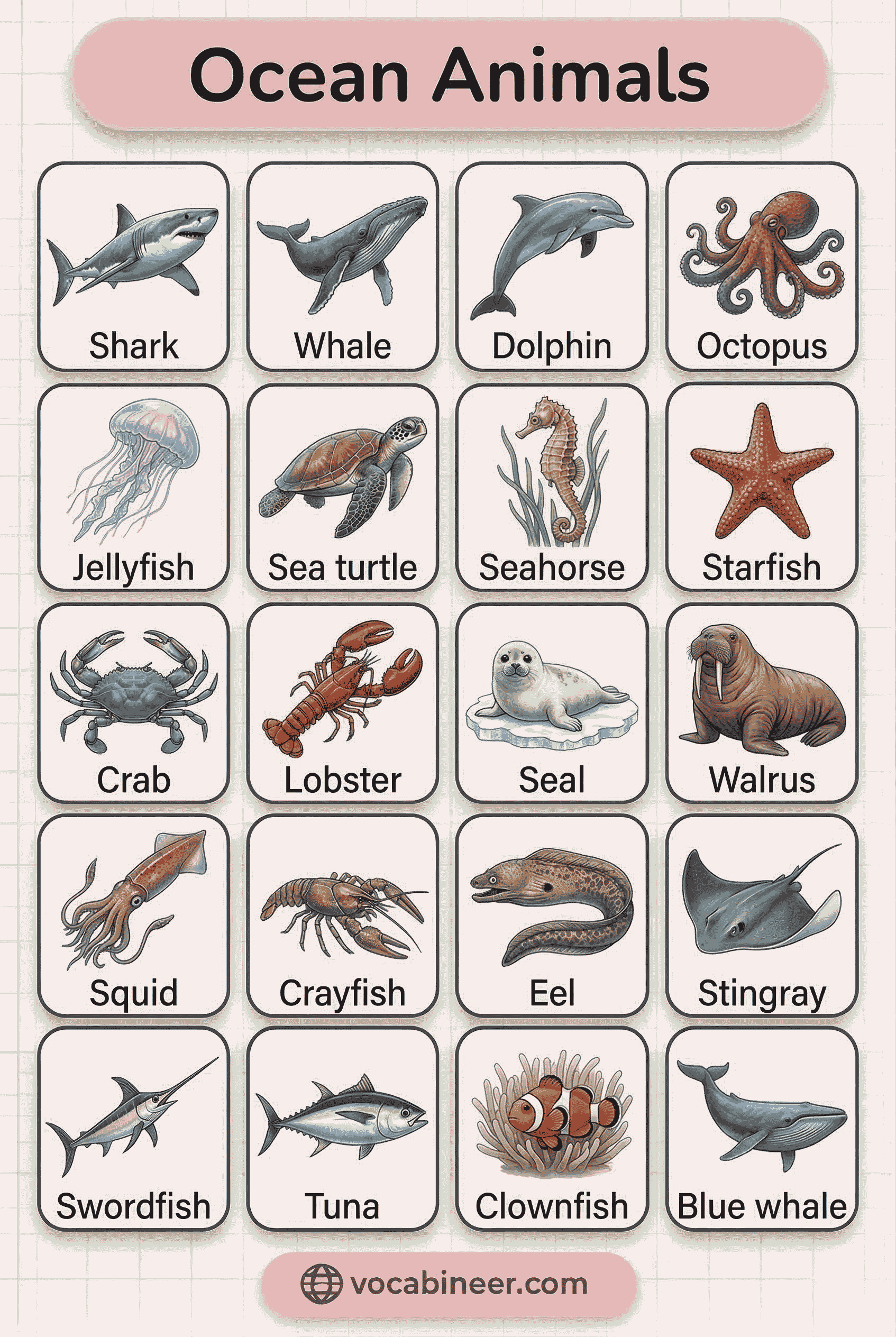
Many ocean animals are known for swimming, diving, floating, or living on the ocean floor. Some are large and powerful, while others are small, colorful, or unusual. Together, they make ocean-animal vocabulary rich and useful for learners.
- Whale
- Dolphin
- Shark
- Octopus
- Jellyfish
- Starfish
- Seahorse
- Crab
- Lobster
- Shrimp
- Seal
- Walrus
- Sea lion
- Orca
- Tuna
- Clownfish
- Swordfish
- Eel
- Stingray
- Sea turtle
- Penguin
- Seagull
- Pelican
- Coral
- Oyster
- Squid
- Whale shark
- Hammerhead shark
- Anglerfish
- Blue whale
Ocean Mammals Names
Ocean mammals are animals that live in the ocean but breathe air. Some stay in the water most of the time, while others come onto ice, rocks, or shores to rest. Because they are warm-blooded and care for their young, they are different from fish.
- Whale: A large ocean mammal that lives in saltwater.
- Dolphin: A smart ocean mammal known for swimming in groups.
- Orca: A powerful ocean mammal also called the killer whale.
- Blue whale: The largest animal in the ocean.
- Seal: A smooth-bodied marine mammal that swims well.
- Walrus: A large ocean mammal with tusks and thick blubber.
- Sea lion: A marine mammal with flippers and a loud call.
- Beluga whale: A white whale found in cold ocean waters.
- Sperm whale: A deep-diving whale with a large head.
- Manatee: A large sea mammal known for slow movement.
Ocean Fish Names
Ocean fish are one of the biggest groups of marine animals. Some live near reefs, while others swim in deep or open ocean waters. Their shapes, colors, and sizes can be very different, which makes this section useful for vocabulary learning.
- Shark: A powerful ocean fish with sharp teeth.
- Tuna: A fast-swimming fish found in the ocean.
- Clownfish: A small colorful fish often seen near sea anemones.
- Swordfish: A large fish with a long pointed bill.
- Eel: A long fish with a snake-like body.
- Stingray: A flat fish with a long tail.
- Whale shark: A very large fish with a wide mouth.
- Hammerhead shark: A shark with a wide hammer-shaped head.
- Anglerfish: A deep-ocean fish known for its glowing lure.
- Salmon: A fish that may live in the ocean and return to rivers.
- Mackerel: A fast ocean fish with a slim body.
- Sardine: A small silver fish that swims in groups.
Ocean Invertebrates Names
Ocean invertebrates are animals without a backbone. Many of them live on the ocean floor, near reefs, or in open water. Some have shells, while others have soft bodies or many arms and legs.
- Octopus: A soft-bodied ocean animal with eight arms.
- Jellyfish: A floating animal with a soft bell-shaped body.
- Starfish: A sea animal with arms that spread from the center.
- Crab: A hard-shelled animal with claws.
- Lobster: A large shellfish with a long body and claws.
- Shrimp: A small sea animal with a curved body.
- Coral: A tiny sea animal that forms large reef structures.
- Oyster: A shellfish that lives inside a rough shell.
- Squid: A sea animal with a soft body and long tentacles.
- Sea urchin: A round sea animal covered with spines.
- Sea cucumber: A soft ocean animal with a long body.
- Scallop: A shellfish with a fan-shaped shell.
Ocean Birds Names
Ocean birds live near coasts, islands, cliffs, or open water. Some dive for fish, while others glide over the waves or rest on the shore. As a result, they are an important part of ocean-animal vocabulary.
- Penguin: A sea bird that cannot fly but swims very well.
- Seagull: A common ocean bird often seen near beaches.
- Pelican: A large bird with a pouch under its beak.
- Albatross: A large ocean bird known for long-distance flight.
- Puffin: A seabird with a colorful beak.
- Cormorant: A dark sea bird that dives for fish.
- Tern: A slim seabird with pointed wings.
- Skua: A strong seabird found in cold ocean regions.
- Gannet: A seabird known for diving into the water.
- Petrel: A bird that spends much of its life over the ocean.
Deep Ocean Animals Names
Deep ocean animals live far below the ocean surface where sunlight is very low or absent. Some have unusual shapes, glowing body parts, or special features that help them survive under great pressure. Because of that, this section adds a more fascinating side to ocean-animal vocabulary.
- Anglerfish: A deep-sea fish known for its glowing lure.
- Gulper eel: A deep-ocean fish with a very large mouth.
- Lanternfish: A small deep-sea fish that can produce light.
- Vampire squid: A deep-sea animal with a dark body and webbed arms.
- Giant squid: A huge deep-ocean animal with long tentacles.
- Blobfish: A deep-sea fish known for its unusual body shape.
- Fangtooth: A deep-sea fish with very large teeth.
- Hatchetfish: A small deep-ocean fish with a thin body.
- Frilled shark: A rare deep-sea shark with an eel-like body.
- Sea spider: A long-legged ocean animal found in deep water.
Ocean Animals Names for Kids
Ocean animals names for kids should be simple, familiar, and easy to remember. So, this section focuses on common sea creatures that children often see in books, charts, cartoons, and beginner lessons.
- Whale
- Dolphin
- Shark
- Octopus
- Jellyfish
- Starfish
- Seahorse
- Crab
- Lobster
- Shrimp
- Seal
- Walrus
- Sea lion
- Clownfish
- Stingray
- Sea turtle
- Penguin
- Seagull
- Pelican
- Squid
Big and Small Ocean Animals Names
Ocean animals come in many sizes. Some are huge and powerful, while others are tiny and delicate. This grouping makes ocean animals names easier to compare and remember.
Big Ocean Animals Names
- Blue whale: The largest animal in the ocean.
- Whale shark: A huge fish with a wide mouth.
- Sperm whale: A large deep-diving ocean mammal.
- Orca: A powerful ocean mammal with a black-and-white body.
- Walrus: A large marine mammal with tusks.
- Giant squid: A very large deep-ocean animal with long tentacles.
- Hammerhead shark: A large shark with a wide head.
- Sea lion: A large marine mammal with strong flippers.
Small Ocean Animals Names
- Seahorse: A small ocean animal with a curved body.
- Shrimp: A tiny sea animal with a soft shell.
- Clownfish: A small colorful fish often seen near reefs.
- Sardine: A small silver fish that swims in groups.
- Jellyfish: Some jellyfish are small and delicate.
- Sea urchin: A small round sea animal with spines.
- Oyster: A small shellfish that lives inside a shell.
- Lanternfish: A small deep-ocean fish that can produce light.
Herbivorous, Carnivorous, and Omnivorous Ocean Animals
Ocean animals eat different kinds of food depending on their species and habitat. Some feed on plants or algae, some hunt other animals, and others eat both plant and animal matter. Because of that, this grouping makes ocean animals names easier to study in a clear way.
Herbivorous Ocean Animals
- Manatee: Eats sea grass and water plants.
- Sea turtle: Some sea turtles eat sea grass and algae.
- Sea urchin: Feeds on algae and ocean plants.
- Parrotfish: Eats algae from coral and rocks.
- Dugong: Eats mainly sea grass.
Carnivorous Ocean Animals
- Shark: Hunts fish and other sea animals.
- Orca: Eats fish, seals, and other marine animals.
- Blue whale: Feeds on krill and tiny sea creatures.
- Octopus: Eats crabs, fish, and shellfish.
- Squid: Hunts small fish and sea animals.
- Stingray: Eats small sea creatures from the ocean floor.
- Anglerfish: Hunts in deep ocean waters.
- Seal: Eats fish and other marine animals.
Omnivorous Ocean Animals
- Crab: Eats plants, tiny animals, and scraps.
- Lobster: Feeds on small animals and plant matter.
- Shrimp: Eats algae, tiny animals, and organic matter.
- Dolphin: Mostly eats fish and squid, but in simple learning groups it is often placed with mixed feeders because diet can vary by species.
- Seagull: Eats fish, scraps, and many other foods.
Ocean Animals and Their Babies
Ocean animals and their babies are useful to learn together because many young animals have simple English baby names. This makes vocabulary learning easier and more memorable.
- Whale — Calf
- Dolphin — Calf
- Blue whale — Calf
- Orca — Calf
- Seal — Pup
- Walrus — Calf
- Sea lion — Pup
- Shark — Pup
- Sea turtle — Hatchling
- Penguin — Chick
- Pelican — Chick
- Seagull — Chick
- Octopus — Larva
- Jellyfish — Larva
- Crab — Larva
- Lobster — Larva
- Shrimp — Larva
- Squid — Larva
Most Popular Ocean Animals Names
Some ocean animals are more popular than others because people often see them in books, videos, cartoons, aquariums, and school lessons. As a result, these are usually the first ocean animal names learners remember.
- Whale: One of the most famous ocean animals.
- Dolphin: A very popular sea mammal known for intelligence.
- Shark: A famous ocean predator with sharp teeth.
- Octopus: A well-known sea animal with eight arms.
- Jellyfish: A familiar ocean animal with a soft floating body.
- Starfish: A popular sea creature known for its star shape.
- Crab: A common ocean animal with claws.
- Sea turtle: A famous ocean reptile with a shell.
- Penguin: A very popular ocean bird that swims well.
- Seahorse: A small ocean animal with a unique body shape.
Ocean Animals vs Sea Animals
Ocean animals and sea animals are closely related, but the two terms are not always used in exactly the same way. In general, ocean animals refers to animals linked with the open ocean and large saltwater habitats, while sea animals is a broader everyday term used for many saltwater animals. This distinction makes the meaning clearer for learners.
Here is a simple table showing the difference between ocean animals and sea animals.
| Feature | Ocean Animals | Sea Animals |
|---|---|---|
| Meaning | Animals linked with oceans and large saltwater habitats | A broader everyday term for animals living in saltwater |
| Main habitat idea | Open ocean, deep ocean, reefs, and large marine areas | Seas, coasts, shallow saltwater areas, and ocean habitats |
| Scope | Slightly more specific | Slightly broader in everyday use |
| Common examples | Whale, dolphin, shark, tuna, anglerfish | Crab, starfish, jellyfish, octopus, seagull |
| Learning focus | Ocean-based marine vocabulary | General saltwater animal vocabulary |
FAQs
Ocean animals are animals that live in saltwater habitats such as the open ocean, reefs, coastal waters, and deep-sea areas.
Common ocean animals include whale, dolphin, shark, octopus, jellyfish, crab, seahorse, starfish, seal, and penguin. These are also common beginner sea-animal vocabulary examples.
Both terms overlap a lot, but “ocean animals” sounds more specific to large marine habitats, while “sea animals” is a broader everyday learning term.
Deep ocean animals include anglerfish, giant squid, lanternfish, blobfish, and other creatures adapted to dark, high-pressure ocean layers.
Easy names for kids include whale, dolphin, shark, octopus, jellyfish, starfish, crab, seahorse, penguin, and sea turtle because they appear often in beginner ocean-learning materials.
Conclusion
Ocean animals names help readers learn many animals that live in saltwater habitats. These animals include mammals, fish, invertebrates, birds, and deep-ocean creatures, so the topic gives wide and interesting vocabulary coverage.
When the names are learned in clear groups, they become easier to understand and remember. At the same time, sections such as kids’ names, baby names, food groups, and the difference table make the article more complete and more useful for learners.
Read More