

Passed vs Past often causes confusion because the words sound identical but function differently in grammar. One is a verb form, while the other can act as a noun, adjective, adverb, or preposition. Their spelling reflects action versus time or position contrast.
Understanding Passed vs Past helps you choose the correct form in structured writing, academic tasks, and daily communication. This article explains their meaning, grammar roles, usage patterns, sentence structure, and common mistakes so you can apply them accurately.
In This Page
Passed vs Past: Quick Definition
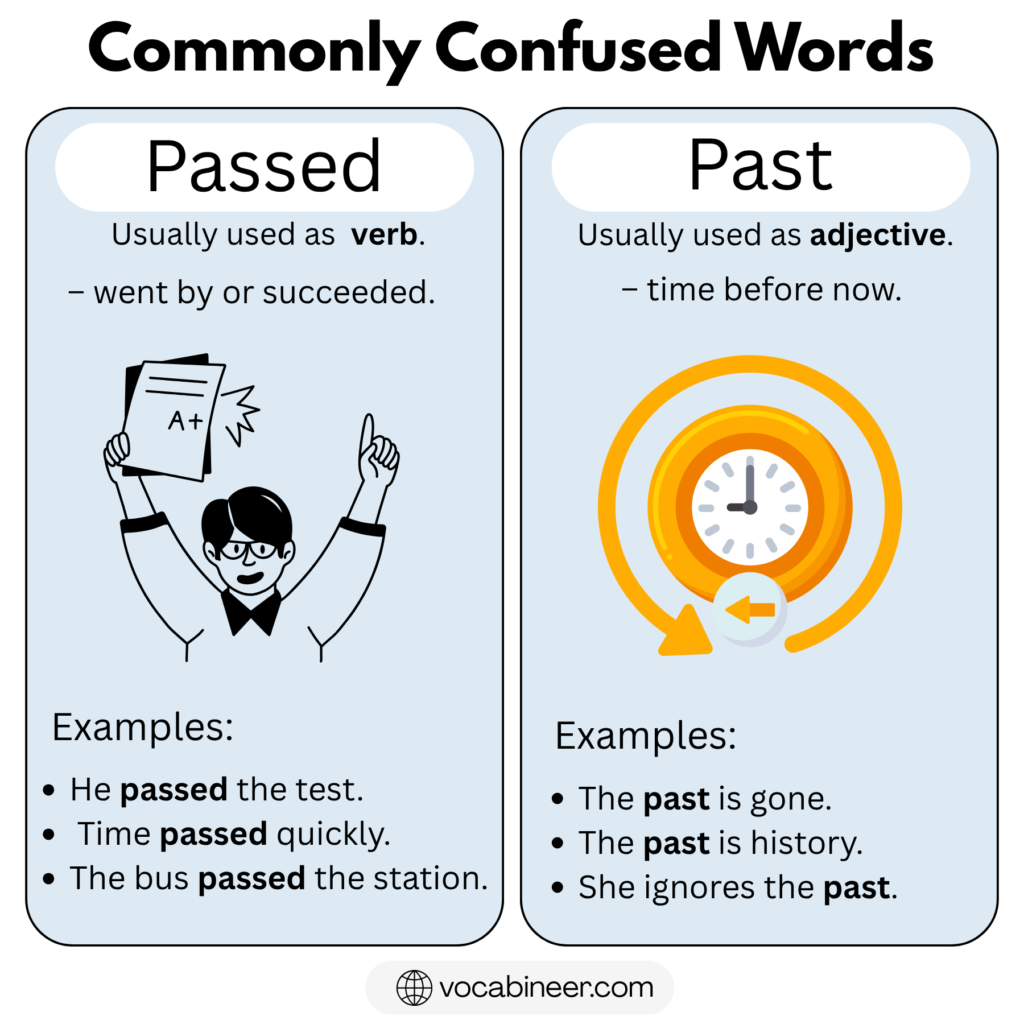
Passed is the past tense of pass and shows action.
Past refers to time before now or movement beyond something.
The key difference in Passed vs Past is action versus time or position.
Passed vs Past Difference in One Sentence
Passed shows completed action.
Past refers to earlier time or position beyond something.
Why Passed and Past Are Often Confused
Passed and Past are often confused because they are homophones. They sound exactly the same in speech. Therefore, writers sometimes select the wrong spelling when typing quickly.
However, their grammar roles are different. Passed is always a verb form. Past can function as a noun, adjective, adverb, or preposition. As a result, confusion usually happens in writing rather than pronunciation.
Word Origin and Etymology
The history of Passed vs Past shows a shared root. Both words come from the verb pass. Over time, Passed developed as the past tense verb form. Past developed into a word referring to time or position beyond something.
Although they share the same origin, their grammar functions are now different. Therefore, spelling determines correct usage.
Meaning of Passed
Passed refers to an action that has already happened. It is the past tense or past participle of pass.
Definition of Passed
Passed means moved beyond, succeeded in, or completed something.
It functions as a verb.
Passed as a Verb
Because Passed is a verb, it shows action that happened in the past.
Examples using Passed:
- She passed the exam.
- He passed the ball to his friend.
- The car passed us on the highway.
- Time passed quickly.
- They passed the test.
- She passed the message along.
- The teacher passed the papers out.
- He passed the interview.
- The law passed yesterday.
- The train passed the station.
- She passed her driving test.
- He passed away peacefully.
- The storm passed during the night.
- The students passed their exams.
- The opportunity passed him by.
- She passed the salt.
- He passed the checkpoint.
- The year passed quickly.
- The runner passed the finish line.
- She passed her friend in the hallway.
Notice something important. Passed always shows completed action.
Common Uses and Collocations of Passed
- Passed the exam
- Passed away
- Passed the test
- Passed the law
- Passed the ball
- Passed the time
- Passed the checkpoint
- Passed the message
- Passed the opportunity
- Passed the interview
- Passed quickly
- Passed the station
- Passed through
- Passed by
- Passed out
Meaning of Past
Past refers to time before now or movement beyond a point. In the Passed vs Past contrast, Past does not show action. Instead, it refers to earlier time, position, or previous experience.
Unlike Passed, which is always a verb, Past can function as different parts of speech.
Definition of Past
Past means earlier time, beyond a position, or something that already happened.
It can function as a noun, adjective, adverb, or preposition.
Past as a Noun
When Past functions as a noun, it refers to earlier time.
Examples using Past as a noun:
- The past shapes our future.
- She learned from her past.
- The past cannot be changed.
- He regrets the past.
- We should not live in the past.
- The past teaches lessons.
- Her past influenced her decisions.
- They discussed the past.
- The past still affects him.
- She left the past behind.
Past as an Adjective
When Past functions as an adjective, it describes something earlier.
Examples:
- In past years, prices were lower.
- During the past week, it rained.
- The past event was successful.
- The past month was busy.
- In the past decade, changes occurred.
- The past experience helped him.
- Over the past few days, she improved.
- The past generation faced challenges.
- The past situation was difficult.
- The past season was exciting.
Past as a Preposition
Past often functions as a preposition to show movement beyond something.
Examples:
- He walked past the store.
- The car drove past us.
- She ran past the gate.
- The train went past the station.
- We moved past the problem.
- He looked past the mistake.
- The bird flew past the window.
- She stepped past the puddle.
- The bus went past the stop.
- They rushed past the crowd.
Notice something important. Past does not show action like Passed. Instead, it refers to time or position.
Common Uses and Collocations of Past
- Past year
- Past week
- Past experience
- Past event
- Past mistake
- Past midnight
- Past few days
- Past generation
- Walked past
- Ran past
- Drove past
- Move past
- Look past
- Past history
- Past season
Each phrase refers to time before now or movement beyond something.
Passed vs Past: Key Difference Explained
The main difference in Passed vs Past depends on grammar role. Passed is a verb that shows completed action. Past refers to earlier time or position beyond something.
If the sentence needs a verb showing action, use Passed.
If the sentence refers to time or movement beyond something, use Past.
Here is the difference in one sentence:
Passed shows action that happened.
Past refers to time before now or position beyond something.
Passed vs Past: Difference in One Look
| Feature | Passed | Past |
|---|---|---|
| Part of Speech | Verb | Noun, adjective, preposition, adverb |
| Meaning | Completed action | Earlier time or beyond position |
| Shows Action | Yes | No |
| Changes Form | From pass | No tense change |
| Replace With | Moved, completed | Earlier, beyond |
Notice something important. Passed always connects to an action. Past usually connects to time or position.
Passed vs Past: Side by Side Sentence Contrast
- She passed the exam.
- She learned from her past.
- The car passed us.
- The car drove past us.
- Time passed quickly.
- In the past, things were different.
In each pair, Passed shows action. Past refers to time or movement beyond.
Passed vs Past: Sentence Structure Comparison
Understanding structure makes the difference easier.
| Structure Type | Passed Pattern | Past Pattern |
|---|---|---|
| Verb Form | She passed the test | Not used |
| Time Reference | Not used | In the past |
| Movement | Not used | Walked past the house |
| Adjective Use | Not used | The past week |
| Noun Use | Not used | The past matters |
If the word connects to a subject performing action, choose Passed. If it refers to time or position beyond something, choose Past.
When to Use Passed and When to Use Past
Choosing between Passed vs Past becomes simple when you check whether the sentence shows action or refers to time or position.
Use Passed when the sentence refers to:
- Completing something
- Moving beyond something
- Succeeding in an exam
- Giving or transferring something
- Time going by
Examples:
- She passed the exam.
- He passed the ball to me.
- The car passed us quickly.
- Time passed slowly.
- They passed the law.
- She passed the interview.
- He passed the salt.
- The train passed the station.
- She passed her driving test.
- The storm passed during the night.
Use Past when the sentence refers to:
- Earlier time
- Previous experience
- Position beyond something
- Time expressions
- Historical reference
Examples:
- The past cannot be changed.
- In the past, life was different.
- He walked past the store.
- The car drove past us.
- During the past week, it rained.
- She learned from her past.
- The train went past the station.
- In past years, prices were lower.
- He moved past the problem.
- The event happened in the past.
If the word shows action that happened, choose Passed. If it refers to earlier time or movement beyond something, choose Past.
Context Based Usage Guide
Context provides strong clues in Passed vs Past decisions.
Passed frequently appears:
- After a subject
- Before an object
- With exam, test, law, ball
- In completed actions
Examples:
- Passed the test
- Passed the ball
- Passed the law
- Passed the checkpoint
Past frequently appears:
- After time expressions
- With year, week, decade
- After movement verbs like walk or drive
- In historical discussions
Examples:
- In the past
- The past year
- Walked past
- Drove past
A helpful clue is grammar. If the word follows a subject and shows action, use Passed. If it describes time or position, use Past.
Grammar Difference Between Passed and Past
The grammar difference between Passed vs Past is clear.
Passed is a verb form.
Past is not a verb.
Passed changes from the base verb pass:
- She passed the test.
- He has passed the exam.
Past does not change tense:
- The past matters.
- He walked past the store.
If the sentence needs a verb, choose Passed. If it refers to time or position, choose Past.
Pronunciation Difference Between Passed and Past
In spoken English, Passed vs Past are pronounced exactly the same. Both words sound like “past.” Because there is no sound difference, pronunciation does not help you choose the correct spelling.
Below is a quick comparison:
| Feature | Passed | Past |
|---|---|---|
| Pronunciation | Past | Past |
| Sound Difference | None | None |
| Meaning | Completed action | Earlier time or beyond |
| Grammar Role | Verb | Noun, adjective, preposition |
Since both words are homophones, you must rely on sentence meaning and grammar structure.
Common Mistakes With Passed and Past
Most mistakes in Passed vs Past happen because writers depend on sound instead of grammar. Since both words sound the same, spelling confusion is common.
Below are frequent mistakes with corrections.
- Incorrect: She past the exam.
Correct: She passed the exam. - Incorrect: He walked passed the store.
Correct: He walked past the store. - Incorrect: Time past quickly.
Correct: Time passed quickly. - Incorrect: In the passed, life was different.
Correct: In the past, life was different. - Incorrect: The car past us.
Correct: The car passed us. - Incorrect: During the passed week, it rained.
Correct: During the past week, it rained. - Incorrect: She has past the test.
Correct: She has passed the test. - Incorrect: He drove passed the station.
Correct: He drove past the station. - Incorrect: The opportunity past him by.
Correct: The opportunity passed him by. - Incorrect: We should not live in the passed.
Correct: We should not live in the past.
Notice the consistent pattern. If the word shows action, use Passed. If it refers to time or position, use Past.
FAQs
The main difference in Passed vs Past is grammar role. Passed is a verb that shows completed action. Past refers to earlier time or movement beyond something and is not a verb.
No. Past is not used as a verb. The correct verb form is Passed, which comes from the base verb pass.
If the sentence shows action that happened, use Passed. If it refers to time before now or movement beyond something, use Past.
Yes. Past is often used in time expressions such as the past year, in the past, or during the past week.
Both words are pronounced the same. Therefore, writers sometimes choose the wrong spelling based on sound instead of grammar.
Final Summary
Passed vs Past may sound identical, but their grammar roles are different. Passed is the past tense of pass and shows completed action. Past refers to earlier time or movement beyond something. If the sentence requires a verb showing action, choose Passed. If it refers to time or position, choose Past. Understanding this distinction prevents common spelling mistakes and improves writing accuracy.
Read More
