

Peace vs Piece often creates confusion because the words sound identical but have completely different meanings. One refers to calmness or absence of conflict, while the other refers to a part of something. Their spelling reflects abstract noun versus concrete noun contrast.
Understanding Peace vs Piece helps you choose the correct word in structured writing, academic contexts, and daily communication. This article explains their meaning, grammar roles, usage patterns, sentence structure, and common mistakes so you can apply them accurately.
In This Page
Peace vs Piece: Quick Definition
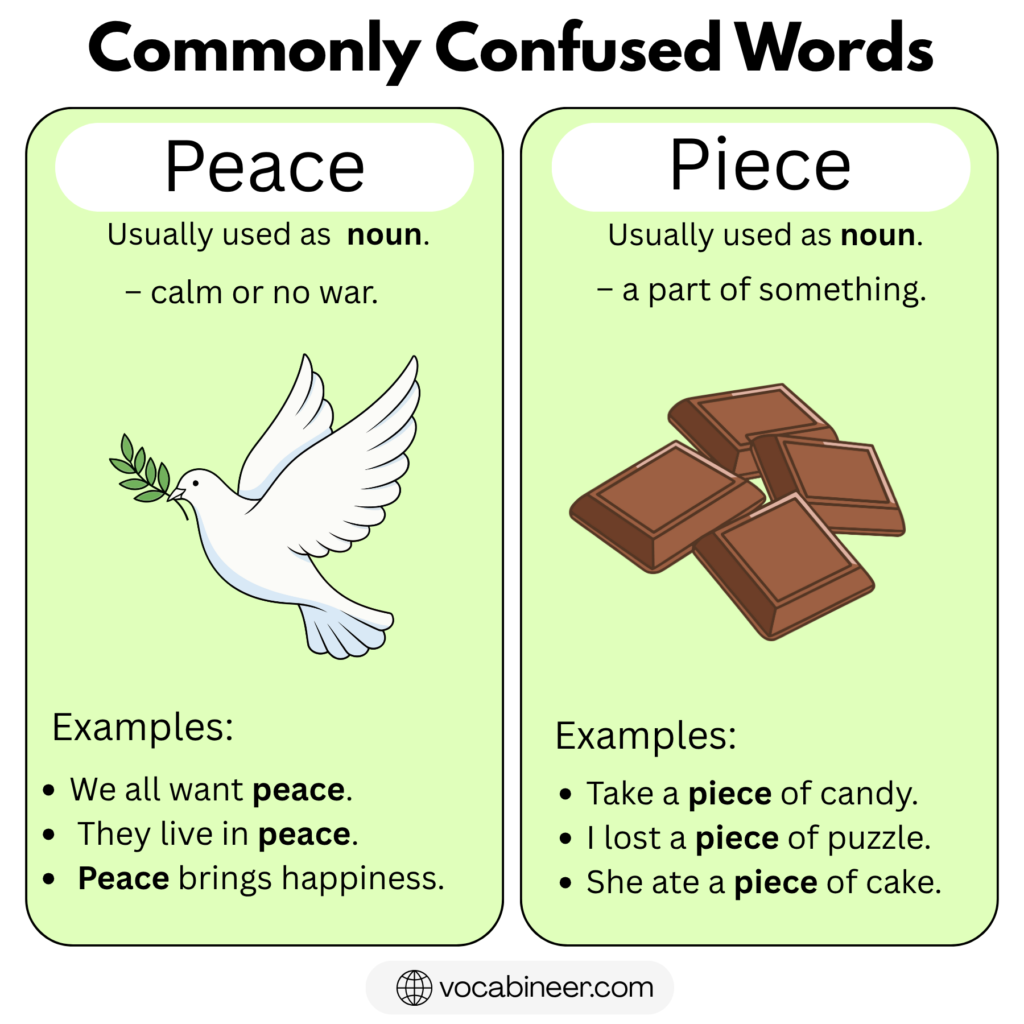
Peace means calm, harmony, or absence of conflict.
Piece means a part or portion of something.
The key difference in Peace vs Piece is harmony versus portion.
Peace vs Piece Difference in One Sentence
Peace refers to calm or harmony.
Piece refers to a part of something.
Why Peace and Piece Are Often Confused?
Peace and Piece are often confused because they are homophones. They sound exactly the same in speech. Therefore, writers sometimes select the wrong spelling when typing quickly.
However, their meanings are completely different. Peace relates to emotional or social calm. Piece refers to a physical or measurable part. As a result, confusion usually happens in writing rather than pronunciation.
Word Origin and Etymology
The history of Peace vs Piece shows different origins. Peace comes from Latin roots meaning agreement or tranquility. Piece developed from French roots meaning a portion or fragment.
Although both words are pronounced the same today, their meanings evolved independently. Therefore, spelling determines correct usage.
Meaning of Peace
Peace refers to a state of calm, quiet, or absence of conflict. It can describe emotional calm, social harmony, or freedom from disturbance.
Definition of Peace
Peace means freedom from conflict, disturbance, or stress.
It functions as a noun.
Peace as a Noun
Because Peace is a noun, it names a state or condition rather than showing action.
Examples using Peace:
- We all want peace.
- The country signed a peace agreement.
- She found inner peace.
- They prayed for world peace.
- The war ended in peace.
- He values peace and quiet.
- The community lived in peace.
- She enjoys moments of peace.
- The treaty brought peace.
- Meditation promotes peace.
- The leaders discussed peace.
- The garden gives a sense of peace.
- They worked toward lasting peace.
- The family sought peace at home.
- The protest demanded peace.
- He prefers peace over conflict.
- The church symbolizes peace.
- Silence brought peace to the room.
- The region finally experienced peace.
- She hopes for permanent peace.
Common Uses and Collocations of Peace
- Peace agreement
- Peace treaty
- World peace
- Inner peace
- Peace talks
- Peace process
- Peaceful resolution
- Peace offering
- Peace and quiet
- Peace movement
- Peace symbol
- Peace effort
- Peace conference
- Peace mission
- Peace campaign
Meaning of Piece
Piece refers to a part, portion, or fragment of something larger. In the Peace vs Piece contrast, Piece always relates to something that can be divided or counted.
Unlike Peace, which refers to calm or harmony, Piece refers to a physical or measurable part.
Definition of Piece
Piece means a part, portion, or individual item from a larger whole.
It functions as a noun.
Piece as a Noun
Because Piece is a noun, it names a part or section of something.
Examples using Piece:
- I ate a piece of cake.
- She picked up a piece of paper.
- He broke the glass into a piece.
- Give me a piece of advice.
- She found a missing piece of the puzzle.
- I need one more piece.
- He bought a piece of land.
- The artist created a beautiful piece.
- She tore a piece of fabric.
- He added another piece to the collection.
- That is my favorite piece of music.
- She shared a piece of chocolate.
- The machine has a broken piece.
- He wrote a short piece for the newspaper.
- I dropped a piece of bread.
- The child lost a piece of the toy.
- She received a piece of information.
- The puzzle has 500 pieces.
- He cut the rope into a small piece.
- She offered a piece of fruit.
Notice something important. Piece usually refers to something countable or divisible.
Common Uses and Collocations of Piece
- Piece of cake
- Piece of paper
- Piece of land
- Piece of advice
- Piece of information
- Piece of furniture
- Piece of art
- Piece of chocolate
- Puzzle piece
- Broken piece
- Missing piece
- Small piece
- Large piece
- Final piece
- Important piece
Each phrase shows part of a whole rather than calm or harmony.
Peace vs Piece: Key Difference Explained
The main difference in Peace vs Piece depends on meaning. Peace refers to calm, harmony, or absence of conflict. Piece refers to a part or portion of something.
If the sentence refers to emotional calm or agreement, use Peace.
If the sentence refers to a part of something, use Piece.
Here is the difference in one sentence:
Peace means harmony or calm.
Piece means a part of something.
Peace vs Piece: Difference in One Look
| Feature | Peace | Piece |
|---|---|---|
| Part of Speech | Noun | Noun |
| Meaning | Calm or harmony | Part or portion |
| Context | Emotional or social state | Physical or measurable part |
| Replace With | Harmony | Portion |
| Countable | No | Yes |
Notice something important. Peace is uncountable. Piece is countable.
Peace vs Piece: Side by Side Sentence Contrast
- The country hopes for peace.
- I want a piece of cake.
- She found inner peace.
- She found a missing piece.
- They signed a peace agreement.
- He picked up a piece of paper.
In each pair, Peace refers to harmony. Piece refers to a part.
Peace vs Piece: Sentence Structure Comparison
Understanding structure makes the difference easier.
| Structure Type | Peace Pattern | Piece Pattern |
|---|---|---|
| Emotional State | Inner peace | Not used |
| Agreement | Peace treaty | Not used |
| Portion | Not used | Piece of + noun |
| Countable Form | No plural | Pieces |
| With Article | No article often | A piece of |
If the sentence uses a piece of something, choose Piece. If the sentence refers to calm or absence of conflict, choose Peace.
When to Use Peace and When to Use Piece
Choosing between Peace vs Piece becomes simple when you check whether the sentence refers to harmony or a portion of something.
Use Peace when the sentence refers to:
- Calmness
- Absence of conflict
- Emotional balance
- Social harmony
- Agreement between groups
Examples:
- They prayed for peace.
- The country signed a peace treaty.
- She enjoys moments of peace.
- The war ended in peace.
- Meditation brings peace.
- The leaders discussed peace talks.
- He values peace and quiet.
- The agreement restored peace.
- She found inner peace.
- The region hopes for lasting peace.
Use Piece when the sentence refers to:
- A part of something
- A portion of food
- A fragment or section
- An individual item
Examples:
- I ate a piece of cake.
- She picked up a piece of paper.
- He lost a piece of the puzzle.
- Give me a piece of advice.
- She shared a piece of chocolate.
- The machine has a broken piece.
- I need one more piece.
- He bought a piece of land.
- She tore a piece of fabric.
- The puzzle has many pieces.
If the word refers to calm or harmony, choose Peace. If it refers to a portion or fragment, choose Piece.
Context Based Usage Guide
Context provides clear clues in Peace vs Piece decisions.
Peace frequently appears:
- In discussions about war or agreement
- In emotional or spiritual contexts
- With words like treaty, talks, harmony
Examples:
- Peace agreement
- World peace
- Inner peace
- Peace talks
Piece frequently appears:
- After the phrase a piece of
- With countable nouns
- In food or object contexts
Examples:
- A piece of cake
- A piece of paper
- A missing piece
- A piece of information
A helpful clue is quantity. If you can count it, it is usually Piece, not Peace.
Grammar Difference Between Peace and Piece
The grammar difference between Peace vs Piece is based on countability.
Peace is an uncountable noun.
Piece is a countable noun.
Peace does not usually take a plural form:
- They hope for peace.
- She seeks peace.
Piece can take a plural form:
- He collected many pieces.
- The puzzle has 500 pieces.
If the sentence uses numbers or the phrase a piece of, use Piece. If it refers to calm or absence of conflict, use Peace.
Pronunciation Difference Between Peace and Piece
In spoken English, Peace vs Piece are pronounced exactly the same. Both words sound like “pees.” Because there is no pronunciation difference, sound does not help you choose the correct spelling.
Below is a quick comparison:
| Feature | Peace | Piece |
|---|---|---|
| Pronunciation | Pees | Pees |
| Sound Difference | None | None |
| Meaning | Harmony or calm | Part or portion |
| Grammar Role | Uncountable noun | Countable noun |
Since both words are homophones, you must rely on meaning and sentence structure when writing.
Common Mistakes With Peace and Piece
Most mistakes in Peace vs Piece happen because writers rely on sound. Since both words are pronounced the same, spelling errors are common.
Below are frequent mistakes with corrections.
- Incorrect: I want world piece.
Correct: I want world peace. - Incorrect: She ate a peace of cake.
Correct: She ate a piece of cake. - Incorrect: They signed a piece treaty.
Correct: They signed a peace treaty. - Incorrect: Give me a peace of paper.
Correct: Give me a piece of paper. - Incorrect: He hopes for inner piece.
Correct: He hopes for inner peace. - Incorrect: I need a peace of advice.
Correct: I need a piece of advice. - Incorrect: The war ended in piece.
Correct: The war ended in peace. - Incorrect: She dropped a peace of bread.
Correct: She dropped a piece of bread. - Incorrect: They prayed for piece.
Correct: They prayed for peace. - Incorrect: He found the missing peace of the puzzle.
Correct: He found the missing piece of the puzzle.
Notice the consistent pattern. If the sentence refers to harmony or calm, use Peace. If it refers to a part or portion, use Piece.
FAQs
The main difference in Peace vs Piece is meaning. Peace refers to calm, harmony, or absence of conflict. Piece refers to a part or portion of something.
Peace is an uncountable noun. It does not usually take a plural form and is not used with numbers.
Yes. Piece is a countable noun. It can become pieces, such as puzzle pieces or small pieces of paper.
If the sentence talks about harmony, agreement, or calm, use Peace. If it refers to a portion or fragment of something, use Piece.
Both words are pronounced the same. Therefore, writers sometimes rely on sound instead of checking the meaning and grammar structure.
Final Summary
Peace vs Piece may sound identical, but their meanings are completely different. Peace refers to calm, harmony, or absence of conflict. Piece refers to a part or portion of something. If the sentence discusses agreement or emotional calm, choose Peace. If it refers to a fragment or section of something, choose Piece. Understanding this distinction prevents common spelling errors and strengthens sentence clarity.
Read More
- Confusing Words in English
- American vs British Words
- Desert vs Dessert in English
- Capital vs Capitol in English
