

Quiet vs Quite often causes confusion because the words look similar but have completely different meanings. One describes a lack of noise or calmness, while the other is an adverb that means very or completely. Their spelling difference reflects adjective versus adverb contrast.
Understanding Quiet vs Quite helps you choose the correct word in structured writing, academic contexts, and everyday communication. This article explains their meaning, grammar roles, pronunciation difference, usage patterns, and common mistakes so you can apply them accurately.
In This Page
Quiet vs Quite: Quick Definition
Quiet means silent or making little noise.
Quite means very, fairly, or completely.
The key difference in Quiet vs Quite is silent versus degree or intensity.
Quiet vs Quite Difference in One Sentence
Quiet describes low noise.
Quite describes degree or intensity.
Why Quiet and Quite Are Often Confused
Quiet and Quite are often confused because they differ by only one letter. In addition, both words appear frequently in everyday sentences. Therefore, writers sometimes type one instead of the other by mistake.
However, their meanings are unrelated. Quiet describes sound level, while Quite modifies adjectives or verbs to show degree. As a result, confusion usually happens due to spelling similarity rather than meaning overlap.
Word Origin and Etymology
The history of Quiet vs Quite shows that both words come from different Latin roots. Quiet comes from the Latin word quietus, meaning calm or at rest. Quite developed from an older form meaning completely or entirely.
Over time, English preserved Quiet as an adjective describing silence, while Quite became an adverb expressing degree. Therefore, their spelling similarity does not reflect similar meaning.
What Does Quiet Mean?
Quiet describes a state of little or no noise. It can also describe someone who speaks softly or behaves calmly.
Definition of Quiet
Quiet means silent, calm, or making little noise.
It usually functions as an adjective.
Quiet as an Adjective
Because Quiet is an adjective, it describes nouns rather than showing action.
Examples using Quiet:
- The room is quiet.
- Please be quiet.
- She lives in a quiet neighborhood.
- The baby remained quiet.
- It was a quiet evening.
- He prefers quiet places.
- The classroom became quiet.
- She has a quiet voice.
- The library is quiet.
- The street was quiet at night.
- He kept a quiet attitude.
- The town felt quiet after midnight.
- She stayed quiet during the meeting.
- It was a quiet morning.
- The crowd grew quiet.
- They enjoyed a quiet dinner.
- The office remained quiet.
- He asked for quiet time.
- The house seemed quiet.
- The park was peaceful and quiet.
Notice that Quiet describes condition or sound level.
Common Uses and Collocations of Quiet
- Quiet room
- Quiet voice
- Quiet place
- Quiet neighborhood
- Quiet evening
- Quiet street
- Quiet morning
- Quiet time
- Quiet atmosphere
- Quiet area
- Quiet environment
- Quiet moment
- Quiet behavior
- Quiet space
- Quiet crowd
What Does Quite Mean?
Quite is an adverb that modifies adjectives, adverbs, or sometimes verbs. In the Quiet vs Quite contrast, Quite does not describe sound. Instead, it adds emphasis or degree to a word.
Unlike Quiet, which describes silence, Quite shows intensity or extent.
Definition of Quite
Quite means very, fairly, or completely, depending on context.
It functions as an adverb.
Quite as an Adverb
Because Quite is an adverb, it modifies adjectives, adverbs, or occasionally verbs. It does not describe nouns directly.
Examples using Quite:
- The movie was quite interesting.
- She is quite happy today.
- It is quite cold outside.
- The test was quite difficult.
- He speaks quite clearly.
- The house is quite large.
- She was quite surprised.
- The problem is quite serious.
- That answer is quite correct.
- The book was quite long.
- He is quite confident.
- The room looks quite clean.
- It became quite dark.
- The task was quite easy.
- She is quite ready.
- The result was quite unexpected.
- He felt quite tired.
- The plan is quite simple.
- The weather is quite warm.
- The story was quite emotional.
Notice something important. Quite usually appears before adjectives or adverbs to increase their intensity.
Common Uses and Collocations of Quite
- Quite good
- Quite interesting
- Quite different
- Quite sure
- Quite ready
- Quite happy
- Quite simple
- Quite difficult
- Quite large
- Quite small
- Quite clear
- Quite certain
- Quite important
- Quite common
- Quite unusual
Each phrase shows degree or emphasis rather than silence.
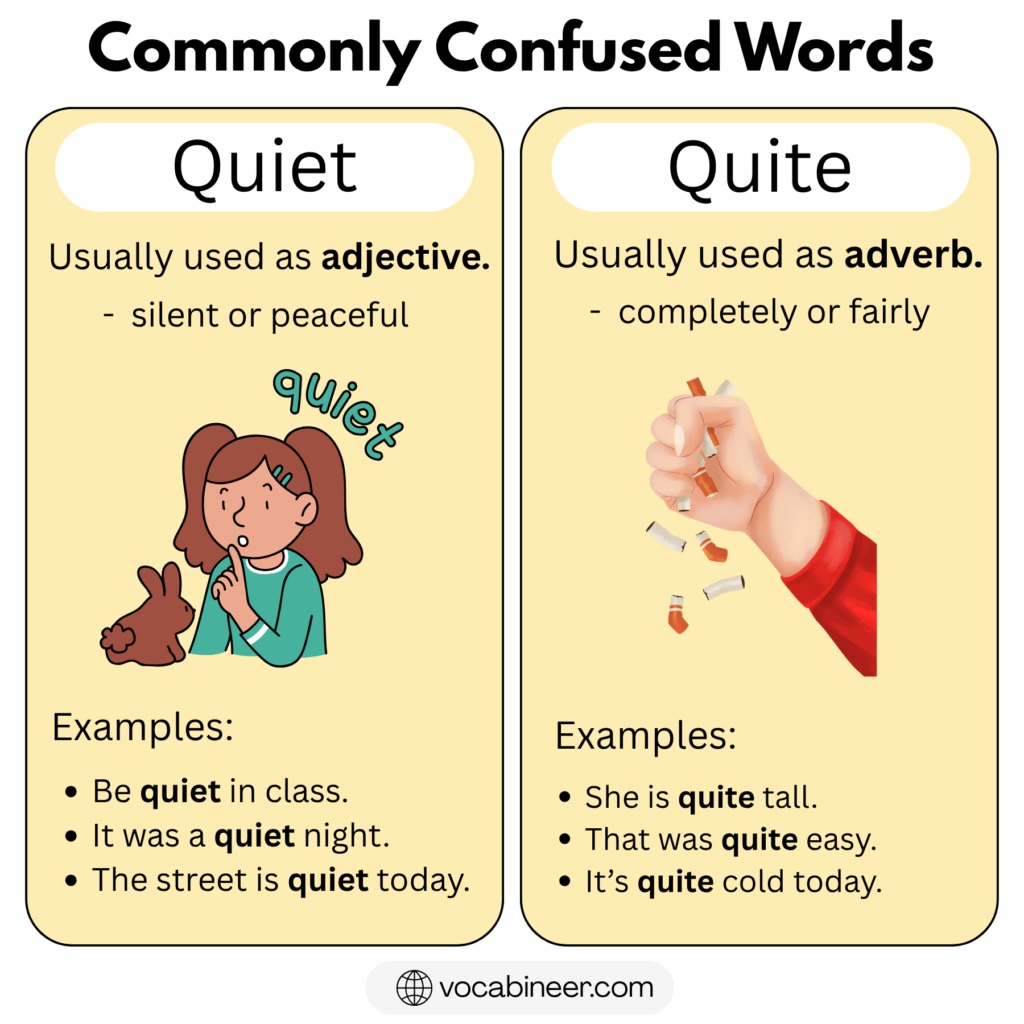
Quiet vs Quite: Key Difference Explained
The main difference in Quiet vs Quite depends on grammar role and meaning. Quiet describes silence or calmness. Quite modifies another word to show degree or intensity.
If the sentence refers to low noise or calm behavior, use Quiet.
If the sentence increases or emphasizes another word, use Quite.
Here is the difference in one sentence:
Quiet means silent.
Quite means very or fairly.
Quiet vs Quite: Difference in One Look
| Feature | Quiet | Quite |
|---|---|---|
| Part of Speech | Adjective | Adverb |
| Meaning | Silent or calm | Very or fairly |
| Describes | Nouns | Adjectives or adverbs |
| Shows Degree | No | Yes |
| Replace With | Silent | Very |
Notice something important. Quiet describes a thing, while Quite modifies another describing word.
Quiet vs Quite: Side by Side Sentence Contrast
- The room is quiet.
- The room is quite clean.
- Please stay quiet.
- She is quite ready.
- It was a quiet evening.
- It was quite cold outside.
In each pair, Quiet describes silence. Quite increases the intensity of another word.
Quiet vs Quite: Sentence Structure Comparison
Understanding structure makes the choice easier.
| Structure Type | Quiet Pattern | Quite Pattern |
|---|---|---|
| Basic Pattern | The area is quiet | The area is quite large |
| With Linking Verb | She became quiet | She became quite upset |
| With Command | Be quiet | Not used in command form |
| Before Adjective | Not used | Quite difficult task |
| With Adverb | Not used | Quite quickly |
If the word describes a noun directly, it is usually Quiet. If the word appears before an adjective or adverb to show degree, it is usually Quite.
When to Use Quiet and When to Use Quite
Choosing between Quiet vs Quite becomes easier when you check what the sentence needs. Ask yourself whether the word should describe silence or increase the strength of another word.
Use Quiet when the sentence refers to:
- Low noise
- Silence
- Calm behavior
- Peaceful atmosphere
Examples:
- The classroom is quiet.
- Please remain quiet.
- She prefers quiet places.
- The baby stayed quiet.
- It was a quiet night.
- The town felt quiet after midnight.
- He kept a quiet tone.
- The library is always quiet.
- They enjoyed a quiet afternoon.
- The room became quiet.
Use Quite when the sentence refers to:
- Degree or intensity
- Emphasis
- Extent of something
- Modification of an adjective or adverb
Examples:
- The test was quite difficult.
- She is quite happy today.
- The movie was quite interesting.
- It is quite cold outside.
- He speaks quite clearly.
- The house is quite large.
- She felt quite tired.
- The plan is quite simple.
- The result was quite surprising.
- The task was quite easy.
If the word describes silence, choose Quiet. If it strengthens another describing word, choose Quite.
Context Based Usage Guide
Context provides clear clues in Quiet vs Quite decisions.
Quiet frequently appears:
- After linking verbs like is, seems, became
- In requests or commands
- In descriptions of places or behavior
Examples:
- The office is quiet.
- Please stay quiet.
- The park was quiet in the morning.
- She remained quiet during the meeting.
Quite frequently appears:
- Before adjectives
- Before adverbs
- In emphasis based sentences
Examples:
- The problem is quite serious.
- She answered quite confidently.
- The weather is quite warm.
- The instructions were quite clear.
You may notice a helpful clue. If the word appears before an adjective like good, large, or difficult, it is usually Quite, not Quiet.
Grammar Difference Between Quiet and Quite
The grammar difference between Quiet vs Quite is based on part of speech.
Quiet is usually an adjective.
Quite is an adverb.
Quiet describes nouns:
- The street is quiet.
- She has a quiet voice.
Quite modifies adjectives or adverbs:
- The street is quite empty.
- She speaks quite softly.
If the word needs to modify another describing word, use Quite. If it directly describes a noun or state of silence, use Quiet.
Pronunciation Difference Between Quiet and Quite
Although Quiet vs Quite look very similar, their pronunciation helps separate them. The difference lies in syllable count and sound pattern.
Quiet has two syllables: KWI-uht.
Quite has one syllable: KWITE.
Below is a quick comparison:
| Feature | Quiet | Quite |
|---|---|---|
| Part of Speech | Adjective | Adverb |
| Syllables | Two | One |
| Sound Pattern | KWI-uht | KWITE |
| Meaning | Silent | Very or fairly |
Say them slowly:
Quiet
Quite
You may notice that Quiet takes slightly longer to pronounce because of the extra syllable.
Common Mistakes With Quiet and Quite
Most mistakes in Quiet vs Quite happen when writers type quickly and confuse the spelling. Since the words differ by only one letter, the error often goes unnoticed.
Below are frequent mistakes with corrections.
- Incorrect: The room is quite.
Correct: The room is quiet. - Incorrect: Please be quite.
Correct: Please be quiet. - Incorrect: It was a quite evening.
Correct: It was a quiet evening. - Incorrect: The test was quiet difficult.
Correct: The test was quite difficult. - Incorrect: She is quiet happy today.
Correct: She is quite happy today. - Incorrect: The house is quiet large.
Correct: The house is quite large. - Incorrect: He asked for quite in the room.
Correct: He asked for quiet in the room. - Incorrect: The library was quite.
Correct: The library was quiet. - Incorrect: She answered quiet clearly.
Correct: She answered quite clearly. - Incorrect: It became quite in the hall.
Correct: It became quiet in the hall.
Notice the consistent pattern. If the word refers to silence, use Quiet. If it strengthens another word, use Quite.
FAQs
The difference in Quiet vs Quite is meaning and grammar role. Quiet means silent or calm and usually acts as an adjective. Quite means very or fairly and acts as an adverb to increase degree.
No. Quiet is usually an adjective. It describes a noun or state of silence, such as a quiet room or a quiet voice.
No. Quite is an adverb. It modifies adjectives or adverbs, as in quite happy or quite slowly.
No. The correct form is be quiet because the sentence refers to silence, not degree.
Check the sentence structure. If the word describes silence, use Quiet. If it appears before an adjective to show degree, use Quite.
Final Summary
Quiet vs Quite may look almost identical, but their meanings and grammar roles are different. Quiet is an adjective that describes silence or calmness. Quite is an adverb that increases the degree of another word. If the sentence describes low noise, choose Quiet. If it strengthens an adjective or adverb, choose Quite. Understanding this contrast prevents common spelling errors and improves sentence clarity.
Read More
- Confusing Words in English
- American vs British Words
- Breath vs Breathe in English
- Who’s vs Whose in English
