

Right vs Write often creates confusion because the words sound identical but have different meanings and grammar roles. One relates to correctness or direction, while the other refers to the act of forming words. Their spelling reflects adjective and noun forms versus verb contrast.
Understanding Right vs Write helps you choose the correct word in structured writing, academic tasks, and daily communication. This article explains their meaning, grammar roles, usage patterns, sentence structure, and common mistakes so you can apply them accurately.
In This Page
Right vs Write: Quick Definition
Right means correct, proper, or a direction.
Write means to form letters or words on a surface.
The key difference in Right vs Write is correctness or direction versus action of forming words.
Right vs Write Difference in One Sentence
Right refers to correctness or direction.
Write refers to the action of creating text.
Why Right and Write Are Often Confused
Right and Write are often confused because they are homophones. They sound exactly the same in speech. Therefore, writers sometimes choose the wrong spelling when typing quickly.
However, their meanings are completely different. Right can function as an adjective, noun, or adverb. Write functions as a verb. As a result, confusion usually happens in writing rather than pronunciation.
Word Origin and Etymology
The history of Right vs Write shows separate origins. Right comes from Old English roots meaning correct, straight, or just. Write comes from Old English roots meaning to inscribe or form letters.
Although they sound identical today, their origins and meanings developed independently. Therefore, spelling determines their role in a sentence.
Meaning of Right
Right has multiple meanings depending on context. It can refer to correctness, direction, morality, or entitlement.
Definition of Right
Right means correct, proper, or a direction opposite of left.
It can function as an adjective, noun, or adverb.
Right as an Adjective
When Right functions as an adjective, it describes something as correct or appropriate.
Examples using Right as correct:
- You gave the right answer.
- This is the right solution.
- She made the right choice.
- That is the right way.
- He gave the right response.
- This is the right time.
- You are in the right place.
- That was the right decision.
- She chose the right path.
- He did the right thing.
Right as a Direction
Right can also refer to direction.
Examples using Right as direction:
- Turn right at the corner.
- The store is on the right.
- Look to your right.
- She moved to the right side.
- The chair is to your right.
- Walk straight, then go right.
- The exit is on the right.
- He raised his right hand.
- The sign is on the right wall.
- Keep to the right.
Common Uses and Collocations of Right
- Right answer
- Right decision
- Right direction
- Right side
- Right choice
- Right time
- Right place
- Right now
- Right away
- Right person
- Right move
- Right solution
- Right hand
- Right reason
- Right opportunity
Meaning of Write
Write refers to the action of forming letters, words, or sentences. In the Right vs Write contrast, Write always shows action. It describes creating text using a pen, pencil, keyboard, or other tools.
Unlike Right, which can describe correctness or direction, Write functions only as a verb.
Definition of Write
Write means to form letters, words, or symbols on a surface or screen.
It functions as a verb.
Write as a Verb
Because Write is a verb, it shows action. It also changes tense depending on time.
Present form: write
Past form: wrote
Past participle: written
Continuous form: writing
Examples using Write:
- Please write your name.
- She will write a letter.
- He likes to write stories.
- I need to write an email.
- They write reports every week.
- She wrote a poem yesterday.
- He has written three books.
- We are writing notes.
- Can you write clearly?
- She plans to write a novel.
- I will write the answer.
- He is writing a message.
- She wrote her address.
- They have written the exam.
- Please write neatly.
- He writes quickly.
- She is learning to write.
- We write emails daily.
- He has written a report.
- I forgot to write it down.
Notice something important. Write changes form because it is a verb. Right does not change tense.
Common Uses and Collocations of Write
- Write a letter
- Write a book
- Write a message
- Write an email
- Write a report
- Write a note
- Write clearly
- Write neatly
- Write quickly
- Write down
- Write a story
- Write your name
- Write a sentence
- Write an essay
- Write instructions
Each phrase shows action of creating text.
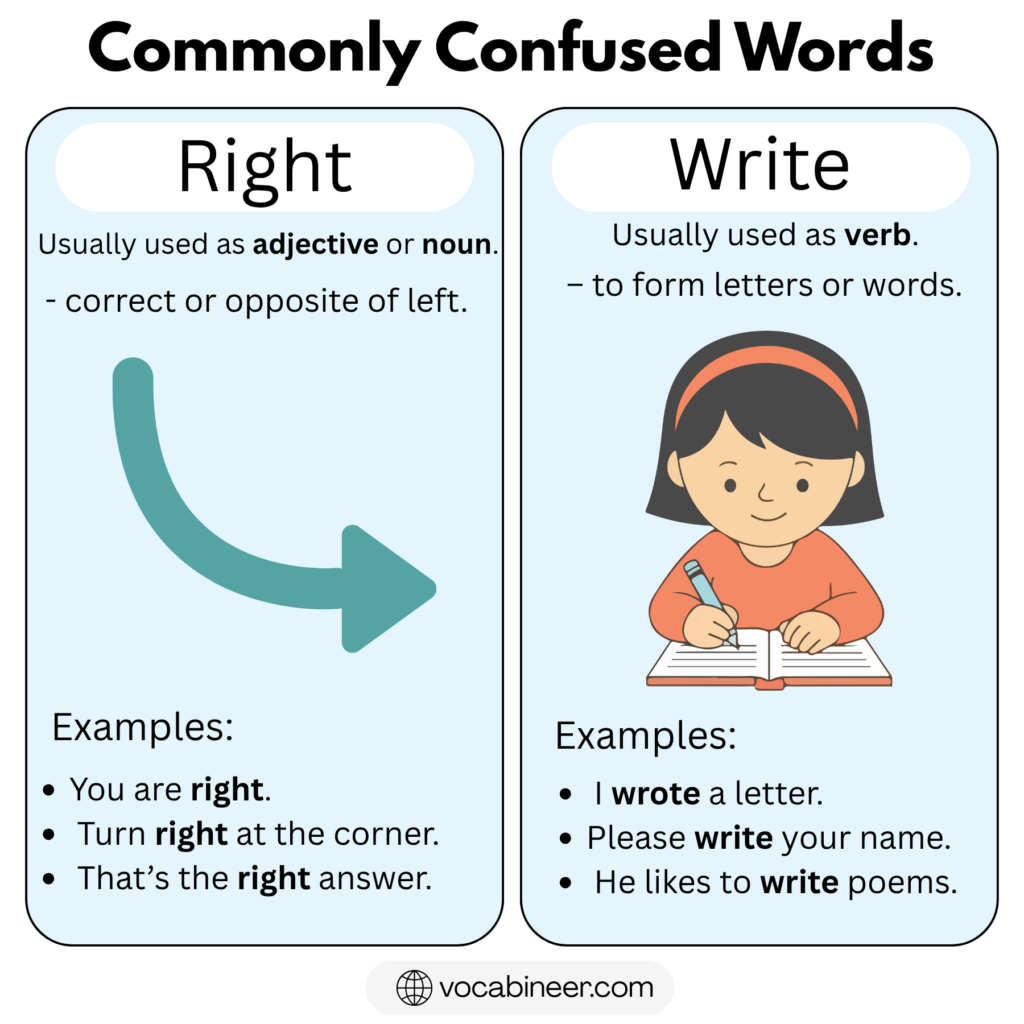
Right vs Write: Key Difference Explained
The main difference in Right vs Write depends on grammar role and meaning. Right refers to correctness, direction, or entitlement. Write refers to the action of forming letters or words.
If the sentence describes something correct or a direction, use Right.
If the sentence shows action of creating text, use Write.
Here is the difference in one sentence:
Right refers to correctness or direction.
Write refers to the act of forming words.
Right vs Write: Difference in One Look
| Feature | Right | Write |
|---|---|---|
| Part of Speech | Adjective, noun, adverb | Verb |
| Meaning | Correct or direction | Form letters or words |
| Shows Action | No | Yes |
| Changes Form | No tense change | Write, wrote, written |
| Replace With | Correct | Compose |
Notice something important. Because Write is a verb, it changes tense. Right does not change form in that way.
Right vs Write: Side by Side Sentence Contrast
- That is the right answer.
- Please write the answer.
- Turn right at the corner.
- Write your address clearly.
- She made the right decision.
- She will write a decision report.
In each pair, Right describes correctness or direction. Write shows the action of creating text.
Right vs Write: Sentence Structure Comparison
Understanding structure makes the difference easier.
| Structure Type | Right Pattern | Write Pattern |
|---|---|---|
| Adjective | The right way | Not used |
| Direction | Turn right | Not used |
| Action | Not used | Write + object |
| Past Form | Not used | She wrote a note |
| Continuous | Not used | He is writing |
If the word appears before a noun showing correctness, it is usually Right. If it appears before an object and shows action, it is usually Write.
When to Use Right and Write
Choosing between Right vs Write becomes simple when you check whether the sentence shows correctness or action.
Use Right when the sentence refers to:
- Correctness
- Direction
- Moral choice
- Proper behavior
- Entitlement
Examples:
- You gave the right answer.
- Turn right at the signal.
- She made the right decision.
- He is on the right side.
- That is the right way.
- Choose the right option.
- You are in the right place.
- The exit is on the right.
- He did the right thing.
- This feels right.
Use Write when the sentence refers to:
- Forming letters
- Creating text
- Recording information
- Producing written content
Examples:
- Please write your name.
- She will write a letter.
- He likes to write poems.
- I need to write an email.
- They write reports daily.
- She wrote a story yesterday.
- He has written three books.
- We are writing notes.
- Can you write clearly?
- She plans to write a novel.
If the sentence describes something correct or a direction, choose Right. If it shows action of creating text, choose Write.
Context Based Usage Guide
Context provides strong clues in Right vs Write decisions.
Right frequently appears:
- Before nouns
- In directional instructions
- In expressions of correctness
- In moral discussions
Examples:
- Right answer
- Right direction
- Right decision
- Right time
Write frequently appears:
- With direct objects
- In instructions
- In academic tasks
- In communication contexts
Examples:
- Write a letter
- Write your name
- Write a report
- Write an email
You may notice a helpful clue. If the word changes to wrote or written, it must be Write, not Right.
Grammar Difference Between Right and Write
The grammar difference between Right vs Write is clear.
Right can function as:
- An adjective
- A noun
- An adverb
Write functions only as:
- A verb
Right does not change tense:
- That is right.
- She chose the right answer.
Write changes tense:
- She writes daily.
- She wrote yesterday.
- She has written before.
If the sentence needs a verb showing action, use Write. If it describes correctness or direction, use Right.
Pronunciation Difference Between Right and Write
In spoken English, Right vs Write are homophones. Both words are pronounced the same way and sound like “rite.” Because there is no pronunciation difference, sound does not help you choose the correct spelling.
Below is a quick comparison:
| Feature | Right | Write |
|---|---|---|
| Pronunciation | Rite | Rite |
| Sound Difference | None | None |
| Meaning | Correct or direction | Form letters or words |
| Grammar Role | Adjective, noun, adverb | Verb |
Since both words sound identical, you must rely on sentence structure and meaning to select the correct form.
Common Mistakes With Right and Write
Most mistakes in Right vs Write happen because writers rely on sound instead of grammar. Since pronunciation offers no difference, spelling errors are common.
Below are frequent mistakes with corrections.
- Incorrect: Please right your name.
Correct: Please write your name. - Incorrect: You are write.
Correct: You are right. - Incorrect: Turn write at the corner.
Correct: Turn right at the corner. - Incorrect: She will right a letter.
Correct: She will write a letter. - Incorrect: That is not write.
Correct: That is not right. - Incorrect: He can right clearly.
Correct: He can write clearly. - Incorrect: You made the write decision.
Correct: You made the right decision. - Incorrect: I need to right an email.
Correct: I need to write an email. - Incorrect: The answer is write.
Correct: The answer is right. - Incorrect: She right a poem yesterday.
Correct: She wrote a poem yesterday.
Notice the consistent pattern. If the word shows action of forming words, use Write. If it refers to correctness or direction, use Right.
FAQs
The main difference in Right vs Write is meaning and grammar role. Right refers to correctness or direction. Write is a verb that means to form letters or create text.
Ask whether the sentence shows action of creating text. If someone is forming letters, composing a message, or recording information, use Write.
Use Right when the sentence refers to correctness, direction, moral choice, or something proper, such as the right answer or turn right.
No. Right does not mean to form letters. Only Write functions as the verb related to creating text.
Both words are pronounced the same. Therefore, writers sometimes rely on sound instead of checking the sentence meaning and grammar.
Final Summary
Right vs Write may sound identical, but their meanings and grammar roles are different. Right refers to correctness, direction, or moral choice. Write is a verb that means to form letters or create text. If the sentence describes something correct or a direction, choose Right. If it shows action of writing, choose Write. Understanding this distinction prevents common spelling errors and improves sentence clarity.
Read More
- Confusing Words in English
- American vs British Words
- Desert vs Dessert in English
- Capital vs Capitol in English
