

Sight vs Site often causes confusion because the words sound identical but have different meanings. One relates to vision or something seen, while the other refers to a place or location. Their spelling reflects sensory noun versus location noun contrast.
Understanding Sight vs Site helps you choose the correct word in structured writing, academic tasks, and daily communication. This article explains their meaning, grammar roles, usage patterns, sentence structure, and common mistakes so you can apply them accurately.
In This Page
Sight vs Site: Quick Definition
Sight refers to vision or something seen.
Site refers to a place or location.
The key difference in Sight vs Site is vision versus location.
Sight vs Site Difference in One Sentence
Sight relates to seeing.
Site refers to a physical or digital location.
Why Sight and Site Are Often Confused?
Sight and Site are often confused because they are homophones. They sound exactly the same in speech. Therefore, writers sometimes select the wrong spelling when typing quickly.
However, their meanings are completely different. Sight connects to vision and observation. Site refers to a place, position, or location. As a result, confusion usually happens in writing rather than pronunciation.
Word Origin and Etymology
The history of Sight vs Site shows different origins. Sight comes from Old English roots connected to seeing or vision. Site comes from Latin roots meaning position or location.
Although they sound identical today, their meanings developed separately. Therefore, spelling determines correct usage.
Meaning of Sight
Sight refers to the ability to see or something that is seen.
Definition of Sight
Sight means vision or something visible.
It functions as a noun.
Sight as a Noun
Because Sight is a noun, it names a sense or an object that can be seen.
Examples using Sight:
- The sunset was a beautiful sight.
- Losing sight can affect daily life.
- The mountains were an amazing sight.
- He caught sight of the bird.
- The accident was a shocking sight.
- She regained her sight after surgery.
- The city lights were a pleasant sight.
- He lost sight of the ball.
- The parade was an exciting sight.
- They enjoyed the sight of the ocean.
- The building was an impressive sight.
- He kept the goal in sight.
- The stars were a wonderful sight.
- She saw the tower at first sight.
- The view was a breathtaking sight.
- The festival was a colorful sight.
- He waved when he caught sight of her.
- The monument is a famous sight.
- The fireworks were a bright sight.
- The castle was a historic sight.
Common Uses and Collocations of Sight
- Catch sight of
- Lose sight of
- At first sight
- In sight
- Out of sight
- A beautiful sight
- A common sight
- A rare sight
- A shocking sight
- A pleasant sight
- Sightseeing
- Sight range
- Line of sight
- Sight distance
- Sight test
Meaning of Site
Site refers to a place, position, or location. In the Sight vs Site contrast, Site never relates to vision. Instead, it names a physical area, building location, or digital platform.
Unlike Sight, which connects to seeing, Site functions as a noun that refers to location.
Definition of Site
Site means a place where something is located, built, or happens.
It functions as a noun.
Site as a Noun
Because Site is a noun, it names a specific location or position.
Examples using Site:
- The construction site is closed today.
- They visited the historical site.
- The company chose a new site for the factory.
- The accident site was blocked.
- The building site is under inspection.
- She works at a research site.
- The campsite is a beautiful site.
- The website is popular among students.
- The team surveyed the project site.
- The hospital site is near the highway.
- The school will build on this site.
- The crime site was secured.
- The event site was crowded.
- The archaeological site attracted tourists.
- They selected a safe site for construction.
- The company launched a new web site.
- The excavation site revealed artifacts.
- The development site covers ten acres.
- The mining site operates daily.
- The festival site is downtown.
Notice something important. Site refers to a location, whether physical or digital.
Common Uses and Collocations of Site
- Construction site
- Historical site
- Project site
- Building site
- Crime site
- Archaeological site
- Work site
- Event site
- Web site
- Mining site
- Development site
- Survey site
- Hospital site
- Camp site
- Research site
Each phrase refers to a location rather than something seen.
Sight vs Site: Key Difference Explained
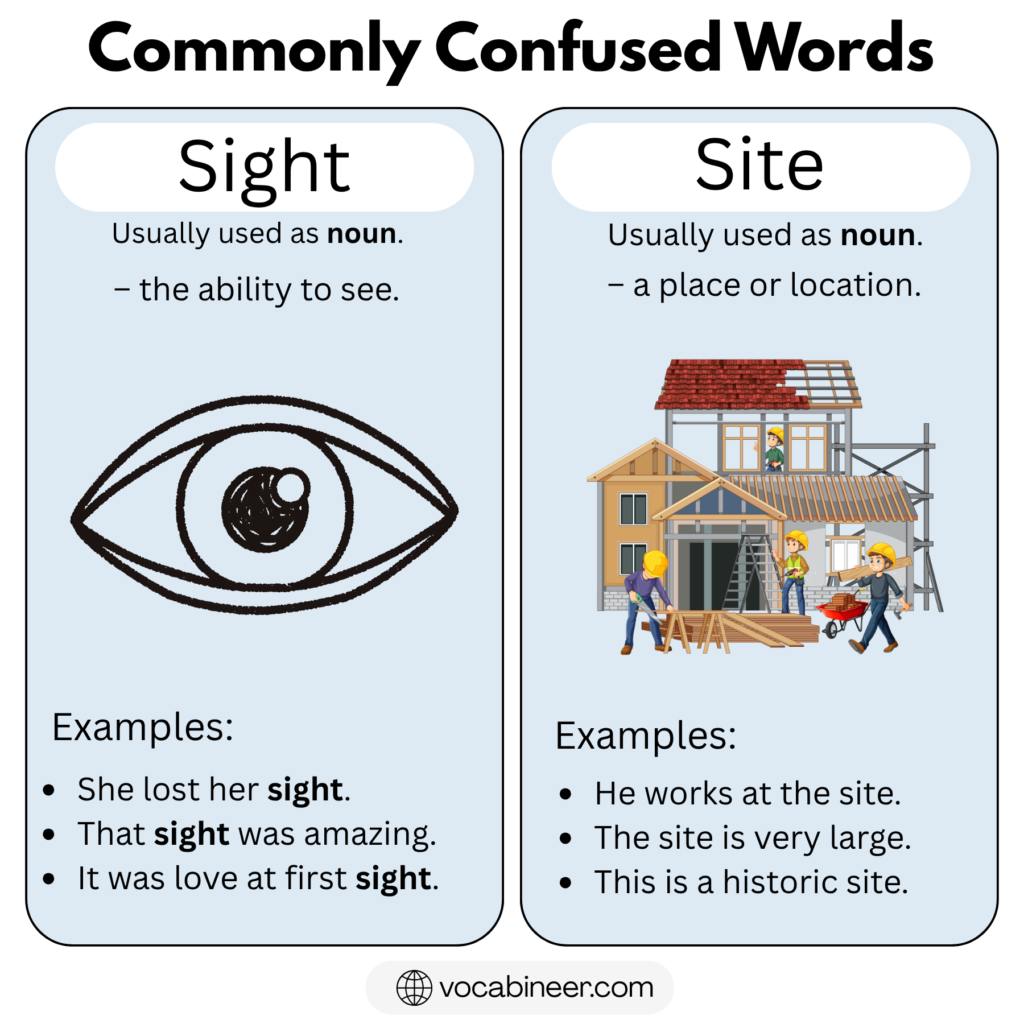
The main difference in Sight vs Site depends on meaning. Sight relates to vision or something seen. Site refers to a place or location.
If the sentence refers to seeing or vision, use Sight.
If the sentence refers to a location or position, use Site.
Here is the difference in one sentence:
Sight connects to vision.
Site refers to a place.
Sight vs Site: Difference in One Look
| Feature | Sight | Site |
|---|---|---|
| Part of Speech | Noun | Noun |
| Meaning | Vision or something seen | Place or location |
| Context | Seeing, observing | Physical or digital place |
| Replace With | View | Location |
| Related Words | Sightseeing | Website |
Notice something important. Sight relates to the eyes. Site relates to position or location.
Sight vs Site: Side by Side Sentence Contrast
- The waterfall was a beautiful sight.
- The construction site is closed.
- He lost sight of the ball.
- The building site is under inspection.
- They enjoyed the sight of the mountains.
- The company selected a new site.
In each pair, Sight refers to vision. Site refers to a place.
Sight vs Site: Sentence Structure Comparison
Understanding structure makes the difference easier.
| Structure Type | Sight Pattern | Site Pattern |
|---|---|---|
| Vision | A beautiful sight | Not used |
| Phrase | Catch sight of | Not used |
| Location | Not used | Construction site |
| With Article | A sight | A site |
| Compound | Sightseeing | Website |
If the sentence refers to seeing or observing, choose Sight. If it refers to a place or location, choose Site.
When to Use Sight and When to Use Site
Choosing between Sight vs Site becomes simple when you check whether the sentence refers to vision or location.
Use Sight when the sentence refers to:
- Seeing something
- Vision or eyesight
- Something impressive to look at
- A visual experience
- Observing something
Examples:
- The beach was a beautiful sight.
- He lost sight of the runner.
- The parade was an exciting sight.
- She caught sight of her friend.
- The fireworks were a bright sight.
- The castle was a historic sight.
- The stars were a wonderful sight.
- He kept the goal in sight.
- The mountains were a stunning sight.
- She regained her sight after treatment.
Use Site when the sentence refers to:
- A physical location
- A construction or project area
- A historical place
- A digital platform
- A building or event location
Examples:
- The construction site is busy.
- They visited the historical site.
- The company selected a new factory site.
- The web site is easy to use.
- The accident site was blocked.
- The building site is under inspection.
- The research site collects data.
- The festival site was crowded.
- The mining site operates daily.
- The development site covers several acres.
If the word refers to seeing or vision, choose Sight. If it refers to a location or place, choose Site.
Context Based Usage Guide
Context gives strong clues in Sight vs Site decisions.
Sight frequently appears:
- With verbs like catch or lose
- In phrases about vision
- In expressions about appearance
Examples:
- Catch sight of
- Lose sight of
- A beautiful sight
- At first sight
Site frequently appears:
- With construction or development terms
- In business or digital contexts
- With words like project, building, web
Examples:
- Construction site
- Project site
- Web site
- Research site
A helpful clue is meaning. If the sentence involves eyes or seeing, use Sight. If it involves place or position, use Site.
Grammar Difference Between Sight and Site
The grammar difference between Sight vs Site is based on meaning rather than part of speech.
Both words are nouns.
However, they belong to different semantic categories.
Sight relates to vision.
Site relates to location.
Sight examples:
- A beautiful sight
- Lose sight
Site examples:
- Construction site
- Historical site
If the sentence talks about seeing something, choose Sight. If it refers to a place, choose Site.
Pronunciation Difference Between Sight and Site
In spoken English, Sight vs Site are pronounced exactly the same. Both words sound like “site.” Because there is no pronunciation difference, sound does not help you choose the correct spelling.
Below is a quick comparison:
| Feature | Sight | Site |
|---|---|---|
| Pronunciation | Site | Site |
| Sound Difference | None | None |
| Meaning | Vision or something seen | Place or location |
| Grammar Role | Noun | Noun |
Since both words are homophones, you must rely on meaning and sentence structure to select the correct word.
Common Mistakes With Sight and Site
Most mistakes in Sight vs Site happen because writers depend on sound. Since both words sound the same, spelling errors are common.
Below are frequent mistakes with corrections.
- Incorrect: The waterfall was a beautiful site.
Correct: The waterfall was a beautiful sight. - Incorrect: The construction sight is closed.
Correct: The construction site is closed. - Incorrect: He lost site of the ball.
Correct: He lost sight of the ball. - Incorrect: They visited the historical sight.
Correct: They visited the historical site. - Incorrect: She caught site of her friend.
Correct: She caught sight of her friend. - Incorrect: The accident sight was blocked.
Correct: The accident site was blocked. - Incorrect: The mountains were an amazing site.
Correct: The mountains were an amazing sight. - Incorrect: The building sight is under inspection.
Correct: The building site is under inspection. - Incorrect: The fireworks were a bright site.
Correct: The fireworks were a bright sight. - Incorrect: The company chose a new sight.
Correct: The company chose a new site.
Notice the consistent pattern. If the sentence refers to vision or something seen, use Sight. If it refers to a location, use Site.
FAQs
The main difference in Sight vs Site is meaning. Sight relates to vision or something seen. Site refers to a place or location.
Yes. Both words are nouns, but they belong to different meaning categories. Sight connects to seeing. Site connects to location.
If the sentence involves vision, observing, or something visible, use Sight. If it refers to a place, building area, or website, use Site.
Both words are pronounced exactly the same. Therefore, writers sometimes rely on sound instead of checking the sentence meaning.
Yes. A web site is a digital location on the internet, not something related to vision.
Final Summary
Sight vs Site may sound identical, but their meanings are very different. Sight refers to vision or something seen. Site refers to a physical or digital location. If the sentence connects to seeing or eyesight, choose Sight. If it refers to a place or position, choose Site. Understanding this distinction prevents spelling errors and improves writing accuracy.
Read More
- Confusing Words in English
- American vs British Words
- Loose vs Lose in English
- Quiet vs Quite in English
