

Stationary vs Stationery often causes confusion because the words look almost identical but have completely different meanings. One describes something that is not moving, while the other refers to writing materials like paper and envelopes. Their spelling reflects adjective versus noun contrast.
Understanding Stationary vs Stationery helps you choose the correct word in structured writing, academic contexts, and daily communication. This article explains their meaning, grammar roles, usage patterns, sentence structure, and common mistakes so you can apply them accurately.
In This Page
Stationary vs Stationery: Quick Definition
Stationary means not moving.
Stationery refers to writing materials such as paper, envelopes, and notebooks.
The key difference in Stationary vs Stationery is motion versus office supplies.
Stationary vs Stationery Difference in One Sentence
Stationary describes something that is still.
Stationery refers to writing supplies.
Why Stationary and Stationery Are Often Confused?
Stationary and Stationery are often confused because they differ by only one letter. In addition, their pronunciation is very similar in speech. Therefore, writers sometimes type the wrong spelling when working quickly.
However, their meanings are completely different. Stationary relates to movement. Stationery refers to paper products and office materials. As a result, confusion usually happens in writing rather than pronunciation.
Word Origin and Etymology
The history of Stationary vs Stationery shows different developments. Stationary comes from Latin roots meaning standing still. Stationery developed from French roots connected to writing materials sold by stationers.
Although both words share a common base related to position or station, their meanings evolved in separate directions. Therefore, spelling determines correct usage.
Meaning of Stationary
Stationary describes something that is not moving or changing position. It refers to objects, vehicles, or people that remain still in one place.
Definition of Stationary
Stationary means not moving or staying in one place. It describes a person, object, or situation that is completely still and not changing position.
It functions as an adjective.
Stationary as an Adjective
Because Stationary is an adjective, it describes nouns rather than showing action.
Examples using Stationary:
- The car remained stationary.
- The train was stationary at the platform.
- The bike stayed stationary.
- The object appeared stationary.
- The fan looked stationary.
- The boat was stationary in the water.
- The camera remained stationary.
- The crowd stood stationary.
- The truck was stationary during the inspection.
- The vehicle remained stationary at the signal.
- The balloon stayed stationary in the air.
- The helicopter was stationary above the field.
- The machine remained stationary.
- The airplane stayed stationary on the runway.
- The figure appeared stationary from a distance.
- The bus was stationary for several minutes.
- The drone hovered and stayed stationary.
- The ship remained stationary in the harbor.
- The screen image looked stationary.
- The athlete held a stationary position.
Common Uses and Collocations of Stationary
- Stationary vehicle
- Stationary position
- Stationary object
- Stationary bike
- Stationary train
- Stationary machine
- Stationary camera
- Stationary phase
- Stationary equipment
- Stationary target
- Stationary structure
- Stationary engine
- Stationary posture
- Stationary platform
- Stationary mode
Meaning of Stationery
Stationery refers to writing materials and office supplies. In the Stationary vs Stationery contrast, Stationery never describes movement. Instead, it names paper products and tools used for writing or printing.
Unlike Stationary, which is an adjective, Stationery functions only as a noun.
Definition of Stationery
Stationery means paper, envelopes, notebooks, and other writing supplies.
It functions as a noun.
Stationery as a Noun
Because Stationery is a noun, it names a category of items rather than describing something.
Examples using Stationery:
- She bought new stationery.
- The office ordered more stationery.
- I need stationery for school.
- The company printed custom stationery.
- He keeps his stationery organized.
- The shop sells colorful stationery.
- She received elegant stationery as a gift.
- We ordered wedding stationery.
- The drawer is full of stationery.
- The store displays creative stationery.
- I packed my stationery in my bag.
- The school provides basic stationery.
- She designs handmade stationery.
- The brand launched premium stationery.
- He collected vintage stationery.
- The office restocked its stationery.
- They selected formal stationery.
- She organized her desk and arranged the stationery.
- The company logo appears on the stationery.
- I prefer simple stationery.
Notice something important. Stationery refers to items used for writing, not movement.
Common Uses and Collocations of Stationery
- Office stationery
- School stationery
- Wedding stationery
- Custom stationery
- Printed stationery
- Company stationery
- Personalized stationery
- Branded stationery
- Formal stationery
- Decorative stationery
- Business stationery
- Letter stationery
- Designer stationery
- Wholesale stationery
- Premium stationery
Each phrase refers to writing materials or office supplies.
Stationary vs Stationery: Key Difference Explained
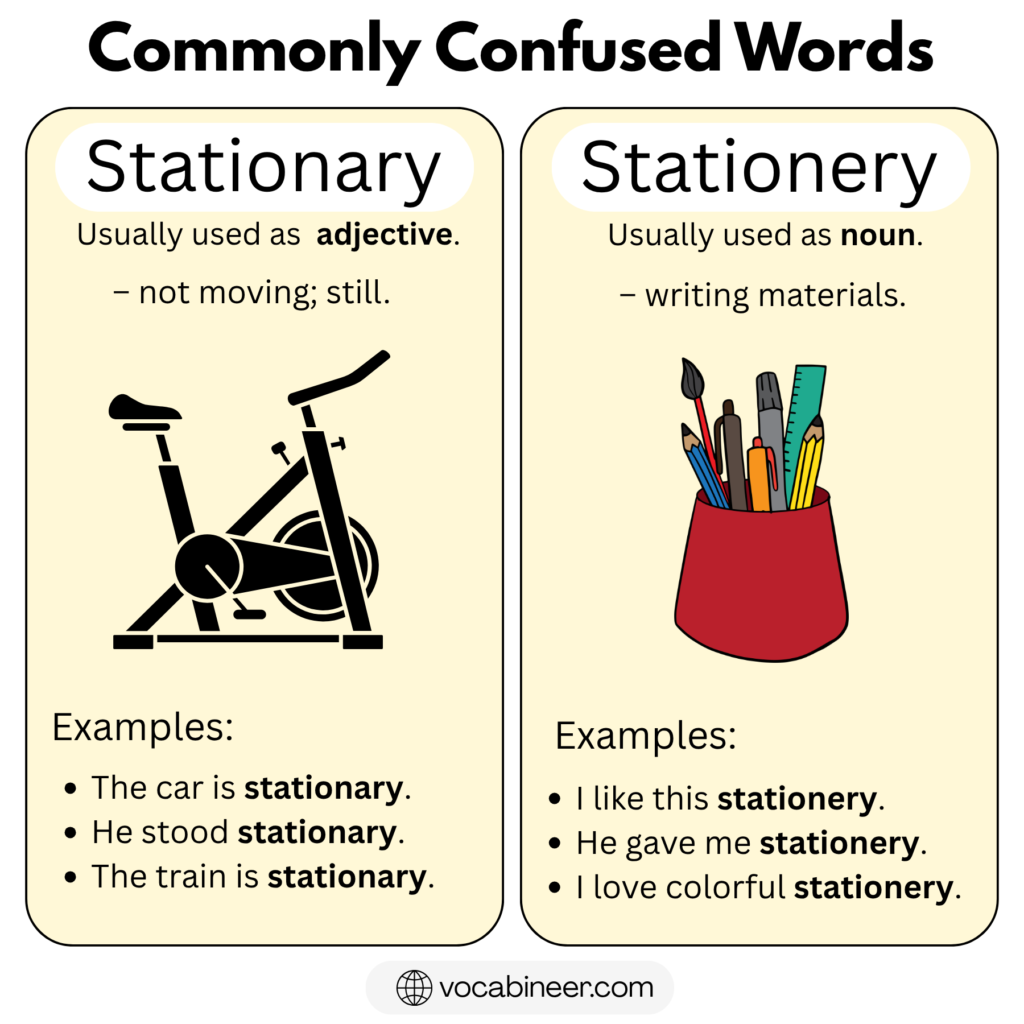
The main difference in Stationary vs Stationery depends on meaning and grammar role. Stationary describes something that is not moving. Stationery refers to writing materials and office supplies.
If the sentence describes something still or fixed, use Stationary.
If the sentence refers to paper, envelopes, or writing supplies, use Stationery.
Here is the difference in one sentence:
Stationary means not moving.
Stationery means writing materials.
Stationary vs Stationery: Difference in One Look
| Feature | Stationary | Stationery |
|---|---|---|
| Part of Speech | Adjective | Noun |
| Meaning | Not moving | Writing supplies |
| Shows Action | No | No |
| Countable | Not countable | Uncountable |
| Replace With | Still | Writing materials |
Notice something important. Stationary describes movement. Stationery names objects.
Stationary vs Stationery: Side by Side Sentence Contrast
- The car remained stationary.
- She bought new stationery.
- The train stayed stationary at the station.
- The office ordered fresh stationery.
- The object looked stationary.
- The drawer contains school stationery.
In each pair, Stationary describes something still. Stationery refers to writing materials.
Stationary vs Stationery: Sentence Structure Comparison
Understanding structure makes the difference easier.
| Structure Type | Stationary Pattern | Stationery Pattern |
|---|---|---|
| Describes Noun | Stationary vehicle | Not used |
| Position | Remained stationary | Not used |
| Category | Not used | Office stationery |
| With Verb | Is stationary | Bought stationery |
| Before Noun | Stationary object | School stationery |
If the word describes a noun and relates to movement, choose Stationary. If it names writing supplies, choose Stationery.
When to Use Stationary and Stationery
Choosing between Stationary vs Stationery becomes simple when you check whether the sentence describes movement or writing supplies.
Use Stationary when the sentence refers to:
- Not moving
- Staying in one place
- Fixed position
- No motion
- Stillness
Examples:
- The car remained stationary at the signal.
- The train was stationary for ten minutes.
- The object appeared stationary.
- The helicopter stayed stationary in the air.
- The machine remained stationary during inspection.
- The bus stood stationary at the stop.
- The drone hovered and stayed stationary.
- The image looked stationary.
- The athlete held a stationary pose.
- The ship remained stationary in the harbor.
Use Stationery when the sentence refers to:
- Writing materials
- Paper products
- Office supplies
- School supplies
- Printed paper items
Examples:
- She bought new stationery.
- The office ordered more stationery.
- I packed my stationery for school.
- The company printed branded stationery.
- He organized his desk and arranged the stationery.
- The store sells colorful stationery.
- We selected wedding stationery.
- The drawer contains office stationery.
- She designs custom stationery.
- The brand launched premium stationery.
If the word describes something still, choose Stationary. If it refers to writing materials, choose Stationery.
Context Based Usage Guide
Context gives strong clues in Stationary vs Stationery decisions.
Stationary frequently appears:
- After verbs like remain, stay, appear
- With vehicles or objects
- In descriptions of position
Examples:
- Remained stationary
- Stayed stationary
- Appeared stationary
- Stationary vehicle
Stationery frequently appears:
- With buy, order, design, print
- In office or school contexts
- With words like paper, envelope, notebook
Examples:
- Buy stationery
- Office stationery
- School stationery
- Printed stationery
A helpful clue is meaning. If the sentence involves movement, choose Stationary. If it involves writing supplies, choose Stationery.
Grammar Difference Between Stationary and Stationery
The grammar difference between Stationary vs Stationery is based on part of speech.
Stationary is an adjective.
Stationery is a noun.
Stationary describes a noun:
- The car is stationary.
- The train remained stationary.
Stationery names objects:
- She bought stationery.
- The office needs stationery.
If the word must describe a noun, choose Stationary. If it must name writing supplies, choose Stationery.
Pronunciation Difference Between Stationary and Stationery
In spoken English, Stationary vs Stationery are pronounced almost the same. Both words sound like “stay-shuh-ner-ee.” Because the pronunciation is nearly identical, sound does not help you choose the correct spelling.
Below is a quick comparison:
| Feature | Stationary | Stationery |
|---|---|---|
| Pronunciation | Stay-shuh-ner-ee | Stay-shuh-ner-ee |
| Sound Difference | None | None |
| Meaning | Not moving | Writing supplies |
| Grammar Role | Adjective | Noun |
Since both words are homophones in most accents, you must rely on meaning and grammar to select the correct form.
Common Mistakes With Stationary and Stationery
Most mistakes in Stationary vs Stationery happen because writers focus on sound instead of meaning. Since both words are pronounced the same, spelling errors are common.
Below are frequent mistakes with corrections.
- Incorrect: The car remained stationery.
Correct: The car remained stationary. - Incorrect: I bought new stationary for school.
Correct: I bought new stationery for school. - Incorrect: The train was stationery at the station.
Correct: The train was stationary at the station. - Incorrect: The office ordered more stationary.
Correct: The office ordered more stationery. - Incorrect: The object looked stationery.
Correct: The object looked stationary. - Incorrect: She packed her stationary in the bag.
Correct: She packed her stationery in the bag. - Incorrect: The bus stood stationery.
Correct: The bus stood stationary. - Incorrect: The company printed custom stationary.
Correct: The company printed custom stationery. - Incorrect: The machine remained stationery.
Correct: The machine remained stationary. - Incorrect: I need more stationary for writing letters.
Correct: I need more stationery for writing letters.
Notice the consistent pattern. If the sentence refers to something not moving, use Stationary. If it refers to writing supplies, use Stationery.
FAQs
The main difference in Stationary vs Stationery is meaning and grammar role. Stationary describes something that is not moving. Stationery refers to writing materials such as paper, envelopes, and notebooks.
Stationary is an adjective. It describes a noun by showing that something is still or not moving.
Stationery is generally treated as an uncountable noun. It refers to a group of writing supplies rather than individual countable items.
If the sentence talks about movement or position, use Stationary. If it refers to paper or office supplies, use Stationery.
Both words are spelled almost the same and sound identical in speech. Therefore, confusion usually happens in writing rather than pronunciation.
Final Summary
Stationary vs Stationery may look nearly identical, but their meanings are very different. Stationary is an adjective that describes something not moving. Stationery is a noun that refers to writing materials. If the sentence describes stillness or lack of motion, choose Stationary. If it refers to paper or office supplies, choose Stationery. Understanding this distinction prevents common spelling mistakes and improves writing accuracy.
Read More
- Confusing Words in English
- American vs British Words
- Altogether vs All Together
- Peace vs Piece in English
