

Theater vs theatre is a common spelling difference in English. Both words have the same meaning. However, the spelling changes depending on regional English usage.
Many learners feel confused because they see both forms in movies, signs, and books. In reality, both are correct. The difference depends on whether you are using American English spelling or British English spelling.
In this guide, you will learn the meaning, grammar rules, usage differences, pronunciation, and when to use theater or theatre correctly.
In This Page
Theater vs Theatre: Quick Definition
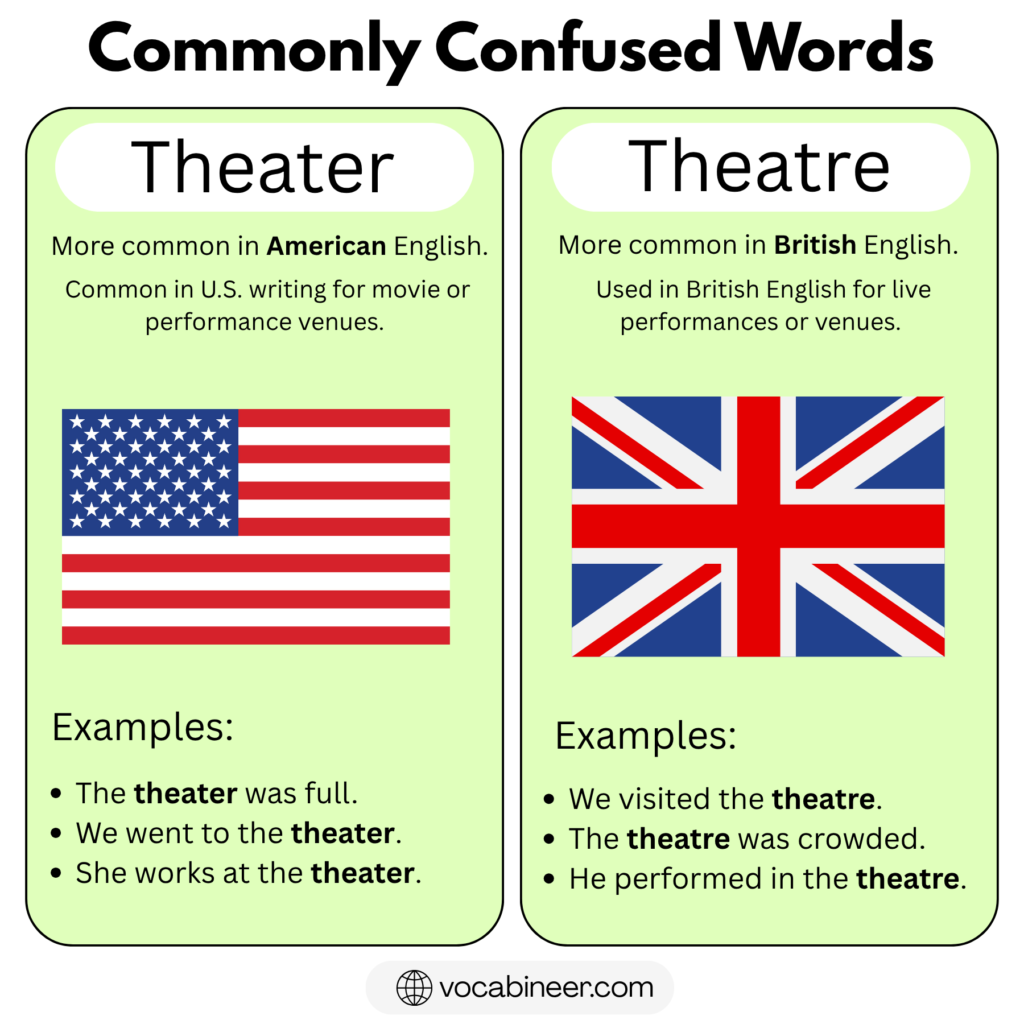
Theater is the American English spelling.
Theatre is the British English spelling.
Theater vs Theatre Difference in One Sentence
Theater is used in American English.
Theatre is used in British English.
Why Theater and Theatre Are Often Confused?
Theater and theatre are often confused because both spellings are correct. Therefore, learners do not see a difference in meaning.
First, both words refer to the same place or form of art. So, context does not help you choose between them. Second, movies, websites, and event posters use both spellings depending on the country. As a result, students regularly see both versions.
Moreover, some organizations keep traditional spellings for branding. For example, a building in the United States may use theatre for style, even though theater is standard in American English.
In addition, other words follow a similar pattern of regional spelling differences:
- center / centre
- meter / metre
- fiber / fibre
Because of these patterns, learners mix American English spelling and British English spelling. So, the confusion is about regional preference, not meaning.
Word Origin and Etymology
The word comes from the Greek word theatron, meaning a place for viewing. Later, it entered Latin as theatrum and then Old French as theatre.
From French, the word became part of Middle English as “theatre.” Originally, English used the “-re” spelling.
However, in the 1800s, American English simplified many words by changing “-re” to “-er.” Therefore, “theatre” became “theater” in American English.
Meanwhile, British English kept the traditional “-re” ending.
Today, both spellings are historically correct. The difference depends entirely on regional English usage.
Meaning of Theater
Theater refers to a building where movies, plays, or live performances are shown. It can also describe the art of acting and stage performance as a field of study or entertainment.
In American English spelling, theater uses the “-er” ending. However, it has the same meaning as the British English spelling “theatre.”
Definition of Theater
Theater refers to a building where plays, movies, or performances are shown. It can also refer to the art of acting and stage performance.
In American English spelling, theater follows the “-er” ending. However, the meaning is the same as the British spelling “theatre.”
Theater as Part of Speech
Theater functions mainly as a noun. It can describe a place, an activity, or a field of art.
As a place, theater refers to a building for performances.
- We went to the theater last night.
- The new theater opens this weekend.
- That theater shows classic films.
- The school built a modern theater.
- The theater was full of people.
- She works at the local theater.
- The city renovated its oldest theater.
- The movie starts at the downtown theater.
- They bought tickets at the theater entrance.
- The theater seats were comfortable.
As an art form, theater refers to acting and stage performance.
- She studies theater in college.
- He loves musical theater.
- They work in professional theater.
- The program focuses on modern theater.
- She plans a career in theater.
- The festival celebrates local theater.
- He teaches theater arts.
- The class explores classical theater.
- She joined the school theater club.
- They support community theater projects.
Common Uses and Collocations of Theater
Theater appears in many common American English combinations.
- movie theater
- theater ticket
- theater performance
- theater stage
- theater company
- theater production
- musical theater
- live theater
- community theater
- dinner theater
- home theater
- theater arts
- theater critic
- theater festival
- theater program
These collocations show how widely theater is used in American English writing and everyday speech.
Meaning of Theatre
Theatre refers to a building where plays, films, or live performances are presented. It can also describe the art of acting and stage performance as a creative field.
In British English spelling, theatre uses the traditional “-re” ending. However, it has the same meaning as the American English spelling “theater.”
Definition of Theatre
Theatre refers to a building where plays, films, or live performances are shown. It can also describe the art of acting and stage performance.
In British English spelling, theatre follows the traditional “-re” ending. However, the meaning is exactly the same as the American spelling “theater.”
Theatre as Part of Speech
Theatre functions mainly as a noun. It can describe a place, an art form, or a field of study.
As a place, theatre refers to a building for performances.
- We went to the theatre last night.
- The new theatre opens this weekend.
- That theatre shows classic films.
- The school built a modern theatre.
- The theatre was full of people.
- She works at the local theatre.
- The city renovated its oldest theatre.
- The film starts at the town theatre.
- They bought tickets at the theatre entrance.
- The theatre seats were comfortable.
As an art form, theatre refers to acting and live stage performance.
- She studies theatre at university.
- He loves musical theatre.
- They work in professional theatre.
- The course focuses on modern theatre.
- She plans a career in theatre.
- The festival celebrates local theatre.
- He teaches theatre arts.
- The class explores classical theatre.
- She joined the school theatre club.
- They support community theatre projects.
Common Uses and Collocations of Theatre
Theatre appears in many common British English combinations.
- theatre ticket
- theatre performance
- theatre stage
- theatre company
- theatre production
- musical theatre
- live theatre
- community theatre
- dinner theatre
- home theatre
- theatre arts
- theatre critic
- theatre festival
- theatre programme
- operating theatre
These collocations show how widely theatre is used in British English writing and everyday communication.
Theater vs Theatre: Key Difference Explained
Theater and theatre have the same meaning and pronunciation. However, the spelling difference depends on regional English usage.
In American English, the correct spelling is theater. It follows the simplified “-er” ending used in words like center and meter.
In contrast, British English uses theatre. This spelling keeps the traditional “-re” ending found in words like centre and metre.
Importantly, neither spelling is wrong. The difference is only regional. Therefore, your choice depends on your audience and writing style.
If you are writing for readers in the United States, use theater consistently. However, if your audience is in the United Kingdom or other regions that follow British English, use theatre throughout your document.
Mixing both spellings in the same article can reduce clarity and professionalism. So, choose one version and stay consistent.
Theater vs Theatre: Difference in One Look
| Feature | Theater | Theatre |
|---|---|---|
| English Variant | American English | British English |
| Spelling Pattern | “-er” ending | “-re” ending |
| Meaning | Building or art of performance | Building or art of performance |
| Pronunciation | Same | Same |
| Used In | USA | UK, Canada, Australia |
| Example | movie theater | movie theatre |
This table clearly shows that the only real difference is spelling preference, not meaning or grammar.
Theater vs Theatre: Side by Side Sentence Contrast
Both spellings fit into the same sentence patterns. However, the spelling changes depending on regional English.
American English:
- We went to the theater last night.
- The movie starts at the downtown theater.
- She studies musical theater.
- The new theater opens this Friday.
- He bought tickets at the theater counter.
- The school has a modern theater hall.
- They support community theater programs.
- The theater performance was excellent.
British English:
- We went to the theatre last night.
- The film starts at the town theatre.
- She studies musical theatre.
- The new theatre opens this Friday.
- He bought tickets at the theatre counter.
- The school has a modern theatre hall.
- They support community theatre projects.
- The theatre performance was excellent.
As you can see, the meaning stays the same. Only the spelling changes.
Theater vs Theatre: Sentence Structure Comparison
Both words function as nouns. Therefore, the sentence structure remains identical.
Basic noun structure:
Subject + verb + theater/theatre
- The theater is crowded.
- The theatre is crowded.
Prepositional structure:
Go to + theater/theatre
- We went to the theater.
- We went to the theatre.
Descriptive structure:
Adjective + theater/theatre
- A large theater building.
- A large theatre building.
So grammatically, both forms behave the same way. The difference appears only in American English spelling versus British English spelling.
When to Use Theater and Theatre
Choosing between theater and theatre depends on the type of English you are using.
If you are writing in American English, use theater. This spelling is standard in the United States and follows the “-er” ending pattern.
If you are writing in British English, use theatre. This spelling is standard in the United Kingdom and other regions that follow British spelling conventions.
Both forms are correct in standard English. However, you should not mix theater and theatre in the same document unless you are explaining the difference.
Therefore, match the spelling to your target audience and remain consistent throughout your writing.
Context Based Usage Guide
Use this simple guide to choose the correct spelling.
For American audiences:
- Use theater
- Use related forms like center and meter
- Keep American spelling consistent
For British audiences:
- Use theatre
- Use related forms like centre and metre
- Stay consistent with British spelling
In academic writing:
- Follow the required style guide
- Avoid mixing regional variants
If targeting global readers:
- Choose one spelling at the beginning
- Keep the same version in headings and examples
During exams:
- Match the English variant mentioned in instructions
- Do not switch between American English and British English
So, the correct choice depends on regional usage, not meaning.
Grammar Difference Between Theater and Theatre
Theater and theatre follow the same grammar rules. The only difference is regional spelling.
Both words function as nouns. They can describe a building, a performance space, or the art of acting. Their sentence structure does not change between American English and British English.
Here is a clear comparison table:
| Grammar Feature | Theater (American English) | Theatre (British English) |
|---|---|---|
| Noun (Place) | We went to the theater. | We went to the theatre. |
| Noun (Art Form) | She studies theater. | She studies theatre. |
| Plural Form | theaters | theatres |
| Related Words | theatergoer | theatregoer |
| Meaning | Same | Same |
As shown above, grammar remains identical. Only the spelling reflects the regional English variant.
Pronunciation Difference Between Theater and Theatre
There is no pronunciation difference between theater and theatre.
Both are pronounced:
/ˈθiːətər/
The stress falls on the first syllable. Therefore, the words sound the same in American English and British English.
The difference appears only in written form, not in spoken language.
Common Mistakes With Theater and Theatre
Many learners make small mistakes when using theater and theatre. However, most errors happen because of regional mixing.
One common mistake is switching between theater and theatre in the same article. This creates inconsistency in spelling.
Another mistake is thinking that one version is incorrect. In fact, both are correct. The difference depends only on American English spelling and British English spelling.
Some writers also forget related words. For example:
- center vs centre
- meter vs metre
- theatergoer vs theatregoer
Additionally, students sometimes use American spelling in British exams or British spelling in American tests. Therefore, always follow the required English variant and remain consistent.
FAQs
Both are correct spellings. Theater is used in American English, while theatre is used in British English and other regions that follow UK spelling.
In the United States, the standard spelling is theater with the “-er” ending. It follows American English spelling patterns like center and meter.
In the United Kingdom, the correct spelling is theatre with the “-re” ending. It follows traditional British spelling patterns like centre and metre.
No, both words have the same meaning. They refer to a building for performances or the art of acting. The difference is only spelling style.
No, both spellings are pronounced the same way in spoken English. The difference appears only in writing, not in pronunciation.
Final Summary
Theater vs theatre highlights a spelling difference between American English and British English. Both words have the same meaning and pronunciation. They refer to a building where performances take place or to the art of acting itself.
However, theater is the standard spelling in American English, while theatre is used in British English and other regions that follow UK spelling rules. Therefore, the correct choice depends on your audience.
Read More
- Confusing Words in English
- American vs British Words
- Moral vs Morale in English
- Favorite vs Favourite in English
