

Their vs There often causes confusion because the words sound the same but have completely different meanings and grammar roles. One shows possession, while the other refers to place or introduces a sentence. Their spelling reflects possessive determiner versus adverb and pronoun contrast.
Understanding Their vs There helps you choose the correct word in structured writing, academic sentences, and daily communication. This article explains their meaning, grammar roles, usage patterns, sentence structure, and common mistakes so you can apply them accurately.
In This Page
Their vs There: Quick Definition
Their shows possession and means belonging to them.
There refers to place or introduces a sentence.
The key difference in Their vs There is possession versus location or structure.
Their vs There Difference in One Sentence
Their shows ownership.
There shows place or existence.
Why Their and There Are Often Confused
Their and There are often confused because they are homophones. They sound exactly the same in pronunciation. Therefore, writers sometimes choose the wrong spelling based on sound rather than grammar.
However, their meanings are completely different. Their shows ownership. There refers to location or introduces existence. As a result, confusion usually happens in writing, not speech.
Word Origin and Etymology
The history of Their vs There shows different origins. Their comes from Old Norse roots meaning belonging to them. It developed as a possessive determiner in English.
There comes from Old English roots meaning in that place. Over time, it also developed as a structural word used to introduce sentences such as There is or There are.
Although they sound identical, their origins and functions are separate.
What Does Their Mean?
Their shows possession or ownership by a group of people.
Definition of Their
Their is a possessive determiner that means belonging to them.
It functions before a noun.
Their as a Possessive Determiner
Because Their shows ownership, it always appears before a noun.
Examples using Their:
- They forgot their keys.
- The students finished their work.
- The children cleaned their room.
- The players wore their uniforms.
- The teachers graded their papers.
- The parents packed their bags.
- The team celebrated their victory.
- The neighbors repaired their fence.
- The workers completed their task.
- The students presented their project.
- The children played with their toys.
- The guests shared their opinions.
- The employees submitted their reports.
- The actors practiced their lines.
- The friends kept their promise.
- The hikers carried their backpacks.
- The students checked their answers.
- The drivers parked their cars.
- The singers warmed up their voices.
- The players improved their skills.
Notice something important. Their must be followed by a noun because it shows possession.
Common Uses and Collocations of Their
- Their house
- Their car
- Their idea
- Their decision
- Their responsibility
- Their opinion
- Their family
- Their school
- Their goal
- Their team
- Their plan
- Their effort
- Their future
- Their success
- Their problem
What Does There Mean?
There refers to place, position, or existence. In the Their vs There contrast, There does not show ownership. Instead, it either points to a location or introduces a sentence to show that something exists.
Unlike Their, which must be followed by a noun, There can function in different grammatical roles.
Definition of There
There is an adverb of place or a structural word used to introduce sentences.
It can function as:
- An adverb of place
- An introductory or existential word
There as an Adverb of Place
When There refers to location, it answers the question where.
Examples using There for place:
- The keys are over there.
- She is standing there.
- Put the book there.
- We went there yesterday.
- The store is right there.
- He left his bag there.
- I saw her there.
- Sit there quietly.
- The park is over there.
- Leave it there.
There as an Introductory Word
There is often used to introduce sentences that show existence.
Examples using There to show existence:
- There is a problem.
- There are many students here.
- There was a loud noise.
- There were several mistakes.
- There is a book on the table.
- There are two options.
- There was an accident.
- There will be a meeting.
- There has been confusion.
- There remains one question.
Notice something important. In sentences like There is or There are, There does not show location. It introduces the existence of something.
Common Uses and Collocations of There
- There is
- There are
- There was
- There were
- There will be
- There has been
- There remains
- Over there
- Right there
- Back there
- From there
- Up there
- Down there
- Out there
- In there
Each phrase either refers to place or introduces existence.
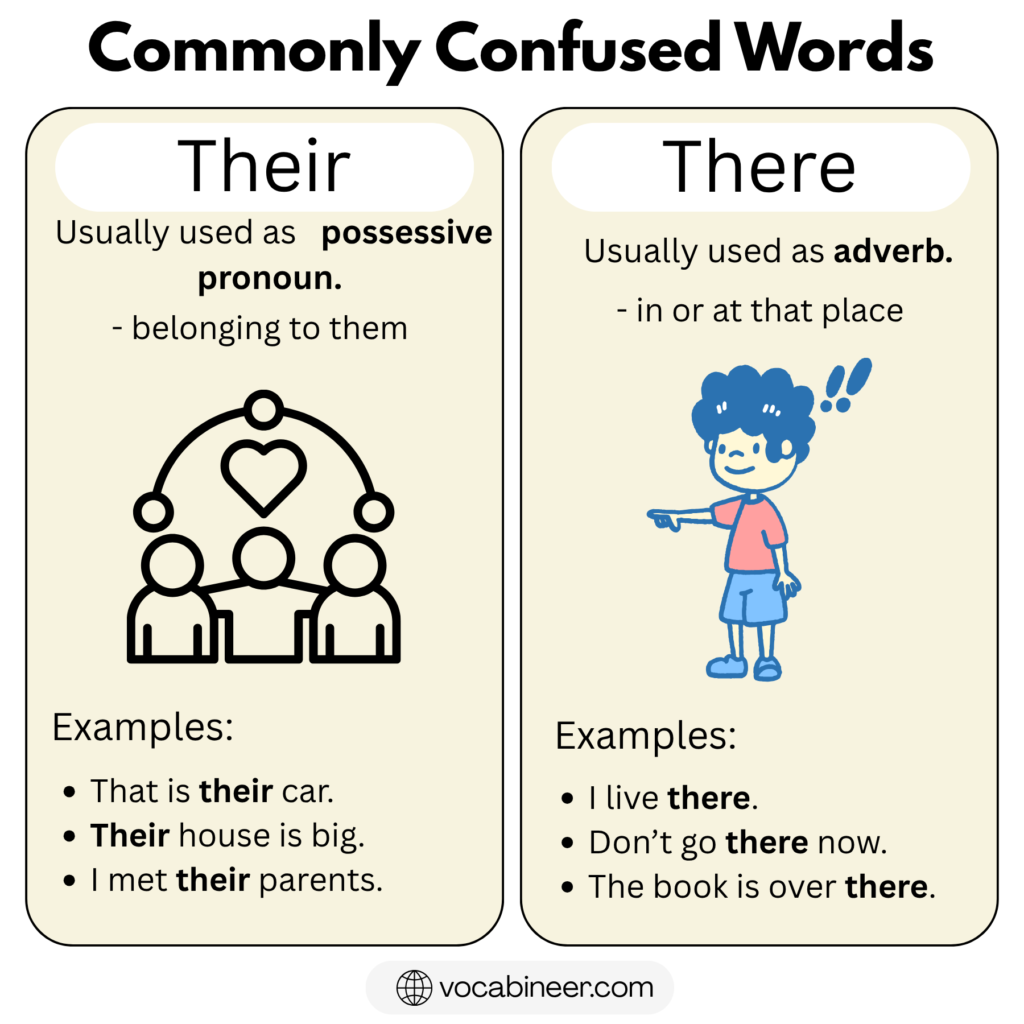
Their vs There: Key Difference Explained
The main difference in Their vs There depends on grammar role and meaning. Their shows possession and always comes before a noun. There refers to place or introduces a sentence to show that something exists.
If the sentence shows ownership, use Their.
If the sentence shows location or existence, use There.
Here is the difference in one sentence:
Their means belonging to them.
There refers to place or existence.
Their vs There: Difference in One Look
| Feature | Their | There |
|---|---|---|
| Part of Speech | Possessive determiner | Adverb or introductory word |
| Meaning | Belonging to them | Place or existence |
| Follows With | Noun | Clause or alone |
| Shows Ownership | Yes | No |
| Common Structure | Their + noun | There is / There are |
Notice something important. Their must always be followed by a noun. There does not require a noun after it.
Their vs There: Side by Side Sentence Contrast
- The students forgot their books.
- The books are over there.
- The players improved their skills.
- The players are waiting there.
- The children cleaned their room.
- There is a room upstairs.
In each pair, Their shows ownership. There shows place or introduces existence.
Their vs There: Sentence Structure Comparison
Understanding structure makes the difference easier.
| Structure Type | Their Pattern | There Pattern |
|---|---|---|
| Possession | Their + noun | Not used |
| Place | Not used | Verb + there |
| Existential | Not used | There + is/are |
| Question Form | Where is their car | Is there a car |
| Plural | Their friends | There are friends |
If the word is followed by a noun showing ownership, use Their. If it appears in There is or refers to location, use There.
When to Use Their and When to Use There
Choosing between Their vs There becomes simple when you check whether the sentence shows ownership or location.
Use Their when the sentence refers to:
- Ownership
- Belonging to a group
- Possession of something
Examples:
- The students finished their homework.
- The players wore their uniforms.
- The teachers graded their exams.
- The children packed their bags.
- The neighbors fixed their fence.
- The workers completed their project.
- The friends shared their ideas.
- The singers practiced their songs.
- The drivers parked their cars.
- The team celebrated their success.
Use There when the sentence refers to:
- A place
- Location
- Existence
- Something being present
Examples:
- The keys are over there.
- She is standing there.
- There is a problem.
- There are many options.
- The restaurant is right there.
- There was a loud noise.
- Sit there quietly.
- There will be a meeting.
- We went there yesterday.
- There has been confusion.
If the word shows ownership, choose Their. If it shows place or existence, choose There.
Context Based Usage Guide
Context gives strong clues in Their vs There decisions.
Their frequently appears:
- Before nouns
- In possessive phrases
- With plural subjects
Examples:
- Their house
- Their decision
- Their responsibility
- Their opinion
There frequently appears:
- In There is or There are structures
- After verbs referring to movement or position
- In location references
Examples:
- There is a solution.
- There are two choices.
- Go over there.
- The store is there.
You may notice a helpful clue. If the word is directly followed by a noun, it is usually Their, not There.
Grammar Difference Between Their and There
The grammar difference between Their vs There is clear.
Their is a possessive determiner.
There is an adverb or introductory word.
Their must be followed by a noun:
- Their car is new.
- Their plan worked.
There may stand alone or introduce existence:
- The car is over there.
- There is a new plan.
If the sentence needs to show ownership, use Their. If it needs to show location or introduce existence, use There.
Pronunciation Difference Between Their and There
In spoken English, Their vs There are homophones. That means they are pronounced exactly the same. Both words sound like “thair.”
Because there is no pronunciation difference, spelling becomes the only reliable clue in writing. Therefore, you must depend on sentence structure and meaning rather than sound.
Below is a quick comparison:
| Feature | Their | There |
|---|---|---|
| Pronunciation | Thair | Thair |
| Sound Difference | None | None |
| Meaning | Belonging to them | Place or existence |
| Grammar Role | Possessive determiner | Adverb or introductory word |
Since both words sound identical, careful attention to grammar prevents confusion.
Common Mistakes With Their and There
Most mistakes in Their vs There happen because writers choose spelling based on sound. Since pronunciation offers no difference, grammar must guide the choice.
Below are frequent mistakes with corrections.
- Incorrect: Their is a problem.
Correct: There is a problem. - Incorrect: The books are over their.
Correct: The books are over there. - Incorrect: There house is large.
Correct: Their house is large. - Incorrect: The students forgot there homework.
Correct: The students forgot their homework. - Incorrect: Their are many options.
Correct: There are many options. - Incorrect: The players improved there skills.
Correct: The players improved their skills. - Incorrect: Put the bag their.
Correct: Put the bag there. - Incorrect: There car is parked outside.
Correct: Their car is parked outside. - Incorrect: Their were several mistakes.
Correct: There were several mistakes. - Incorrect: The children cleaned there room.
Correct: The children cleaned their room.
Notice the consistent pattern. If the word shows ownership, use Their. If it shows location or introduces existence, use There.
FAQs
Their shows possession and means belonging to them. There refers to place or introduces a sentence showing existence.
No. Their is only used to show ownership. It must be followed by a noun.
No. There does not show possession. It refers to place or introduces sentences like There is or There are.
Check what follows the word. If it is followed by a noun showing ownership, use Their. If it introduces existence or refers to place, use There.
Both words sound the same. Therefore, writers often rely on sound instead of grammar and choose the wrong spelling.
Final Summary
Their vs There may sound identical, but their meanings and grammar roles are completely different. Their is a possessive determiner that shows ownership. There refers to place or introduces existence. If the sentence shows belonging, choose Their. If it refers to location or uses There is or There are, choose There. Understanding this distinction prevents common spelling errors and strengthens sentence accuracy.
Read More
